1003+ Stories from Ancient India — Free to Read! Explore all stories →

Keep It For The Beggar

Keep It For The Beggar: When anything sweet is prepared in the house on a particular night, and when the children, after feeding to their fill, say to the

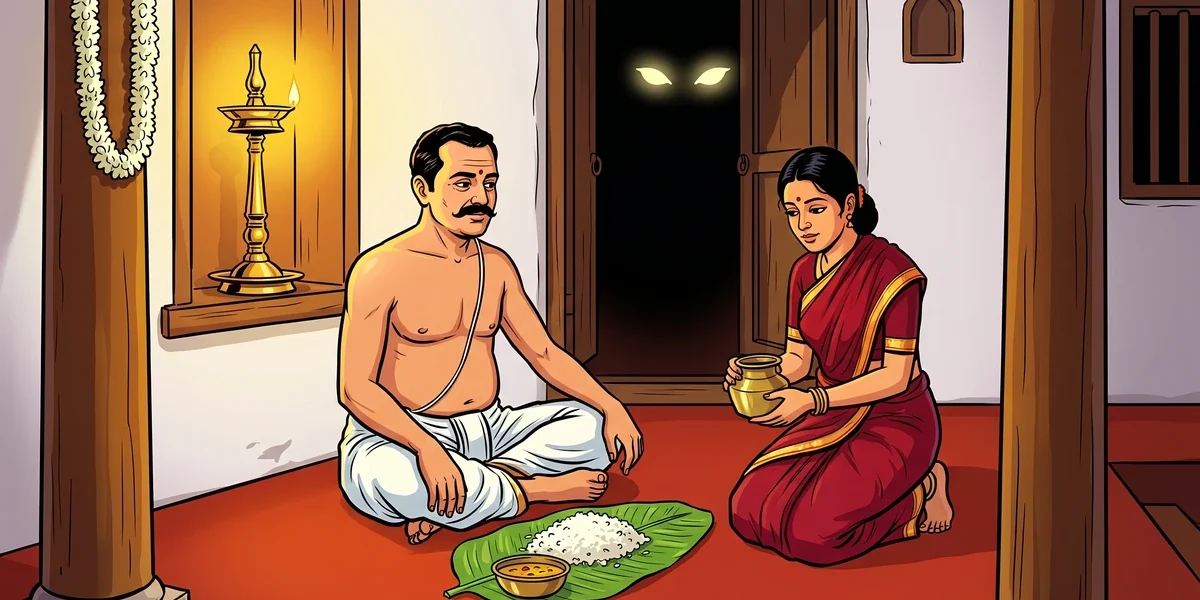
South Indian Tamil Brahmin husband in white dhoti and wife in red Madisar saree with brass chembu pot at evening supper, plantain leaf of rice and dhal soup, jasmine garland and brass kuthu vilakku oil lamp, glowing yellow Yamaduta eyes in shadow of
Ad Space (header)
South Indian Tamil Brahmin husband in white dhoti and wife in red Madisar saree with brass chembu pot at evening supper, plantain leaf of rice and dhal soup, jasmine garland and brass kuthu vilakku oil lamp, glowing yellow Yamaduta eyes in shadow of doorsill — Tales of the Sun ACK illustration
Keep It For The Beggar — South Indian Tamil folk-tale, Tales of the Sun (Kingscote & Sastri, 1890)

Keep It For The Beggar is one of the small, beloved house-tales that South Indian Brahmin grandmothers used to whisper to their children at the brass-lamp hour, and one of the twenty-six tales gathered between the dark blue cloth boards of Tales of the Sun, or Folklore of Southern India, collected by Mrs Howard Kingscote and her great Madras collaborator Pandit S. M. Natesa Sastri and printed by W. H. Allen & Co., 13 Waterloo Place, London & Calcutta, in 1890. It had appeared a few years earlier in Sastri’s own four-volume Madras edition The Folklore of Southern India (1884–1888), the first sustained scholarly effort by a Tamil pandit to set down the kitchen-and-courtyard tales of the Coromandel coast in the language of Macaulay and the Madras Mail.

It is, on its surface, a domestic miniature: a husband who is fond of cold dhâl soup, a wife who never forgets to set a portion aside for his morning meal, and a single sleepy supper-time order — “Keep, my dear, some of this soup for the morning” — that draws unexpected laughter from the doorsill of the house. But beneath the kitchen detail, this is one of the great Indian parables of the certainty illusion. The laughter belongs to a Yamadūta, the messenger of the death-god Yama, who has slipped into the house four ghaṭikās early to do his appointed duty. He cannot help himself when the doomed man speaks of breakfast as if it were a thing already eaten. The tale, told in a light, almost teasing voice, reaches all the way back through the Mahābhārata’s Yakṣa Praśna to the oldest Sanskrit puzzle about the nature of human time, and arrives, perfectly, on the South Indian dining-leaf, where every meal still ends with the small phrase bhikṣukkukku vai — keep it for the beggar.

The Husband Who Always Said “Keep Some For Tomorrow”

Tamil farmer in white dhoti and angavastram walking home along a red mud path through bright green paddy fields with a basket of brinjals and drumsticks, coconut palms and white temple gopuram in distance — Tales of the Sun ACK illustration
The husband returning from the paddy fields with his basket of vegetables

The story opens in a Tamil village of the unspecified-but-clearly-Cauvery delta variety, the sort of place Sastri himself was born in — Sangendhi, near Tiruchirappalli, where the husbands wear the kacche dhoti and the wives serve dinner from green plantain leaves on the polished red oxide floor. The husband of our story is no king, no merchant, no warrior. He is a small landholder — a man who looks after his fields and his vegetable garden by day, and comes home at sunset with a basket of brinjals and drumsticks across his shoulder.

His one indulgence, the only one the story ever names, is dhāl soup — the thick yellow parippu kuzhambu of tuvar dhāl tempered with mustard seed, dried red chilli, asafœtida and a sprig of curry leaf, which a South Indian wife pours over the previous night’s cold rice for breakfast. The husband loves it cold even more than hot. “Keep me some of this soup for the next morning,” he says to his wife after every supper. And every night, faithfully, she sets aside a generous portion in a small brass chembu, covered with a tinkling iron lid, against the dawn. This goes on, the storyteller pauses to insist, for several years.

It is here that the tale’s first quiet wisdom enters. The husband is not a wicked man. He is not greedy. He is not even unusually anxious. He is, simply, like all of us — he speaks of tomorrow’s breakfast as a fact already in his mouth. The Tamil grandmothers who told this story across generations of clay-tile kitchens were drawing, with the smallest possible brushstroke, the great Vedantic māyā: the everyday illusion that the next sunrise is owed to us. The Mahābhārata had said it long before, in the Yakṣa Praśna of the Vana Parva, when Yudhiṣṭhira was asked by the Yakṣa what was the most astonishing thing in the world. The answer was almost the moral of Keep It For The Beggar.

The Gurgling Laughter at the Doorsill

Husband and wife at evening supper in a Tamil Brahmin house startled by gurgling laughter from the doorsill where a translucent blue-skinned Yamaduta with glowing yellow eyes covers his mouth to suppress laughter — Tales of the Sun ACK illustration
The gurgling laughter of the unseen Yamaduta at the doorsill

The night the story turns, nothing about the supper has changed. The wife has set down her husband’s leaf, served the rice and the soup, and waited (as a Brahmin wife must, the storyteller is careful to remind us) for her lord to finish before sitting down to eat from the same leaf herself. The husband, his stomach full, gives the standing order: “Keep, my dear, some of this soup for the morning.”

And from the dark of the doorsill there comes a sound that does not belong in a village house after dusk. It is described, with great care, as a gurgling laughter — the hiccupping, half-suppressed laughter of a being who is trying not to laugh and failing. Husband and wife start. They search the courtyard, the cow-shed, the back kitchen, the narrow lane between their house and the next. There is no one. The neighbours, when asked, swear they have not so much as cleared their throats. The husband, troubled, repeats the order a second time. The laughter comes a second time. A third time, the same. By now the bronze lamp on the household shrine is shivering as if a draft were passing through a closed room.

This is one of the most exquisite small horror touches in all of South Indian folk literature. It is unhurried, almost gentle. The laughter is not cruel; it is not menacing; it is the involuntary giggle of an embarrassed clerk who knows something he is not yet supposed to share. It is the laughter of a Yamadūta watching a man in confident possession of his own breakfast, and Sastri’s grandmotherly storyteller knows the children listening will hear in it everything the rest of the tale has yet to say.

The Serpent in the Backyard, the Hour of the Ghatika

Husband in white dhoti with brass oil lamp reaching for the back-passage door bolt at midnight while a Russell's viper coils to strike at his bare feet, an unnaturally tall hooded Yamaduta shadow falling across the whitewashed wall behind him — Tales of the Sun ACK illustration
The Russell’s viper at the back-passage and the hooded shadow on the wall

Some hours later — in the still part of the night when South Indian houses lower their wicks and the only sound is the heavy breathing of sleeping cattle — the husband walks through the back-passage to draw the bolt on the kitchen yard. In the darkness against the threshold, a thin shape coils. A nāgam, perhaps a Russell’s viper or one of the kraits that come out of the rice-stubble at midnight, strikes him on the finger. He cries out once and falls.

The neighbours come running with cudgels and lanterns. The wife is already kneeling by his side, lamenting in the sharp, formulaic mourning Tamil grandmothers know by heart: “My dear husband — how did you forget your soup so soon and leave us all for the other world? Just now you gave me the order, and before tasting it even you have died.” The men beat the kitchen floor and the back-passage looking for the snake. They do not find it. They find, instead, a voice.

The voice, the storyteller tells us, comes from the empty air. It is calm, almost apologetic. It says: “This husband’s fate ended at the twelfth ghaṭikā of this night. Yama ordered me to go and fetch him to his world. I came down and reached this house at the eighth ghaṭikā, when the husband was giving the order to reserve for the morning meal his dear dhāl soup. I could not contain my laughter, and so broke out with a gurgling noise. As I am divine no one could perceive me. Then I transformed myself into a serpent and waited for the hour to do my death-dealing duty. The poor man is now no more. Four ghaṭikās ago he was of opinion that he would live and eat his cold rice tomorrow morning. How very sanguine people are in this world of uncertainty.”

The detail of the ghaṭikā is the single most beautiful piece of cultural specificity in the tale. A ghaṭikā is the classical Indian time-unit of one-sixtieth of an ahorātra, the day-and-night cycle — that is, twenty-four minutes. The Yamadūta arrived at the eighth ghaṭikā of the night, somewhere around four hours after sunset, and the husband’s death was appointed for the twelfth ghaṭikā, around four-and-three-quarter hours after sunset. Between the last order for soup and the snake-bite at the doorsill there were exactly four ghaṭikās — ninety-six minutes — of confidently expected morning. Time, in this tale, is measured to the minute. Death is on a schedule. Only the dying man does not know.

The Mother’s Lesson and the Phrase That Stayed

Tamil grandmother in saffron-cream Madisar saree with jasmine in her grey hair seated cross-legged on red oxide floor with a brass bowl of payasam, telling the moral of the story to three small children gathered around her by the brass kuthu vilakku, a small wooden shrine niche with a garlanded image of Yama behind her — Tales of the Sun ACK illustration
The grandmother teaching the children the household phrase “keep it for the beggar”

The Yamadūta vanishes — back, the storyteller says, to inform his master how he has executed his orders — and the household lamp gutters out in the small hour. The frame returns, and we are once again at the South Indian mother’s knee, with the children round her on the cool red floor, asking why the household phrase is bhikṣukkukku vaikeep it for the beggar — and never kālaikku vaikeep it for the morning.

“And from that day, my children,” the mother concludes, “it was fixed that our life in this world is always uncertain, and that one who lives at this moment cannot be sure of doing so at the next moment. While such is the case, how can you say, ‘Keep the pudding for tomorrow morning?’ Since you saw in the story just related to you that we can never be certain of our life, you must say, instead of ‘for tomorrow morning,’ ‘for the beggar.’ If we keep it for the beggar, and if we fortunately live till tomorrow morning, we shall use a portion of it and give the remainder to the beggar.”

It is a piece of household etiquette so practical that the cosmic dimension barely shows through it. The phrase bhikṣukkukku vai turns the morning’s leftover rice into a small but daily act of atithi sat-kāram — the honouring of the unannounced guest — which the Śatapatha Brāhmaṇa names as one of the three perpetual fires a Brahmin must keep burning in his house. By substituting bhikṣuka (beggar, mendicant) for kālai (morning), the South Indian mother performs, every night, a tiny linguistic act of humility in the face of Yama, refusing on her children’s behalf to make a claim on tomorrow that the husband in the tale once made and lost. The food is set aside; the morning is not.

Moral — “What Is The Most Astonishing Thing In This World?”

The moral of Keep It For The Beggar is one of the oldest and most directly stated in all of Indian wisdom literature, and the South Indian grandmothers who told this story were transmitting, in domestic miniature, the central lesson of the Yakṣa Praśna dialogue from the Mahābhārata, Vana Parva, chapter 313, in which the Yakṣa (the spirit of the lake) asks Yudhiṣṭhira what is the most amazing thing in the world. Yudhiṣṭhira’s answer, in Sanskrit, is the same answer that the gurgling Yamadūta gives by his laughter at the doorsill of a Tamil village house two thousand years later:

अहन्यहनि भूतानि गच्छन्ति यममन्दिरम् ।
शेषाः स्थावरमिच्छन्ति किमाश्चर्यमतः परम् ।।
ahanyahani bhūtāni gacchanti yama-mandiram |
śeṣāḥ sthāvaram icchanti kim āścaryam ataḥ param ||

— “Day after day living beings depart to the abode of Yama; those who remain still wish to live for ever — what is more astonishing than this?”

This is precisely the joke that breaks the Yamadūta’s composure at the doorsill. He has been sent down through the eighth ghaṭikā of the night to fetch a soul whose final breath is appointed at the twelfth, and the soul in question is busy reserving cold rice for a morning that will never come. The wisdom of the tale is not that we should be morbid, or refuse to plan, or stop loving cold dhāl soup. It is that the small linguistic substitution — for the beggar in place of for the morning — is enough to keep us inside the truth of māyā while still cooking dinner, raising children, and keeping a brass-lamp household running in a Cauvery delta village. It is the gentlest possible memento mori, taught by a mother to a child while the rice is still warm.

Why The Tale Has Lasted

Keep It For The Beggar is, by length and ornament, one of the smallest tales in the 1890 Kingscote-Sastri volume — the gem-cut diamond next to the long castles-and-princesses tales of The Soothsayer’s Son or Why the Fish Laughed. But it has outlived almost all of them. It is the only tale from Tales of the Sun that is still embedded in the spoken Tamil of South Indian Brahmin households more than a century after Mrs Howard Kingscote took it down, and the little phrase bhikṣukkukku vai — preserved by every grandmother who ever wrapped thayir sādam in a banana leaf for tomorrow’s lunchbox — is its living monument. The tale travelled, in a sense, as the phrase travelled: in the kitchens, in the matrilineal handing-down of household speech, in the small Brahminical dharma of giving away tomorrow’s leftover to whoever knocks at the door.

It has lasted, also, because it gets the proportions of cosmic seriousness exactly right for a child. The terror of Yama is real, but the dhāl soup is more vivid; the ghaṭikās are precisely measured, but the gurgling laughter is what stays in memory; the Yamadūta is divine, but he cannot help giggling at a man who is so confidently planning his breakfast. Grandmothers who told the tale used the laughter, not the snake, as the line every child remembered. Pandit Natesa Sastri, who heard it as a boy in Sangendhi and wrote it down for the Folklore of Southern India volumes that he was producing at white heat through the 1880s, knew that the tale’s brevity was its strength. He let it stand, on its single page, almost exactly as a Tamil mother would have told it in a brass-lamp evening — which is why, more than a hundred and thirty-five years later, it is still on the Indian Folk Tales shelf, and still teaches the same small, indispensable lesson at the same small, indispensable hour.

Ad Space (in-content)
Moral of the Story
“Preparation and foresight are essential for overcoming future challenges. ---”
Ad Space (after-content)

Get a New Story Every Week!

Join thousands of parents and teachers who receive our hand-picked folk tales every Friday. Stories with morals your kids will love.

Free forever. No spam. Unsubscribe anytime.