Kupti And Imani
A Punjabi folktale from Andrew Lang's Olive Fairy Book (1907): the younger princess Imani, sent away to live with a poor fakir, builds her own fortune at the loom — and saves the king who would marry her.
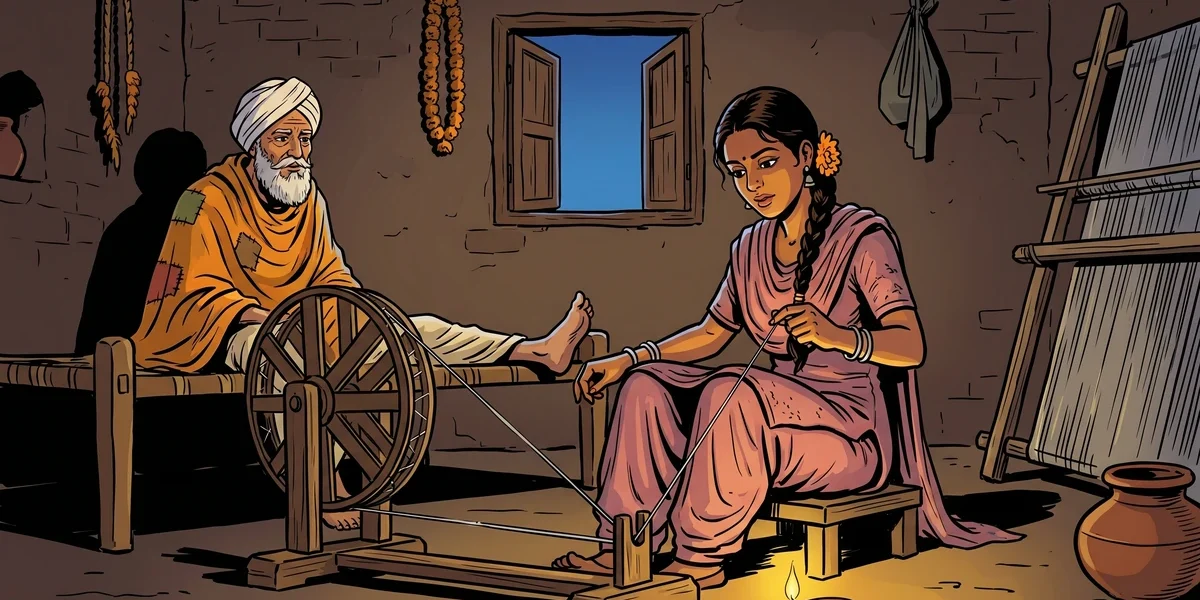
Origin & Tradition. A Punjabi folk romance from the doab of the Sutlej, taken down in the late nineteenth century by Major Campbell — almost certainly at the cantonment of Firozpur (Ferozepore) in undivided Punjab — and printed in English by Andrew Lang as “Kupti and Imani” in The Olive Fairy Book (London: Longmans, Green & Co., 1907), pp. 119–130. Lang notes only “(Punjâbi story)” at its close, deliberately preserving its regional anchor. The tale’s name pun on Subbar Khan — from Persian-Urdu ṣabr (صبر), “patience” — identifies it as belonging to the qṣah-i hind (story of Hind) tradition shared between Punjabi, Urdu, and Persian narrators on the Mughal-Sikh frontier.
Folk-narrative type. Aarne–Thompson–Uther ATU 923 (“Love Like Salt” / “The Daughter Who Said She Would Make Her Own Fortune”), spliced with ATU 613 (“The Two Travellers” — secret cure overheard from animals in a tree) and ATU 879 (“The Sage and the Servant” — the literalised pun gift). Stith Thompson motifs L52 (rejected younger daughter), L113.0.1 (heroine of humble station), K2212.1 (treacherous sister), D1162.1 (magic fan), D1174 (magic casket that opens only to its true owner), N451.1 (cure overheard from animals in a tree), K1825.1 (heroine in male disguise as physician), H94.4 (recognition by ring) and L162 (lowly heroine marries prince) are all attested. The pattern places “Kupti and Imani” alongside the Cinderella-without-shoes group of South Asian heroine tales, the Bengali Phakir Chand, and the Kashmiri Sharaf the Thief.
Lineage & recorders. The Punjabi heroine-cycle to which this tale belongs was first systematically collected by Charles Swynnerton (Indian Nights’ Entertainment, 1892) and by Flora Annie Steel with R. C. Temple’s annotations in Tales of the Punjab (1894), the same Temple who edited the Indian Antiquary and the Legends of the Panjâb. Lang’s 1907 version is the textus receptus in English; vernacular cognates are preserved in Devanâgarí-script Punjabi kissa chapbooks of Lahore and Amritsar (Mirzâ-Sahibân press tradition) and in the Hindi-Urdu reading primers of the early twentieth-century Punjab textbook committees. Modern scholarly anchors: A. K. Ramanujan, Folktales from India (Pantheon, 1991), pp. 3–7 on industrious-younger-daughter heroines; Sadhana Naithani, The Story-Time of the British Empire (Univ. Press of Mississippi, 2010), pp. 31–48 on Major Campbell and the Punjabi informants; Kirin Narayan, Mondays on the Dark Night of the Moon (Oxford, 1997), pp. 61–79 on the “own-fortune” heroine. Read time: 10 minutes.
Beat I — The Question in the Marble Court
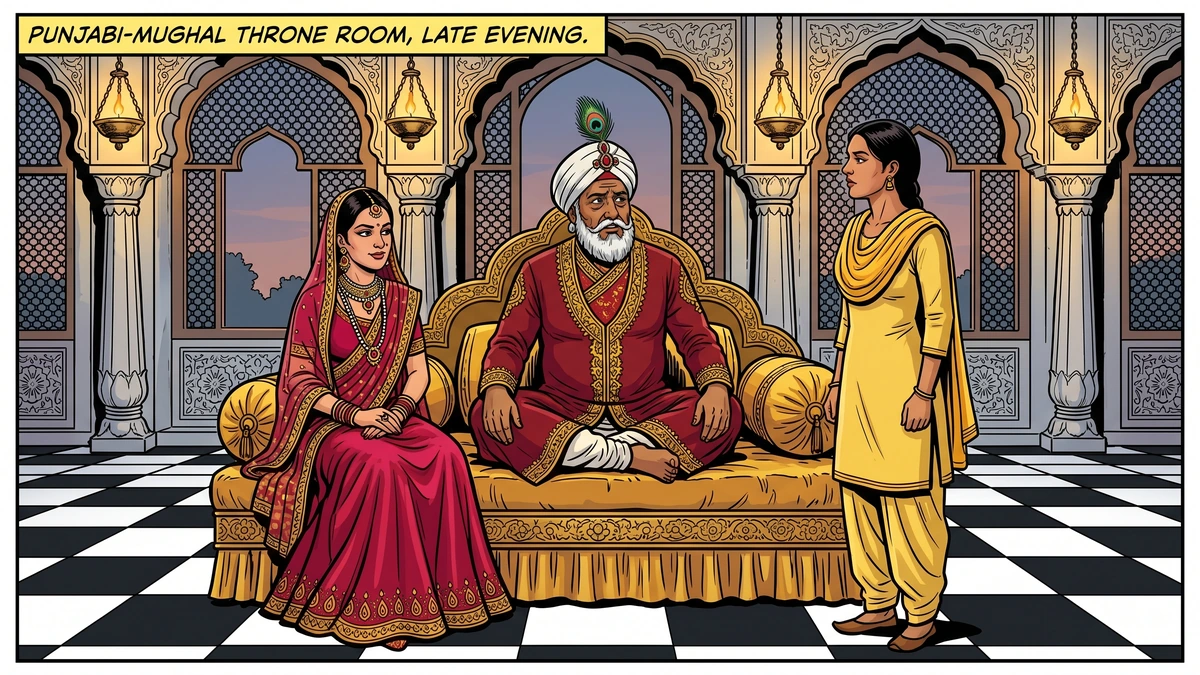
There was, in the time of an old king whose name has slipped from the tale, a court of pillared white marble in the plains of Punjab where two princesses grew up beside their father. The elder was called Kupti, the younger Imani, and the king loved them with the unequal tenderness that even good fathers bring to their daughters — loving Kupti, who never argued, a little for her ease, and loving Imani, who looked him straight in the eye, a little more for her flame. He spent his evenings between them. They sat at his feet on cushions of Multani embroidery while he told them of the deserts beyond Multan, of the cypress gardens of Dûr, and of the small affairs of the palace cats; and they thought, the way daughters do, that this would last forever.
One evening — the season of mâgh, when the cold north wind whips the cotton-fields and the women bring out their first quilts — the king turned to his elder and asked the question that opens this tale: “Are you satisfied, my daughter, to leave your life and your fortune in my hands?” Kupti looked at him with the round-eyed surprise of a child asked whether the sun is warm. “Verily yes,” she answered. “In whose hands should I leave them, if not in yours?” The king nodded; this was the answer he had been brought up to expect, the answer his mother had given his grandfather and his sisters had given his uncle. He turned to Imani.
Imani took her time. She watched the lamp-flame waver against the screen and considered, and then she said: “No, indeed! If I had the chance I would make my own fortune.” The marble of the throne-room seemed to grow a little colder. The king’s pleasure withdrew from his face the way a turtle withdraws into its shell. He told her she was too young to know the meaning of her words. And then — for he was, like many fathers before and since, a man whose pride was easier to wound than to mend — he resolved to give her the chance of speaking the truth.
He sent for the poorest man in his kingdom: an old, lame fakir who lived in a tumbledown hut on the outskirts of the city, the kind of faqír whose begging-bowl had been blackened in three different shrines and whose stories of the road were older than his bones. “You are old and crippled,” said the king to the trembling old man. “You will be glad of a young person to live with you and serve you. I will send you my younger daughter. She wishes to earn her living, and she may do so with you.” The fakir had no word to say. The princess Imani went out from her father’s house smiling, and the old man hobbled beside her in stunned and perplexed silence. So the trial of the daughter who said she would make her own fortune began.
Beat II — A Penny, an Earthen Lamp, and a Loom
The fakir’s hut stood at the city’s edge where the kikar trees thinned out and the camel-roads began. Inside there was a single charpoy of fraying jute string, two old cooking-pots blackened past redemption, an earthen matka for water, and nothing else — not a quilt, not a lamp, not a comb. Imani looked around her with the appraising eye of a woman taking inventory of a battlefield, and asked the question on which the rest of the story turns: “Have you any money?” The fakir scratched in the corner of his shawl and produced one penny — one copper paisa, the smallest coin of the bazaar. “Very well,” said Imani. “Give it to me, and go out and borrow a spinning-wheel and a loom.”
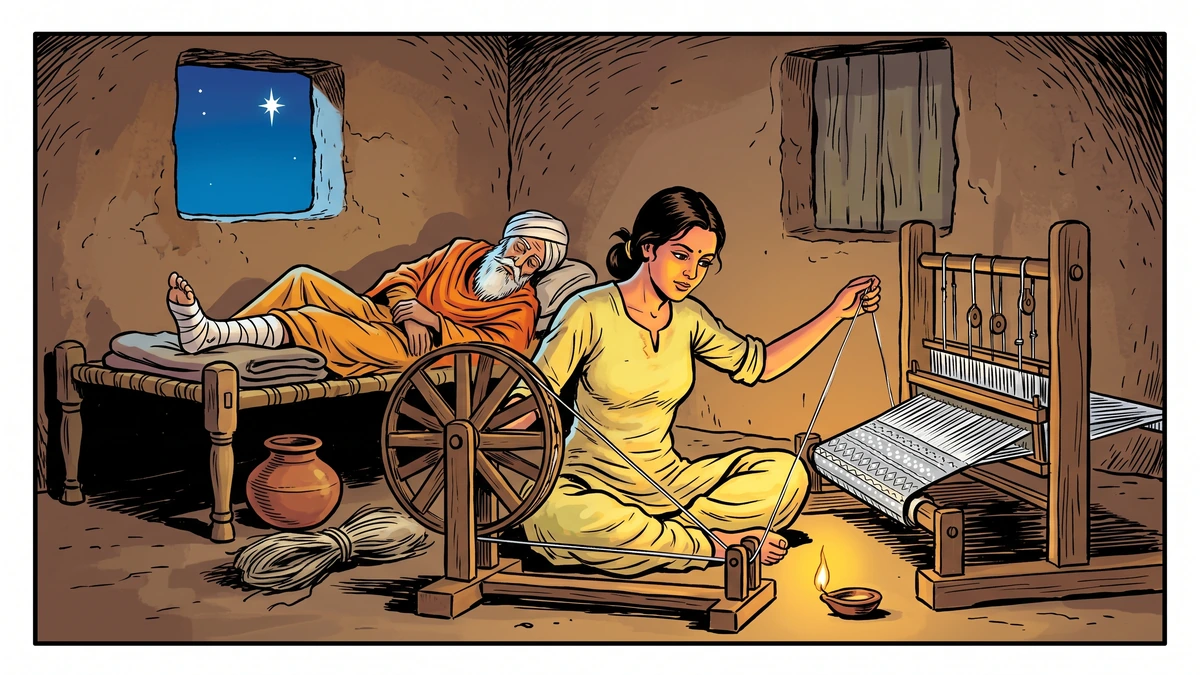
The princess had not been raised to spin. In the marble palace, women like her watched other women spin; they did not bend their own backs to the charkha. But the daughters of Punjabi kings, even the pampered ones, had at least seen the cotton-women of their courts, and the watcher’s memory is sometimes enough. While the fakir hobbled into the market for the borrowed wheel, Imani walked out into the bazaar herself and divided the penny into four parts: a farthing for oil, a farthing for flax, and two farthings for a small earthen wick-lamp. With the oil she rubbed the old man’s crippled leg for an hour while he lay astonished on the bedstead, the way you might stroke a frightened dog. With the flax she sat down to the wheel.
She spun all night, while the fakir slept, while the village dogs barked, while the moon walked west across the cane-fields. By dawn she had spun the finest thread that anyone in that quarter had ever seen — a thread that caught the morning light like a strand of cold silver. By evening she had woven it into a small cloth on the loom: a cloth of silver weft and white warp, no bigger than a turban, but soft as river-mist. “Take this,” she told the fakir, “to the market. Sell it for two gold pieces.” Two gold pieces was an outrageous price, and the old man set out hobbling, half-ashamed, half-proud, to ask it.
It was Kupti, the elder princess, who stopped her chariot at the cloth-seller’s stall. The silvery weave held her eye the way only excellent work can hold the eye of someone raised in luxury. She paid the two gold pieces without bargaining and drove on. So the first cycle of Imani’s economy was complete: penny → oil → flax → thread → cloth → gold. She did the same the next day, and the next, and the day after that. The fakir’s lame leg began to walk straighter under the daily oil. The hole under the floor of the hut, where Punjabi villagers always kept their savings, began to fill with hammered mohurs. The bazaar began to whisper of the silver cloth from the fakir’s lane. And after some months, when a quiet income had grown into a small fortune, Imani sent for builders and they raised her a house behind the hut: a courtyard of red brick with a peepal tree at its centre, the second-finest house in the city, second only to the king’s palace. When the news of it reached her father, the king laughed bitterly into his beard and said: “Well, she said she would make her own fortune, and somehow she has done it.”
Beat III — The Pun, the Casket, and Subbar Khân of Dûr
The second movement of the tale is also its great bilingual joke — one of those moments where Punjabi storytelling, with one foot in the Persian court and the other in the village dust, refuses to translate cleanly. Business of state took the king to the country of Dûr, the “far country” whose name in Persian-Urdu (dûr, دور) means “distant.” Before he set out he asked Kupti what gift she would like brought back. “A necklace of rubies,” she said, like any sensible princess. Then, partly out of conscience, the king sent a messenger to ask Imani the same question. The messenger arrived at her loom in the middle of an inconvenient knot. Without looking up, she snapped the only word her mind had room for: “Patience!” — meaning wait a moment. The messenger took it as her gift-request, bowed, and ran.
So the king of Punjab arrived at the city of Dûr with two errands: to buy a ruby necklace, and to buy patience. He sent his servant into the bazaar crying “Ṣabr-i biyâ-froshí! Has anyone patience to sell? Patience to sell?” until the news reached the king of Dûr himself, whose name was Subbar Khân. Ṣabr (صبر) is the Persian-Urdu word for patience; Subbar is the Punjabi-Urdu agentive form of the same root. The king’s name was patience. He laughed. He went to his apartment and took out a small casket without lock or hinge or visible spring, into which he placed a folded fan, and gave it to the servant saying: “Here is a casket. It will open only to the touch of the person who needs its contents. Whoever opens it shall obtain patience — though I cannot tell whether it will be quite the kind of patience she wants.”
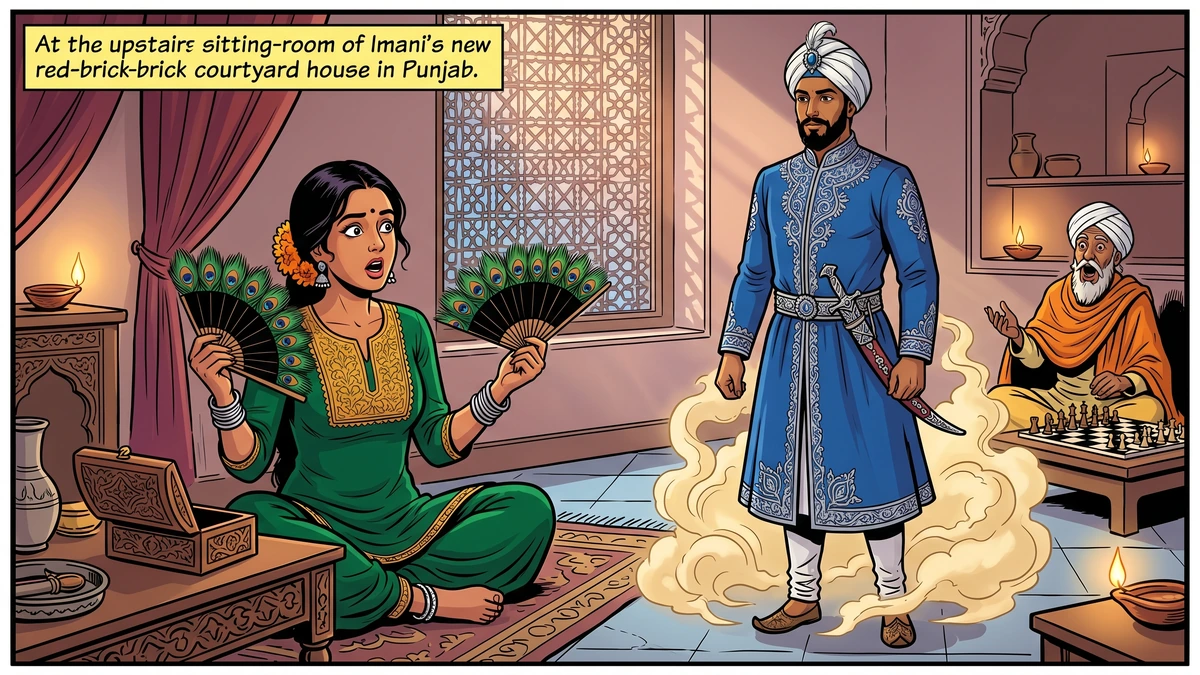
The casket reached Imani. The fakir tried to open it; it was locked as a stone. Imani touched its lid with one finger and it sprang open. Inside lay a fan of black sandalwood and peacock feathers. She took it out. She fanned herself three strokes — and there, in the room with her and the old fakir, stood Subbar Khân himself, summoned across half a thousand kos of country by the magic embedded in his own name. “My name,” he told the astonished fakir, “is Subbar Khân of Dûr. This lady has summoned me, and here I am.” Three taps of the folded fan upon a table would send him home again; three strokes opened would bring him back. The high-spirited princess wanted to send him away at once — a strange king in her sitting-room is a strange king in her sitting-room, fan or no fan — but the old fakir, who had not had a chess partner of his own rank in forty years, was already setting up the ivory pieces. They played until the second watch of the night. Subbar Khân came again the next week, and the next, and a small upstairs room in the new house began to be called the king’s room. Punjabi village storytellers will tell you that this is the moment, and not the eventual marriage, where Imani’s new life properly begins: the moment a strange king becomes a regular guest, summoned not by lineage but by competence.
Beat IV — Glass under the Sheet, and What the Monkeys Said
Word of the rich and handsome young king who appeared and disappeared at Imani’s house travelled fast in the gossipy lanes of the city, and at last it reached the marble palace where Kupti the elder sister still lived in her father’s untroubled care. Kupti’s jealousy was the slow, silent kind that does not announce itself; it simply settled in her like sediment in a pond. One afternoon, with sweet talk and feigned affection, she came to visit. Imani showed her round the new house, the loom-room, the stairway, the courtyard with its peepal tree. When they passed Subbar Khân’s upstairs chamber Kupti slipped inside on a pretext, lifted the linen sheet on the bed, and spread beneath it a paper of finely powdered glass that she had soaked in the venom of a black scorpion — the kala bichchhu poison of the Punjabi medicine-books. Then she went home and sent a basket of fruit as a sister’s peace-offering.
That evening Subbar Khân came as usual; the fakir laid out the chessboard; they played past midnight. Tired, the king lay down on the bed in his upstairs room, and the thousand splinters of poisoned glass entered him like a swarm of small fires. He did not cry out. He was, after all, called Patience. He sat up alone all night in agony, deduced where the poison must have come from and not who had laid it, and at the first grey of dawn folded the fan, tapped three times, and was carried back to Dûr. There he summoned every hakím, every vaidya, every Persian, Greek, and Ayurvedic doctor in his country; not one could name his disease. Slowly his strong young body began to fail. In Imani’s loom-room the fan opened three times, four times, ten times, and no king came. The princess sat by her wheel at last and laid down her shuttle. “I will go,” she said.
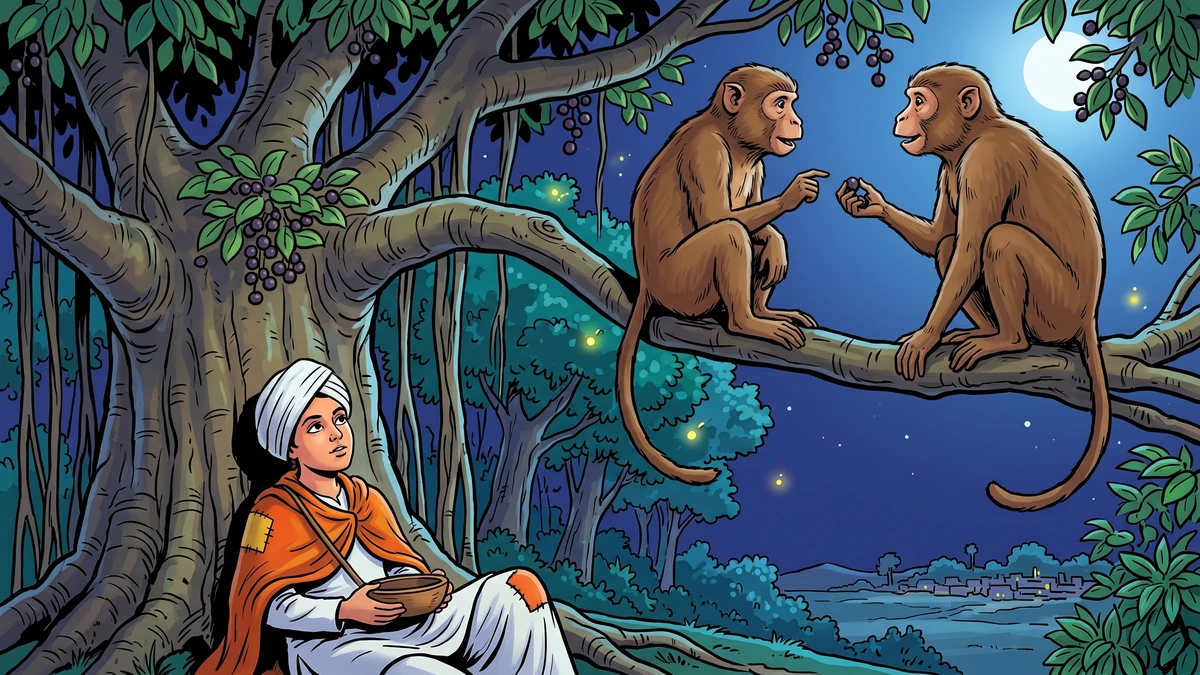
She put off her woman’s clothes and put on the saffron robe, the patched cloak, and the wooden bowl of a wandering young fakir. She walked out of her city in disguise — alone, on foot, as a fakir must — through the cold of an early pûs night, across the salt-tract of the Bias river. On the third evening she found herself in a forest where the roosting-cries of green parakeets had given way to the rustle of larger creatures. She lay down under an old tree to sleep, but sleep would not come. Above her, in the branches, she heard two great brown monkeys talking. “Whence come you, brother?” said one. “From Dûr,” said the other, “and the news is that the king is dying.” “Of what?” “Of poisoned glass that the king’s daughter Kupti spread upon his bed. The birds, who carry all the messages, say so.” The first monkey shook his head. “A pity. The berries of the very tree we sit in, steeped in hot water, would cure such a disease in three days at most. But men shut themselves up in stuffy houses; they miss the best things.”
Imani did not weep. She listened until the monkeys slept; then she climbed into the tree by moonlight and gathered every berry she could carry into the folds of her saffron cloth. She walked two days and two nights to Dûr without stopping. In the city bazaar she set up the cry “Medicine for sale! Medicine for sale!”, and a kind man brought her to the palace and to the dying king. She did not let him recognise her; she barely recognised him. She steeped the berries in hot water and washed his body with the brew; he slept the first night through. The second day she did the same and he called for food. By the fourth day he was sitting on his throne and demanding the name of the young fakir who had cured him. Imani would take no money. She asked, and was given, only two small things: the king’s signet ring, and his handkerchief embroidered with his cipher. Then she walked home through the forest the way she had come.
A month later, when she had told the old fakir all she had seen, they fanned the air three times with the magic fan. Subbar Khân appeared. He sat down beside the chessboard with the awkwardness of a man explaining a long absence; he had been ill, he said, very ill, almost dead, and a young fakir had cured him. Imani let him finish. Then she rose, went to a cabinet, and brought out the king’s signet ring and the embroidered handkerchief. She laid them on the chessboard, and she laughed. “Are these the rewards you gave to your doctor?” Subbar Khân looked from the ring to her face, and from her face to the ring, and the recognition broke over him like the first rain of sâwan. He put the magic fan in his pocket and refused to be sent home unless she came with him. The old fakir packed his charpoy and his two old cooking-pots; the second-finest house in the city was given over to its servants; and Imani went to Dûr and was married to Subbar Khân. Of Kupti the tellers say only that she lived; the older Punjabi versions add, with the cool justice of village storytelling, that she lived alone.
The Moral — صبر کا پھل میٹھا
“Ṣabr kâ phal míṭhâ” — The fruit of patience is sweet.
(Punjabi-Urdu proverb; in Gurmukhí ਸਬਰ ਦਾ ਯਲ ਮਿਂਾ; in Persian, «صبر تلخ است و لیکن بر ده د شیرینتر از قند» — “Patience is bitter, but its end is sweeter than honey”).
Imani is one of South Asia’s great moral inversions, and the inversion is double. First, she refuses the comfortable lie that women’s fortunes lie in the hands of their fathers. Second, she earns the right to refuse it by doing the work — the unromantic, knuckle-bruising work of spinning all night, of rubbing oil into a stranger’s leg, of sleeping on a charpoy that scrapes the floor. The story is unimpressed by abstract feminism and unimpressed by abstract piety; it asks only what your hands can do with one penny. Subbar Khân, whose name means patience, only enters Imani’s life after she has demonstrated the patience of the loom. The casket opens only to the person who needs its contents because patience, in the Punjabi proverbial mind, is not a virtue you ask for; it is a virtue you are recognised by. Kupti’s downfall, in turn, is not greed but a softer and more universal sin: a refusal to do her own building, and so a refusal to bear the success of someone who did. The tale, in its quiet Punjabi way, says: own the loom, own the cure, own the ring, own the fortune.
Why This Story Has Lasted
“Kupti and Imani” has survived for at least two reasons that storytellers’ manuals and folklore monographs both confirm. The first is structural: a tale built on a refused-flattery question (ATU 923), upgraded with a literalised pun (ATU 879), and resolved by a cure overheard from animals (ATU 613) is a tale built like a triple-arch bridge — if any one panel weakens, the others hold. The Punjabi narrators of the late nineteenth century were experts at this kind of compound construction; the same triple-arch is visible in “Princess Aubergine” (Steel-Temple, 1894) and in the Bengali “Phakir Chand” (Day, 1883). The second reason is moral: the heroine’s wealth is built on visible labour, and so the listener — even a child listener — can verify it. There is no fairy godmother. There is a penny, an earthen lamp, a borrowed wheel, and a girl who has decided that she will not be ashamed of her hands. That is the kind of victory a Punjabi grandmother could honestly promise her granddaughter, and so the grandmothers passed it down, generation after generation, until Major Campbell wrote it down, and Andrew Lang printed it, and we read it now under a different sky.
It is also worth noticing what the tale does not contain. There is no curse. There is no transformation into a deer or a swan. There is no test of beauty. The magic is small — a fan, a casket, a tree of berries — and serves only as a transport-system for human kindness and human spite. In the long history of Indo-European fairy tales the “own-fortune” heroine is unusually rare; the story’s closest cousins are the Persian Nigar Khanum and the Tibetan Daughter of the Salt, but in both of those the heroine’s industry is supernatural. Only here, in the doab between Sutlej and Ravi, does she spin the thread herself. That is why grandmothers, when they finish telling it on a winter evening, will still pat the youngest girl on the head and add the small didactic line that the printed versions usually omit: “Beti, jâ karke kar lo” — “Daughter, do, and what you have done becomes yours.”
Frequently Asked Questions
**Q: Why is this story important?**
You May Also Like
 Indian Folk Tales
Ages 12+ / YA
Indian Folk Tales
Ages 12+ / YA
The Story Behind The Congress Party’s Hand Symbol – Story of Hemambika
The Pallassana goddess of two raised palms — Parashurama’s remorse, temple lore, and the debated link to the Congress hand symbol.
 Indian Folk Tales
Ages 3-5
Indian Folk Tales
Ages 3-5
The Ivory City And Its Fairy Princess
The Ivory City And Its Fairy Princess: One day a young prince was out practising archery with the son of his father’s chief vizier, when one of the arrows
 Indian Folk Tales
Ages 9-12
Indian Folk Tales
Ages 9-12
How Raja Rasalu Killed the Giants | Punjabi Folk Epic (9–12+)
Punjabi hero Rasalu stops for a weeping widow, takes her son’s place, and ends Nila’s tribute to the giants. Full episode + moral.