Good Luck to the Lucky One
Good Luck to the Lucky One: In a certain town there lived a wealthy Brâhmiṇ. He wished to build a house - pretty large and spacious - as became his riches. The
Good Luck to the Lucky One; Or, Shall I Fall Down? — one of the twenty-six tales gathered into Tales of the Sun, or Folklore of Southern India (London & Calcutta: W. H. Allen & Co., 13 Waterloo Place, 1890) by Mrs. Howard Kingscote and Pandit S. M. Natesa Sastri — is a piece of pure Tamil household storytelling, collected at the close of the nineteenth century from the limestone-and-cardamom country of the deep south. Pandit Natesa Sastri ends the printed text with a quiet footnote: “This story was also related to me by my step-mother, whose birth-place is a village in the Trichinopoly district.” That single sentence places the tale, with unusual precision, in the agricultural plain of the river Kâvêri, in what is now Tamil Nadu’s Tiruchirappalli district — a country of paddy, jaggery, and the temple-towns of &Sring;rîrangåm and Jañbúkêswaram — and gives us the rare pleasure of knowing the actual mouth of an actual woman from whom Natesa Sastri first heard it.
The international classification is Aarne–Thompson–Uther type 745A, The Predestined Treasure — the cluster of folktales in which a hoard of gold cannot be claimed by anyone except the one for whom it was, from the beginning, set aside. The Finnish folklorist Antti Aarne first noted the type in his 1910 catalogue; Stith Thompson revised it through his 1928 and 1961 editions; and Hans-Jörg Uther finalised it in The Types of International Folktales (FF Communications 284–286, Helsinki: Suomalainen Tiedeakatemia, 2004), where the central definition is recorded as “the gold appears as gold to the destined owner, and as something worthless or harmful (scorpions, snakes, charcoal, dung) to anyone else.” The Tamil recension catches the pure narrative shape exactly: the wealthy Brâhmiṇ who built the house cannot keep its treasure; the poor Brâhmiṇ who entered it in extremity sees the same falling river of mohurs that the rich man sees as a torrent of crawling scorpions.
The motif catalogue of Stith Thompson lists the story’s essential elements as N141.0.1 (lucky and unlucky persons), N211.1 (treasure goes to person for whom it is destined), N531 (treasure discovered through dream or supernatural voice), D2074.2 (calling forth a treasure-hoard by a magic word), J1485 (mistaken identification: gold seen as scorpions), and H1411 (fear test: the haunted house). The Indian comparanda are deep and old. The notion that bhāgya (Sanskrit, “destined fortune”) is the only true cause of any individual’s wealth runs through the Hitopadeśa, the Pañcatantra, the Tamil Tirukkuṛaḷ (where the couplets of book III on luck and effort are still memorised by Tamil schoolchildren), and the long Telugu and Kannada didactic tradition; the Tamil proverb that closes the present tale is itself a folk distillation of that classical doctrine. The Anglo-Indian folklorist Charles Henry Tawney (translator of Somadeva’s Kathāsaritsāgara) and Norman Mosley Penzer (in his expanded 1924–1928 ten-volume edition The Ocean of Story, London: Chas. J. Sawyer) noted at least seven independent Indian recensions of the predestined-treasure motif, including the Sanskrit story of King Śûdrāka and the buried jar of dinars, and the Kāshmîri tale of the gold that became coal in the wrong man’s sack. Outside the subcontinent, parallels appear in the Thousand and One Nights (the “destined treasure of Baghdad” cycle), in the Italian Cunto de li Cunti of Giambattista Basile (1634), and in many Eastern European recensions catalogued by Lutz Röhrich in Enzyklopädie des Märchens X.682–689 (Berlin: de Gruyter).
For all this comparative depth, however, the present tale belongs first and last to the Tamil household. Its texture is local. The astrological terms it uses — Râhu-kâḷa, the “hour of the demon Rāhu,” and tyâjya, “the time to be avoided” — are taken from the south-Indian Pañcāṅga almanac, the same almanac that even today determines when a Tamil family will start cooking the first pot of rice in a new kitchen, when a new business may be opened, when a child may be given a name. The honorific epithet bhūsuras, the “earthly gods,” for the Brâhmiṇ class is Tamil ceremonial idiom, used to this day in the temple inscriptions of Tiruchirappalli and Thañjāvūr. The currencies that fall from the roof — mohurs, the gold pieces of the Mughal and Maratha mints, and pagodas, the gold coins of the Vijayanagara and Mysore dynasties (called paḥaḥu in Tamil and varahā in Sanskrit) — are the precise denominations a wealthy Tamil household of 1880 still kept in clay pots buried beneath the threshold. The proverb that the rich man hears himself say at last — Adhrishṭam uḷḷavanukku kiḍaikkum, “to the fortunate, fortune comes” — is the catchphrase a Tamil grandmother will still murmur in 2026 when a piece of unexpected good news lands in someone’s lap. The tale is, in this sense, not a generic moral cartoon: it is a tightly local document of a particular Tamil cosmology of bhāgya, hospitality, and the moral mathematics of the haunted house.
I. The Wealthy Brâhmiṇ and the Mansion of Ten Years
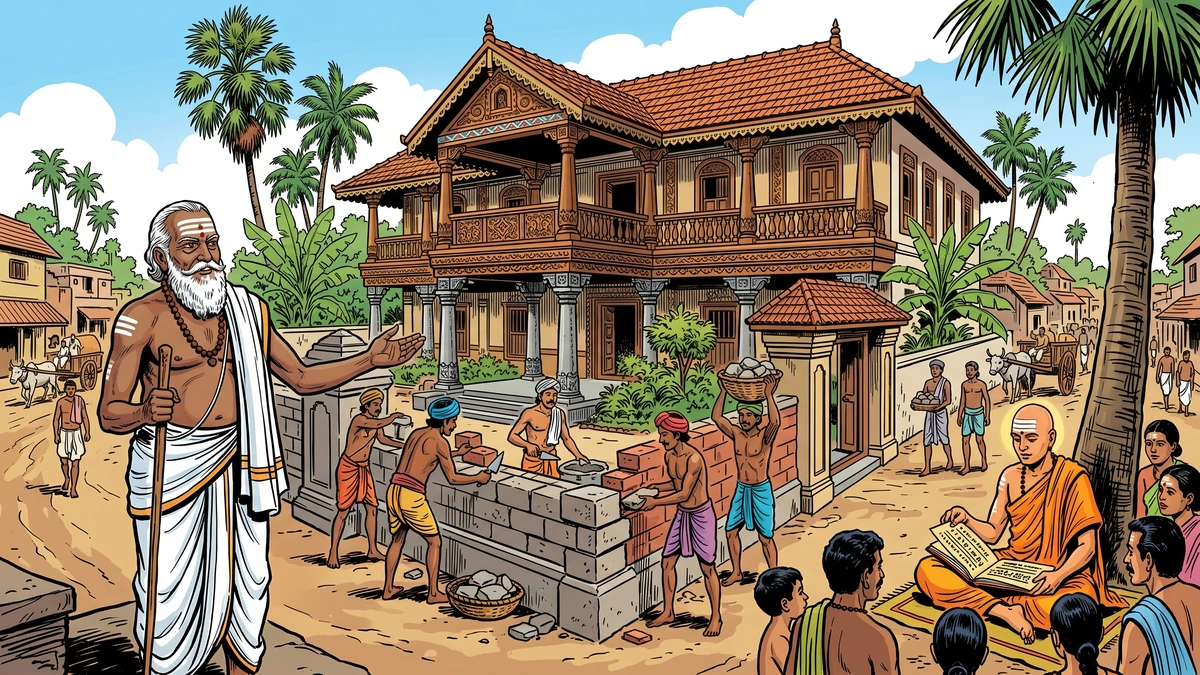
The opening of the tale unfolds in the patient, ceremonious key in which Tamil prosperity has always announced itself. In a town that Natesa Sastri does not name — though the Trichinopoly district is the most likely setting, with its sluiced paddy fields and palmyra-fringed lanes — there lived a wealthy Brâhmiṇ who, having decided to build a great house “as became his riches,” set about the project with all the patient piety of an orthodox Tamil household. He summoned a great number of jyôtịar — the village astrologers, with their palm-leaf almanacs and their cowrie-shells and their soft red chalk for marking auspicious squares on the ground — and from their conjoined readings of the Pāla–tatva–chakra (the lunar-mansion table) and the Rāhu-kāla-cakra (the diurnal “wheel of the hour of Rāhu”) the place and the moment of the foundation-laying were fixed.
The two intervals the wealthy Brâhmiṇ was meticulous to avoid were the Rāhu-kāla and the tyajya. Rāhu-kāla is, in Tamil and Sanskrit astrology, a portion of the day (about ninety minutes long, varying with the day of the week) when the shadow-planet Rāhu — the demon-snake who once swallowed the moon — is held to dim the auspiciousness of any work begun under his light. Tyajya (literally “to be cast off”) is the briefer interval, sometimes only a few minutes, when one of the lunar mansions has just turned and the day is held to be in flux. A serious Tamil householder will not so much as sign a deed, light a brick-kiln, or cut the first turmeric-stained ribbon of a new threshold during these intervals. The wealthy Brâhmiṇ, being scrupulous in this regard and being also — we are told — meticulous about the size and ornament of every column and lintel and beam, took ten years to finish the mansion. Ten years of mason-work and carpentry, of hand-quarried granite from Tiruchirappalli rock and rosewood from the southern Western Ghats and stained glass shipped up from Pondicherry, and at last the great house stood ready: spacious, two-storeyed, finished with carved teak balconies and a courtyard paved in coloured stone.
The day of the gārha-praveśa — the householder’s formal first entry — was, by long Tamil custom, a day of full ceremony. The wealthy Brâhmiṇ spent freely. Twenty-five Brâhmiṇs of the orthodox quarter were fed; the gods of the hearth-fire and the gods of the threshold were summoned with offerings of clarified butter and white rice and sandal-paste; the nādasvaram and tavil — the great curving south-Indian oboe and its companion drum — sounded continuously from dawn through the noon meal; women of the lineage drew elaborate kôlam rice-flour designs at every doorway. The text calls the courtyard music veoras, an old transliteration of vādyas, the temple-orchestra. By evening, when the last guest had taken his leaf-plate of curd-rice and gone home, the householder, exhausted by the day’s exertions, retired to his upper-storey bedroom under a roof of new teak rafters and laid his head down on a cushion of fresh cotton.
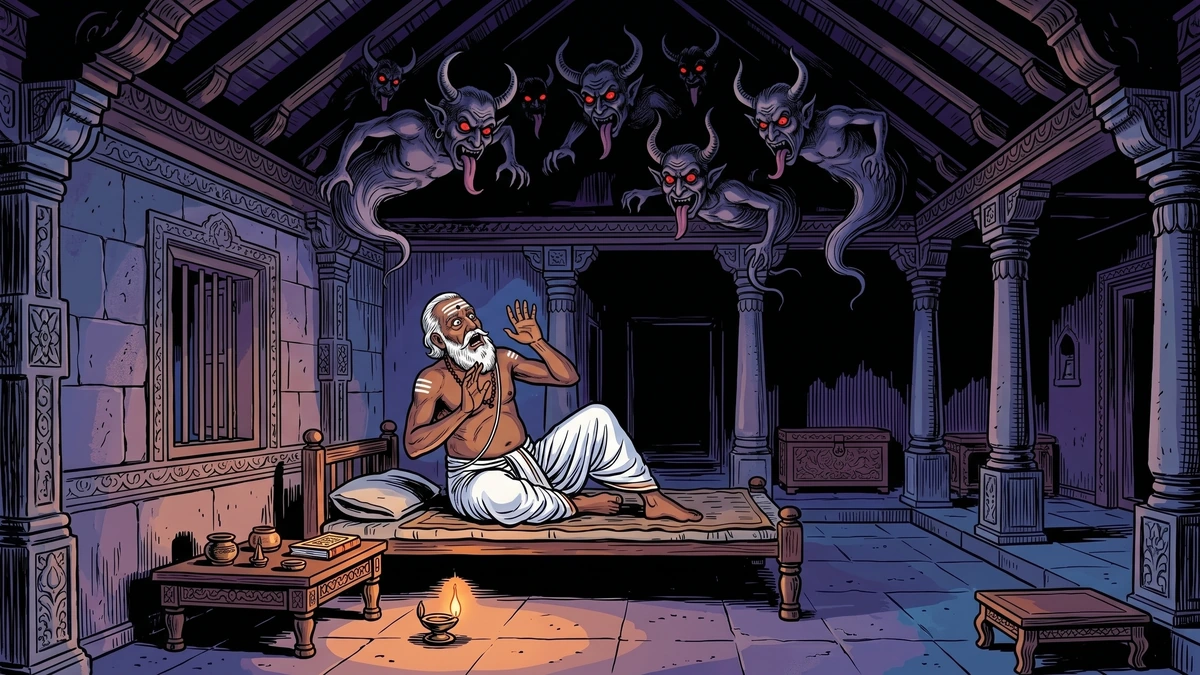
And then, before sleep could close his eyelids, a voice came down to him — a great voice from somewhere in the dark of the rafters above his head — and it asked, twice and slowly, the question that has run through Tamil household nightmare for a hundred and forty years since this story was first written down: “Shall I fall down? Shall I fall down?”
The wealthy Brâhmiṇ did what almost any householder in his position would have done: he panicked. He concluded that some pêy or piśāca (a Tamil class of demon associated with possession of houses and crossroads, recorded in the Tamil Mahākāṿyas and in the long Tamil Yākṇam theatre tradition) had taken possession of the great new house, and that the demon was about to drop the entire roof, with all its rafters of imported teak and all its ten years of ceremonial labour, on his single sleeping head. With the same haste with which he had entered the house at noon, the wealthy Brâhmiṇ vacated it before midnight, scuttled across the courtyard in his white vṛttam, and went back across the lane to his old, smaller house. He did not enter the new mansion again that year, or the next, or the next. He locked the great door and put the key on a brass nail.
II. The Tamil Proverb of the Small House and the Six Months of Scandal
For the Tamil reader of 1890 — and for the village listener of 1880 from whom Natesa Sastri’s step-mother first heard the tale — the moment of the wealthy Brâhmiṇ’s flight is glossed by a saying so familiar that the storyteller pauses to gloss it for the foreign reader. Natesa Sastri sets the proverb in italics and then translates it: “Sirukak kaṭṭi perukavậka,” the Tamil saying goes; literally “build small and live great.” The proverb is a piece of agricultural Tamil wisdom, far older than the present tale, and it was the everyday counsel of the village elder against the showy mansions of the absentee landlord. Build small — do not lay out your capital uselessly in big houses — and live large. The saying remains in living circulation in the Tamil countryside today: a typical schoolmaster in Tiruchirappalli will quote it in 2026 to a young couple about to drain their savings on a wedding-hall mansion.
The hidden barb of the proverb is that the wealthy Brâhmiṇ has now demonstrated its truth on his own skin. The very spaciousness that he calculated as a sign of his prosperity has now — in his own analysis — opened a door wide enough for any roof-demon of the unseen world to fly into. He had, as the proverb says, not built small; and now he could not, as the proverb says, live great. He retreated, ashamed, to his small old house, while his ten years of mason-work and carpentry stood empty in the moonlight at the head of the lane.
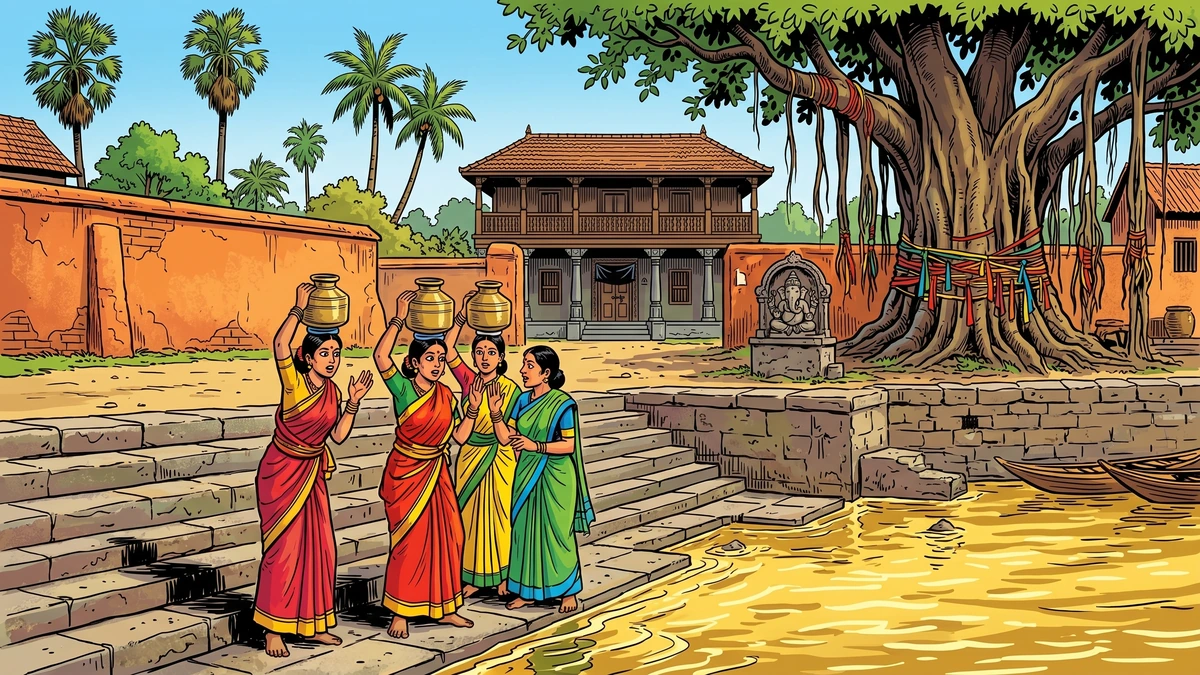
What followed is one of the most precisely-observed pieces of village sociology in all of Anglo-Indian folktale collection. The empty house, locked in the dark, became at once the property of the whole village’s imagination. The women of the lane — gathered at the river-side ghaṭ, where Tamil village women have for centuries done their morning washing and their morning gossiping in equal measure — began to speak about the haunted mansion. One woman, fetching water at dawn, swore she had seen a circle of pêys dancing around the central upper-storey pillar; another said she had observed unearthly green and yellow lights moving from window to window the previous night; a third said she had heard, from across the courtyard, the unmistakable bass of a vṛtt-demon humming a marriage-song. None of these women had observed any such thing. The story was generating itself; it was furnishing, as folklore always furnishes, “new colours and new adventures out of pure imagination for a phenomena which they never saw.” The wealthy Brâhmiṇ had now to bear not only the loss of his house but the slow, inexorable, six-month accumulation of his own posthumous reputation as the man whose mansion the demons had taken.
This is the cultural setting in which the second protagonist enters the story. Six months passed. In the same town, in a small dripping mud-and-thatch hut at the margin of the agricultural quarter, lived a poor Brâhmiṇ: a beggar by daily necessity, a householder by the technicality of having a wife and seven children and four mud walls. He had, the text tells us, no proper hearth-fire and no proper roof and no proper dhoti for the temple. The roof of the only hut he possessed had begun, that very monsoon, to fall in. Winter (the south-Indian kārtikai–mārgaśśira winter, the season of the cold north-east monsoon) was approaching. The seven children were hungry. The wife was at the end of her own counsel. The poor Brâhmiṇ, in the privacy of his own thoughts, and without speaking of it to a single soul, had reached the resolution that all of human dignity must reach when it has been beaten too long: he had decided to die, and to take his family with him.
He could not, however, bring himself to do it by his own hand. The classical Tamil and Sanskrit interdiction on suicide is one of the strongest in Indian moral teaching: the ātma-hātya doctrine of the Manusmṛti and the equivalent prohibition in the Tamil Tirukkuṛaḷ are unambiguous. The poor man was, by background, a Brâhmiṇ: he had been raised on the prohibition. He could not lift his own hand against himself. So he conceived a plan that, in his exhausted mind, must have seemed at once self-extinguishing and theologically tolerable. He would go, with his wife and his seven children, to the haunted mansion of the wealthy Brâhmiṇ on the next lane — and let the demons of that mansion do the work the dharma forbade his own hand.
III. The Mohur-Fall and the Word that Reverses the World
So one bright and cold winter morning, the poor Brâhmiṇ walked across the lane and presented himself at the door of the rich Brâhmiṇ’s old (small) house, and made the request that he had been rehearsing through the long sleepless night. “My noble lord, the winter is approaching, and the roof of my hut has fallen away. If you would kindly allow it, I shall pass the rainy days in your big house.” The wealthy Brâhmiṇ — a man whose own narrative had now been six months in scandal — was almost embarrassingly grateful at this turn. There was, at last, a single soul in his entire village willing to put a single foot inside the great mansion. He gave the key; he gave his blessing; he gave, with an unforced honesty that turns out to be the moral hinge of the whole tale, the precise theological diagnosis: “I built it, and I am not destined to live there. You can go and try your fortune there.” In the Tamil hearing of the line, the operative word is destined — the rich man, almost without realising the depth of what he is saying, has handed the poor man not just a roof but the entire bhāgya of the building.
That same night the poor Brâhmiṇ’s wife and seven children, exhausted by the day’s carrying of cooking-pots and rice-bags and the family idol across the lane, slept the full sleep of children who do not know they are about to die. The poor Brâhmiṇ lay awake in the upper-storey room, on the same cushion the wealthy man had abandoned six months earlier, watching the rafters and waiting for the demons. He had, in the privacy of his soul, said his goodbyes. He had, that morning, taken a clean bath and put on a clean white dhoti and broken a young coconut at the threshold — the small Tamil rituals one does before a ceremonial death. He was ready.
And then, exactly as before, the great voice came down out of the rafters in the dark: “Shall I fall down? Shall I fall down?” The poor Brâhmiṇ, with the long fatalism of a man who has already decided to be killed by the very demon now addressing him, replied without hesitation in the small clear Tamil voice that the storytellers love — the voice of a man who has nothing left to defend: “Fall down.”
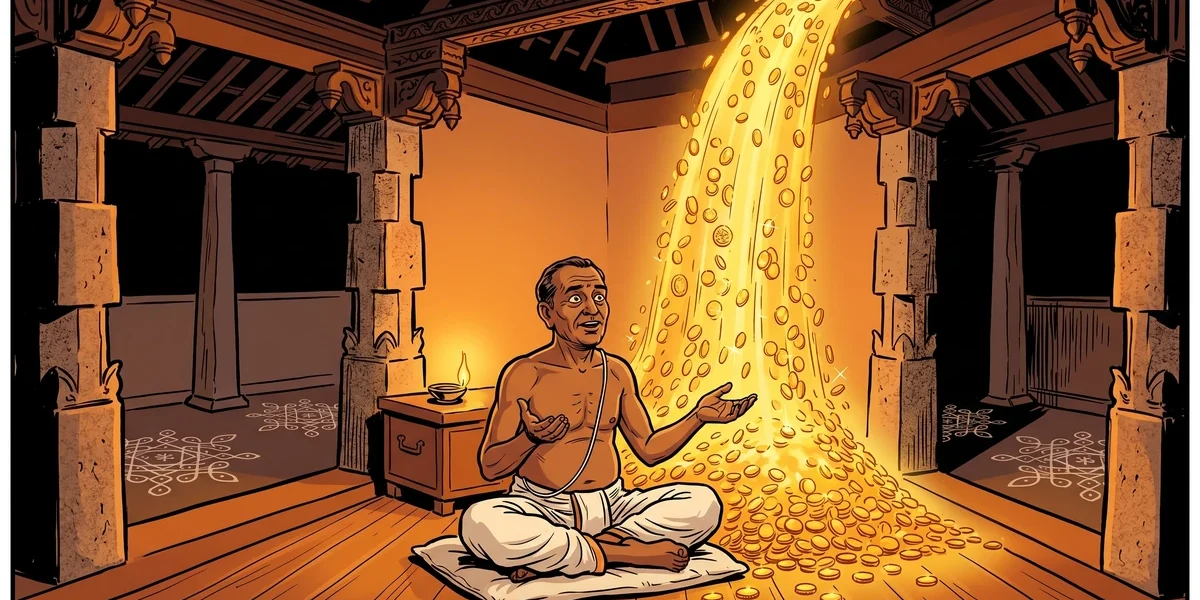
What followed is one of the great pieces of pure Tamil narrative imagery in nineteenth-century folktale collection. There fell, from the centre of the rafters of that upper room, a golden river: mohurs first, the heavy gold pieces with the Mughal calligraphy, and then pagodas, the smaller, thicker gold coins of the Vijayanagara mints with their stamped figure of Viṣṇu between two attendants. They fell as a waterfall falls; they fell with the steady noise of a small temple-bell continuously rung; they fell and fell and fell, piling like a small bright cone in the centre of the floor and growing higher as the man sat agape. The poor Brâhmiṇ, who had come into the house intending to be killed by demons, sat for several long seconds simply unable to comprehend what he was seeing — and then, when the cone had risen above his ankles and he began to think with a small distant rational fragment of his mind that he and his wife and his seven children might literally be buried in mohurs, he found his voice and said, in the same level Tamil tone he had used before: “Stop please.” The mohur-fall came at once to a sudden full stop. The room went silent. The single oil-lamp flickered. The cone of mohurs, head-high in places, shone in the lamp-light like a small piece of the sun left in the room by mistake.
The idea of suicide had quietly, and entirely, gone out of the poor man’s mind. He woke his wife and his eldest son. They moved the mohurs and the pagodas, basket by basket, into a side-room and locked it. The poor Brâhmiṇ took the key and put it on a string round his own neck. He told his wife and his seven children — all of whom, the text says with a certain pride in its protagonists, kept the matter perfectly secret — that they were to live, from that morning on, exactly as before in the matter of food and clothing, save only that the family would not starve. He converted the mohurs, day by day and only one or two at a time, into village rupees at the local chettiār’s shop, and bought rice and lentils and clean cloth and the vibhūti ash for his children’s morning baths. The family, after seven children of hunger, ate.
IV. The Scorpions, the Honest Word, and the Half-Share Forever
This is where the moral arithmetic of the tale tightens. The Tamil village, like every village, observes its neighbours’ condition closely. The poor Brâhmiṇ’s family, which had been at the edge of starvation in the month of kārtikai, now ate twice a day in the month of mārgaśśira; the children were seen at the temple in clean cotton; rice-water no longer ran out by the third day. Within a month, rumour had begun to spread — by the river-side ghaṭ and the kahve and the chettiār’s shop — that the poor Brâhmiṇ had found a treasure-trove inside the wealthy Brâhmiṇ’s mansion. The rumour reached the wealthy Brâhmiṇ.
The rich man came across the lane that evening, and the poor man — here is the second great Tamil moral hinge of the tale — told him every word of the truth. He hid nothing. He told him about the voice in the rafters, the question and the answer, the river of mohurs and pagodas, the cone of gold in the centre of the upper-storey floor, the stop-word, the locked side-room. He offered, in the long honest manner of the Tamil household ethic, to demonstrate the whole phenomenon to the rich Brâhmiṇ that very night.
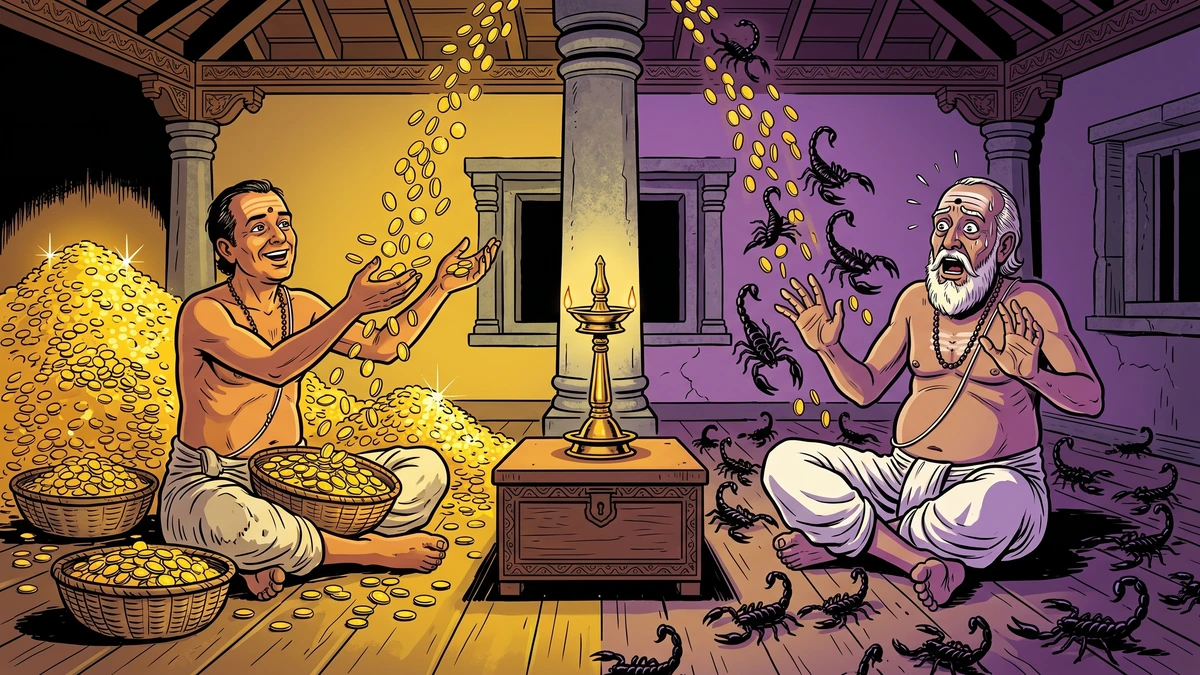
The wealthy Brâhmiṇ agreed. He stayed that night. He lay on a second cushion in the upper-storey room, beside the poor Brâhmiṇ, and waited for the great voice. At about midnight, exactly as before, it came: “Shall I fall down?” The poor man, level as ever, said: “Fall down.” And down came the river of mohurs and pagodas, gold piling on gold in a brilliant cone in the centre of the room. The poor man, joyful in the lamp-light, began to heap the gold pieces into baskets.
The wealthy Brâhmiṇ did not see what the poor Brâhmiṇ saw. To his eyes — horror of horrors — the falling river was not gold at all. It was a falling river of scorpions: glistening black scorpions, their tails curled high, their pincers clicking in the lamp-light, falling and crawling and piling into a scorpion-cone at the centre of the floor. The poor Brâhmiṇ’s baskets, when the wealthy Brâhmiṇ looked at them, were teeming with scorpions. The wealthy Brâhmiṇ, soaked in his own sudden cold sweat, understood at last what had happened to him in that house six months earlier. He had not run from a roof-demon. He had run from this same fall — which to him would have been, exactly as it now was, a fall of scorpions — and the demon-voice had been, all along, the polite warning of his own failure of bhāgya. The treasure was not, and never had been, his.
The poor Brâhmiṇ, when this had been understood between them, called the mohur-fall to its stop with the same single word, and turned to the rich man with the small unstudied generosity of an Indian household that has just received its first piece of luck. “My lord, you may take home this heap for your use.” The wealthy Brâhmiṇ began to weep. “I have heard my old father often repeat a proverb,” he said: “‘to the fortunate, fortune comes,’ and only to-day have I discovered its meaning. I see all your mohurs as so many scorpions. I have not the fortune to see them as mohurs. But you have that gift. So from this moment this house is yours.” He came down out of the upper-storey room and out of the courtyard and back across the lane to his small old house and slept the true sleep of a man who has at last accepted a piece of his own destiny. The poor Brâhmiṇ, with the courtesy of the Tamil household that does not forget its benefactors even when fortune has reversed itself, made him a single concession that he would honour for the rest of both their lives: each year, half of his wealth would be sent across the lane to the man who had given him the key. The story closes on this small, honest, perpetually divided gold — an arrangement which, in the deep ethics of the Tamil village, is the only way wealth that has come by destiny can be lived with by the man it was destined for.
V. The Moral — The Tamil Doctrine of Bhāgya
The closing line of the tale is its key, and Natesa Sastri prints it in Tamil so that the moral cannot be mistaken. The proverb the wealthy Brâhmiṇ finally hears himself say, and the proverb that the entire tale has been an extended commentary on, is:
அதிர்ஷ்டம் உள்ளவனுக்கு கிடைக்கும்
“Adhrishṭam uḷḷavanukku kiḍaikkum.”
“To the fortunate, good fortune comes.”
The English of the proverb sounds, at first, like a small mercenary tautology — the lucky get lucky — but the Tamil philosophical force is rather different and rather deeper. The classical Sanskrit term that stands behind the Tamil adhrishṭam is bhāgya: the share, the lot, the portion of the universe that has been measured out for one particular life from the beginning. Bhāgya is not the same as luck in the modern sense. It is not random, not redistributable, not negotiable; it is the specific quantum of joy and sorrow, of treasure and loss, of meeting and parting, that has been written for one specific person. The story’s teaching is that the mohurs in the rafters of the upper-storey room had, from the moment the rich Brâhmiṇ first laid the foundation-stone, been written into the bhāgya-line of the poor Brâhmiṇ. The rich man could spend ten years building the house and could lay every astrological square correctly and could feed every Brâhmiṇ in the orthodox quarter, and the gold would still not turn into gold for him; it would turn into scorpions. The poor man could come into the house for a single night, with no architectural plan and no astrological square and no money for a single feast, and the gold would fall for him because he was the destined hand. The rich man’s acceptance of this teaching is the small Tamil triumph of the story’s closing pages. He does not, like the rival in many ATU 745A variants from elsewhere in Eurasia, fight for the treasure or contrive a theft. He weeps; he hands over the key permanently; he goes home; he accepts the proverb. Adhrishṭam uḷḷavanukku kiḍaikkum. The proverb is not envy, and it is not resignation. It is a piece of cheerful Tamil philosophical realism: each man has his own bhāgya, and the wisest thing one can learn in a long life is which of the things in front of one belongs to one’s share, and which does not.
The deeper teaching, which is why the Tamil grandmothers of Trichinopoly have kept the tale alive for at least a hundred and fifty years, is that bhāgya rewards a particular kind of person. The poor Brâhmiṇ in this story is not, in any strict sense, virtuous in a way that one could itemise. He has not performed great vows. He has not given alms (he was a beggar himself). He has not undertaken pilgrimage. What he has done is two small things. One: when he had been beaten too far by the world, he chose not to lift his own hand against himself, but to wait inside the appointed house and let what was destined to happen, happen. Two: when fortune fell, he did not lie about it. He told the rich man the whole truth, and he honoured his benefactor with the half-share for the rest of his life. These are the two minimum conditions for bhāgya in Tamil household ethics: not to break the dharma of the body, and not to break the dharma of the word. Inside those two thin walls, fortune is permitted to find a man.
VI. Why This Tale Has Lasted
The story has lasted, in the Tamil and broader south-Indian household for at least the better part of two centuries, because it converts an old and difficult metaphysical doctrine into a single concrete kitchen-image: the river of gold mohurs falling out of the rafters of an upper-storey room. Tamil cosmology of bhāgya is not, in the abstract, easy teaching — it brushes uncomfortably close to fatalism, and fatalism is a doctrine that no living culture can accept entirely. What the tale does, with the elegance of true folklore, is hand the listener a single concrete experiment that resolves the ambiguity. The same falling river is gold to one man and scorpions to another. The proverb is no longer a piece of cold philosophy; it is the after-image of a specific, vivid, easily-recalled scene. The old grandmother of the Trichinopoly village did not, when she told this story to her step-son the future Pandit S. M. Natesa Sastri in the 1860s or 1870s, need to argue for bhāgya. She only had to make the listener see, in the lamp-light of his own imagination, the cone of mohurs and the cone of scorpions; and the listener, ever after, would believe.
The second reason for the story’s endurance is its gentle handling of the rich man. In most Eurasian variants of ATU 745A — in the Italian, the Russian, the Greek — the unlucky rival is humiliated, robbed, beaten, sometimes killed. The Tamil tale does none of this. The wealthy Brâhmiṇ is not punished. He is, on the contrary, gently educated. The scorpions teach him a single lesson, and he goes home a wiser man, and the poor Brâhmiṇ pays him half-share for the rest of his life. There is in this an enormously characteristic Tamil ethical preference: let no man, even one who has missed his own bhāgya, be left in scorpions. The story closes with a small permanent transfusion of fortune from the lucky to the unlucky — not by force, not by guilt, not by law, but by the spontaneous decision of the lucky one to share. This is the second teaching the grandmothers of Trichinopoly have wanted preserved: the man who has received his bhāgya is morally obliged to keep a stream of it always flowing back to the man whose hand merely passed it on.
For the modern reader, in 2026, the lessons of the Trichinopoly grandmother who first told this story to her step-son in the 1870s are surprisingly current. Most of us live, like the wealthy Brâhmiṇ, in houses we built ourselves, and most of us have moments — usually at three in the morning — when we hear an unidentifiable noise in our own roof-rafters and conclude, in panic, that the building is about to fall. Most of us, like the poor Brâhmiṇ, have at least one occasion in our lives when we are at the edge of giving up entirely, and the only thing that prevents us is some old prohibition against lifting our own hand against ourselves. The story is gentle with both panicked sleeplessness and quiet despair, and it has the same answer for both: let what is destined for the room come into the room, and answer the voice when it speaks. Adhrishṭam uḷḷavanukku kiḍaikkum: to the fortunate, fortune comes — but the fortune is in the answer one is willing to give from the small cushion in the dark, when the great voice in the rafters has at last spoken.
Canonical attribution · “Good Luck to the Lucky One; Or, Shall I Fall Down?” in Tales of the Sun, or Folklore of Southern India, by Mrs. Howard Kingscote (Georgiana Howard Kingscote, née Wolff) and Pandit S. M. Natesa Sastri (Sangendi Mahalinga Natesa Sastri, 1859–1906; Tamil scholar, Madras Civil Service, founding member of the Madras Folklore Society) — London & Calcutta: W. H. Allen & Co., 13 Waterloo Place, 1890; Project Gutenberg e-text 37002. Storyteller’s footnote: “related to me by my step-mother, whose birth-place is a village in the Trichinopoly district” (now Tiruchirappalli district, Tamil Nadu, India). International tale-type ATU 745A The Predestined Treasure (Aarne 1910; Thompson 1928, 1961; Uther, FF Communications 284–286, Helsinki: Suomalainen Tiedeakatemia, 2004). Stith Thompson motifs N141.0.1 (lucky and unlucky persons), N211.1 (treasure goes to person for whom it is destined), N531 (treasure discovered through supernatural voice), D2074.2 (treasure-hoard called forth by magic word), J1485 (mistaken identification: gold seen as scorpions), H1411 (fear test: the haunted house). Comparative scholarship: Lutz Röhrich, Enzyklopädie des Märchens X.682–689 (Berlin: de Gruyter); Charles Henry Tawney & Norman Mosley Penzer, The Ocean of Story (London: Chas. J. Sawyer, 1924–28), 10 vols. Indian comparanda: Somadeva, Kathāsaritsāgara, c. 1070 CE (Kashmir); the Hitopadeśa and Pañcatantra traditions on bhāgya; Tamil Tirukkuṛaḷ (book III on luck and effort). Closing Tamil proverb: அதிர்ஷ்டம் உள்ளவனுக்கு கிடைக்கும் (Adhrishṭam uḷḷavanukku kiḍaikkum), “to the fortunate, fortune comes.” Cited Tamil agricultural proverb: Sirukak kaṭṭi perukavāḷka, “build small and live great.” Reading time: ~10 min.
Frequently Asked Questions
Where does “Good Luck to the Lucky One” come from, and who first wrote it down?
The tale was collected in Tamil Nadu in the 1870s or early 1880s by Pandit Sangendi Mahalinga Natesa Sastri (1859–1906), a young Tamil scholar of the Madras Civil Service and a founding member of the Madras Folklore Society. He records explicitly, in his closing footnote, that the story was “related to me by my step-mother, whose birth-place is a village in the Trichinopoly district” — now the Tiruchirappalli district of Tamil Nadu. Natesa Sastri co-edited his English translation of twenty-six such tales with the British folklorist Mrs. Howard Kingscote (Georgiana Howard Kingscote, née Wolff), and the volume was published as Tales of the Sun, or Folklore of Southern India by W. H. Allen & Co., 13 Waterloo Place, London & Calcutta, in 1890. The book is now in the public domain and is available as Project Gutenberg e-text 37002.
What is the international tale-type, and where else does the predestined-treasure motif appear?
The story is classified as Aarne–Thompson–Uther type 745A, The Predestined Treasure, the cluster of folktales in which a hoard of gold cannot be claimed by anyone except the one for whom it has been destined from the beginning. Hans-Jörg Uther formalised the type in The Types of International Folktales (FF Communications 284–286, Helsinki, 2004), defining the central feature as “gold appears as gold to the destined owner, and as something worthless or harmful (scorpions, snakes, charcoal, dung) to anyone else.” Indian recensions are deep and old: a near-relative appears in Somadeva’s eleventh-century Sanskrit Kathāsaritsāgara (the story of Kśūdrāka and the buried jar), and other versions are catalogued by Tawney and Penzer in their ten-volume Ocean of Story (London, 1924–28). Outside India, the type appears in Italian Basile (1634), in the Thousand and One Nights, and in many Eastern European variants documented by Lutz Röhrich in Enzyklopädie des Märchens X.682–689.
What do the Tamil terms Rāhu-kāla, tyajya, and bhūsuras mean in the story?
These three terms are taken directly from the south-Indian Pañcāṅga almanac and from Brâhmiṇical ceremonial idiom. Rāhu-kāla is the daily “hour of the demon Rāhu” — an inauspicious portion of the day, about ninety minutes long, varying with the day of the week, during which serious work should not be begun. Tyajya (Sanskrit, “to be cast off”) is the smaller astrological window during which one of the lunar mansions has just turned and the day is held to be in flux; sensible Tamil householders avoid signing deeds, lighting brick-kilns or laying foundations during these intervals. Bhūsuras (literally “earthly gods”) is the honorific epithet for the Brâhmiṇ class, recorded on temple inscriptions in Thañjāvūr and Tiruchirappalli to this day. The wealthy Brâhmiṇ’s scrupulous avoidance of Rāhu-kāla and tyajya during the building of the mansion sets up the irony of the tale: even with every astrological square correctly drawn, the gold in the rafters belongs to someone else.
What is the Tamil concept of bhāgya, and how does the closing proverb work?
The closing proverb of the tale is அதிர்ஷ்டம் உள்ளவனுக்கு கிடைக்கும் (Adhrishṭam uḷḷavanukku kiḍaikkum) — “to the fortunate, fortune comes.” The classical Sanskrit philosophical term that stands behind the Tamil adhrishṭam is bhāgya, the “share” or “portion” of the universe written for one specific life. Bhāgya is not the modern English “luck”: it is not random, not redistributable, not negotiable. The story’s teaching is that the mohurs in the rafters had, from the moment the foundation-stone was laid, been written into the bhāgya-line of the poor Brâhmiṇ, not the rich one. The rich man’s scorpions are not punishment; they are simply the form in which a hoard not destined for one’s hand presents itself. The deeper teaching is that bhāgya permits itself to be received by the man who keeps two minimum dharmas: the dharma of the body (he does not lift his own hand against himself in despair) and the dharma of the word (he tells the rich man the whole truth and shares half-share with him every year for the rest of his life). Inside those two thin walls, fortune is permitted to find a man.
What does the Tamil agricultural proverb “build small and live great” mean, and why is it quoted in the middle of the story?
The Tamil saying Sirukak kaṭṭi perukavāḷka — “build small, live great” — is an old piece of agricultural Tamil wisdom and remains the everyday counsel of the village elder against the showy mansions of the absentee landlord. The literal meaning is “do not lay out your capital uselessly in big houses; build small houses without much expense and live prosperously.” Natesa Sastri quotes it at exactly the point of the wealthy Brâhmiṇ’s flight from the haunted upper room because the rich man has now demonstrated the proverb against himself: the very spaciousness he calculated as a sign of prosperity has, in his own analysis, opened a door wide enough for any roof-demon to fly through. The barb of the proverb is that he did not build small, and so cannot now live great. The saying is still in living circulation in the Tamil countryside in 2026; a typical schoolmaster in Tiruchirappalli will quote it to a young couple about to drain their savings on a wedding-hall mansion.
You May Also Like
 Indian Folk Tales
Ages 6-8
Indian Folk Tales
Ages 6-8
The Mouse Deer and the Crocodile: How Wit Overcomes Danger
The Mouse Deer and the Crocodile: How Wit Overcomes Danger: In the dense forests of Indonesia, where the rivers flow like liquid silver and the jungle is alive
 Indian Folk Tales
Ages 3-5
Indian Folk Tales
Ages 3-5
The Two Brothers Indian Folktale
The Two Brothers Indian Folktale: Once upon a time there lived a King who had two young sons; they were good boys, and sat in school learning all that kings’
 Indian Folk Tales
Ages 3-5
Indian Folk Tales
Ages 3-5
The Prince And The Fakir
The Prince And The Fakir: There was once upon a time a King who had no children. Now this King went and laid him down to rest at a place where four roads met