The Jewelled Arrow
Tricked into shooting his father’s magic arrow at a strange crane, a young prince follows the bird to the city of a cruel magician and falls in love.
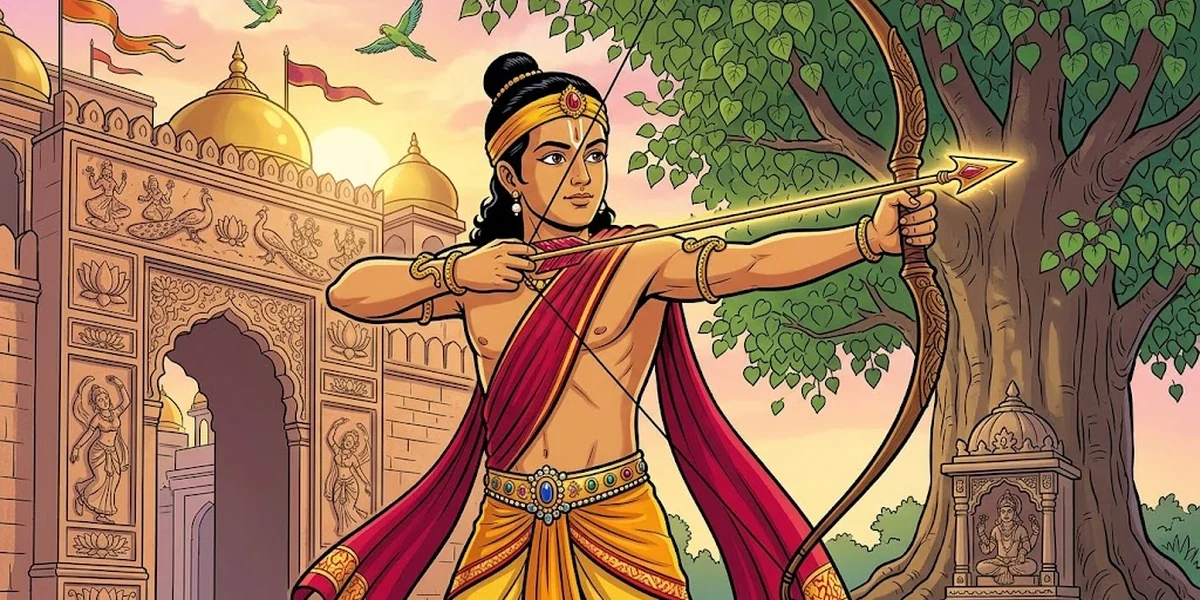
Long ago a mighty king called Vira-Bhuja ruled the Indian city of Vardhamana. He had many wives, and each of them had several sons. Of all his wives, the king loved Guna-Vara best, and of all his sons, his favourite was her youngest, Sringa-Bhuja.
Guna-Vara was as good as she was lovely. Her patience was so great that nothing ever made her lose her temper, she never thought of herself before others, and so wise that she could understand how other people felt, however different they were from her.
Her son Sringa-Bhuja was like her in his good looks and his unselfishness, and he was also very strong and very clever. His brothers were nothing like him. They always wanted their own way, and they were bitterly jealous of their father’s love for him. Though they often quarrelled among themselves, they would always join together to try to do him harm.
It was much the same with the king’s wives. They hated Guna-Vara because the king loved her more than them, and they kept coming to him with made-up stories about the wicked things she had done. Among other things, they told him that Guna-Vara did not really love him, and that she cared for someone else more. The most spiteful of them all was a wife called Ayasolekha, who was cunning enough to know which stories the king would believe.
Because Vira-Bhuja loved Guna-Vara so much, he was all the more ready to fear that she did not love him back, and he longed to know the truth. So he made up a story of his own to test her. One day he went to her rooms, sent all her servants away, and told her that he had very sad news from his chief astrologer, the man believed at court to read signs in the stars. Guna-Vara never doubted that it was true, and she listened with her heart pounding, afraid that some trouble was coming to the people she loved.
Imagine her grief and surprise when the king told her that, according to the astrologer, a terrible disaster threatened him and his kingdom, and that the only way to prevent it was to lock Guna-Vara in prison for the rest of her life.
The poor queen could hardly believe her ears. She knew she had done nothing wrong, and she could not see how putting her in prison would help anyone. She was sure that her husband loved her, and no words could describe how much it hurt to think of being sent away from him and her dear son. Yet she did not resist. She did not even ask to see Sringa-Bhuja one last time. She simply bowed her beautiful head and said, “Let it be as my lord wishes. If he wants my life, I am ready to give it.”
Her meek answer made the king even more miserable. He longed to take her in his arms and promise never to let her go, and perhaps, if she had looked up at him then, he would have seen all her love in her eyes. But she stood perfectly still with her head bowed, waiting to hear her fate, and the thought came into the king’s mind: “She dares not meet my eyes. Ayasolekha was right after all.”
So he summoned the guards and had his wife led away and locked in a strong prison. She did not struggle, turning only to give her husband one loving look as she was led away.
The king went back to his palace, and he had not been there long when Ayasolekha sent a message begging to see him, for she had something very important to tell him. The king agreed at once, thinking, “Perhaps she has learned that her tale about my dear Guna-Vara was false.”
But to his great disappointment, the wicked woman told him she had discovered a plot to kill him. Guna-Vara’s son and some of the chief men of the kingdom, she said, had agreed to murder him so that Sringa-Bhuja could rule instead. She and some of the other wives had overheard them talking, and they were terrified that their beloved lord would be hurt.
Vira-Bhuja simply could not believe it, for he trusted his son as much as he loved him. He sent the troublemaker away and told her never to come near him again. All the same, he could not stop thinking about it. He had Sringa-Bhuja watched closely, and when nothing was found against him, the king began to feel easier. He was even thinking of visiting Guna-Vara in prison to ask her to open her heart to him, when something happened that made him fear that his dear son was not loyal after all.
The king owned a wonderful arrow set with precious jewels, which a magician had given him. It could hit whatever it was aimed at without fail, however far away. On the very day he had meant to visit his wife, he found that the arrow was missing from its secret hiding place. He was very upset. After searching for it in vain, he called together everyone who worked in the palace and asked whether anyone knew anything about it. He promised to forgive anyone who helped him get it back, even the thief, but he warned that if it was not found within three days, he would have all the servants beaten until the thief confessed.
The truth was that Ayasolekha knew where the king kept the arrow. She had taken it to her own rooms and called together her sons and the sons of the other wives, who all hated Sringa-Bhuja, to tell them of a plan to disgrace their brother.
“You know how much more your father loves Sringa-Bhuja than any of you,” she said, “and that when he dies, he will leave him the kingdom and all his treasure. I will help you stop that by getting rid of Sringa-Bhuja. You must hold a great archery contest. Your brother is so proud of his archery that he will jump at the chance to join in. On the day of the contest, I will send for him and give him your father’s jewelled arrow to shoot with, telling him the king said I might lend it to him. Your father will think he stole it and will order him to be put to death.”
The brothers were delighted with what they thought a very clever plan, and they did exactly as Ayasolekha advised.
When the day came, great crowds gathered to watch the shooting at a large target set up near the palace. The king and all his court watched from the walls, and the guards had trouble keeping the course clear. The brothers took their turns, starting with the eldest, and pretended to try to hit the target. But none of them really wanted to win. They expected that when Sringa-Bhuja’s turn came, last of all as the youngest son, he would win with the jewelled arrow. Then the king would have him brought before him and sentence him to death or to prison for life.
But, as so often happens, something nobody expected upset the whole carefully laid plan. Just as Sringa-Bhuja was about to shoot, a big crane landed on the ground between him and the target, so that he could not take proper aim. The brothers saw the bird, and each of them wanted to shoot it himself, so they all clamoured for another turn. Nobody objected, and Sringa-Bhuja stood aside with the jewelled arrow on his bowstring, waiting to see what they would do, and feeling sure that he would be the one to bring the bird down.
One brother after another tried, but the great bird was not touched. Then a travelling beggar stepped forward and cried out, “That is no bird! It is a wicked magician who has taken that shape to fool you all. If he is not killed before he changes back into his own form, he will bring misery and ruin on this city and the country around it.”
The crowd took the wandering stranger for a holy man and listened to him with excitement and fear. They had heard stories of disasters brought on other cities by rakshasas, the supernatural beings described as evil magicians in this telling. The brothers all wanted to try their luck again, but the beggar stopped them.
“No, no. Where is your youngest brother, Sringa-Bhuja?” he said. “He alone can save your homes, your wives and your children from destruction.”
So Sringa-Bhuja stepped forward. As the sun flashed on the jewels of the stolen arrow, the king, watching from the walls, saw that it was his own beloved son who had taken it. The young prince let the arrow fly straight at the bird. It wounded the crane but did not kill it, and the bird flew away with the arrow stuck in its breast, dripping blood as it went and flying slower and slower.
When the king saw the bird carrying off his precious jewelled arrow, he was furious, and he sent orders for Sringa-Bhuja to be brought to him at once. But before the messengers reached him, the prince had set off after the bird, following the drops of blood on the ground.
As Sringa-Bhuja raced after the crane, the beggar drew strange signs in the air with his walking staff, and such clouds of dust rose up that nobody could see which way the prince had gone.
Ayasolekha and the brothers were dismayed at how things had turned out, and they were afraid that the king would take out his anger on them now that Sringa-Bhuja had vanished. The king did send for them and question them, but they all kept the secret of how Sringa-Bhuja had come by the arrow, and they promised to do everything they could to help get it back. Once more the king thought of visiting the mother of his dear youngest son, and once more something held him back. So poor Guna-Vara was left alone, and nobody came near her except the jailer who brought her food each day. After trying everything to find out where Sringa-Bhuja had gone, the king began to favour another of his sons, and as the months went by, it seemed that the young prince and the jewelled arrow had both been forgotten.
Meanwhile Sringa-Bhuja travelled on and on, following the trail of blood, until he came to the edge of a fine forest, where many well-worn paths led to a great city. He sat down to rest under a broad, spreading tree, and as he gazed up at the city’s towers and spires rising high into the sky, he had a feeling that he was no longer alone. He was right. Down one of the paths a beautiful young girl was wandering slowly towards him, humming a sweet song under her breath. She had the soft eyes of a fawn, and her face was perfect, and something in it made Sringa-Bhuja think of his mother, and wonder sadly whether he would ever see her face again.
When she was close to him, he startled her by asking, “Can you tell me the name of this city?”
“Of course I can, for I live there,” she said. “It is called Dhuma-Pura, and it belongs to my father, a great magician named Agni-Sikha, who does not like strangers. Now tell me who you are and where you come from.”
So Sringa-Bhuja told her all about himself and why he had wandered so far from home. The girl, whose name was Rupa-Sikha, listened carefully, but when he described shooting the crane and tracking the wounded bird to recover his father’s arrow, she started to shake.
“Oh no!” she said. “The bird you shot was my father. He can take any shape he likes. He came home only yesterday, and I pulled the arrow out of his wound and dressed it myself. He has handed the jewelled arrow to me for safekeeping, and I mean to keep it always. And you must go, as quickly as you can. My father forgives nobody, and his power is so great that you could never get away if he knew you were here.”
Sringa-Bhuja’s heart sank. It was not fear of the magician that troubled him. He had fallen in love with the girl at first sight and was determined to make her his wife. She, too, felt drawn to him and did not like to think of him going away. What was more, her father frightened her. He was mighty, and just as cruel, and many young men who had hoped to marry her had been done away with by him. She had never cared for any of them, and she had been happy to live unmarried, wandering about near her home and winning the love of everyone around her, even the wild creatures of the forest, which would never have dreamed of hurting her. Again and again she had stood between her father’s rage and the people he wanted to harm, for in spite of all his wickedness, he loved her dearly and wished her to be happy.
Rupa-Sikha quickly decided what to do. “I will give you back your golden arrow,” she told the prince, “and you must hurry out of our country before my father finds out you are here.”
“No! No! A thousand times no!” cried the prince. “Now that I have seen you, I can never leave you. Can’t you learn to love me and be my wife?” He threw himself at her feet and gazed up at her so lovingly that she could not resist him. She bent down to him, and the next moment they were in each other’s arms, forgetting all the dangers around them.
Rupa-Sikha was the first to remember her father. She drew away and said, “Listen, here is my plan. Yes, my father is a magician, but I am his child, and some of his magic runs in me as well. Promise to follow my instructions to the letter, and I believe I can keep you alive, and maybe even marry you. Of all his many children, I am the youngest and the one he loves most. I shall tell him that a powerful prince, hearing of his marvellous magic, has travelled all this way to meet him. After that I will confess that I have met you, that I love you and that I wish to be your wife. It will flatter him that his fame has travelled so far, and he will want to see you, even if he will not let me marry you. I will take you to him and leave you alone with him, and if you truly love me, you will find a way to win him over. But you must keep out of his sight until I have prepared the way. Come with me now, and I will show you a hiding place.”
She led him deep into the forest to a great tree whose spreading branches swept the ground and hid its trunk completely. In the trunk was an opening big enough for a man to pass through, and steps cut inside it led down to a wide space underground. There she told him to wait for her.
“One more thing,” she said. “Here is my secret password. If anyone finds you, it will save your life. It is LOTUS FLOWER. Anyone who hears it will understand that I am protecting you.”
Back at the palace, Rupa-Sikha found her father in a foul mood because she had not been to ask how the wound in his breast was healing. She did her best to make up for it. She dressed the wound very carefully, cooked him a delicious meal with her own hands and served him herself while he ate. All this pleased him, and he was in quite a good mood when she said, “Now I must tell you that I have had an adventure too. Out in the forest, as I picked herbs, I came across a stranger, a tall, good-looking young man with the air of a prince. He told me he was looking for the palace of a great and wonderful magician whose marvellous deeds he had heard of. Who could that be but you, Father? I told him I was your daughter, and he begged me to ask you to see him.”
Agni-Sikha listened without a word. He was pleased at this new sign that his fame had spread far and wide, but he guessed at once that his daughter had not told him everything. He waited for her to go on, and when she said nothing more, he turned on her angrily and roared, “And what did my daughter answer?”
Then Rupa-Sikha knew that her secret was out. She drew herself up to her full height and answered proudly, “I told him I would find you and ask you to receive him. And now I will tell you, Father, that I have met the only man I will ever marry, and if you forbid it, I cannot live, for I cannot live without him.”
“Send for the man at once,” cried the magician, “and you shall hear my answer when he stands before me.”
“I cannot send for him,” said Rupa-Sikha, “for nobody knows where I left him. And I will not fetch him until you promise that no harm will come to him.”
At first Agni-Sikha laughed out loud and said he would promise no such thing. But his daughter was as stubborn as he was, and when he saw that he would get nowhere unless he gave in, he said crossly, “Very well, he may leave this palace alive, with his handsome head still on his neck. I promise nothing more.”
“That won’t do,” said Rupa-Sikha. “Repeat these words: ‘No harm at all shall come to him, and he shall be welcomed as my honoured guest.’ Otherwise you will never see him.”
In the end the magician gave his word, privately planning to find some other way to be rid of Sringa-Bhuja if he did not like him as a son-in-law. As soon as he had said the words, Rupa-Sikha flew off as fast as the wind, her heart full of hope.
She found the prince waiting anxiously and quickly explained how things stood. “Don’t say anything about me to my father at first,” she said. “Talk only about him and all you have heard about him. If he grows fond of you and wants you near him, so much the better. Then you can say that you must soon leave for home, and rather than let you go, he will want us to marry and live here with him.”
Sringa-Bhuja loved Rupa-Sikha so much that he was ready to do whatever she asked, so he went with her to the palace straight away. Everywhere he looked he saw signs of the magician’s power. At every gate stood tall guards in gleaming armour; they saluted the princess but glared at him, and he knew that if he had come alone, they would never have let him pass.
At last they came to the great hall, where the magician was striding up and down, working himself into a fury at being kept waiting. The moment he saw the prince, he knew him as the man who had shot the jewelled arrow at him when he was a crane, and he made up his mind to have his revenge. But he was too cunning to let Sringa-Bhuja know that he recognised him. Instead he pretended to be delighted to see him. He even said that he had long wished to find a prince worthy of his youngest and favourite daughter. “And you seem to be just the man,” he added, “young, handsome and, judging by your rich clothes and jewels, able to give my darling everything she needs.”
The prince could hardly believe his ears, and Rupa-Sikha was very surprised too. She guessed that her father had some wicked plan in mind, and she looked hard at Sringa-Bhuja, hoping to make him understand. But the prince was so overjoyed at the thought of marrying her that he noticed nothing. So when Agni-Sikha added, “I make only one condition: you must promise never to disobey my orders, but to do whatever I tell you without a moment’s delay,” Sringa-Bhuja said at once, without stopping to think, “Let me marry your daughter, and I will do anything you ask of me.”
“Then that’s settled!” cried the magician, clapping his hands. At once a crowd of servants appeared, and he ordered them to take the prince to the best rooms in the palace, prepare a bath for him and give him whatever he asked for.
As Sringa-Bhuja followed the servants, Rupa-Sikha managed to whisper to him, “Be careful! Wait for a message from me!”
He had bathed and was putting on fresh clothes, with servants waiting on him hand and foot, when a messenger arrived with a sealed letter. The prince guessed at once who had sent it, and he quickly finished dressing and sent the servants away so that he could read it alone.
“My beloved,” said the letter, “my father is plotting against you, and it was very foolish of you to promise to obey him in everything. I have ten sisters who look exactly like me. We all wear the same dresses and the same necklaces, so that few people can tell us apart. Soon you will be called to the great hall, where we will all be together, and my father will tell you to choose your bride from among us. If you choose wrongly, all will be lost for us. But I will wear my necklace on my head instead of around my neck, and so you will know your own true love. And remember, my dearest, do not obey any more of his orders without hearing from me, for only I can outwit my terrible father.”
Everything happened just as Rupa-Sikha had said. The prince was called before Agni-Sikha, who handed him a garland of flowers and told him to place it around the neck of the girl he was to marry. Without a moment’s hesitation, Sringa-Bhuja picked out the right sister. The magician was secretly furious, but he pretended to be delighted at this proof of a lover’s sharp eyes. “You are the son-in-law for me!” he cried. “The wedding shall be tomorrow!”
Sringa-Bhuja was overjoyed, but Rupa-Sikha was certain her father’s words were empty. She stood silently next to the prince until the magician sent all the other sisters out of the hall. Then, with a very wicked look on his face, Agni-Sikha said, “Before the wedding, there is just one little thing you must do for me, my dear son-in-law-to-be. Go outside the city, and near the tower farthest to the west you will find a team of oxen and a plough waiting for you. Beside them is a heap of three hundred bushels of sesame seed. You must sow it all today, or tomorrow, instead of a bridegroom, you will be a dead man.”
Sringa-Bhuja was horrified, but Rupa-Sikha whispered, “Don’t be afraid. I will help you.”
Sadly the prince left the palace on his own to find the field. The guards knew he was the chosen husband of their favourite mistress, so they let him pass. There, sure enough, near the western tower, were the oxen, the plough and an enormous heap of seed. Poor Sringa-Bhuja had never done a day’s hard work in his life, but his love for Rupa-Sikha made him determined to do his best. He was just about to start driving the oxen across the field when, all at once, everything changed. Instead of rough, weedy ground there was a field ploughed in neat rows of furrows. The heaps of seed were gone, and flocks of birds were gathering, hoping to snatch some of the seed lying in the furrows.
As Sringa-Bhuja stared in amazement, he saw Rupa-Sikha coming towards him, looking lovelier than ever. “I am not my father’s daughter for nothing,” she said. “I too know how to make nature do as I wish. But the danger is not over yet. Go back to the palace quickly and tell Agni-Sikha that his wishes have been carried out.”
The magician was very angry indeed when he heard that the field had been ploughed and sown. He knew at once that magic had been at work, and he suspected that Rupa-Sikha was behind it. Without a moment’s pause he said to the prince, “No sooner had you gone than I decided not to have that seed sown after all. Go back at once and pile it up where it was.”
This time Sringa-Bhuja felt no fear, for he was sure that his bride-to-be had both the power and the will to help him. So back he went, and there he found the whole huge field covered with millions upon millions of ants, busily gathering up the seed and heaping it against the city wall. Rupa-Sikha came to cheer him up, but she warned him that their troubles were not over. She feared that her father might prove stronger than she was, she said, for he had many allies at neighbouring courts ready to help him with his wicked plans. “Whatever task he sets you next, don’t set foot outside the palace until you have talked to me. My trusted messenger will tell you where we can meet in secret.”
When the prince reported that the seed was back in its heap, Agni-Sikha showed little surprise. “I must get this tiresome fellow out of my lands, where that too-clever child of mine can’t help him,” he thought.
“Well,” he said aloud, “I suppose the wedding must take place tomorrow after all, for I am a man of my word. Now we must invite the guests, and you shall have the pleasure of doing it yourself. That way my friends will know in advance what a handsome young son-in-law I am getting. The first person to invite is my brother, Dhuma-Sikha, who lives in a deserted temple a few miles from here. Ride there at once, stop your horse in front of the temple and call out, ‘Dhuma-Sikha, your brother Agni-Sikha has sent me to invite you to see me marry his daughter, Rupa-Sikha, tomorrow. Come without delay!’ When you have given the message, ride back to me, and I will tell you what other tasks you must do before the happy day dawns.”
When Sringa-Bhuja left the palace, he had no idea where to find a horse. But as he came near the gate he had gone out by to sow the field, a handsome boy came up to him and said, “Come with me, my lord, and you will learn what you must do.” The voice sounded somehow familiar, and when they were out of the guards’ hearing, the boy looked up at him with a smile, and he saw that it was Rupa-Sikha herself.
“Come with me,” she said. She took his hand and led him to a tree, under which stood a noble horse in rich trappings. It pawed the ground and whinnied to its mistress as she came near.
“You must ride this horse,” said Rupa-Sikha. “Just whisper to him and he will do as you say. I am also going to give you four things to carry: earth, water, wood and fire. Go straight to the temple, and as soon as you have called out your message, turn round at once and ride for your life as fast as the horse will go, looking behind you all the time. You won’t need to guide him, for Marut, which is my horse’s name, knows exactly what to do.”
Then she handed him a bowl filled with earth, a jar filled with water, a bundle of thorny twigs and a little stove of glowing coals, and she hung them on strong straps on the front of his saddle, where he could easily reach them.
“My father has told my uncle to kill you,” she said, “and he will chase you on his swift Arab horse. As soon as you hear him close behind, fling the earth down in front of him. Should that fail, empty out the water. If he still keeps coming, scatter the thorns, and then the burning charcoal.”
Away went the prince, and very soon he was in front of the temple. The statues of three gods still stood there, showing that it had once been a holy place before the magician made his home in it. As soon as Sringa-Bhuja shouted out his message, the wicked man who lived there came charging out of the gateway on a huge horse that seemed to breathe flames from its nostrils as it leapt along.
For one terrible moment Sringa-Bhuja thought he was lost. But Marut used all his strength to stay a little ahead of the enemy, giving the prince time to throw the earth behind him. At once a great mountain rose up across the road, and Sringa-Bhuja thought he was safe. He was wrong, for when he looked back, he saw Dhuma-Sikha coming over the top of the mountain. In a moment the magician was close behind him.
So the prince emptied his jar of water, and suddenly a huge river with great waves rolled between them. Even this did not stop the mighty Arab horse. It swam swiftly across, while its rider shouted at the prince to stop.
When the prince heard hoofs striking dry ground behind him, he threw out the thorns, and a thick wood sprang up as if by magic. For a few moments Sringa-Bhuja felt new hope, for it seemed that even the powerful magician could not get through it. But he did, though he came out with his clothes in shreds and his horse streaming with blood from the scratches of the thorns.
Sringa-Bhuja was getting tired, and he knew he had only one chance left to stop his relentless enemy. He could almost feel the breath of the panting horse behind him. With a loud cry to his beloved Rupa-Sikha, he threw the burning charcoal onto the road. In an instant the grass by the roadside, the trees that hung over it and the magic wood that had grown from the thorns all burst into flames, burning so fiercely that no living thing could come near. The wicked magician was beaten at last, and he fled as fast as he could, with the flames chasing after him as if they longed to swallow him up.
Sringa-Bhuja never found out whether Dhuma-Sikha got home to his temple. Worn out by all he had been through, the young prince was carried back to the palace by the faithful Marut, and there he found Rupa-Sikha waiting for him.
She told him that her father had promised that if the prince came back, he would no longer stand in the way of their marriage. “For,” he had said, “if he can escape your uncle, he must be more than human, and worthy even of my daughter.”
“He doesn’t expect to see you alive at all,” Rupa-Sikha added. “And even if he lets us marry, he will never stop hating you, for I am sure he knows that you shot the jewelled arrow at him when he was a crane. If I become your wife, he will try to hurt you through me. But don’t be afraid. I shall know how to handle him. I have been given new powers by another uncle whose magic is stronger than that of any of my other relatives.”
When Sringa-Bhuja had bathed and rested, he dressed in the clothes he had been wearing on the day he first saw Rupa-Sikha, and the two of them went together to the great hall to see Agni-Sikha. The magician had felt quite sure that he was rid of the unwanted suitor for good, and when he saw him walk in with Rupa-Sikha as though they were married already, he could not hold back his rage. He stamped about, shouting insults until he was quite worn out, while the two young people watched quietly without a word.
At last Agni-Sikha came close to them and shouted harshly, “So you have not obeyed my orders! You have not invited my brother to the wedding. Your life is forfeit, and tomorrow you will die instead of marrying Rupa-Sikha. Describe the temple where Dhuma-Sikha lives, and what its owner looks like.”
Then Sringa-Bhuja described the temple so exactly, naming the gods whose statues still stood there, and the terrible man on the great horse who had chased him, that the magician had to believe him, much as he did not want to. And knowing that he must keep his word to Rupa-Sikha, he agreed that the wedding preparations should begin.
The wedding was held the next day with great splendour, and the bride and groom were given a beautiful set of rooms. But in spite of this, they could not feel safe or happy, for they knew very well that Agni-Sikha hated them.
The prince soon grew homesick and wanted to take his beautiful wife to meet his own people. He thought of his poor mother, still locked away in prison, and he blamed himself for having forgotten her so long. So he said to Rupa-Sikha, “Let us go to my city, Vardhamana, my love. My heart longs for my dear ones there, and I want them to meet you.”
“My lord,” said Rupa-Sikha, “I will go with you wherever you wish, to the very edge of the world. But my father must not suspect that we mean to leave, for he would forbid it and set spies to watch our every move. We will slip away secretly, riding together on my faithful Marut and taking only what we can carry.”
“And my jewelled arrow,” said the prince, “so that I can give it back to my father and explain how I lost it. Then he will take me back into his favour, and perhaps he will forgive my mother too.”
“Don’t worry,” said Rupa-Sikha. “All will go well with us. Remember that I have been given new powers, which will save us from my father and help me to rescue your mother from her cruel fate.”
Before dawn the next day the two of them set off alone. Marut seemed proud to carry them both and bore them along so swiftly that by sunrise they had almost reached the edge of Agni-Sikha’s lands. Just as they thought they were safe, they heard a loud rushing sound behind them, and looking round, they saw the bride’s father close behind them on his Arab horse, with his sword raised to strike.
“Don’t be afraid,” Rupa-Sikha whispered to her husband. “Now I will show you what I can do.” She waved her arms to and fro and muttered some strange words, and she turned herself into an old woman and Sringa-Bhuja into an old man, while Marut became a big pile of wood by the roadside.
When the angry father reached the spot, the old couple were busy gathering sticks to add to the pile, and they seemed far too busy to notice him.
“Have you seen a man and a woman pass this way?” he shouted.
The old woman straightened up, peered into his face and said, “No. We are much too busy with our work to notice anything else.”
“And what, may I ask, are you doing in my wood?” said Agni-Sikha.
“We are helping to gather fuel for the funeral fire of the great magician Agni-Sikha,” said Rupa-Sikha. “Don’t you know he died yesterday?”
In the magician’s land, a funeral pyre would need a great deal of wood, so gathering fuel made the disguised couple’s story seem plausible. What astonished Agni-Sikha, and nearly took his breath away, was to be calmly told that he was dead. He began to think he must be dreaming. “I can’t really be dead without knowing it,” he said to himself, “so I must be asleep.” And he quietly turned his horse and rode slowly home.
That was just what his daughter wanted. The moment he had vanished down the road, she gave all three of them their true forms, laughing merrily at how easily she had got rid of her father.
Once more the couple set off, and once more they soon heard Agni-Sikha coming after them. When he had reached his palace and the servants ran out to take his horse, he had guessed that someone had played a trick on him. He did not even get down from his horse, but turned it round and galloped back. “If I ever catch those two,” he thought, “I’ll make them sorry they disobeyed me. Yes, they will suffer for it. I won’t stand for being defied like this!”
This time Rupa-Sikha simply made her husband and Marut invisible and turned herself into a letter carrier, hurrying along the road as if there were not a moment to lose. She took no notice of her father until he pulled up his horse and shouted, “Have you seen a man and a woman on horseback go by?”
“No, indeed,” she said. “I have a very important letter to deliver, and I can think of nothing but getting there as fast as I can.”
“And what does this urgent letter say?” asked Agni-Sikha.
“I can certainly tell you,” she replied. “But wherever have you been hiding, that you haven’t heard the dreadful news about the lord of this country?”
“There is nothing you can tell me about him that I don’t know,” said the magician. “Nobody is closer to him than I am.”
“Then you will know that he was hurt fighting his enemies yesterday, and the wound will be the death of him. This letter is for his brother, Dhuma-Sikha, begging him to come quickly while there is still time.”
Once more Agni-Sikha wondered whether he was dreaming, or whether he was under some strange spell and did not really know who he was. Since he could cast spells on other people, he was ready to believe that the same thing had happened to him. He said nothing when he heard that he was wounded, and he was about to turn back when Rupa-Sikha said, “Since you are on horseback and can reach Dhuma-Sikha’s temple faster than I can, will you take him the message that his brother is dying, and tell him to hurry if he wants to see him alive?”
That was too much for the magician, who became sure that something was badly wrong with him. He knew he was not wounded or dying, so he thought he must be ill with a fever that made him hear things that were not real. He stared hard at his daughter, and she stared up at him, half afraid that he would recognise her, but he never guessed.
“Do your own errands,” he said at last. He whipped his poor innocent horse, wheeled round and dashed home as fast as he could. His servants ran out to meet him, and he climbed down gloomily and told them to send his chief adviser to his private rooms. Shut away with him, he poured out all his troubles, and the adviser told him to see his doctor at once, for he was sure that these strange fancies were caused by illness.
The doctor was very puzzled, but he looked as wise as he could and ordered complete rest and all kinds of nasty medicines. He was very surprised at the change in his patient, who, instead of angrily insisting that there was nothing wrong with him, was plainly terrified about his health. Agni-Sikha shut himself away for many days, and it took him a long time to get over the shock. By then it was too late for him to take revenge on the young couple.
Free of Agni-Sikha at last, Rupa-Sikha and her husband were soon far out of his reach, in the country of Sringa-Bhuja’s father, who had grieved bitterly for his lost son. When the king was told that two strangers, a handsome young man and a beautiful woman who seemed to be husband and wife, had entered his capital, he hurried out to meet them, hoping they might have news of Sringa-Bhuja. How happy he was when he recognised his own dear son, holding the jewelled arrow that had caused all the trouble in his right hand and guiding Marut with his left! The king leapt down from his horse, and Sringa-Bhuja handed the reins to Rupa-Sikha and jumped down too. The next moment he was in his father’s arms, and everything was forgiven in their joy at being together.
There was great rejoicing at Sringa-Bhuja’s homecoming, and a warm welcome for his beautiful bride, who soon won the love of everyone, apart from the wives and sons who had plotted against her husband and his mother. They were afraid of the king’s anger once he learned how they had deceived him, and they were right to be afraid.
Sringa-Bhuja’s very first act was to beg for his mother to be set free. He would not tell anyone about his adventures, he said, until she could hear them too. The king, full of sorrow for the way he had treated her, went with him to the prison where she was locked away all that time. How happy poor Guna-Vara was when the two of them walked into the place where she had cried so many tears! At first she could not believe her eyes or her ears, but soon she understood that her suffering was truly over. Still, she could not be completely happy until her husband told her he knew she had never loved anyone but him. She was innocent of every charge, she said, and she wanted the woman who had lied about her to be made to admit the truth.
This was done in front of the whole court. When Ayasolekha was judged, Sringa-Bhuja’s brothers were brought to stand in front of their father, who charged them with deceiving him. They were found guilty too, and all of them would have been locked up for the rest of their lives if the people they had wronged had not begged for them to be forgiven. Guna-Vara and her son threw themselves down at the foot of the throne and would not get up until they had won a pardon for their enemies.
So Ayasolekha and the brothers were set free. Yet it was Sringa-Bhuja, the youngest prince of all, whom the king named as the next king. His brothers went on hating him, and when he became king, they caused him a great deal of trouble. But until then he had many happy years with his wife and his parents, and he was always glad of the mistake over the jewelled arrow, for without it, he knew, he would never have met his beloved Rupa-Sikha.
About this tale
This tale comes from Hindu Tales from the Sanskrit, translated by S. M. Mitra and adapted for English children by Mrs. Arthur Bell, published in 1919. Project Gutenberg lists the adapter under her pen name, N. D’Anvers. In her introductory note she explains that Mitra translated the stories from Sanskrit, some from ancient Indian classics and others from tales passed down by word of mouth.
The original is divided into thirteen short chapters, each followed by questions for children to think about, following the educational method advocated in Bell’s introductory note. The questions are left out of the story here. When Rupa-Sikha tells her father she cannot live without the prince, the original has her threaten to take her own life; this is softened here.
Read the original: S. M. Mitra and Mrs. Arthur Bell, Hindu Tales from the Sanskrit (Project Gutenberg #11310, The Jewelled Arrow)
Reading guidance: for mature readers or a carefully selected family reading. The long story includes wrongful imprisonment of a spouse, threats of execution and beating, violent pursuit, and language about being unable to live without a lover.
A closer reading
The two fathers make dangerous judgments in different ways. Vira-Bhuja treats Guna-Vara’s lowered eyes as proof of guilt after inventing a cruel test himself. Agni-Sikha promises safety while arranging impossible tasks and an ambush. In each household, affection coexists with control; saying someone is beloved does not make that person safe.
Rupa-Sikha repeatedly turns vague hope into a specific plan: she insists on the exact promise of no harm, marks her necklace so the prince can distinguish her, gathers the scattered seed, and equips the escape with four obstacles. His success depends on listening to her knowledge rather than on strength alone. His rash promise to obey her father shows why understanding a condition matters before agreeing to it.
The return of the arrow resolves the prince’s visible problem, but Guna-Vara asks for more than release: she wants her innocence acknowledged before the court. That request gives her a voice after her long silence in prison. The pardon also has limits. The brothers continue to hate Sringa-Bhuja, so forgiveness is not presented by the events as a guarantee of changed behavior.
Try this with the story
Compare three promises: the king’s invented demand that Guna-Vara enter prison, Agni-Sikha’s promise of safety, and the prince’s promise to obey. Record who has the power to enforce each and who bears its risk. Then find the moment when Rupa-Sikha improves a promise by insisting on more precise words.
Think about it
- How did Ayasolekha and the brothers plan to get Sringa-Bhuja into trouble?
- What mistake did Sringa-Bhuja make when he agreed to Agni-Sikha’s condition?
- How did Rupa-Sikha help the prince with each of her father’s tasks?
- Do you think Guna-Vara and her son were right to ask for their enemies to be forgiven? Why?
More stories like this
- Harisarman — another tale from the Sanskrit, about a lucky trickster
- The Ivory City and Its Fairy Princess — another Indian tale of a prince who follows a sign to a faraway princess
- Punchkin — another Indian story about a powerful magician
Frequently Asked Questions
Why does Sringa-Bhuja pursue the crane?
Who enables him to survive the tasks?
Does forgiveness end every conflict?
You May Also Like
 Indian Folk Tales
Jackal or Tiger?
A king banishes his queen over a silly quarrel about a howl in the night, and years later the son raised in the forest comes to his court as a servant.
 Indian Folk Tales
The Birth of Lord Krishna
Warned that his sister’s eighth son will destroy him, wicked King Kansa locks her away, but on a stormy midnight the baby Krishna is carried to safety.
 Indian Folk Tales
Ages 9-12
Indian Folk Tales
Ages 9-12
The Jackal and the Pea-Hen
A pea-hen plants plum stones and teases a hungry jackal about his buried bones until he ends their friendship in one snap.