A Lesson for Kings
A Lesson for Kings: Long ago, in the prosperous kingdom of Magadha, there ruled a mighty king named Brahmadatta. He was powerful, commanding vast armies and
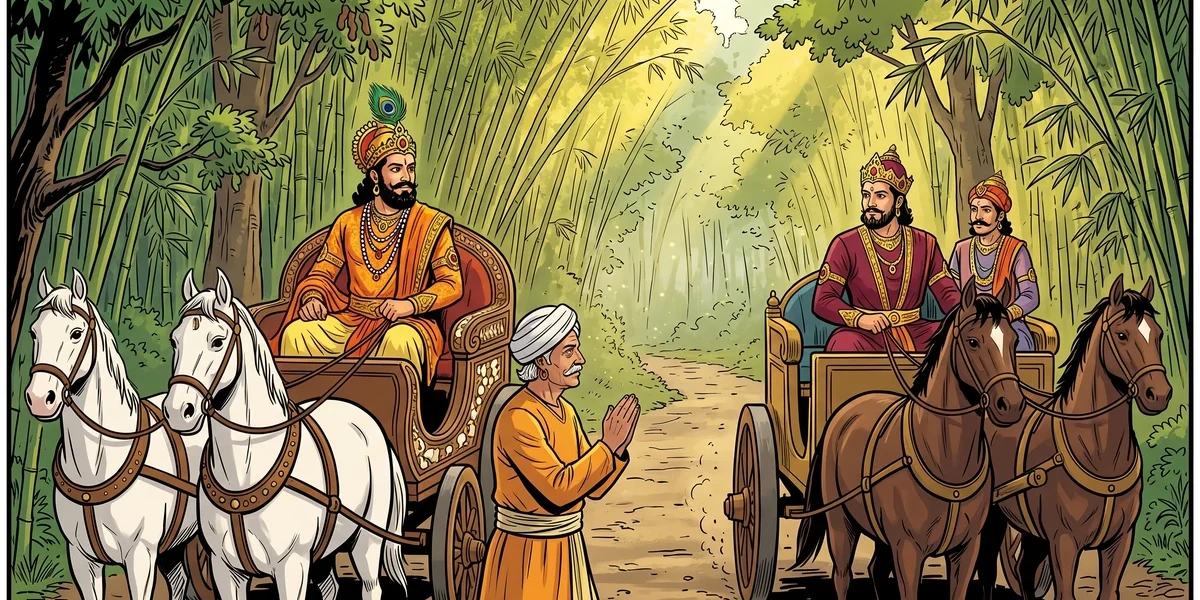
A Lesson for Kings: The Pali Buddhist Birth-Story of Two Monarchs Who Met on a Narrow Road
A Lesson for Kings is the celebrated English title under which the Australian-born folklorist Joseph Jacobs (1854–1916) introduced one of the most morally elegant of the Buddhist Jataka birth-stories to the wider world of nineteenth-century children’s literature. Jacobs included it as Tale XV of his anthology Indian Fairy Tales (David Nutt, London, 1892), illustrated by John D. Batten, and his note (page 247) acknowledges the source with characteristic precision: “From Rhys Davids’s translation of the Buddhist Jatakas, vol. i. p. 211,” the volume being the very first English rendering of the Pali canon’s birth-story collection by the great Pali scholar Thomas William Rhys Davids (1843–1922) of the Royal Asiatic Society, published as Buddhist Birth Stories (Trübner & Co., London, 1880). The story belongs to the canonical Khuddaka-Nikaya of the Theravada Tipitaka and is preserved as the Rajovada-Jataka, “The Birth-Story of the Royal Admonition” — Jataka number 151 in the standard numbering established by V. Fausbøll’s six-volume Pali edition (Trübner, London, 1877–1897). The full text was re-translated under the editorship of Edward Byles Cowell as Volume II of The Jataka, or Stories of the Buddha’s Former Births (Cambridge University Press, 1895), where Robert Chalmers rendered the verses afresh. Pali tradition records that the Buddha himself related the tale at Jetavana Monastery near Savatthi, in the Kosala kingdom of King Pasenadi, and that the Bodhisatta — the future Buddha — was at that birth a charioteer-driver in service to King Brahmadatta of Benares. The story is classified under Aarne-Thompson-Uther type ATU 921C* “The Two Kings on a Narrow Road,” with Stith Thompson motifs J1289.6 (the right of way contest), W11 (kindness), W34 (loyalty), L315 (small bests great), J1170 (clever judgments), and J144 (well-trained charioteer outwits king). The tale’s pedigree is unbroken: it is recited by Pali bhikkhus from Sri Lanka to Burma to Thailand, illustrated in the murals of Wat Suthat in Bangkok, painted in the gilded panels of the Shwedagon in Yangon, and retold in English by Jacobs, Marie L. Shedlock, Ethel Beswick, and the Amar Chitra Katha series.
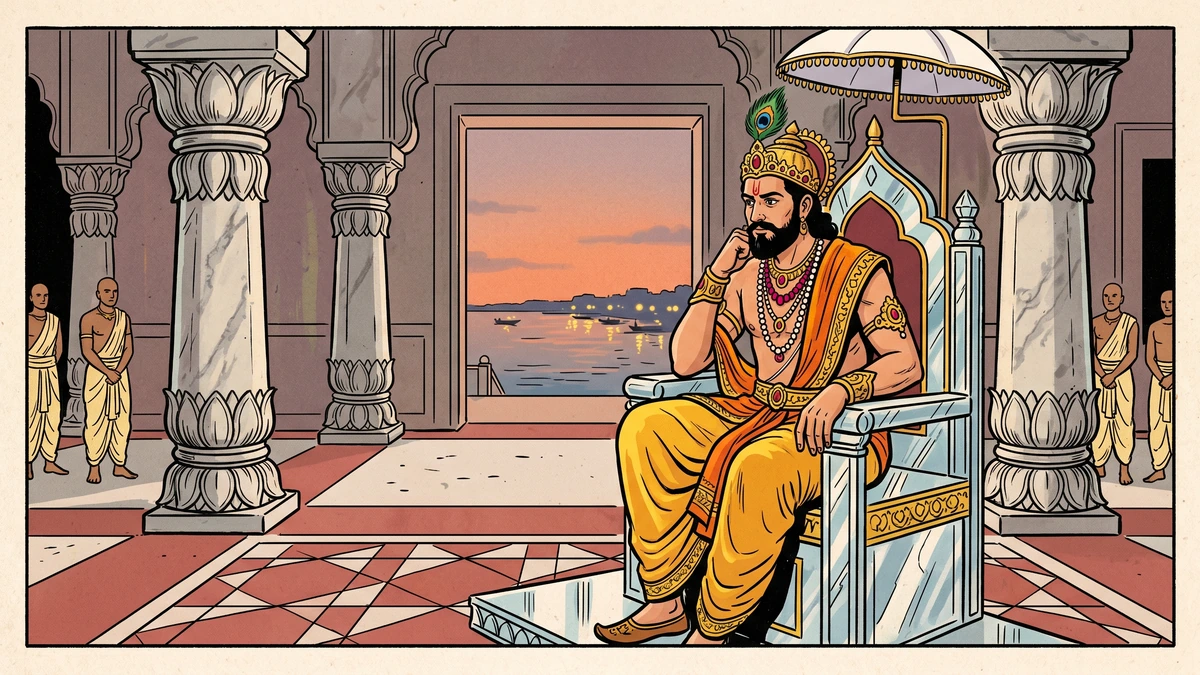
The Setting: Two Capitals in the Sixth-Century BCE Gangetic Plain
The world in which A Lesson for Kings unfolds is the world of the sixteen maha-janapadas, the great realms of the Gangetic plain in the sixth century before the Common Era — the very world in which the historical Buddha, Siddhartha Gautama, walked the dusty roads from Kapilavastu to Rajagriha. Two of those kingdoms stand opposite one another in the tale: the Kosala realm in the north, with its capital at Sravasti (modern Saheth-Maheth, Uttar Pradesh) and ruled in the Buddha’s own day by King Pasenadi of the Iksvaku line; and the Kashi realm, whose capital was Varanasi — called by the Pali sources Baranasi, the holy city of light upon the Ganga — ruled by a dynasty of monarchs who all bore the dynastic title Brahmadatta. The Pali geography between them is the great Trunk Road of the Aryavarta, the ancient highway that crossed forest, savannah, and the rolling laterite uplands of what is now the Bihar-Uttar Pradesh border country. Along that road, the Pali storyteller assures us, the two royal chariots met one bright morning — chariots of teak and rosewood inlaid with ivory and jasper, drawn by milk-white Sindhi stallions, mounted by kings in jeweled diadems and worked-gold breastplates, attended by retinues of armed warriors and umbrella-bearers. The road at the moment of meeting was a narrow defile cut through a brake of bamboo and tamarind, broad enough for one chariot to pass and not for two. And the entire moral weight of the tale — weighed in the Buddha’s scales of dhamma — comes to rest on the question: which king shall give way to the other?
Beat I — A King Sets Out to Test His Own Reputation
Long ago in the Pali tradition, in the great city of Baranasi, there reigned a Bodhisatta-king under the dynastic name Brahmadatta. He was, the storyteller insists, a king of perfect virtue: he ruled with gentleness, he honoured the brahmins and the recluses, he kept the ten royal duties of a raja-dhamma — generosity, virtue, self-sacrifice, honesty, mildness, austerity, freedom from anger, harmlessness, patience, and conformity to the law. He gave alms at the four city-gates, he tested every minister with his own ear at the audience hall, and he went disguised through the city after sunset to listen for the cry of any subject who suffered injustice. One day, sitting upon his crystal throne in the marble hall of the Sandalwood Pavilion, he said to himself: “I have ruled long, and the bards say my name is sweet from the Indus to the Sarayu. But men praise their king to the king’s own face. Let me leave my throne and ride out alone in plain dress; let me journey through the kingdoms; let me hear, with my own ears in the marketplaces and at the wells, what common men say of Brahmadatta of Baranasi when his name is on the wind.” And so he summoned his charioteer — a man named in the Pali commentary as Mata-li, the very name borne in older Sanskrit lore by the charioteer of Indra, king of gods — and ordered the chariot prepared with no banners, no umbrella, no bodyguard, only the two of them. Before sunrise the king and his driver rolled silently out of the southern gate of Baranasi and turned northward upon the great trunk road, and for many days they journeyed, the king listening at every mile-post and water-tank, hearing only praise.
Now in the same hour, in the city of Sravasti far to the north, another monarch had been moved by the same restless thought. King Mallika of Kosala — a king famed in Pali tradition for his own probity and the strict justice of his courts — had also said to himself: “Men praise me to my face. Let me ride forth alone with my charioteer and learn what they say behind my back.” And so the King of Kosala, also disguised, also accompanied by no one but his own driver, set out from the Sravasti gate and turned southward upon that selfsame highway. Two unattended royal chariots, two unsuspected kings, two driving charioteers — the Bodhisatta on the southern chariot, an unnamed but equally skilled driver on the northern — rolled toward each other across the country of the Kosalas and the Kashis. And the road, narrowing at last between the bamboo brakes of the border defile, brought them face to face.
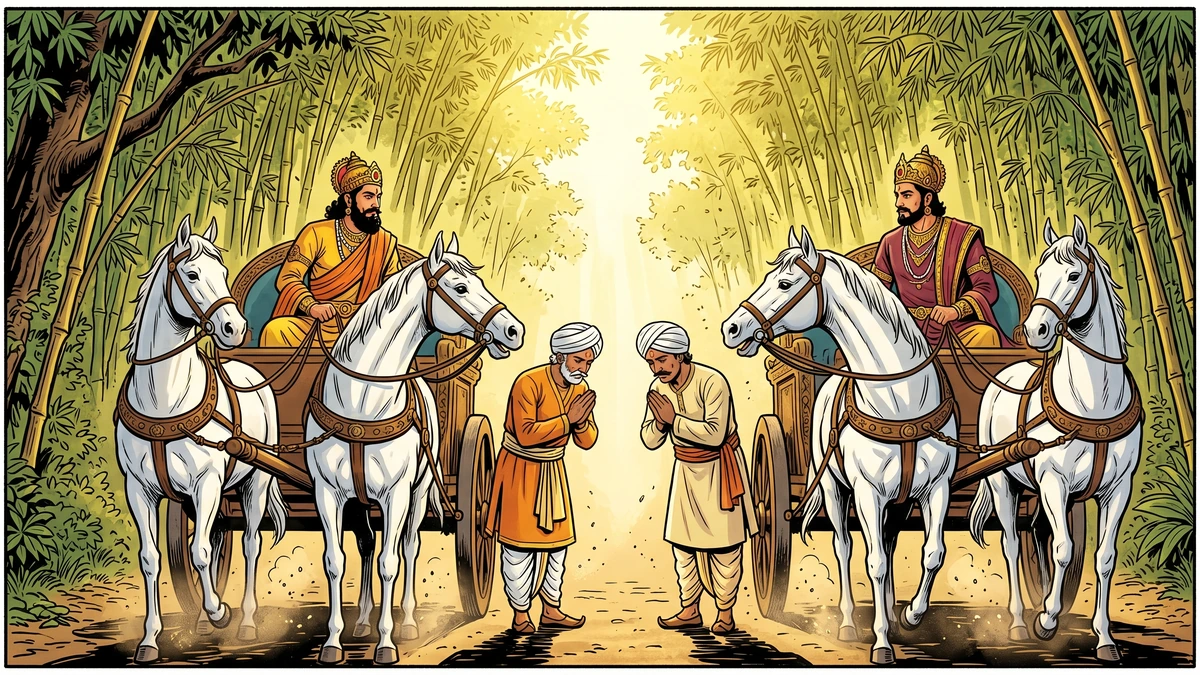
Beat II — The Meeting on the Narrow Road and the Charioteers’ Dispute
The two chariots stopped, axle to axle, in the narrow place. There was room only for one to pass. The dust settled. The two stallion-teams stood snorting, eye to eye. The two charioteers descended — for the kings, in their disguise, sat motionless and let their drivers speak first — and bowed, each to the other, and the senior of the two (which was Mata-li the Bodhisatta, the Baranasi-driver) said politely: “Friend, draw aside thy chariot. Mine bears a king.” The Kosala-driver smiled gravely and replied: “Friend, draw thou aside. Mine also bears a king.” They stared at each other in the morning light. Then the Bodhisatta, perceiving the difficulty, said: “Two kings, both equal in lineage, both equal in territory, both equal in armies and treasury. Plainly we cannot judge by these. Let us therefore judge by the virtues of the king inside — let the elder in dhamma have the road, and let the lesser yield. Therefore, friend, sing me the praises of thy king; I will sing the praises of mine; and the road shall be his whose virtues are higher.” To which the Kosala-driver agreed, and stepped forward to begin.
The Kosala-driver lifted his hand and chanted in anuṣtubh verse the praises of King Mallika of Kosala, in words preserved in the Pali couplet which Rhys Davids translates thus: “Strong overcomes the weak, our Mallika; the soft he wins by softness too. The bad he overcomes by good; the stingy by his bounty’s flow. The liar he by truth o’erthrows. So is our Mallika.” The Pali original, preserved in Fausbøll’s edition Vol. II at page 4, runs: balaṃ balena so hanti, mudunā hanti maddavaṃ; sādhuṃ sādhunā jināti, asādhuṃ asādhunā jine; etādiso ayaṃ rājā Mallikaṃ maggaṃ dehi re — “The strong he beats by force, the soft by gentleness; the good he wins by goodness, the bad he beats by badness in turn; such a king is our Mallika — yield up the road!” The Kosala-driver folded his hands proudly when the verse was done, certain that no king in Jambudvipa could be praised more highly. But the Bodhisatta-driver smiled and said quietly, “Friend, are these then all the virtues of thy king? Are these his greatest? For if these are his highest praises, my king has greater. Hear thou now the praises of Brahmadatta of Baranasi.”
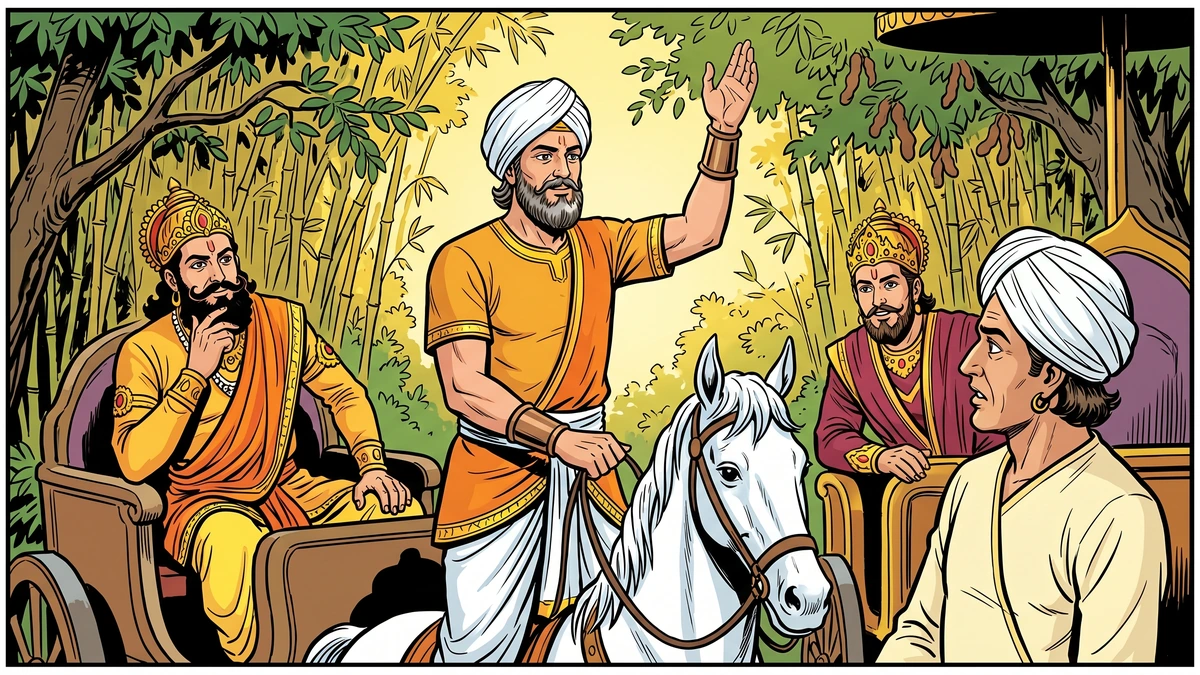
Beat III — The Bodhisatta’s Verses and the Higher Path
The Bodhisatta lifted his hand and chanted, also in the four-foot anushtubh measure, the verses preserved in the Pali Jataka and rendered into English by Rhys Davids in 1880 and re-rendered by Robert Chalmers in 1895 in this form: “Anger he conquers by calmness, and by the good he conquers the bad; the stingy he conquers by giving, and by the truth the liar of words. So is our Brahmadatta.” The Pali couplet of the Rajovada-Jataka, in the original verse-form, runs: akkodhena jine kodhaṃ, asādhuṃ sādhunā jine; jine kadariyaṃ dānena, saccen’ ālīkavādinaṃ — etādiso ayaṃ rājā Brahmadatto maggaṃ dehi re — “Anger let him overcome with non-anger; the bad let him overcome with the good; let him overcome the stingy by giving, and the liar by truth — such is our king Brahmadatta — yield up the road!” This verse is among the most famous in the Pali canon. It is recited not only in the Rajovada-Jataka but appears almost word-for-word as verse 223 of the Dhammapada, in the chapter Kodhavagga: akkodhena jine kodhaṃ, asādhuṃ sādhunā jine; jine kadariyaṃ dānena, saccena alika-vādinaṃ — the Buddha’s own teaching on how one ought to overcome the four perennial evils of the householder’s life. The two verses thus echo the dharma itself; the Bodhisatta’s chariot-driver, by reciting them at the narrow road, is in effect quoting the Buddha-to-be’s own future doctrine across the divide of one of his earlier births.
The Kosala-driver heard the verses. He looked at his own king sitting silent in the disguised chariot. He looked at the Bodhisatta-driver. And he understood at once what had happened: his king’s principles — though noble — were the principles of a worldly justice that returned like for like (force for force, softness for softness, evil for evil); but the Baranasi-king’s principles were the principles of dhamma itself, in which evil is overcome by good and like is not returned for like. Without a word, the Kosala-driver stepped down, took the bridle of his stallions, and led his chariot off the road into the bamboo, leaving the highway open for the Baranasi king to pass. Then King Mallika, having heard everything from inside the disguised chariot, stepped down also, came forward, and bowed to the unknown stranger in the other chariot. “Friend,” said Mallika, “tell me — who is the king behind those curtains, and what is his name and his city?” The Bodhisatta replied: “Sire, this is King Brahmadatta of Baranasi, who has ridden forth to learn what men say of him.” And Mallika bowed again, and said: “I too am a king; I am Mallika of Kosala; I too rode forth this morning on the same errand. I have heard the verse of dhamma from your driver’s lips, and I have given way before its higher truth. Henceforth let there be no enmity between Baranasi and Sravasti.”
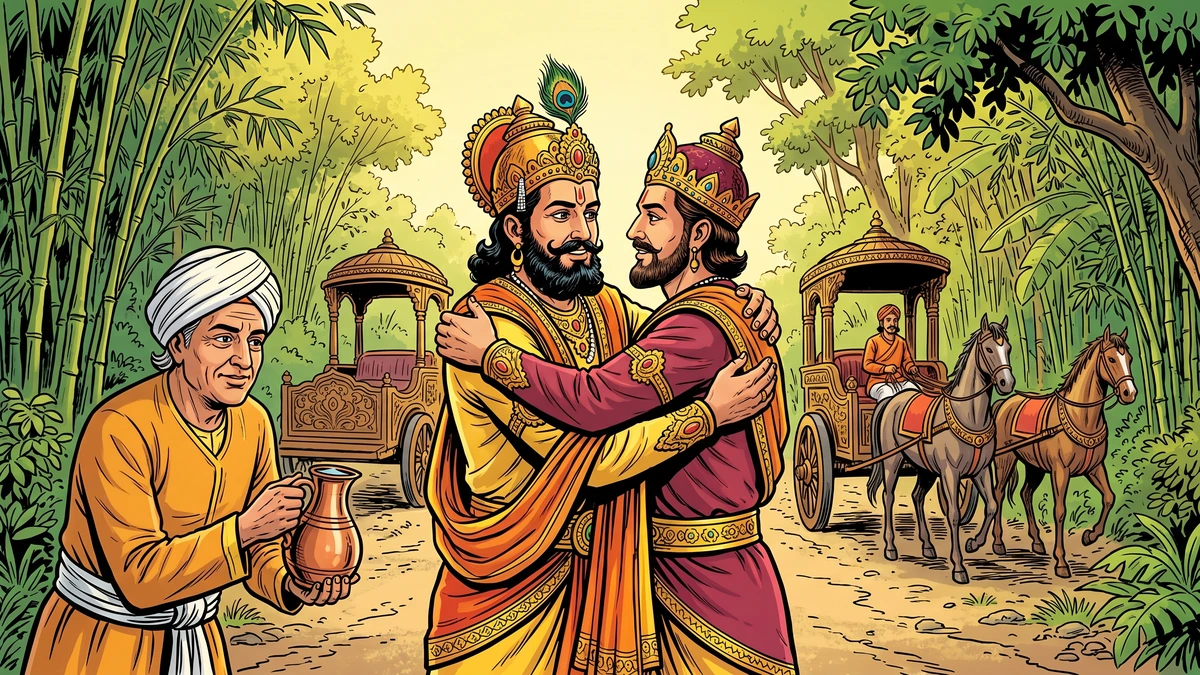
Beat IV — The Kings Embrace and the Bodhisatta’s Counsel
King Brahmadatta drew aside the curtain of his chariot, descended, and embraced King Mallika in the dust of the highway, in full view of both charioteers and of the morning sun rising over the bamboo brake. The two monarchs sat down together by the wayside, and the Bodhisatta-charioteer poured out cool water from his copper flask for both kings to drink. They spoke long and gravely — of the duties of a king, of the heavy weight of the white parasol, of the difficulty of governing without anger, of the rarity of true counsel, and of the wisdom of testing one’s own reputation in disguise. King Brahmadatta said to King Mallika: “Brother, return with me as my guest to Baranasi for the rains-retreat. We shall hear the dhamma together at the foot of the great bodhi-tree near my palace, and we shall send our two charioteers to learn the verses of the dhammapada side by side.” King Mallika consented, and the two royal chariots, one behind the other now, rolled together south towards Baranasi. The two charioteers walked at the head of the horses talking of the verses they had exchanged in the defile, and thereafter, the Pali commentary tells us, there was peace between Baranasi and Sravasti for the rest of the lifetimes of those two kings, and no soldier of either kingdom ever again drew sword against a soldier of the other. So ended the meeting on the narrow road.
The Buddha, having related this story at Jetavana to a quarrelsome monk who had spoken harshly to a brother-monk, identified the births: “The Mallika of that day is now Ananda; the unnamed Kosala-driver is now Moggallana; the Baranasi-king Brahmadatta is now Sariputta; and the Bodhisatta-charioteer who chanted the verses of non-anger was I myself.” The Pali frame-story, called the paccuppanna-vatthu (the “present-day account”), is a regular feature of every Jataka: each birth-story is occasioned by some quarrel or perplexity in the Sangha, which the Buddha resolves by recalling a previous lifetime in which the same souls played similar parts. In A Lesson for Kings, the present quarrel is some petty dispute between two monks over precedence at the alms-round, and the Buddha’s tale of the two kings on the narrow road is offered as a mirror in which the two monks may see themselves: the world’s most powerful kings yielded to each other in dhamma; how can two ordained renunciants quarrel over a step in the alms-line?
Moral: Akkodhena Jine Kodham — Anger Conquered by Non-Anger
The moral of A Lesson for Kings is the very heart of the Buddha’s social teaching, given in a single Pali verse so important that it appears both in the Rajovada-Jataka and at Dhammapada 223 in the Kodhavagga (the “Chapter on Anger”). It is the doctrine of akkodha — non-anger — as the spiritual conqueror of kodha, anger; of danna, generosity, as the conqueror of kadariya, miserliness; of sacca, truth, as the conqueror of alika-vada, false speech; and of sadhu, the good, as the conqueror of asadhu, the bad. The verse, in its original Pali, runs:
अक्कोधेन जिने कोधं असाधुं साधुना जिने
जिने कदरियं दानेन सच्चेन अलिकवादिनं ।
akkodhena jine kodhaṃ, asādhuṃ sādhunā jine;
jine kadariyaṃ dānena, saccena alikavādinaṃ.
“Conquer anger with non-anger, conquer evil with good;
conquer the miser with giving, the liar with truth.”
— Dhammapada 223 (Kodhavagga); Rajovada-Jataka 151, Pali Khuddaka-Nikaya, c. fifth-third century BCE
The doctrine is not a counsel of weakness but a counsel of higher strength. To meet anger with anger is to lose the contest before it has begun, for one has already become like one’s adversary; to meet anger with calm, the Buddha says, is to remain master of oneself and to give the adversary nothing to push against. The Pali word jine — from the root ji, to conquer — is the same root that gives the Sanskrit jaya and the Jain epithet jina; it carries the imagery of military victory. The Buddha is therefore not asking the king to surrender the field but to win it by a higher means. And in the tale itself, that is precisely what King Brahmadatta does: he wins the road not by force of arms but by force of dhamma, and the king who yields is not weakened but ennobled by his yielding. The lesson for kings — from which Joseph Jacobs’s English title takes its dignity — is that the highest sovereignty is not the sovereignty of the parasol over the people, but the sovereignty of the four virtues over the four passions in one’s own breast. A king who can rule himself by non-anger, generosity, truth, and goodness can rule any kingdom; a king who cannot, will lose all kingdoms in the end.
Why The Tale Has Lasted
For over two thousand four hundred years, the Rajovada-Jataka — A Lesson for Kings — has been recited in the assembly halls of Theravada monasteries from Anuradhapura to Pagan to Ayutthaya to Luang Prabang, painted on the walls of viharas in jewel-bright vegetable colors, sculpted in the medallions of the Bharhut and Sanchi stupas (second century BCE), inscribed in the Pali on palm-leaf manuscripts of the Burmese kingdoms, and translated into Sinhala, Burmese, Mon, Khmer, Thai, Lao, Chinese (in the Ι-tsing recension), Tibetan, and at last, by Rhys Davids in 1880, into English. Its endurance comes from the geometric perfection of its premise: two equal kings, two equal chariots, one narrow road, one verse to decide. The premise leaves no place for power-politics, for genealogy, for force-of-arms, or even for the customary calculations of artha-shastra. It admits only one criterion — the ethical sovereignty of the king inside the chariot — and it expresses that criterion in a verse of such metrical perfection and moral weight that the Buddha himself put it twice in the canon. Joseph Jacobs in 1892 understood this when he gave the tale a title at once dignified and humble — A Lesson for Kings — for it is indeed a lesson, and it is indeed for kings, and it is also, by extension, a lesson for any soul who finds himself face to face on the narrow road of life with another equally proud and equally just. The instruction is the same: akkodhena jine kodham. Conquer anger with non-anger; conquer the world with the dhamma. To read this story is to step for one morning onto the dusty highway between Baranasi and Sravasti; to listen to it is to hear the Buddha quoting himself across the centuries; and to understand it is to know why, when two chariots meet on a narrow road, the only victory worth winning is the victory that the loser cannot help but call his own.
You May Also Like
 Indian Folk Tales
Older Kids / Teens / Adults
Indian Folk Tales
Older Kids / Teens / Adults
Good Will Grow Out Of Good: Tamil Folk Tale of the Lime & the Blessing
Southern Indian folk tale — Brāhmin Pāpabhīru’s daily yellow lime, the Tamil blessing “if good is sown, good will grow,” and how sown good and sown evil return. Full story + FAQ.
 Indian Folk Tales
Ages 3-5
Indian Folk Tales
Ages 3-5
The Snake Woman And King Ali Mardan
The Snake Woman And King Ali Mardan: Once upon a time King Ali Mardan went out a-hunting, and as he hunted in the forest above the beautiful Dal lake, which
 Indian Folk Tales
All Ages
Indian Folk Tales
All Ages
The Brahmi ‘s Girl That Married A Tiger
The Brahmi 's Girl That Married A Tiger: In a small village nestled between the rolling hills of Tamil Nadu, there lived a learned Brahmin who had a beautiful