Pride Goeth Before A Fall
Pride Goeth Before A Fall: In a certain village there lived ten cloth merchants, who always went about together. Once upon a time they had travelled far

Pride Goeth Before a Fall — Panchatantra, Book III: Kākolūkīyam
This tale comes from the third book of the Panchatantra, the ancient Indian compendium of nītiśāstra (statecraft and worldly wisdom) compiled by the scholar Vishnu Sharma around 300 BCE. Book III, Kākolūkīyam — “Of Crows and Owls” — is principally concerned with the dynamics of pride, rivalry, and the strategic blindness that arrogance produces. The phrase “pride goeth before a fall,” most familiar to Western readers from the Hebrew Book of Proverbs (16:18), states in one line what the Panchatantra explores in carefully observed narrative: pride is not merely a moral failing but a strategic one, because it prevents the proud from perceiving changes in the conditions upon which their success depends.
The Story
Beat I — The Master of the River
In a great forest there lived a heron who had, across many seasons, established himself as the undisputed master of a long stretch of river. He was large, patient, and precise — a hunter of extraordinary skill who had never gone hungry through drought or flood, who had seen rivals come and fail, and who had accumulated enough success to begin believing that the success was entirely his own doing and entirely permanent.
This belief — that past achievement reliably guarantees future achievement, that methods which worked yesterday will work identically tomorrow, and that the conditions which produced success are stable — is precisely what the Panchatantra identifies as the specific texture of dangerous pride. The heron was not wrong about his skills. He was profoundly wrong about their relationship to circumstances he was not controlling.
Beat II — The Drought
A severe drought came to the forest. The river shrank steadily. Fish retreated to deeper pools the heron had never needed to visit. He stood at his usual spot — the broad, slow bend where he had always fished — and waited with the patience that had always produced results. It produced nothing. He moved slightly upstream and waited again. Still nothing.
The accumulated authority of past success told him the problem was temporary. His usual methods, applied in his usual places, would eventually yield his usual results. This conviction kept him motionless in increasingly empty water while more adaptable birds moved to find the fish where the fish had actually gone.
Beat III — The Kingfisher’s Counsel
A small kingfisher — recently arrived, less accomplished, carrying none of the heron’s authority — had spent the morning ranging widely across unfamiliar stretches of river. She found the fish: concentrated in a deep pool fed by an underground spring, just past a bend the heron had checked years ago and dismissed as too shallow.
She offered this information to the heron carefully, aware of the difference in their standing. The heron received it with the particular displeasure of an expert receiving intelligence from a less established practitioner. He knew this river. He had fished it through a dozen seasons. The pool downstream was shallow in summer and exhausted in winter — he had checked it years ago and moved on. He thanked the kingfisher with formal politeness and returned to his usual spot.
He was wrong. The drought had transformed the pool. What had been shallow was now the deepest available water in the area, fed by an underground spring whose existence the heron had never discovered because he had never needed to investigate it carefully. The fish were there in abundance. The kingfisher ate well. The heron stood in empty water, held there by the accumulated weight of his own past knowledge — accurate about a river that no longer existed in quite its old form.
Beat IV — The Panchatantra’s Analysis
The Panchatantra’s treatment of pride is always structural rather than moral. The heron is not condemned as a character flaw but shown to be making a specific cognitive error: treating past successful models as authoritative for present conditions without verifying that present conditions match those in which the model was developed. This error is especially seductive in those whose past success has been genuine — because genuine success provides real evidence that a model works, making it harder to question the model when conditions shift.
The Arthashastra of Kautilya addresses this danger in the context of military strategy: a general who has won several engagements with a particular formation may continue deploying it after conditions have changed sufficiently to make it vulnerable. His confidence is not irrational given his history — but it becomes a liability the moment it prevents him from assessing whether the formation remains appropriate. Kautilya prescribes that every strategic situation be evaluated freshly, as if no precedent applied — not because precedent is valueless, but because unexamined precedent blinds.
The heron’s pride prevented the fresh assessment. He knew the downstream pool was inadequate — but he knew it based on what the pool had been, not what drought had made it. The knowledge was real. The knowledge was obsolete. Pride made it impossible to distinguish between the two.
Beat V — What Falls When Pride Falls
The Panchatantra does not require dramatic catastrophe to make its point. The heron’s story ends not in death but in prolonged hunger and the slow erosion of his position as the drought wears on. What falls is not the heron himself but his certainty — and with it, the comfortable myth that past achievement creates future security.
This is a subtler and more instructive ending than destruction: the heron must eventually follow the kingfisher’s advice, must investigate the pool he dismissed, and must discover that the smaller, less established bird perceived something real that pride had made invisible to him. The lesson the Panchatantra draws for its royal students is not “do not be proud of your achievements.” It is: hold the models produced by past success loosely enough to test them against present conditions.
“The surest sign that past success will produce future failure is the certainty that past success has made the question unnecessary.”
— Panchatantra principle, Book III: Kākolūkīyam
Why This Story Has Lasted 2,300 Years
“Pride Goeth Before a Fall” endures across traditions — from the Panchatantra through the Hebrew wisdom literature through every subsequent culture that has valued the examined life — because the failure mode it describes is structural, not cultural. Every era produces those who have succeeded through genuine competence and then allowed that success to insulate them from evidence that circumstances have changed.
The river is always shifting. The fish are always somewhere new. The question is whether accumulated certainty keeps you in the old spot, or whether you can follow the kingfisher to the pool you had written off.
About the Panchatantra
The Panchatantra (“Five Treatises”) was composed by Vishnu Sharma circa 300 BCE as a comprehensive manual of nītiśāstra — statecraft, ethics, and practical wisdom — expressed through interlocking animal fables. Book III, Kākolūkīyam (“Of Crows and Owls”), examines the dynamics of rivalry, pride, and the self-destruction that follows when arrogance overrides situational assessment. Translated into Pahlavi in the 6th century CE and subsequently into Arabic (Kalila wa-Dimna), Hebrew, Latin, and all major European languages, the Panchatantra became one of the most widely read books of the pre-modern world and continues in active global circulation today.
Frequently Asked Questions
**Q: Why is this story important?**
You May Also Like
 Panchatantra Stories
Ages 6-8
Panchatantra Stories
Ages 6-8
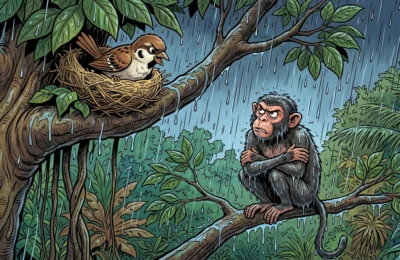
The Story of the Sparrow and the Monkey
The Story of the Sparrow and the Monkey: Somewhere in the jungle; there grew a Shami tree. On its long branches, a pair of sparrows had made theirhorpe. The
 Panchatantra Stories
Ages 6-8
Panchatantra Stories
Ages 6-8
The Brahmin and the Crooks
The Brahmin and the Crooks: Untruth spoken repeatedly appears to be truth.” In a small village, there lived a Brahmin, by the name of Mitra Sharma. He was a
 Panchatantra Stories
Ages 3-5
Panchatantra Stories
Ages 3-5
The Foolish Crane and The Mongoose
The Foolish Crane and The Mongoose: A big banyan tree was home to a number of cranes in a forest. In the hollow of that tree lived a cobra, which used to feed