The Royal Thief-Catcher
The Royal Thief-Catcher: In a bustling town in ancient India, A king appointed a clever man to catch thieves, but the methods were unconventional. This tale
The Royal Thief-Catcher is a Sanskrit niti-katha (instructive tale) preserved in Hindu Tales from the Sanskrit, translated by S. M. Mitra and edited by Nancy Bell (London: Macmillan and Co., 1919). Set in the ancient city of Sravasti — capital of the Kosala kingdom and one of the great centres of the historical Buddha’s ministry — it tells how King Prasenajit (Pali: Pasenadi, c. 6th–5th century BCE) recovered a Brahman’s stolen treasure not by sending soldiers door to door, but by reasoning his way to the thief through a single medicinal plant. The motif belongs to the wider Sanskrit detective-tale tradition associated with the Kathasaritsagara of Somadeva (c. 1070 CE) and the Hitopadesa, and clusters with international tale-types ATU 950 (“Rhampsinitus”) and ATU 926 (“Judgement of Solomon”) — folktale frames where intellect, not force, exposes the wrongdoer.
The Pious Brahman of Sravasti
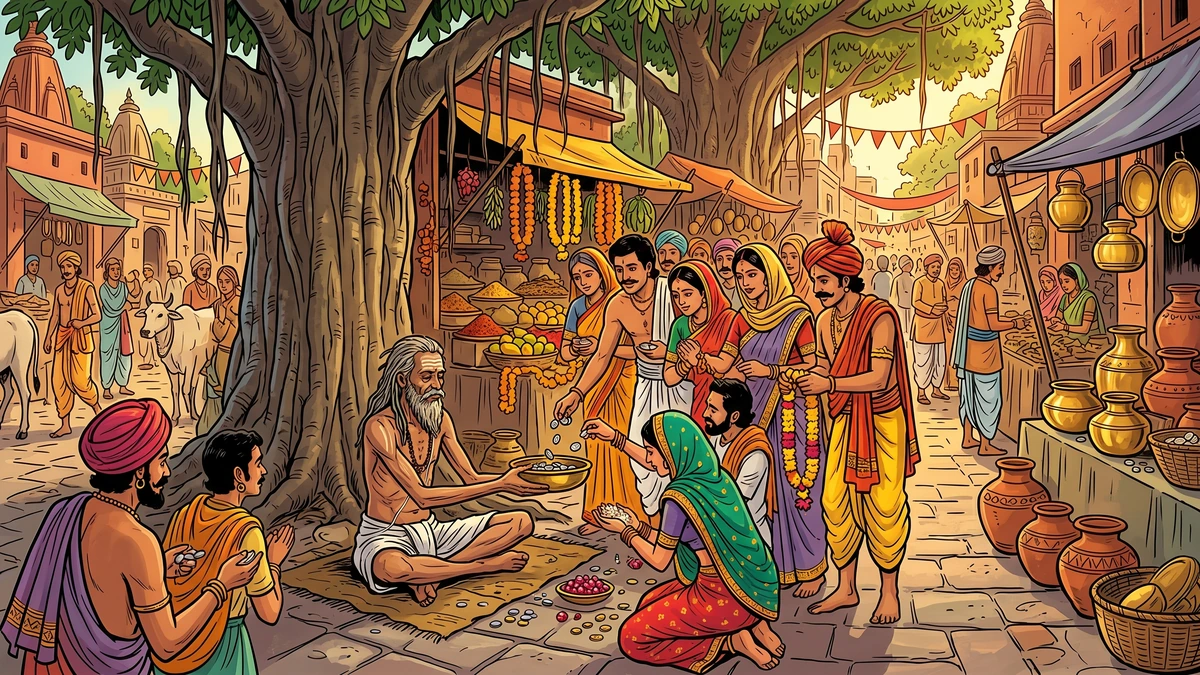
On a blistering afternoon in the smaller Kosalan town of Sravasti, the people gathered to look at a stranger making his slow way along the dusty street. He was a Brahman — a man who, by tradition, had renounced comfort, wealth and good food to devote his life to prayer. His feet were sore from many leagues of walking; his only possessions were a wooden staff and an alms-bowl. He was naked but for a loincloth, and his long uncombed hair was matted in the manner of a wandering ascetic.
The Brahman sank down at a shady corner of the bazaar and held out his bowl. The people of Sravasti were generous: they brought him rice still in the husk, pure water, silver coins, gold pieces, and even jewels of those who had no ready cash. The Brahman accepted everything, refusing only cooked food and impure drink. As days became months his fame spread far beyond the city walls. People travelled from distant villages to consult him on dharma, on family quarrels, on illness and harvest, and they paid him handsomely for his counsel. He was, the citizens told one another, a holy man — and the proof of his holiness was that he never seemed to spend a single coin upon himself.
The truth, however, was more complicated. The Brahman’s outward austerity concealed a private appetite that grew sharper with every donation. He had begun, almost without noticing, to love the money for its own sake. He loved the weight of the gold, the colour of the rubies, the cool slip of silver between his fingers. The people of Sravasti did not know it, but their saint was becoming a miser.
The Hidden Hoard at the Root of the Tree
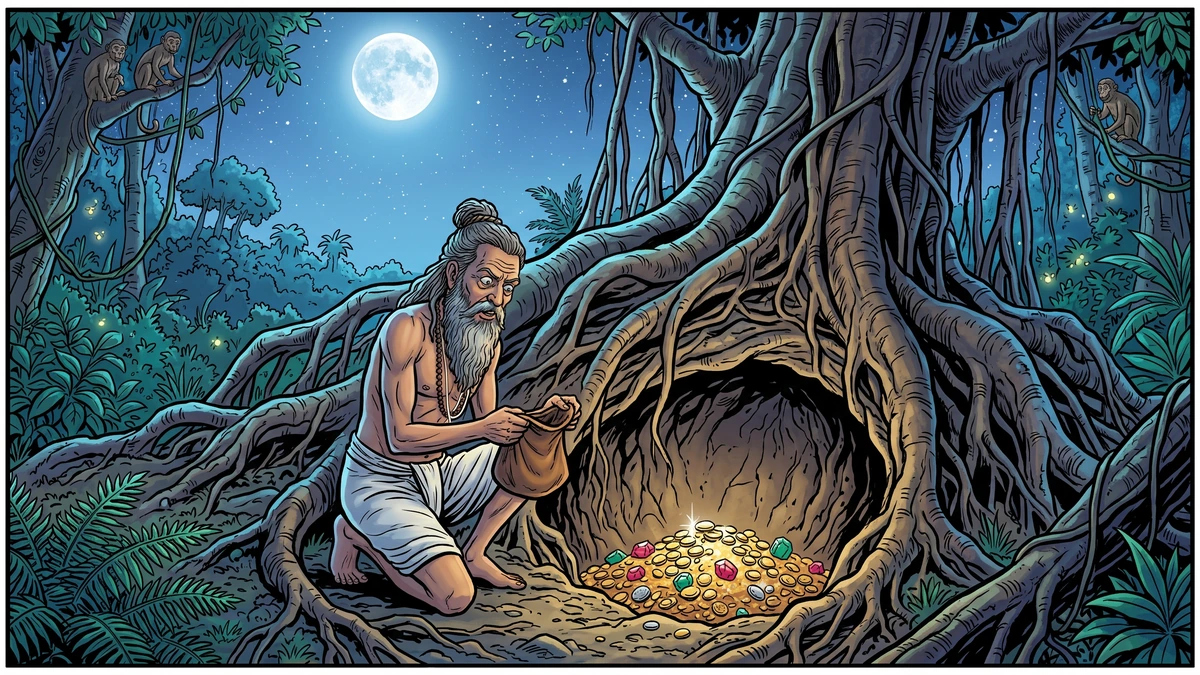
Each night, when the lamps of Sravasti had been put out and his hosts were asleep, the Brahman would slip away into the forest beyond the city. There, at the root of a great tree he had marked for himself, he had dug a deep hiding-hole. Into it he poured every coin and every jewel he received. He covered the hole with earth, then with leaves, then with broken twigs, until even he, returning by daylight, had to look twice to find the spot.
Indians of every station observe a midday rest during the hot months — a siesta when the streets empty and only the prowling dogs are abroad. The Brahman, who needed sleep as much as anyone else, found the lure of his treasure stronger than the lure of rest. Day after day he stole away through the silent streets, into the forest, knelt by his tree, and let his fingers drift through the coins. He held the gemstones up against the falling sunlight to watch them glow; he counted his rupees twice, three times, four times. Then he buried the hoard again, smoothed the earth, scattered the leaves, and walked back to his shady corner of the bazaar in time to lift his alms-bowl as though nothing had happened. Nobody in Sravasti suspected. He kept his face calm, his bowl out, his hair matted; in every visible particular he was the holy man they thought him to be.
For many months the Brahman lived this double life. The hoard grew. The secret hole at the root of the tree filled to the brim. And the day arrived when his luck, like all hidden things, would be brought into the light.
The Theft, the Despair, and the Vow to Die
It happened on an ordinary afternoon. The Brahman, having walked the familiar path, knelt at his tree and brushed the leaves aside. His fingers, expecting cool gold, found only loose earth. The hole was empty. He could not at first believe it. He felt round its sides, stuck his arm in deeper, scrabbled at the bottom — and at last understood that someone, some unknown hand, had been there before him.
The Brahman wept. He tore at his matted hair. He stamped about between the trees. He cried aloud to every god he had ever invoked, promising offerings, vigils, fasts, anything, if only his treasure would be returned. No god answered. The forest stood quiet around him, and the truth pressed in: the people of Sravasti, who had given him so much, must have stolen the rest. He hated them now with the same intensity with which, an hour earlier, he had loved their gold.
He stumbled back into the city and poured out his grief upon the merchant family who had given him a room. Their kindness only inflamed him. They tried to comfort him; they pointed out, gently, that a man who had hidden his wealth at the root of a forest tree had no business calling himself a renunciate. The Brahman would not hear them. At last he announced — half in rage, half in calculated drama — that he would walk to a holy bathing-place on the river and there starve himself to death.
The threat of a holy man’s suicide was a serious matter in ancient Kosala. The merchants pleaded with him. Word raced through the bazaar, and soon every leading citizen of Sravasti had come to entreat him to wait. They promised to find his treasure for him; they begged him not to bring the curse of his death upon their town. The Brahman, half-listening, set out anyway, marching steadily down the road that led toward the river. The crowd that followed him thinned by the mile. Then, when he was almost alone on the dusty highway, he found his path blocked by a tall and dignified figure surrounded by attendants. It was the king himself.
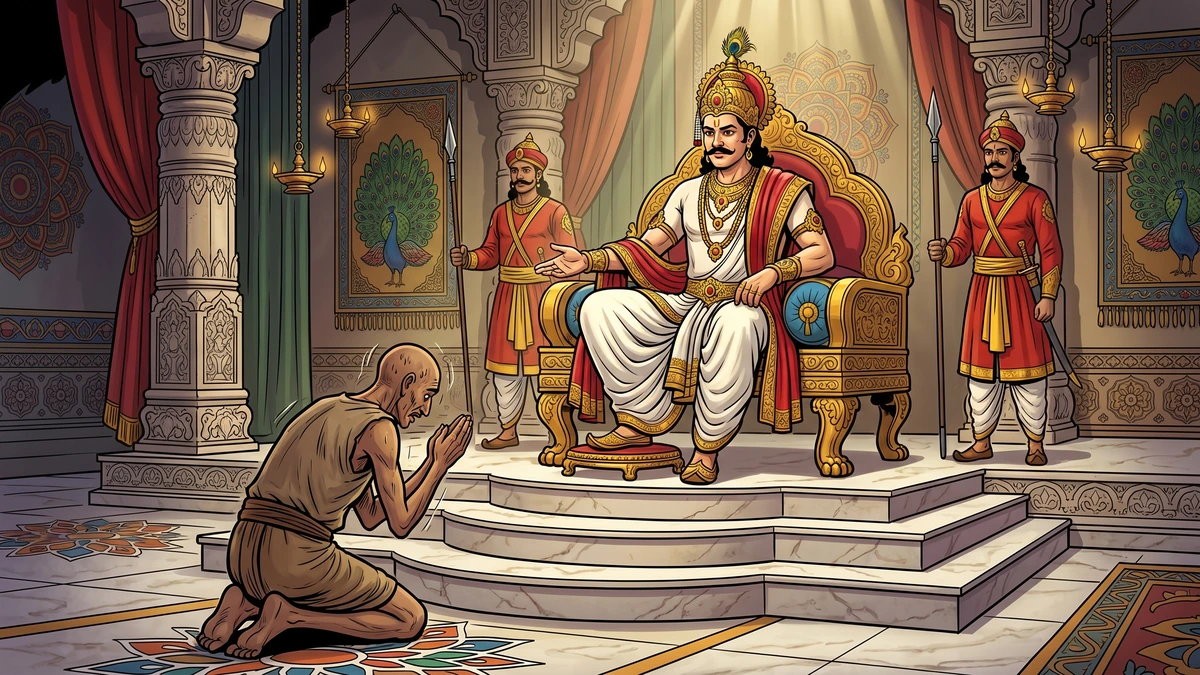
King Prasenajit and the Test of the Nagabala Plant
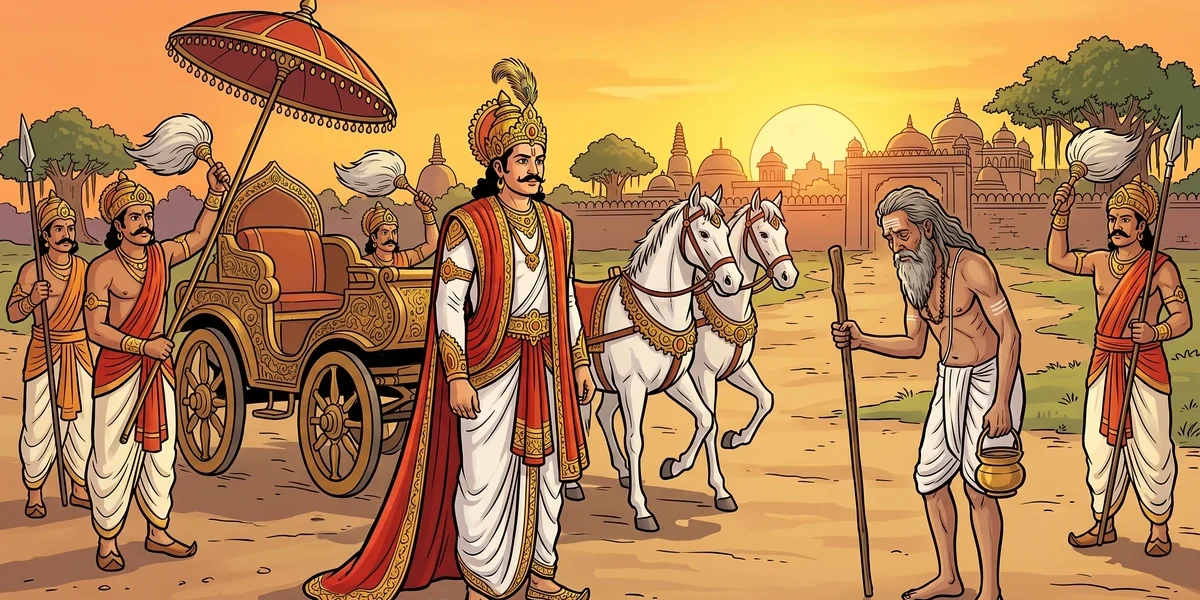
King Prasenajit (Sanskrit Prasenajit; Pali Pasenadi) was no ordinary monarch. The chronicles of early India remember him as a contemporary of the Buddha and Mahavira, ruler of the great northern kingdom of Kosala, a man as celebrated for his curiosity about ethics as for his armies. He had heard of the Brahman’s loss; he had heard of the threat of self-starvation; and he had ridden out himself to settle the matter. He stopped his chariot squarely in the road and addressed the Brahman with patience and authority. “Do not grieve any longer,” he said. “I will find your treasure for you. If I cannot, I will pay you its full worth from my own treasury. Now show me the place.”
The Brahman, who had been ready to die a moment earlier, found himself suddenly compliant. He led the king to the great tree, pointed to the empty hole, described the location, the depth, the path leading to it. The king studied everything in silence. He noted exactly where the tree stood in relation to the city wall, and which roads any thief on foot would have used to reach it. Then he sent the Brahman home and rode back to the palace.
Once inside his chambers, Prasenajit announced that he had been taken suddenly ill. A proclamation went out: every doctor in Sravasti was to attend the king at once. They came, jostling and scowling at one another in the great reception room, each hoping to be the one called in. The attendants ushered them through one by one; but Prasenajit asked nothing about his own headache. Instead he asked each healer for the names of his current patients and the medicines he was prescribing. The doctors obliged, baffled but obedient, and one by one they were dismissed.
At last a famous physician was admitted who told the king that the merchant Matri-Datta was very ill and that he had prescribed the juice of the nagabala plant. Now nagabala — literally “serpent-strength,” identified in classical Ayurveda as Sida cordifolia, the country-mallow — grows only in particular forest tracts. The Brahman’s tree happened to stand in such a tract. The plant required a person to walk into that very forest to gather it. The instant the king heard the name nagabala, he dismissed every other doctor and sent for Matri-Datta.
The merchant arrived shaking. The king greeted him kindly, apologised for the inconvenience of being called from his sickbed, and then asked one quiet question: “When your physician ordered you to take the juice of the nagabala, whom did you send to find it?” Matri-Datta, in confusion, named his servant. The king dispatched the merchant home and sent for the servant. The man came with terrified reluctance and threw himself at the foot of the throne, crying, “Mercy! mercy!” He had not yet been accused of anything. The king let him lie there a long minute, then asked: “Where are the gold and the jewels you took from the hole in the roots of the tree, when you went into the forest to find the nagabala plant for your master?” The servant could not answer; his guilt was already complete.
What Prasenajit did next is the heart of the tale. He ordered no execution, no flogging, no public humiliation. He told the servant simply to fetch the treasure and bring it back. The man hurried into the forest unwatched — Prasenajit sent no guards — and returned at evening, dragging the heavy sack alone. The king received it without anger and said only, “Go back to your home now, and be a thief no more.” The man, expecting death, walked out free; and the chronicle records that he never stole again, but spoke for the rest of his life of the king who had pardoned him. The Brahman received his treasure back with a sterner blessing: “Take it,” said Prasenajit, “and make a better use of it than before. If you lose it again, I shall not seek it for you.”
Historical & Cultural Context
King Prasenajit of Kosala is one of the best-attested rulers of pre-Mauryan northern India. He is named in the Pali Canon (where he is called Pasenadi and engages the Buddha in long ethical dialogues, especially in the Samyutta Nikaya), in Jain Agamas, in the Sanskrit dramas of Bhasa, and in the Mahavastu of the Mahasanghikas. His capital, Sravasti (modern Sahet-Mahet, in Uttar Pradesh), was one of the six great cities of the Buddha’s era and the site of the famous Jetavana monastery. The historical Prasenajit was reputed for unusual personal access to his subjects — exactly the quality this story dramatises in his decision to ride out alone and meet a weeping Brahman on a country road.
The plant at the centre of the story, nagabala (नागबला, “serpent-strength”), is identified in classical Ayurveda as Sida cordifolia Linn., the country-mallow or bala plant family. The Caraka Samhita and Susruta Samhita classify it as a balya (strength-giving) and rasayana (rejuvenative) drug, used for chronic weakness, fevers, and convalescence. Crucially for the plot, nagabala grows wild in particular forest tracts and was traditionally gathered fresh by a household servant rather than sold pre-packaged — exactly the arrangement that makes the trap of the story possible.
The tale itself belongs to a recognisable Sanskrit sub-genre: the nyayadrishti-katha, or “case of judicial sight,” in which a ruler reasons his way to truth from a single physical clue. Cousins of Prasenajit’s logic appear throughout the Kathasaritsagara (Somadeva, c. 1070 CE), in tales of the cycle of King Vikramaditya, and in the Persian Tutinamah. Scholars compare the type to ATU 950 (“Rhampsinitus and the Master Thief,” recorded by Herodotus from Egypt) and to the Solomonic judgement-tales (ATU 926). The Indian inflection is distinctive in its ethical resolution: the thief is not killed but reformed, and the victim is corrected for his own moral failing — a doubled justice that European master-thief tales rarely attempt.
Moral
The Sanskrit moral tradition would summarise this tale in a single famous line of the Manusmriti:
धर्म एव हतो हन्ति धर्मो रक्षति रक्षितः।
तस्माद्धर्मो न हन्तव्यो मा नो धर्मो हतोऽवधीत्॥
dharma eva hato hanti dharmo rakshati rakshitah;
tasmad dharmo na hantavyo ma no dharmo hato ’vadhit.
“Dharma destroyed, destroys; dharma protected, protects. Therefore dharma must not be destroyed, lest, destroyed, it destroy us.” (Manusmriti 8.15)
Prasenajit’s justice is not vengeance — it is dharma in its quietest form. The Brahman is exposed for his hidden greed and warned to use his wealth better. The thief is exposed for his hidden theft and offered a future that does not require him to steal again. Force would have produced a corpse. Wisdom produces a citizen. The verse insists that justice protects the protector: a king who answers crime with intelligence and mercy makes a kingdom in which crime stops being profitable.
Why This Story Has Lasted
The Sanskrit storytellers had a particular fondness for tales in which a clever king or judge unmasks a wrongdoer through a single tiny detail — an overlooked footprint, a misnamed object, a forgotten witness. The tradition runs from the Buddhist Jatakas through the Kathasaritsagara, and outward across the Indian Ocean into Persian, Arabic and European story collections. The clue in The Royal Thief-Catcher — a humble medicinal herb — is among the cleverest of them all. The thief did not betray himself by spending the gold or by boasting; he betrayed himself only because his master happened to be sick, and the cure happened to grow exactly where the treasure was buried. Prasenajit’s mind sees the chain of circumstance no one else even noticed.
The story has lasted because it offers two lessons that complement one another. The first is for rulers: investigation is more powerful than intimidation, and a king who can think calmly is worth a hundred who can shout. The second is for ordinary people: the things we hide do not stay hidden. The Brahman’s gold gave him no joy because it had to be hidden; the moment it became truly his — through the king’s recovery — he was told to use it well or lose it forever. Both halves of the tale point in the same direction. Wealth that cannot be acknowledged is a burden, not a blessing. Justice that cannot temper itself with mercy is force, not law. And a kingdom whose ruler still walks out himself to meet a weeping Brahman on a country road is a kingdom worth living in.
That is why, more than two and a half thousand years after Prasenajit ruled in Sravasti, the story is still being read aloud — in Sanskrit classrooms, in family living rooms, in collections like S. M. Mitra’s 1919 Hindu Tales, and now here, in print and online — to children who will one day be tempted to hide what they cannot honestly hold.
Frequently Asked Questions
What is the source of ‘The Royal Thief-Catcher’?
The story is preserved in ‘Hindu Tales from the Sanskrit’, translated by S. M. Mitra and edited by Nancy Bell, published in 1919 by Macmillan and Co., London. It is part of a nine-tale collection rendered from older Sanskrit narrative sources, and belongs to the wider niti-katha (instructive tale) tradition associated with the Kathasaritsagara of Somadeva (c. 1070 CE) and the Hitopadesa. International tale-type indexes group it with ATU 950 (Rhampsinitus and the Master Thief) and ATU 926 (Solomonic judgement-tales).
Who was King Prasenajit, and was he a real historical figure?
Prasenajit (Pali: Pasenadi) was a historical king of Kosala, c. 6th-5th century BCE, a contemporary of the Buddha and Mahavira. He is a major figure in the Pali Canon, especially in the Samyutta Nikaya, and also appears in Jain Agamas, the Mahavastu, and the Sanskrit dramas of Bhasa. His capital was Sravasti (modern Sahet-Mahet, in Uttar Pradesh), one of the six great cities of the Buddha’s era and the site of the Jetavana monastery. The folktale draws on his historical reputation for personal contact with his subjects and ethical concern for justice.
What is the nagabala plant, and why does it matter to the plot?
Nagabala (Sanskrit: ‘serpent-strength’) is identified in classical Ayurveda as Sida cordifolia Linn., the country-mallow, a real medicinal herb. The Caraka Samhita and Susruta Samhita classify it as balya (strength-giving) and rasayana (rejuvenative), prescribed for weakness, fevers, and convalescence. Crucially, nagabala grows wild in particular forest tracts and was traditionally gathered fresh by a household servant rather than purchased ready-made. This pharmacological detail is what gives King Prasenajit his clue: the only person with reason to walk into that exact stretch of forest at the right time was the merchant Matri-Datta’s servant.
Why does the king pardon the thief instead of punishing him?
Prasenajit’s choice reflects a particular Sanskrit ethical idea: that justice is not synonymous with retribution. He has already recovered the stolen goods and exposed the thief; further punishment would produce a corpse but no improvement. By telling the servant ‘go back to your home now, and be a thief no more,’ he transforms a criminal into a citizen. The story records that the man never stole again. The Manusmriti verse cited in the moral – ‘dharma protected, protects’ – frames this as the protective property of dharma itself: a kingdom in which crime can be answered with intelligence and mercy is one in which crime stops being profitable.
How is this Indian tale connected to other world folktales about clever rulers?
The tale belongs to a Sanskrit sub-genre called nyayadrishti-katha or ‘case of judicial sight,’ in which a ruler reasons his way to truth from a single physical clue. Cousins of Prasenajit’s logic appear in the Kathasaritsagara, the Vikramaditya cycle, and the Persian Tutinamah. International parallels include ATU 950 (Rhampsinitus, recorded by Herodotus from Egypt) and the Solomonic judgement-tales (ATU 926). What distinguishes the Indian inflection is its doubled ethical resolution: the thief is reformed rather than killed, and the victim is also corrected for his own moral failing – a pattern much rarer in European master-thief narratives.
You May Also Like
 Indian Folk Tales
Ages 3-5
Indian Folk Tales
Ages 3-5
Raja Rasalu
Raja Rasalu: Once there lived a great Raja, whose name was Salabhan, and he had a Queen, by name Lona, who, though she wept and prayed at many a shrine, had
 Indian Folk Tales
All Ages
Indian Folk Tales
All Ages
Mr Bunnys Carrot Soup
Mr Bunnys Carrot Soup: Once upon a time Mr. Bunny picked four carrots. I will make carrot soup, he thought. Rat asked, “May I have a carrot please?” “Yes, take
 Indian Folk Tales
Ages 3-5
Indian Folk Tales
Ages 3-5
Chandralekha And The Eight Robbers
Chandralekha And The Eight Robbers: There was an ancient city named Kaivalyam, in the Pânḍiya country, and in that city there lived a dancing girl named