The Crow and the Pitcher
The Crow and the Pitcher: On a scorching afternoon in the ancient lands of Persia, when the sun hung directly overhead like a merciless eye examining every

This is one of the few fables in the entire Aesopic corpus that turned out, in the laboratories of the twenty-first century, to be literally and demonstrably true. Two and a half thousand years before there were universities or experimental psychologists or peer-reviewed journals, an unknown Greek storyteller noticed something about the behaviour of corvids — those clever black-feathered birds that haunt the courtyards and the cypress trees of every Mediterranean village — and turned what he had noticed into a small story for children. The story said: a thirsty crow can solve a problem by dropping stones into a pitcher to raise the water. The story has been told, in one form or another, in every century since.
And then, in 2009, a pair of researchers at the University of Cambridge named Christopher Bird and Nathan Emery sat down with a group of Eurasian rooks and a glass tube of water with a floating worm in it, and tested whether the rooks would drop stones to bring the worm within reach. The rooks did. They did it every time. They selected larger stones over smaller ones, more efficient stones over less efficient ones. The fable, in other words, turned out to be precisely correct. The crow Aesop had described was a real crow doing a real thing that real crows do. Two and a half thousand years had not been enough to invalidate one Greek storyteller’s small careful observation.
The fable belongs to Aesop, the Greek storyteller of the sixth century BCE, in whose corpus it is catalogued as Perry 390 under the Greek title Korone dipsosa — “The Thirsty Crow.” The principal Greek source-form survives in the Augustana recension of the prose Aesopica (1st-2nd c. CE). The fable was retold in Latin by Avianus in his Fable 27, Cornix sitiens (c. 400 CE) — one of the most-copied Latin school-texts of the medieval period — and entered modern English through William Caxton’s first printed Aesop in 1484, then Roger L’Estrange (1692), Samuel Croxall (1722), Thomas Bewick (1818), and Joseph Jacobs (1894). The fable is classified in the Aarne-Thompson-Uther index as type ATU 232D*, with parallels across world story-tradition.
This is the story.
The Heat of the Day

It was, the old tellers said, the hottest summer that anyone in the small mountain villages of central Greece could remember. The streams that came down from the high white limestone rocks of the Peloponnese had run dry one by one through May and June; the small stone wells of the villages had dropped foot by foot through July; and by the middle of August, when the great white Mediterranean sun stood every noon directly overhead in a cloudless cobalt sky, even the deepest of the village cisterns had little more than mud and stones at the bottom of their stone walls. The grass, which had been green in April, was now the colour of straw. The leaves of the olive trees, which had been silver-green in May, were now grey and curled. The cicadas in the cypress trees sang all day with the steady electric hum of insects in great heat. And every bird that lived in those hills — and there were many, for Greece is rich in birds — was busy, every waking minute of every day, with the single hardest task that the summer had set them: to find, somewhere in that long parched landscape, enough cool clean water to keep themselves alive.
One of those birds was a sleek glossy black crow.
He was a bird of perhaps four years old, in the prime of his life, his coat of feathers smooth and shining, his bright black eyes sharp, his sharp grey beak strong and quick. He had been hatched, four summers earlier, in a nest of twigs in the high crown of a cypress tree on the eastern slope of a mountain whose name has not come down to us, and he had lived all his life within a day’s flight of that tree. He knew every wadi in the country. He knew every stream-bed. He knew where the springs came up out of the white rock in damp green moss, and where the old stone fountain in the abandoned shrine still dripped, sometimes, in the cool of the morning. He knew, in short, every reliable source of water within twenty miles of his nest.
But on this particular noon in this particular August, every one of those sources had failed him. He had spent the whole morning flying — first to the wadi that ran down from the eastern shoulder, then to the spring at the top of the hill, then to the stone fountain in the shrine, then to the great green pool below the village threshing-floor. Every one had been dry. The wadi was a streak of cracked white mud. The spring had stopped weeping. The fountain had a coating of yellow dust on its stone basin. The pool below the threshing-floor was a circle of dried mud cracked into a thousand small grey hexagons like a honeycomb. And the crow, by the time the sun was high overhead and the air was thick and still and shimmering with heat, had begun to feel the small dry tightness in his throat that every bird feared and that every bird knew was the first sign of true thirst.
He sat on a low broken stone wall at the edge of an abandoned olive grove and panted, his beak slightly open, his black wings half-spread, his eyes weary. Below him in the grove the long rows of grey-leaved olive trees stretched away into the dusty distance. The air shimmered. The cicadas hummed. And the crow, who was a thoughtful bird as crows go, began to think — slowly, and a little dimly, in the way that thirsty creatures think — about what he was going to do next.
The Pitcher
It was while he was thinking that he saw it.
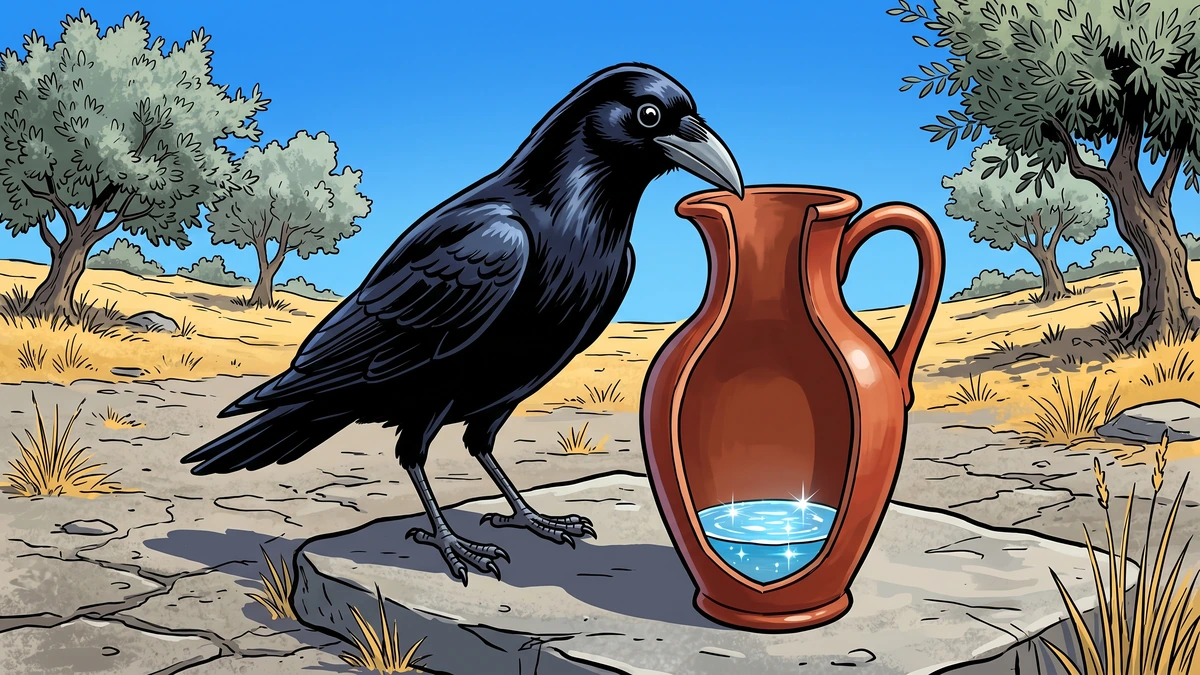
It was sitting on a flat grey stone slab at the edge of the abandoned olive grove, perhaps two hundred paces below his wall — a tall slender Greek terracotta pitcher of polished red-brown clay, of the sort that the village women filled at the spring and carried home on their shoulders. Someone had left it there, he could not say how long ago — perhaps when the spring still ran, perhaps a week ago, perhaps a month — and forgotten it. The pitcher had a narrow neck and a slender belly and a single curved handle, and the noon sun caught its red-brown sides and made them gleam like the polished bronze of a soldier’s helmet.
The crow lifted his head. His black eyes narrowed. A pitcher.
He pushed himself off the wall and flew, in three short heavy beats of his tired black wings, the two hundred paces down to the stone slab, and he landed lightly on the rim of the tall slender pitcher and looked down into its open mouth.
The water was there. He could see it. Far, far down at the bottom of the pitcher, perhaps a hand’s depth below the rim, perhaps a little more, lay a small pool of cool clear water glittering in the sunlight that fell straight down through the open neck. He could see, even from where he stood, the tiny ripples of his own breath disturbing its surface. He could smell the wet cool of it rising up out of the dark interior of the pitcher into his beak. It was real water. It was clean water. It was enough water, perhaps, to fill a small bird three times over.
And it was, by the bitter mathematics of the moment, completely beyond his reach.
For the pitcher was too narrow. The neck was wide enough to admit only the very tip of his sharp grey beak; he could not put his head inside it. He thrust his beak in. He stretched. He pushed. He felt the rough red clay scraping the soft black feathers of his throat. His beak reached down — one finger, two fingers, three — and stopped, with the cool wet smell still rising from below it, four full fingers above the surface of the water. He withdrew his beak. He looked again. He thrust it in again. He stretched again. The same. There was perhaps three inches of empty air between the tip of his beak and the surface of the water, and three inches in a Greek summer, with all the wells of the country dry and his throat closing slowly with thirst, was the same as three miles.
The crow sat down on the rim of the pitcher and stared at the water.
The Smaller Bird’s Despair
A weaker bird, the old tellers said, would have flown away.
A weaker bird, seeing the water at the bottom of an unreachable pitcher, would have given up at once. He would have spread his wings and flown off into the heat-shimmer to die, somewhere, of a thirst that was now beyond the help of any water he could reach.
A more impatient bird would have done something worse. A more impatient bird, seeing the water just out of reach, would have flown into a small angry rage about the unfairness of the world, would have flapped his wings and cawed his frustration, and would perhaps have tried, in the way that thirsty hot impatient birds always try, to knock the whole pitcher over with the side of his beak — to overturn it, smash it open, spill the water onto the dusty ground where he could lap it up. And the result of that would have been a broken pitcher and a small pool of muddy water absorbed in three seconds by the parched earth and one black crow lying dead of thirst beside the wreckage by sunset.
But the crow on the rim of the pitcher was, by the small lucky accident of his own nature, neither weak nor impatient.
He sat. He thought. The sun blazed down on his glossy black feathers. The cicadas sang. He looked at the pitcher. He looked at the water. He looked at his own sharp grey beak. He looked at the dusty cracked grey ground beside the stone slab. And as he looked at the ground, his bright black eyes — sharper, just then, than they had been all morning — fell on a small smooth round grey pebble lying half-embedded in the cracked dust at the foot of the slab.
It was no bigger than the joint of a man’s smallest finger. It was perfectly smooth. It was the colour of the white cliffs above the village. And it was, in that moment, the most important pebble in the world.
For the crow, who had been thinking, had had an idea.
The Stones

The idea was a small one. But it was a complete one.
He hopped down from the rim of the pitcher to the stone slab. He hopped from the slab to the cracked dusty ground. He picked up the small smooth round grey pebble in his sharp grey beak — it was perhaps the size of a chickpea, and it weighed almost nothing — and he flew with it back up to the rim of the tall slender pitcher.
He stood for a moment on the rim with the pebble in his beak.
And then he opened his beak, and he dropped the pebble down into the dark interior of the pitcher.
Plonk.
The pebble hit the water. The crow heard it. He looked down. He could see, at the bottom of the pitcher, the small grey shape of the pebble lying on the bottom under the surface of the water, and he could see — he could just see — that the surface of the water was now perhaps the thickness of a single feather higher than it had been before.
Not much. Not nearly enough. But higher.
The crow flew back down to the cracked dusty ground beside the slab, and he found another pebble — slightly larger this time, the size of a small olive — and he carried it back up to the pitcher, and he dropped it in.
Plonk.
The water rose another feather’s thickness.
And then — patiently, methodically, in the way that no thirsty hot impatient bird has ever yet learned to be — the crow went to work. Down to the dusty ground. Up to the rim of the pitcher. Pebble after pebble. Stone after stone. Some were small as chickpeas. Some were larger, the size of an olive, the size of a date-stone. He found a particularly fine smooth oval one half-hidden under a clump of grey thyme and carried it triumphantly up to the rim. He dropped it in. Plonk. The water rose. He went back down. He found another. Plonk. The water rose. He went back down. He found another. Plonk. The water rose.
The sun moved across the cobalt sky. The shadows of the olive trees lengthened on the cracked grey ground. The cicadas hummed and hummed and hummed. And the patient black crow, with the slow steady accumulation that only patience can produce, dropped his pebbles one after the other into the tall slender Greek terracotta pitcher, and slowly — pebble by pebble, stone by stone, plonk by careful plonk — the water rose.
The Rising Water
It took, the old tellers said, the better part of two hours.
Two hours of flying down and flying up. Two hours of selecting pebbles. Two hours of dropping. Two hours of patient steady invisible progress that, to any casual onlooker who happened to glance at the slab for a moment, would have looked like a single hot black bird doing a single small foolish thing over and over and over. But the crow knew what he was doing. The crow had counted, in some small bird-counting part of his bird-mind, the increments of his progress; he had measured, in his own small bird-way, the rising of the water; and he had judged, with the quiet certainty of a creature who has already done the calculation, that it would work.
And little by little — paulatim, as the Latin of Avianus says — the water in the pitcher rose. It rose past the lower belly of the pitcher. It rose past the middle. It rose into the narrowing of the neck. It rose to within two beak-lengths of the rim. It rose to within one beak-length of the rim. It rose, on the very last pebble — a small white round one that the crow had found half-buried in a crack of the slab itself — to the very top of the pitcher.
And the cool clear water of the abandoned Greek olive grove gleamed, suddenly and beautifully, just below the rim where the crow stood.
The Drink
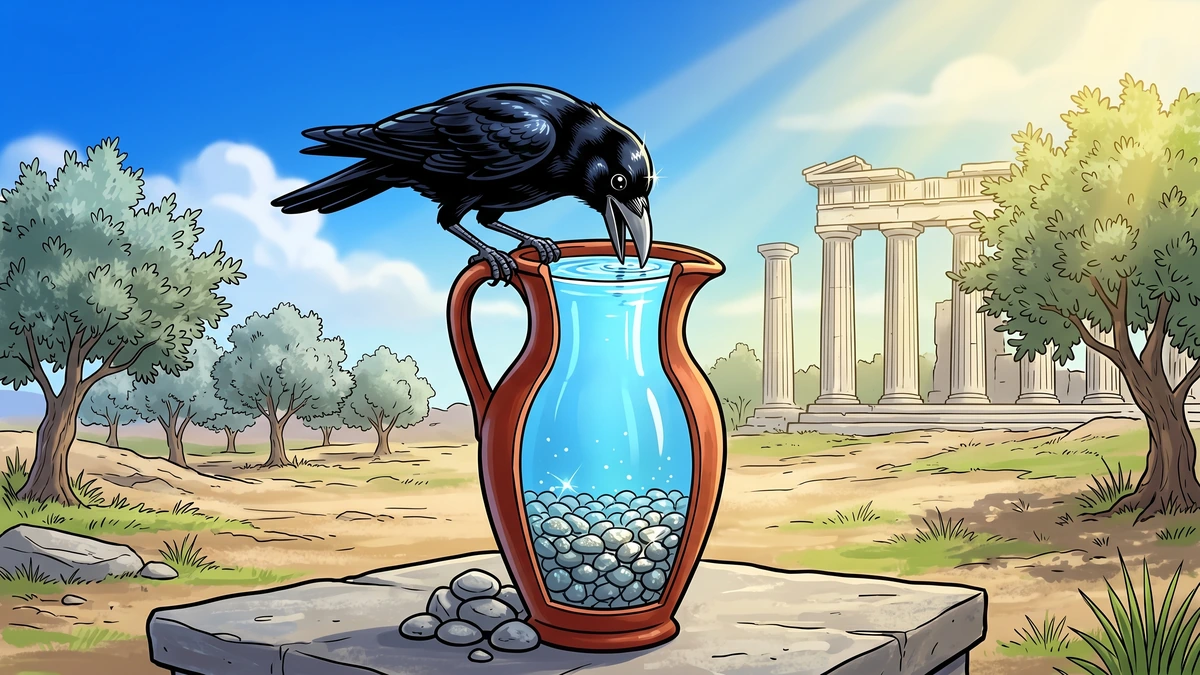
The crow stepped to the edge of the rim. He bent his head. He thrust his sharp grey beak into the cool clear water — easily, now, with no scraping, no stretching, no straining — and he drank.
He drank slowly. He drank deeply. He drank in the way that thirsty creatures drink when at last there is enough water and time enough to drink it. He raised his head, and the cool drops fell from his beak back into the pitcher. He bent and drank again. He raised his head. He bent and drank again. The cool wet feel of the water spread down his black throat and into the small dry empty places of his body, and the slow dryness that had been spreading through him all day began, slowly and gratefully, to retreat.
When he was finished, when his thirst was at last entirely gone, he stood for a long moment on the rim of the pitcher and looked down at the water that was now exactly level with the rim, with a small heap of pebbles glittering grey-and-white at the bottom of the pitcher beneath it. He looked at the pebbles. He looked at the water. And he flew, in three slow strong beats of his refreshed black wings, back up into the bright cobalt sky over the abandoned olive grove and away toward his cypress tree on the eastern slope.
And as he flew, the old tellers said, he was thinking — although crows do not think in words — the small clear thought that has come down from him to every child who has ever heard this story:
What could not be done by strength was done by thought.
The Moral
The Greek prose Aesopica preserves the moral in this form:
“Ho mythos deloi hoti pollakis epinoia kreitton ischyos esti.”
“The fable shows that often resourcefulness is stronger than strength.”
And Avianus, in his Latin verse Fable 27 (c. 400 CE), preserves it in this form:
“Sic quos nulla valet vis vincere, longa subactos / Vincit cura, et quod ratio non tribuit, dat opera.”
“Thus those whom no force can conquer, long care subdues; and what reason does not grant, work bestows.”
The pithy modern English form, descending through Croxall and Jacobs, is the proverb that every English-speaking child has heard:
“Necessity is the mother of invention.”
And the fable also gave English the phrase that has come down through the schoolroom into everyday speech: little by little — the patient incremental progress that is, in the end, the only kind of progress most of us ever actually make.
The Modern Verification
This fable is the rare one whose central observation has been tested by modern science and confirmed.
In 2009, Christopher Bird and Nathan Emery of the University of Cambridge published a study in the journal Current Biology in which they presented Eurasian rooks (a species of corvid closely related to the Greek crow Aesop would have known) with a tall narrow tube of water containing a floating worm just out of reach. The rooks were given a small pile of stones. Without any prior training, the rooks selected stones, dropped them into the tube one by one to raise the water, and successfully retrieved the worm. They preferred larger stones over smaller. They learned, after only a few trials, that some stones (sinking) worked while others (floating) did not. They were, in the careful technical language of the paper, “demonstrating an understanding of cause and effect comparable to that of a five-year-old human child.”
Five years later, in 2014, Sarah Jelbert at the University of Auckland repeated the experiment with New Caledonian crows, with the same result. Corvids really do drop stones into water. The fable, it turned out, was not a fable at all. It was a piece of accurately reported field observation by a Greek storyteller of the sixth century BCE, who had presumably watched a real crow do exactly what his fable described, and turned that small bright observation into a teaching-tale that has lasted twenty-five centuries.
It is worth pausing, for a moment, to honour that anonymous Greek observer. He could not have known what neuroscience is. He could not have known what corvid cognition is. He could not have read, as we can today, the studies in Current Biology that confirmed his observation. He had, as far as we know, only his own two eyes and his own slow patient watching of the birds in the courtyards of his village. And it was enough.
Why This Story Has Lasted
It has lasted because it teaches every child the same simple thing that every adult has, somewhere in his life, had to learn the hard way: when strength fails, think. When the door is locked, do not break it down — find the key. When the pitcher is too narrow for your beak, do not knock it over — drop pebbles in. Every problem in the world is, in some small way, a pitcher with the water at the bottom. The water is at the bottom because that is where water is. And there are always — always — pebbles on the ground. The pebbles are not far away. The pebbles are not magic. The pebbles are not for someone else. The pebbles are right there, in the cracked dust at the foot of the stone slab, and the only thing you have to do is be patient enough to pick them up one at a time and drop them in.
Two and a half thousand years after a small unnamed Greek storyteller watched a crow on the rim of a pitcher and turned what he saw into a single small story, the story is still telling us, in its small clear voice, the same thing it was telling Greek children at the time of Solon and Sappho. Plonk. Plonk. Plonk. Little by little. Stone by stone. The water rises. The crow drinks. The thirsty creature lives.
And what could not be done by strength is done — patiently, methodically, one small pebble at a time — by thought.
Frequently Asked Questions
What is the moral of The Crow and the Pitcher?
Who wrote The Crow and the Pitcher?
What is the story of The Crow and the Pitcher?
What lesson does The Crow and the Pitcher teach kids?
Is The Crow and the Pitcher based on real animal behavior?
You May Also Like
 Aesop's Fables
Ages 9-12
Aesop's Fables
Ages 9-12
The Goose That Laid Golden Eggs
The Goose That Laid Golden Eggs: In a modest farmstead nestled in a valley where green fields stretched to the horizon and wildflowers bloomed in abundance
 Aesop's Fables
Ages 3-5
Aesop's Fables
Ages 3-5
The Poisoned Food
The Poisoned Food: When Manuniti had concluded his story of the wonderful mango-fruit, king Alakesa ordered his four ministers to approach the throne, and
 Aesop's Fables
Ages 3-5
Aesop's Fables
Ages 3-5
The Lion and the Mouse: Friendship Across Worlds
The Lion and the Mouse: Friendship Across Worlds: The savanna stretched endlessly beneath the African sun, a landscape of golden grasses and scattered acacia