The Goldsmiths Fortune
The Goldsmiths Fortune: Once upon a time there was a goldsmith who lived in a certain village where the people were as bad and greedy, and covetous, as they
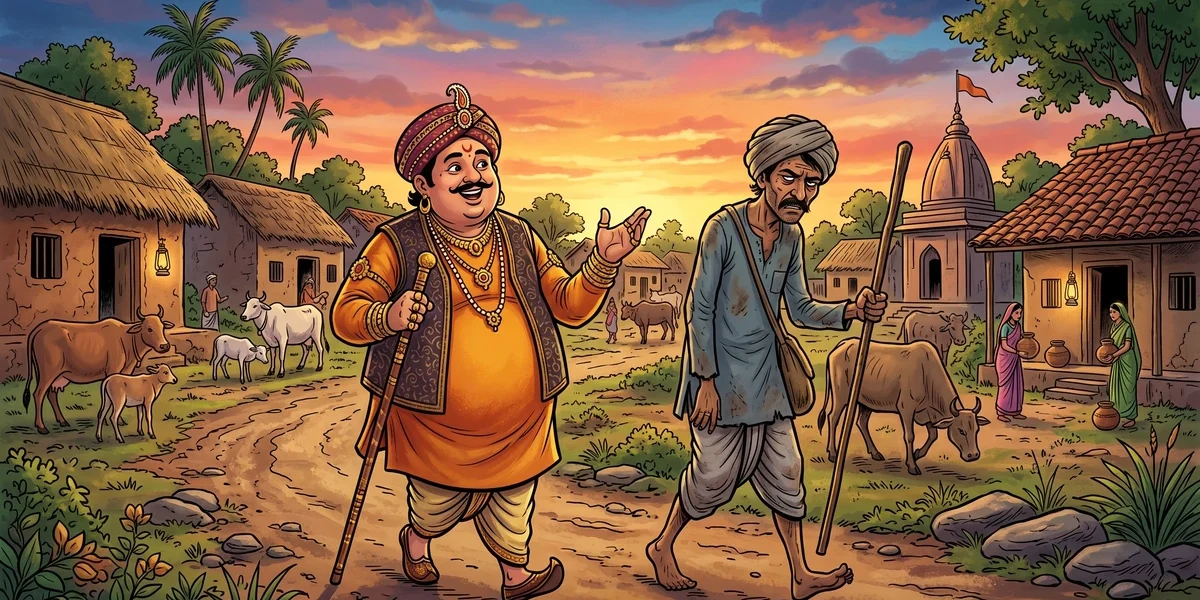
The goldsmith’s art is among the most morally charged of crafts: the artisan works daily with gold — the substance of desire, the medium of corruption — and must choose, transaction by transaction, between the integrity of his craft and the temptations that gold perpetually presents. Indian folk tradition understood this with precision, and “The Goldsmith’s Fortune” belongs to a genre of artisan tales in which craft virtue and craft vice are the direct levers of a character’s fortunes. The goldsmith who is honest prospers not as a pious reward but as the natural consequence of a reputation for integrity. The goldsmith who adulterates or cheats discovers, with equal inevitability, that fortune built on false gold is as unstable as the alloy itself.
I. The Goldsmith in Indian Society: Craft, Caste, and Moral Risk
The goldsmith (sonar in many regional languages, suvarnakara in Sanskrit) occupies a specific and ambivalent position in Indian caste society. As an artisan working with precious metal, the goldsmith is essential to the ritual economy — gold is required for temple ornaments, wedding jewellery, dowry, and royal insignia — and therefore potentially wealthy and socially influential. At the same time, the goldsmith’s daily access to gold creates structural opportunities for deception that the folk tradition tracks obsessively: the goldsmith who shaves a fraction of the gold from each commission and builds a secret hoard; the goldsmith who adulterates high-karat gold with base metals; the goldsmith who assays a client’s gold at a lower purity than it actually possesses.
These forms of goldsmith deception are not merely criminal; they are violations of the craft’s sacred trust. In the Indian understanding, every craft has its own dharma — its proper way of being performed, with its ethical as well as technical standards. The goldsmith’s craft dharma requires accurate assay, honest alloy, and fair return of excess metal to the client. Violations of craft dharma are not merely bad business practice; they are moral corruptions that attract consequences across time — consequences that the folk tale genre exists, in part, to document and make vivid.
Conversely, the goldsmith who maintains craft dharma — who returns every grain of gold, who assays honestly, who resists the temptation that his daily access to gold perpetually presents — is a figure of real moral achievement. The folk tradition celebrates this figure as strenuously as it condemns the cheating goldsmith, because the achievement of maintaining honesty under perpetual temptation is genuinely admirable. Fortune, in such tales, comes not as magical reward but as the social consequence of a hard-won reputation: clients who trust a goldsmith bring more gold, and bring better clients, and the honest goldsmith’s business grows on the compounding interest of earned trust.
II. The Architecture of Goldsmith Fortune: How It Is Built and Lost
Folk tales about goldsmith fortunes typically follow one of two trajectories. In the ascending trajectory, the goldsmith begins poor — perhaps the son of a poor artisan, or a newly trained craftsman without inherited clientele — and builds his fortune through the consistent practice of craft virtue: honest work, fair dealing, refusal of short-cuts even when they would go undetected. His fortune is built slowly, transaction by transaction, reputation by reputation, until it becomes substantial enough to attract royal or merchant patronage — at which point the scale changes but the method does not.
In the descending trajectory, the goldsmith begins prosperous and loses his fortune through a single or cumulative act of craft dishonesty. The loss may come through discovery (the client who tests the assay, the patron who weighs the returned gold), through the corrosive social dynamics of a reputation for dishonesty spreading through the artisan networks, or through the tale’s more cosmological mechanism: the idea that prosperity built on false craft is inherently unstable, likely to dissolve at the first stress test precisely because it lacks the foundation of real craft virtue.
Many goldsmith fortune tales combine both trajectories — a goldsmith who rises honestly, falls through a moment of temptation, and must rebuild on an honest foundation — and this three-part structure is the most pedagogically complete. It shows that honest building is possible, that temptation is real and powerful even for the virtuous, that a fall from honesty has consequences, and that return to craft virtue is the only path back. The middle fall is not presented as disqualifying; it is presented as the most expensive education a goldsmith can receive, one that teaches what the abstract knowledge of craft dharma cannot.
III. Gold as Moral Crucible: The Substance That Tests Character
The folk tradition’s obsession with goldsmith ethics reflects a deeper insight about the relationship between material value and moral character. Gold does not corrupt; it reveals. The person who handles gold regularly and honestly demonstrates a character that the casual observer cannot assess; the person who handles gold and cheats reveals a character that the cheat would prefer to conceal. The goldsmith’s working life is therefore a perpetual moral test — not because gold is uniquely dangerous but because its value makes every transaction a genuine choice between integrity and self-interest.
This is why the folk narrative tradition treats goldsmith stories as moral documents of unusual precision. In most occupations, the temptation to cheat is intermittent and requires specific opportunity. For the goldsmith, the temptation is structural and daily — built into the very conditions of the craft. A goldsmith who maintains honesty for twenty years has made twenty years of daily moral choices. This accumulated integrity is, in the folk tradition’s economy, a form of spiritual capital as well as a practical asset; it is the substance of character rather than merely the product of calculation.
The “fortune” in the tale’s title is thus not simply financial. It is the whole complex of consequence — financial, social, reputational, and spiritual — that attaches to the goldsmith’s moral conduct. The goldsmith’s fortune is his character made visible in the world, expressed in the clients who trust him, the patrons who seek him out, and the prosperity that grows from genuine craft virtue rather than from the temporary gains of deception. When the fortune is lost, it is the character that has been forfeited; when it is rebuilt, it is the character that has been restored.
“The goldsmith who returns your gold to the last grain is worth more than his weight in it.”
— North Indian artisan proverb
Why This Story Lasted
The Goldsmith’s Fortune lasted because it addresses the universal question of how character and prosperity relate — whether honesty actually produces better outcomes in the long run, or whether this is merely a comforting story that the honest tell themselves. The folk tradition’s answer, in artisan tales generally and goldsmith tales specifically, is pragmatic rather than merely pious: honesty produces better long-term outcomes because it builds the compounding interest of a reputation for trustworthiness, and that reputation is more durable than any gain from a single successful deception.
The tale also lasted because the goldsmith is a figure of genuine dramatic interest: intelligent, skilled, daily exposed to temptation, with the technical means to cheat without immediate detection. The choice to remain honest, made repeatedly under these conditions, is a form of heroism the folk tradition recognises as such. The goldsmith’s fortune, when it comes, is earned in a way that the casual accumulation of wealth cannot be — and the folk audience, many of whom were artisans themselves, understood that earning precisely.
What is the role of the goldsmith in Indian folk tales?
The goldsmith (sonar or suvarnakara) appears frequently in Indian folk tales as a figure of moral ambivalence: an essential artisan whose daily access to gold creates structural temptations to adulterate, shave, or misrepresent the precious metal in his care. Folk tales about goldsmiths typically examine the consequences of craft virtue versus craft dishonesty, with honest goldsmiths building lasting fortunes through trust and cheating goldsmiths eventually losing prosperity built on a false foundation. The goldsmith’s tale is a vehicle for examining how character and fortune relate.
What is craft dharma in Indian tradition?
Craft dharma is the proper way of performing a specific craft — its ethical as well as technical standards. In Indian traditional thought, every artisan caste has its own dharma that governs not only how the work should be done but the moral conduct expected of the craftsperson in relation to clients and materials. For the goldsmith, craft dharma includes accurate assay, honest alloy ratios, and honest return of excess metal. Violations of craft dharma are moral failures with consequences in the social and spiritual dimensions of life, not merely commercial infractions.
How does a goldsmith’s reputation function in these tales?
In Indian artisan folk tales, a goldsmith’s reputation functions as the primary form of social capital — more valuable than any individual commission. Clients who trust a goldsmith bring more gold, refer better clients, and create a self-reinforcing cycle of prosperity that grows on the compounding interest of earned trust. The honest goldsmith’s fortune thus grows not through luck or magic but through the entirely natural mechanism of reputation-compounding. Conversely, a reputation for dishonesty spreads rapidly through artisan networks and client communities, destroying the social capital that sustains the business.
What are the common forms of goldsmith deception in folk tradition?
Folk tales about dishonest goldsmiths document several specific forms of craft deception: shaving small amounts of gold from each commission to accumulate a secret hoard; adulterating high-karat gold with base metals while charging for pure gold; assaying a client’s gold at lower purity than it actually possesses to claim more in fees; and substituting inferior metals in decorative elements hidden from view. These deceptions are structurally built into the craft’s conditions — the goldsmith has daily access to precious metal and technical knowledge the client lacks — making their avoidance a genuine moral achievement.
Why does the folk tradition treat goldsmith honesty as a form of heroism?
The folk tradition recognises goldsmith honesty as heroic because it is practised under perpetual, structural temptation rather than intermittent or incidental pressure. A goldsmith who maintains honest craft for twenty years has made twenty years of daily moral choices — each one a genuine choice between integrity and self-interest, with the technical means to cheat without immediate detection. This accumulated integrity is a form of moral achievement that the folk tradition distinguishes sharply from the honesty of those who have never been seriously tempted, and it is celebrated accordingly in tales where fortune follows character.
Frequently Asked Questions
**Q: Why is this story important?**
You May Also Like
 Aesop's Fables
Ages 3-5
Aesop's Fables
Ages 3-5
The Poisoned Food
The Poisoned Food: When Manuniti had concluded his story of the wonderful mango-fruit, king Alakesa ordered his four ministers to approach the throne, and
 Aesop's Fables
Ages 3-5
Aesop's Fables
Ages 3-5
Grasp All Lose All
Grasp All Lose All: Once, in former times, there lived in a certain city in India a poor oil-seller, called Déna, who never could keep any money in his
 Aesop's Fables
Ages 3-5
Aesop's Fables
Ages 3-5
The Journey – A Short Story About Love and Longing
The Journey – A Short Story About Love and Longing: It was an evening of pluvial delicacy. The monsoon had set in. In the month of Sravan the sky was overcast