The Close Alliance A Tale Of Woe
A farmer’s bullocks lead him into a crocodile-infested river—a parable of how bad companions drag the virtuous toward ruin.
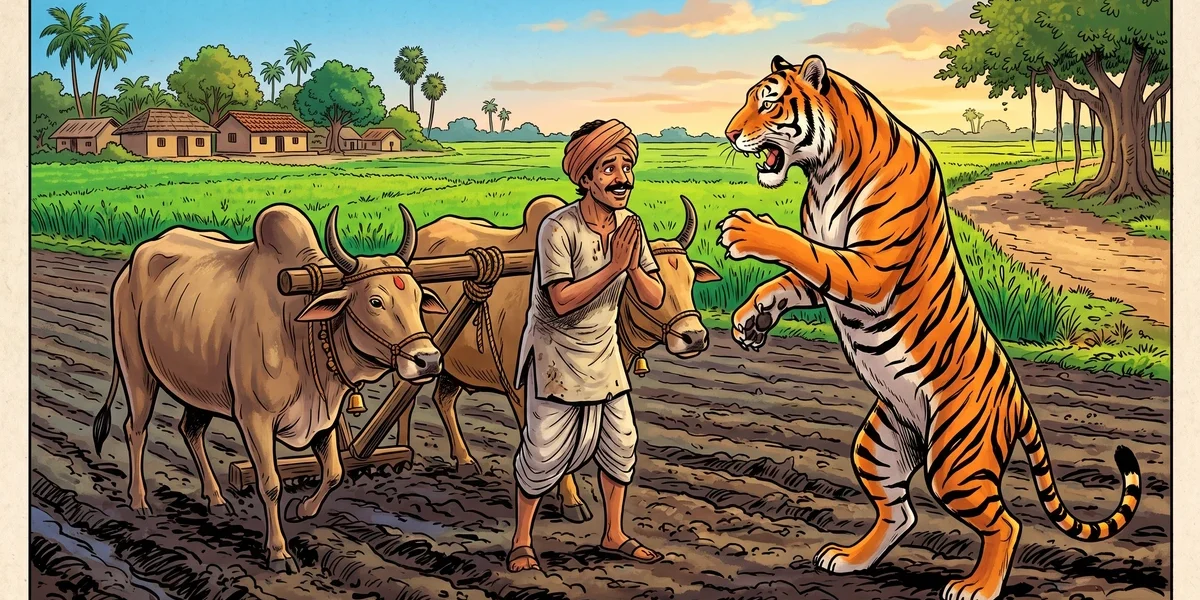
“A tale of woe” — the subtitle does not dissemble. Somewhere in the logic of a close alliance, the folk narrator warns us, lie the seeds of a particular kind of suffering: not the suffering inflicted by enemies, but the deeper wound that only intimacy can deliver. This story belongs to a tradition that scrutinises the very institution of close alliance, asking whether proximity amplifies good or, with equal efficiency, amplifies harm.
I. The Paradox of the Close Alliance in World Folk Wisdom
The close alliance — the sworn friendship, the strategic partnership, the bond of mutual dependency — appears across world folk traditions as both the highest human achievement and a latent source of catastrophe. The same intimacy that makes allies powerful makes them dangerous: they know your weaknesses, they share your resources, and when interests diverge, the divergence happens at the closest possible range. The Indian fable tradition, particularly the Panchatantra and its cognates, is more explicit about this paradox than most: mitra-bhed — the sundering of friendship — is not merely an unfortunate outcome but a formal narrative category, one of the five tantra (books) of the Panchatantra itself.
The woe in this tale arises not from malice but from the structural logic of close alliance. When two parties are tightly bound — by oath, by interest, by long association — the failure of one becomes the failure of both, and the success of one may come at the other’s expense. Folk wisdom is particularly interested in alliances that begin well and curdle: the friendship that enables exploitation once trust is established, the partnership that fractures under the strain of a shared crisis, the bond that was always asymmetric but masked that asymmetry in its early warmth.
Comparative folklorists note that “tale of woe” stories about alliances cluster around a specific structural feature: the moment of asymmetric need. The alliance works when both parties are equally strong or equally vulnerable. It breaks — catastrophically — when one party’s need becomes desperate while the other’s is not. The close ally, unlike the stranger, cannot simply walk away; the very closeness of the bond makes extraction painful and often impossible without mutual destruction.
II. The Anatomy of the Woe: How Alliance Becomes Trap
In folk narrative, the mechanism by which a close alliance transforms into a source of woe typically follows one of three patterns. The first is asymmetric loyalty: one ally’s commitment is genuine and total; the other’s is strategic and contingent. When conditions change, the strategic ally defects while the loyal one remains bound — by oath, by love, by the very depth of the alliance — and suffers for it. This is perhaps the oldest and most widely distributed form of alliance-woe narrative.
The second pattern is contagion of fate: the alliance binds two parties so closely that the misfortune of one automatically becomes the misfortune of both, even when the second party has done nothing to deserve it. The Sanskrit concept of karma-samyoga — the binding of karmic fates through voluntary association — underlies many Indian versions of this pattern. You chose your ally; their consequences become yours. This is not presented as unjust but as the inevitable mathematics of intimacy.
The third pattern is resource competition within alliance: the alliance was formed to share a resource, but the resource proves insufficient for both. What began as mutual aid becomes zero-sum, and the closeness of the alliance means the competition is conducted at arm’s length, with all the intensity that intimacy brings to conflict. The folk tradition is notably unsentimental about this pattern: it does not blame either party for the competition but treats the structural mismatch between the alliance’s ambitions and its resources as the true antagonist.
III. The Moral Geometry of Woe: What the Close Alliance Teaches
The “tale of woe” genre does not exist to discourage alliance. It exists to insist on clear-sightedness at the moment of alliance formation. The Indian narrative tradition’s counsel on friendship and partnership — expressed through figures like Chanakya, the Panchatantra‘s framing narrator, and countless unnamed folk storytellers — is not “avoid close alliance” but rather “know with precision who your ally is, what they want, and what the bond actually commits you both to.”
This is why the tales of woe are didactic rather than merely tragic. They are told to young men and women entering partnerships, to merchants forming trading consortia, to kings contemplating military alliances. The woe is instructive: see how the alliance that seemed so advantageous contained, from the beginning, the structural defect that produced this outcome. Could the protagonist have seen it earlier? The folk tradition usually implies yes — the signs were there, and the protagonist chose not to read them, because the warmth of the early alliance was more comfortable than honest assessment of its terms.
The story also participates in the broader Indian ethical conversation about sanga — association — and its effects on character. The Bhagavad Gita warns that the company one keeps shapes one’s nature; folk tales dramatise this warning. A close alliance with someone whose character or fate is problematic does not merely create practical difficulties; it begins to reshape the allied party’s own moral situation, pulling them toward outcomes they would not have chosen alone.
“Choose your ally as you choose your boat: not by its beauty at the dock, but by what you know of it in rough water.”
— Proverbial wisdom of the Deccan trading communities
Why This Story Lasted
Alliance-woe tales persist across generations because the structural problem they illuminate never disappears. Every generation forms close alliances — personal, commercial, political — and every generation discovers that proximity can wound as surely as enmity, and with greater surprise. The folk tale provides a vocabulary for understanding that wound: not as betrayal (though it may feel like betrayal) but as the working-out of the alliance’s inherent logic. This reframing is valuable precisely because it allows the sufferer to learn rather than merely grieve.
The Indian tradition’s particular contribution to this universal theme is the insistence that woe arising from alliance is not random but structural — it can be foreseen, if one is willing to look. The tale endures as a standing instruction in that kind of looking: attentive, unsentimental, and ultimately compassionate toward both the self and the ally whose interests proved, in the end, not quite aligned with one’s own.
What is mitra-bhed in Indian literature?
Mitra-bhed (literally “sundering of friends”) is both a narrative category and the title of the first book of the Panchatantra, the ancient Indian fable collection. It describes the process by which close friendships or alliances are broken, often through manipulation, misunderstanding, or the working-out of structural incompatibilities. As a formal narrative category it signals stories that examine how and why close bonds fail, and what can be learned from their failure.
Why do folk tales warn against close alliances?
Folk tales do not typically warn against close alliances per se, but they do insist on clear-eyed assessment of alliance terms and the character of potential allies. The “tale of woe” sub-genre explores how alliances that seem advantageous can contain structural defects — asymmetric loyalty, contagion of fate, resource competition — that produce suffering. The didactic intent is to make listeners better at forming and evaluating alliances, not to discourage association altogether.
What is the concept of karma-samyoga in alliance stories?
Karma-samyoga refers to the binding of karmic fates through voluntary association. In Indian folk and philosophical literature, a close alliance with another person creates a karmic link such that the other’s actions and consequences can affect your own situation. Alliance-woe tales often dramatise this principle: the protagonist suffers not from their own moral failures but from those of their ally, because the close bond has made their fates inseparable.
What are the three patterns of alliance woe in folk narrative?
Folk narratives of alliance woe tend to follow three structural patterns: asymmetric loyalty (one ally’s commitment is genuine, the other’s strategic, and the strategic ally defects when conditions change); contagion of fate (the misfortune of one ally automatically becomes the misfortune of the other due to the closeness of the bond); and resource competition within alliance (the shared resource that motivated the alliance proves insufficient for both parties, turning the alliance zero-sum). This story likely exemplifies one or more of these patterns.
How does the sanga concept in Indian philosophy relate to alliance tales?
Sanga — association or company — is a significant ethical concept in Indian philosophy, particularly in texts like the Bhagavad Gita, which warns that the company one keeps shapes one’s character and fate. Alliance-woe folk tales dramatise this philosophical principle: a close alliance with someone whose character or fate is problematic does not merely create practical difficulties but can reshape the allied party’s own moral trajectory, pulling them toward outcomes they would not have chosen in isolation.
Frequently Asked Questions
**Q: Why is this story important?**
You May Also Like
 Aesop's Fables
Ages 3-5
Aesop's Fables
Ages 3-5
Valiant Vicky The Brave Warrior
Valiant Vicky The Brave Warrior: Once upon a time there lived a little weaver, by name Victor Prince, but because his head was big, his legs thin, and he was
 Aesop's Fables
Ages 3-5
Aesop's Fables
Ages 3-5
Internet- The life Saver
Internet- The life Saver: While friends of her age would throw out parties, hang on movie theaters, enjoy weekends in pubs and coffee shops, she would savor
 Aesop's Fables
Ages 3-5
Aesop's Fables
Ages 3-5
The King and The Drum – An Indian Folktale
The King and The Drum – An Indian Folktale: Long ago there lived a king somewhere in the central part of India. He was very proud of his looks. He spent hours