The Talkative Tortoise
The dual-rooted Indian fable of Kambugrīva — "Conch-Necked," the tortoise of Phullotpala pond — and his two wild-goose friends Saṅkaṭa and Vikaṭa, who try to lift him out of a drought by carrying him on a stick. The story comes to us through two ancient traditions at once: the Buddhist Pali Canon as Kacchapa Jātaka No. 215, and the Hindu Panchatantra as Book I, Mitrabheda. It is not, as is often claimed, a tale of Aesop. T.W. Rhys Davids' 1880 translation is preserved in full alongside the Sanskrit retelling, with Sanskrit names restored, the dual-tradition origin explained, and the story's two-thousand-year journey through Pahlavi, Arabic, Persian, Hebrew, Latin, and finally La Fontaine's French traced.
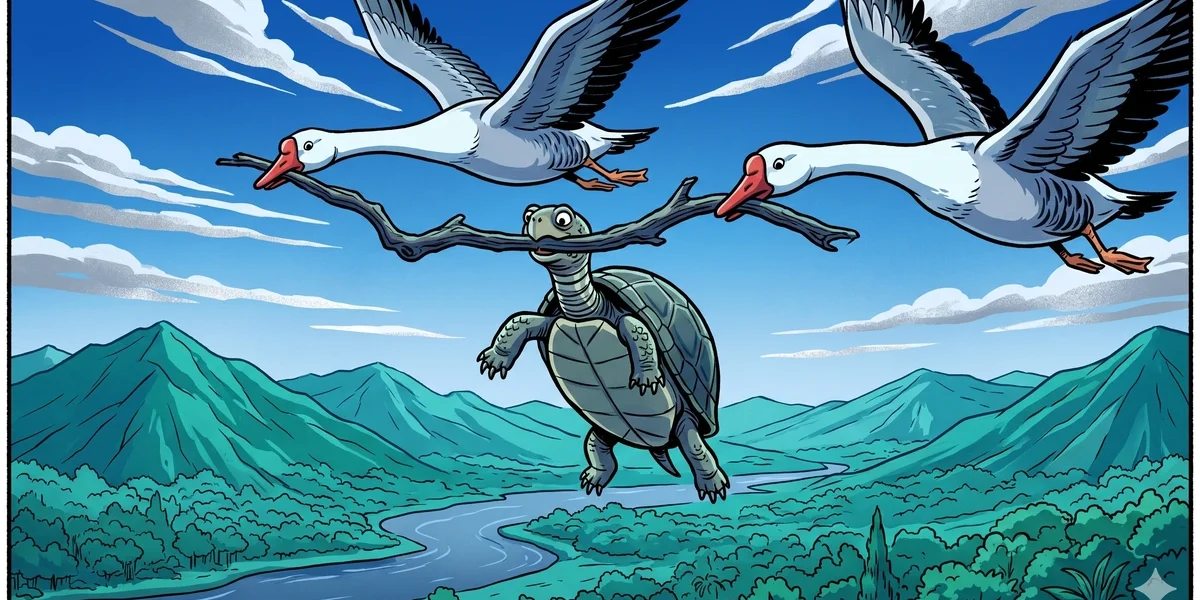
Verily the tortoise killed himself / Whilst uttering his voice; / Though he was holding tight the stick, / By a word himself he slew.
This is one of the oldest stories India ever wrote down — and one of the few that comes to us through two ancient traditions at once. The Buddhists kept it in their Pali canon as the Kacchapa Jātaka, Birth-Story Number 215, where the Buddha himself tells it to scold a monk who could not hold his tongue. The Hindus kept it in the Panchatantra, in Book I — Mitrabheda (“The Loss of Friends”) — where the great teacher Vishnu Sharma uses it to show three young princes that some lessons cost everything to learn. Both versions are old. Both are ours. And both arrive at the same quiet conclusion, which is that a single word, spoken at the wrong moment, can undo a life of careful holding-on.
In the Sanskrit telling the tortoise has a name: Kambugrīva (कम्बुग्रीव), “Conch-Necked,” after the spiraling rings on a tortoise’s neck that resemble the whorls of a conch shell. The two geese are named too — Saṅkaṭa (सङ्कट, “Narrow”) and Vikaṭa (विकट, “Wide”) — a deliberate pair of opposites, one tight and careful and one broad and bold, the way good friends sometimes are. The pond they live in together is called Phullotpala (फुल्लोत्पल), “Lotus-in-Bloom.” Most modern retellings drop these names. We are putting them back in, because a story is itself a kind of holding-on: the names are part of how it stays alive.
Here, first, is the ancient Pali version — translated from the Buddha’s own telling by T.W. Rhys Davids in 1880, in the very first English-language edition of the Jātakas:
The future Buddha was once born in a minister’s family, when Brahmadatta was reigning in Bārāṇasī (Benares); and when he grew up, he became the king’s adviser in things temporal and spiritual.
Now this king was very talkative; while he was speaking, others had no opportunity for a word. And the future Buddha, wanting to cure this talkativeness of his, was constantly seeking for some means of doing so.
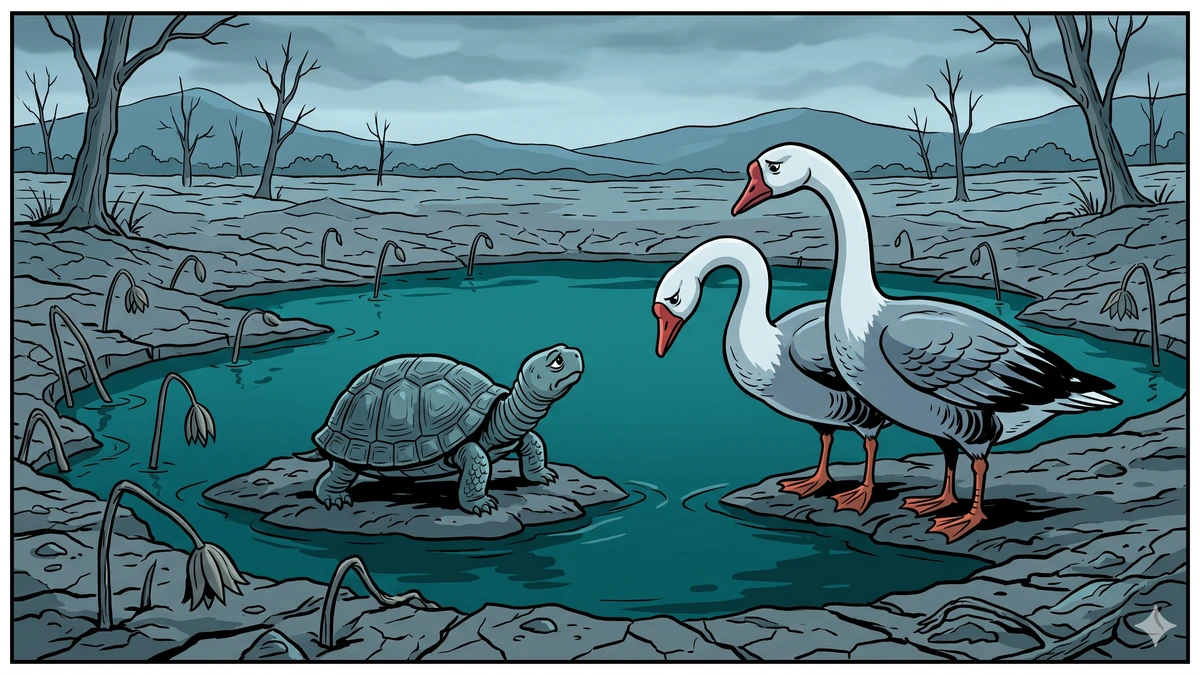
At that time there was living, in a pond in the Himavat (Himalaya) mountains, a tortoise. Two young haṃsas — wild geese — who came to feed there, made friends with him. And one day, when they had become very intimate with him, they said to the tortoise:
“Friend tortoise! The place where we live, at the Golden Cave on Mount Beautiful in the Himalaya country, is a delightful spot. Will you come there with us?”
“How can I?”
“We can take you, if you can only hold your tongue, and will say nothing to anybody.”
“Oh! That I can do. Take me with you.”
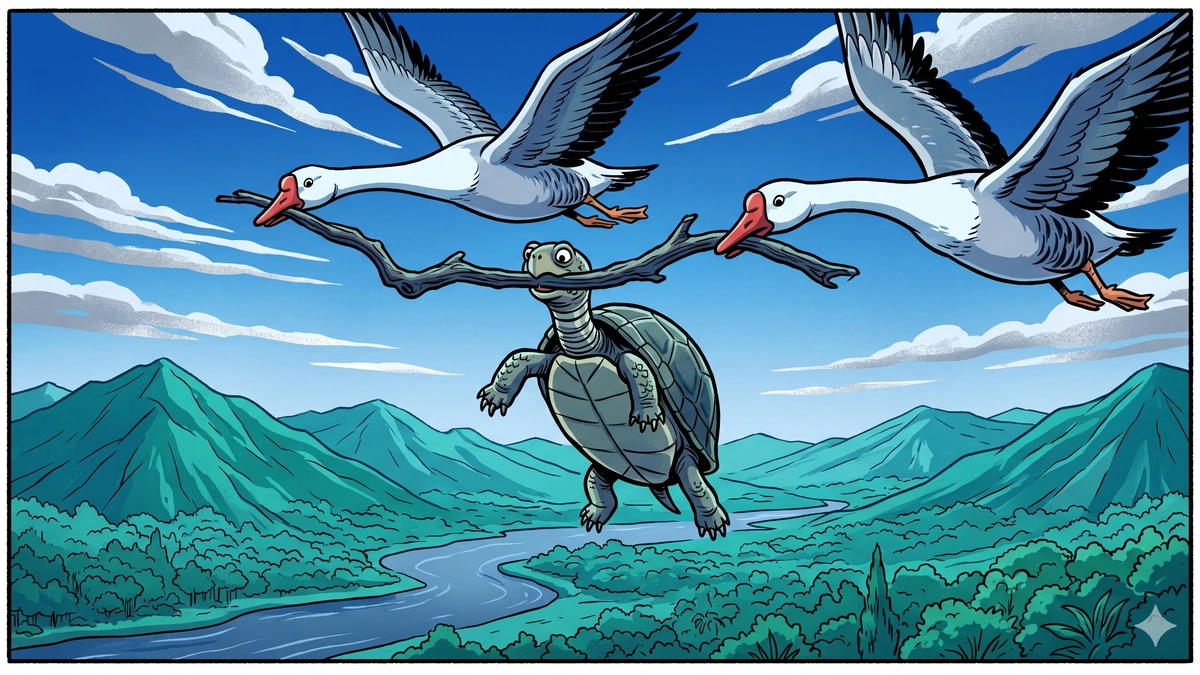
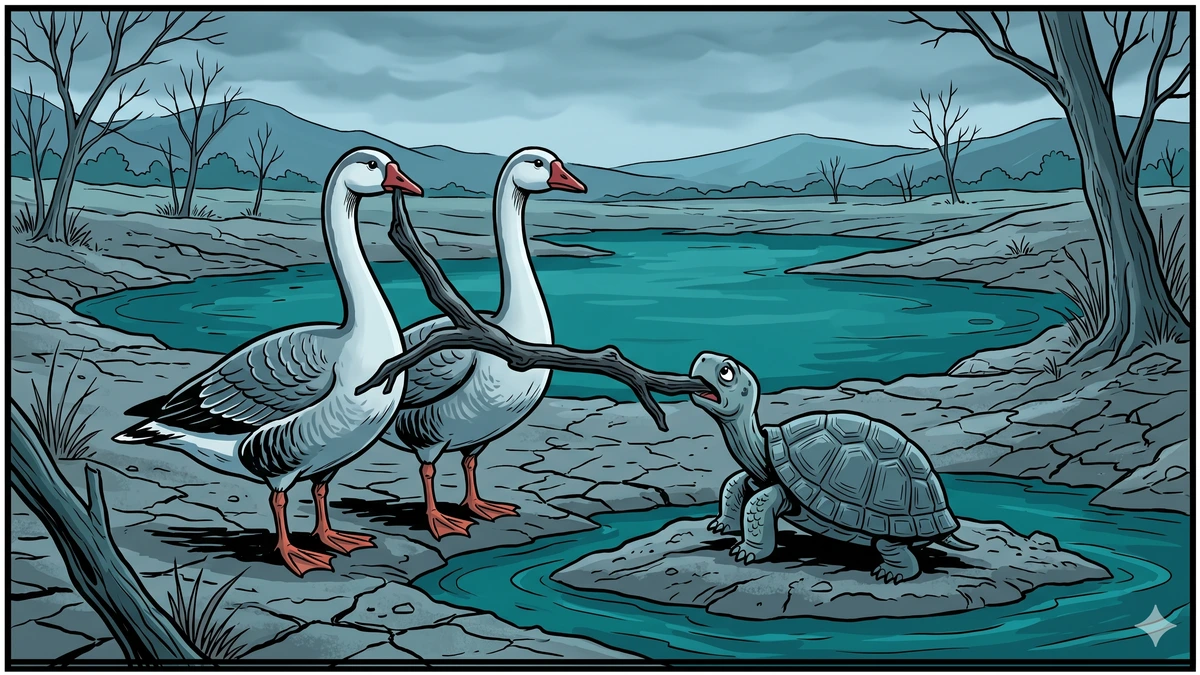
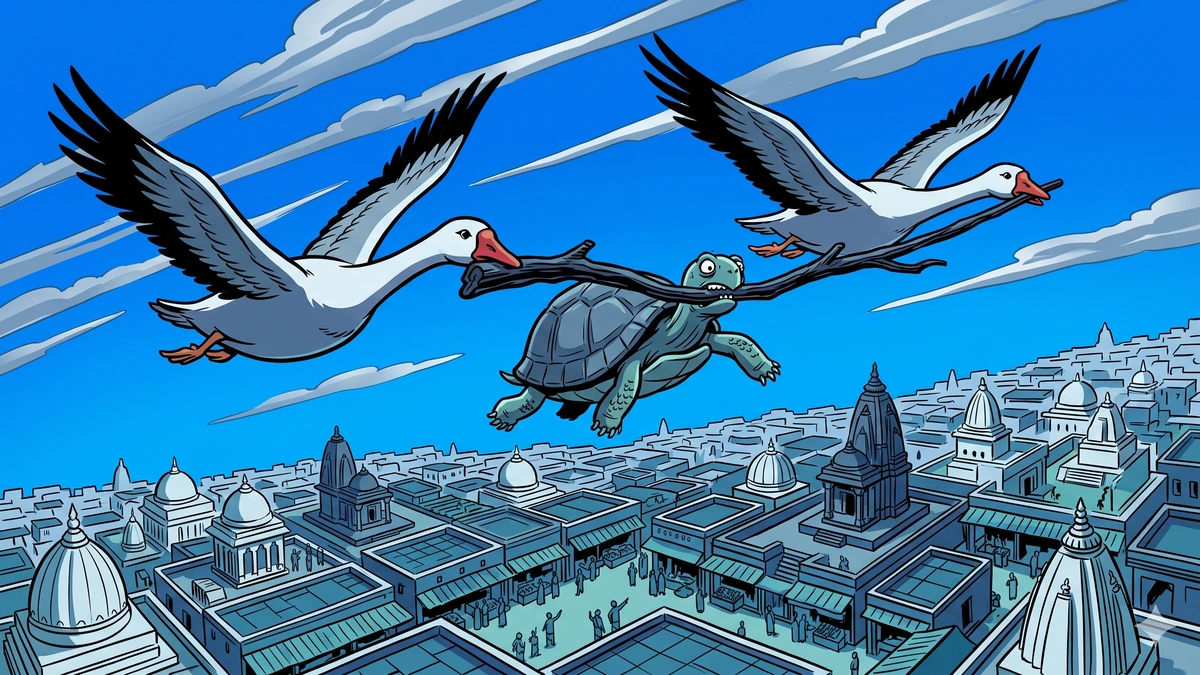
“That’s right,” said they. And making the tortoise bite hold of a stick, they themselves took the two ends in their teeth, and flew up into the air.
Seeing him thus carried by the haṃsas, some villagers called out, “Two wild geese are carrying a tortoise along on a stick!” Whereupon the tortoise wanted to say, “If my friends choose to carry me, what is that to you, you wretched slaves!” So just as the swift flight of the geese had brought him over the king’s palace in the city of Bārāṇasī, he let go of the stick he was biting, and falling in the open courtyard, split in two. And there arose a universal cry: “A tortoise has fallen in the open courtyard, and has split in two!”
The king, taking the future Buddha, went to the place, surrounded by his courtiers; and looking at the tortoise, he asked the Bodhisatta, “Teacher! How comes he to be fallen here?”
The future Buddha thought to himself: “Long expecting, wishing to admonish the king, have I sought for some means of doing so. This tortoise must have made friends with the wild geese; and they must have made him bite hold of the stick, and have flown up into the air to take him to the hills. But he, being unable to hold his tongue when he hears any one else talk, must have wanted to say something, and let go the stick; and so must have fallen down from the sky, and thus lost his life.”
And saying, “Truly, O King! Those who are called chatter-boxes — people whose words have no end — come to grief like this,” he uttered these verses:
“Verily the tortoise killed himself
Whilst uttering his voice;
Though he was holding tight the stick,
By a word himself he slew.
Behold him then, O excellent by strength!
And speak wise words, not out of season.
You see how, by his talking overmuch,
The tortoise fell into this wretched plight!”
The king saw that he was himself referred to, and said, “O Teacher! Are you speaking of us?”
And the Bodhisatta said, “O great king, be it you, or be it any other — whoever holds his mouth open without restraint comes by such a fate as this.” From that day on, the king of Bārāṇasī ceased to be a chatter-box.
The Panchatantra version — Kambugrīva, Saṅkaṭa, and Vikaṭa
The Hindu version, which Vishnu Sharma set down for the three young princes some two thousand years ago, is the same story told from the inside of the tortoise’s heart rather than from the outside of the king’s. It begins with the drought.
In the kingdom of Magadha, in a pond called Phullotpala — the Pond of Lotus-in-Bloom — there lived a tortoise named Kambugrīva, the Conch-Necked. His closest friends in the world were two wild geese: Saṅkaṭa, “the Narrow One,” who thought carefully before he spoke, and Vikaṭa, “the Wide One,” who laughed easily and loudly. Every afternoon the geese came down to gossip with the tortoise on the warm stones at the pond’s edge, and the three of them talked of everything — the colour of the sky, the price of fish, the news of the river, the slow private business of becoming old together.
Then the rains failed. The pond shrank. Day by day the lotus stalks bent lower. The fish vanished. The geese, who could fly to other waters, grew thin; the tortoise, who could not, grew frightened. At last Saṅkaṭa and Vikaṭa came to him with a heavy heart and said: brother, we cannot stay. We are flying north to Lake Mānasa, in the Himalayas, where the water is deep and cold all year. Forgive us. We must go.
Kambugrīva wept. He had nowhere to go. The pond was his world. To stay was to die.
The geese could not bear it. They thought all night, and in the morning Saṅkaṭa said: there is one way. Bite hard upon a strong stick, in the middle, and we will take the two ends in our beaks, and we will carry you with us to Mānasa. But Kambugrīva — listen — you must not open your mouth. Whatever you hear, whatever they shout from below, whatever they say of you or of us, you must not answer. To answer is to fall.
I will not answer, said Kambugrīva. I swear it.
And so they flew.
The land slipped beneath them like a great unrolling cloth. The tortoise saw rivers thin as silver thread, fields green as parrot wings, dust-coloured roads winding among yellow temples. He had never imagined that the world was so big, or that it was made, mostly, of sky.
And then they passed over a city. The market was full. People looked up, and they began to point, and they began to laugh. Look! Two wild geese are carrying a tortoise on a stick! Did you ever see such a thing? What a fool that tortoise must be!
The tortoise heard them. He had been carried for hours and his jaws were tired and the wind was in his ears, and now strangers below him were laughing and calling him a fool, and they had it wrong, all wrong — these were his friends, this had been their idea, he had not asked to be a spectacle, the geese were carrying him out of love, not out of his own foolishness — and he opened his mouth to set the matter right —
And he fell.
What the story is really about
The surface lesson is the one storytellers have spoken for two thousand years: silence is sometimes survival. The tortoise had only one job — to bite. He held the stick for a hundred miles. He let it go for one syllable.
The deeper Panchatantra reading is harder, and gentler. Kambugrīva did not open his mouth out of fear or pain or hunger. He opened it because someone misunderstood him, and he could not bear the misunderstanding. This is not stupidity. This is the oldest and most human of urges: the urge to correct the record, to make sure that strangers see you the way you see yourself. Anyone who has ever typed a regretted reply, sent a cold message to a colleague who got the wrong end of the stick, snapped at a child who misread a kindness, knows exactly the moment Kambugrīva knew — the moment when the wrong impression in someone else’s mind feels worse than the consequences of fixing it.
The Sanskrit word for this is ahaṃkāra (अहंकार) — the I-maker, the small machine in the chest that cannot let a falsehood about the self stand. The Panchatantra is not unkind to it. The story does not call the tortoise a fool. It only shows him falling, and lets us decide what to do with the silence at the end.
How the story travelled
From these two Indian roots — Buddhist Jātaka 215 and Panchatantra Book I — the tale spread further than almost any other in Asia. In the 6th century CE the Persian physician Borzūya carried the Panchatantra back to Sasanian Iran in his Pahlavi translation. From Pahlavi it passed in the 8th century into Arabic, in Ibn al-Muqaffaʿ’s Kalīla wa Dimna, where it became a favourite of the Abbasid courts. It moved into Persian as the Anvār-i Suhaylī; into Hebrew, Latin, Spanish; and finally, in 17th-century France, La Fontaine retold it as La Tortue et les Deux Canards (“The Tortoise and the Two Ducks”), borrowing the entire shape of it without quite knowing how old it was. Folklorists today catalogue the motif as ATU 225A, “The Tortoise Lets Himself Be Carried By Birds.” It is also alluded to in the Mahābhārata’s Śānti Parva, and a near-cousin appears in the Babylonian fable cycle.
The Talkative Tortoise is, in other words, one of the most successful migrations in the history of human storytelling. It has been carried by geese, in a sense, for two and a half thousand years.
For thoughtful readers — a small reflection
It is worth sitting with what the story does not say. It does not say that the geese were wrong to lift him. It does not say that the people in the city were wrong to look up and laugh — they were strangers, and a tortoise carried by geese is genuinely funny. It does not say the tortoise was a bad creature. The story holds all of these things in equal sympathy and lets the gravity do the rest.
That is the deepest mark of the Panchatantra and of the Jātakas at their best: the moral is not don’t be like the tortoise. The moral is look at the tortoise; he is you, on a bad day; what would you have to bite down on, to fly?
Frequently Asked Questions
What is the moral of The Talkative Tortoise?
Which Panchatantra and Jataka book has The Talkative Tortoise?
How did the tortoise die in The Talkative Tortoise?
What lesson does The Talkative Tortoise teach?
Is The Talkative Tortoise a good story for children?
You May Also Like
 Aesop's Fables
Ages 9-12
Aesop's Fables
Ages 9-12
The Goldsmiths Fortune
The Goldsmiths Fortune: Once upon a time there was a goldsmith who lived in a certain village where the people were as bad and greedy, and covetous, as they
 Aesop's Fables
Ages 3-5
Aesop's Fables
Ages 3-5
The Hare and the Tortoise
The Hare and the Tortoise: Original Story from Aesop’s fables, told with a twist. Age group: 1 – 100 years. There was once a Hare who always bragged about how
 Aesop's Fables
Ages 6-8
Aesop's Fables
Ages 6-8
Mr Wont Give And Mr Wont Leave
Mr Wont Give And Mr Wont Leave: In a certain town there lived a clever old Brâhmaṇ, named Won’t-Give(Vidâmundan). He used to go out daily and to beg in all the