The Magic Fiddle
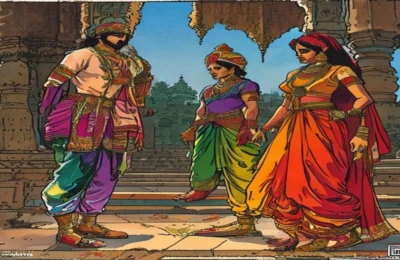
The Magic Fiddle: Once upon a time there lived seven brothers and a sister. The brothers were married, but their wives did not do the cooking for the family.

Someone plays a fiddle. Everyone must dance. The farmer in the field, the judge on the bench, the miser counting his coins, the king on his throne — all of them dance, whether they wish to or not, until the music stops. The magic fiddle tale belongs to one of the most widely distributed motifs in world folk tradition: the irresistible instrument, whose music bypasses the will and commandeers the body directly. In the Indian tradition, this motif connects to the profound philosophical understanding of sound (nada) as the most direct channel between the cosmic and the individual, and to the ancient belief that music is not merely pleasant but potentially the most powerful force available to the human practitioner.
I. Nada-Brahman: The Metaphysics of Sound in Indian Thought
The Indian philosophical tradition’s understanding of sound is radically different from the Western materialist conception of sound as vibrating air. In the Vedic and post-Vedic traditions, nada (sound, especially musical sound) is understood as one of the most direct manifestations of Brahman (the ultimate reality) in the perceptible world. The concept of nada-Brahman — the idea that the universe itself arose from primordial sound, that the cosmic vibration (Aum) underlies all phenomena — places music at the very foundation of metaphysical reality.
This is not mere poetic theology. The Indian musical tradition’s elaborate system of ragas (melodic frameworks) is built on the premise that specific sound patterns have specific effects on specific physical and psychological states. A raga played at the wrong time of day, or in the wrong emotional context, is not merely aesthetically inappropriate; it is efficacious in the wrong direction — it disturbs rather than harmonises the listener’s state. The ragas for morning, for midnight, for the monsoon, for grief, for joy are different precisely because the tradition holds that sound acts on the listener’s physical and psychic constitution in ways that are real, predictable, and controllable by the skilled musician.
The magic fiddle of the folk tale is the popular expression of this understanding, taken to its logical extreme. If music can calm, excite, heal, or grieve the listener, why not compel them to dance? If ragas can affect bodily states, why not override the will entirely? The folk tradition’s magic fiddle is nada-Brahman weaponised — the cosmic power of sound captured in a single instrument, available to whoever holds the bow. Its magic is not arbitrary enchantment but the amplification of something real about music’s relationship to the body.
II. The Global Tradition of Irresistible Music
The irresistible instrument motif is one of the most universally distributed in world folk tradition. The Pied Piper of Hamelin compels the rats, then the children, with his pipe. Orpheus’s lyre moves rocks and trees and soothes Cerberus. David’s harp calms Saul’s madness. Krishna’s flute draws the gopis from their homes and their duties in involuntary devotion. The Norse god Odin’s musical gifts could move armies; the Irish fairy musician could compel the entire village to dance until they dropped.
What unifies these diverse traditions is a shared intuition about music’s relationship to the body: that certain sounds bypass the rational mind and act directly on the motor or emotional systems, producing movement or feeling without the mediation of conscious choice. This intuition is, in its way, supported by modern neuroscience: music activates motor areas in the brain even when the listener is not moving; the “chills” produced by certain music involve involuntary physical responses; rhythmic synchronisation between listeners is an automatic biological effect of shared musical experience. The folk tradition’s magic fiddle is an extreme version of something genuinely real about music’s power over the body.
In Indian versions of the irresistible music tale, the instrument is typically a vina, a sarangi, a bansuri (flute), or in regional folk versions any stringed or wind instrument associated with the tradition’s most powerful musical figures — Saraswati (goddess of music), Narada (the divine musician), or the folk hero who has received musical training from a supernatural source. The origin of the magic instrument’s power is usually a blessing, a gift from a deity or spirit, or the result of the musician’s extraordinary practice (tapas) that has earned supernatural power.
III. The Uses and Abuses of Irresistible Music
Folk tales about magic instruments are rarely simple celebrations of musical power. They almost always include a complication: the irresistible music used well (to compel justice, to reunite the separated, to expose the hypocrite) and the irresistible music used badly (to torment the innocent, to make fools of the powerful, to satisfy personal revenge). The moral geometry of the magic fiddle tale is typically built around this distinction: who deserves to be made to dance, and who is dancing against their will unjustly?
The most celebrated use of the magic fiddle in folk tradition is against the miser, the unjust judge, the cruel landlord — all figures whose dignity and self-possession are the instruments of their power over others. To make such a figure dance involuntarily, helplessly, in front of witnesses, is to expose the performance of dignity as what it is: a constructed social surface that music — with its access to the body beneath the performance — can dissolve in an instant. The judge who must dance cannot pretend to impartiality; the miser who must abandon his counting to dance cannot pretend to gravity. The magic fiddle performs a kind of involuntary truth-telling: it shows the body beneath the pose.
This is the folk tradition’s deepest insight about irresistible music: it is a leveller. In the dance compelled by the magic fiddle, there is no distinction of rank, no dignity of office, no pose of virtue. The king dances with the servant; the priest dances with the merchant; the hypocrite dances with the honest person. Music makes visible the common body beneath the social hierarchy — and this is why the most satisfying magic fiddle tales are the ones where the powerful are compelled to dance for the entertainment of the people they normally compel to serve.
“No man has dignity enough to resist a good tune played by a man who knows the right strings.”
— Folk saying from the Indian storytelling tradition
Why This Story Lasted
The Magic Fiddle lasted because the fantasy of irresistible music is a fantasy of justice — of a power that cannot be purchased, cannot be inherited, cannot be wielded by anyone who is not its rightful holder, and that cuts directly through all the social protections the powerful use to insulate themselves from consequence. The fiddler who makes the unjust judge dance is dispensing a kind of justice that the formal system cannot: immediate, visible, humiliating to the dignity that was used to harm others, and available to anyone with the instrument and the skill.
The tale also lasted because it encodes a genuine insight about music’s power — not magic in the folk tale’s literal sense, but the real phenomenon of music’s access to the body beneath the will, its capacity to move people in ways they did not choose and sometimes do not want. Anyone who has found themselves moving to a rhythm they didn’t ask for, or weeping at a melody that bypassed their resistance, has felt the truth behind the magic fiddle. The folk tale gives this truth its most extreme and most satisfying narrative form.
What is nada-Brahman in Indian philosophy?
Nada-Brahman is the concept in Indian philosophical and musical tradition that sound — particularly musical sound — is one of the most direct manifestations of ultimate reality (Brahman) in the perceptible world. The universe is understood to have arisen from primordial sound (Aum/Om), and music is therefore not merely aesthetic but cosmologically significant. The Indian raga system is built on this premise: specific sound patterns have specific effects on physical and psychological states, and skilled musicians can deliberately produce particular states in their listeners through the precise use of melody, rhythm, and timing.
What is the irresistible instrument motif in world folk tradition?
The irresistible instrument motif appears across world folk traditions: the Pied Piper’s pipe, Orpheus’s lyre, Krishna’s flute, the Norse god’s musical gifts, the Irish fairy musician. All these traditions share the intuition that certain music bypasses rational will and acts directly on the body, producing movement or emotion without conscious choice. This intuition is partially supported by modern neuroscience: music activates motor areas even without movement, produces involuntary physical responses like chills, and generates automatic rhythmic synchronisation between listeners. The magic fiddle amplifies these real phenomena to folk tale extremes.
What is the social function of the magic fiddle in folk tales?
The magic fiddle functions as a leveller: in the dance it compels, there is no rank, no dignity of office, no pose of virtue. The powerful are made to dance alongside the powerless; the unjust judge, the miser, the cruel landlord are stripped of the social performance of dignity that normally insulates them from accountability. The magic fiddle performs involuntary truth-telling — exposing the body beneath the social pose — and the most satisfying versions of the tale are those where the compelled dance is a form of justice: the powerful dancing helplessly for those they normally compel to serve.
Where does the magic fiddle’s power originate in Indian folk tales?
In Indian versions, the magic instrument’s power typically originates from a divine blessing or gift (from Saraswati, Narada, or another musical deity), from supernatural training that the musician has received from a spirit or divine figure, or from the musician’s own extraordinary tapas (spiritual practice) that has earned supernatural musical power. The instrument is frequently associated with the great musical lineages of the tradition — the vina of Saraswati, the flute of Krishna, the sarangi of Narada — and its magic is understood as the concentration and amplification of the genuine power that all music possesses.
How does the magic fiddle tale relate to the raga system?
The Indian raga system is built on the premise that specific melodic frameworks have specific effects on specific physical and psychological states: ragas for morning, midnight, monsoon, grief, and joy are different because the tradition holds they act differently on the listener’s constitution. Playing a raga at the wrong time or context is not merely aesthetically inappropriate — it is believed to disturb rather than harmonise the listener’s state. The magic fiddle is this understanding taken to its logical extreme: if ragas can affect bodily states, why not override the will entirely? The folk tale amplifies something genuinely embedded in the classical tradition’s theory of music’s power.
Frequently Asked Questions
**Q: Why is this story important?**
You May Also Like
 Aesop's Fables
Ages 3-5
Aesop's Fables
Ages 3-5
The Magic Shoes And Staff
The Magic Shoes And Staff: Far, far away in a town of India called Chinchini, where in days long gone by the ancient gods in whom the people believed are said
 Aesop's Fables
Ages 3-5
Aesop's Fables
Ages 3-5
Network of Hope
Network of Hope: Nidhi peered closely for a blinking green light on the Wi-Fi modem, hoping there was a connection. She reloaded the Internet browser and
 Aesop's Fables
Ages 9-12
Aesop's Fables
Ages 9-12
The Talkative Tortoise
The dual-rooted Indian fable of Kambugrīva — "Conch-Necked," the tortoise of Phullotpala pond — and his two wild-goose friends Saṅkaṭa and Vikaṭa, who try to lift him out of a drought by carrying him on a stick. The story comes to us through two ancient traditions at once: the Buddhist Pali Canon as Kacchapa Jātaka No. 215, and the Hindu Panchatantra as Book I, Mitrabheda. It is not, as is often claimed, a tale of Aesop. T.W. Rhys Davids' 1880 translation is preserved in full alongside the Sanskrit retelling, with Sanskrit names restored, the dual-tradition origin explained, and the story's two-thousand-year journey through Pahlavi, Arabic, Persian, Hebrew, Latin, and finally La Fontaine's French traced.