The Snake Prince
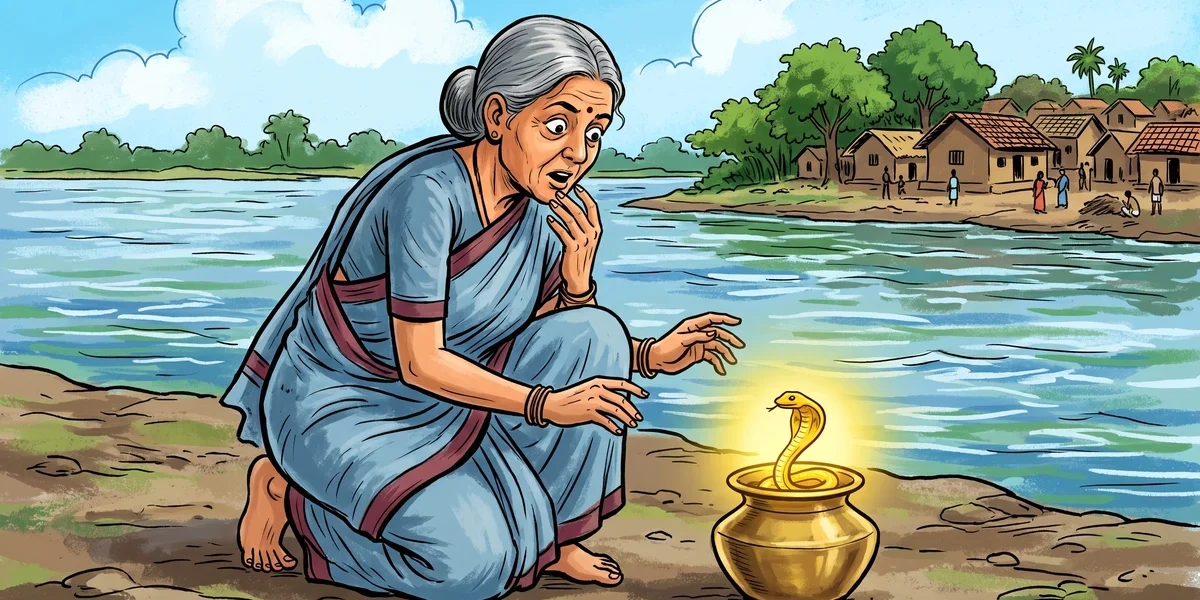
The Snake Prince: Once upon a time there lived by herself, in a city, an old woman who was desperately poor. One day she found that she had only a handful of
The Naga as Royalty: When Serpents Hold Kingdoms
Among the most widespread and cosmologically charged tale-types in South Asian narrative, the Snake Prince occupies a unique position: it is simultaneously a love story, a creation myth in miniature, and a theological statement about the boundary between the human and the serpentine divine. In Indian tradition, Nagas — the semi-divine serpent beings — are not merely animals but a parallel civilization, ancient beyond reckoning, dwelling in the Patala (underworld) kingdoms of immense wealth and wisdom. A Naga prince who takes human form to wed a mortal woman is not condescending; he is crossing a cosmological threshold, honoring the human world with his presence. The tale’s premise is thus far richer than it initially appears: this is not a beast-bridegroom story in the European sense, but a sacred alliance between realms.
Naga mythology pervades the Mahabharata, the Puranas, and Buddhist Jataka literature. Naga kings Vasuki and Shesha serve the gods as cosmic accessories — Vasuki as the churning-rope at the Samudra Manthan, Shesha as Vishnu’s couch. Local Naga cults spread from Kerala’s sarpa kavu (serpent groves) to Nagaland to Nepal, testifying to a pan-Indic reverence for snakes as guardians of fertility, hidden treasure, and ancestral continuity. When a folk tale places a prince in this lineage, it roots him in this entire sacred geography.
The Shape-Shifting Husband: Naga Marriage in Anthropological Perspective
The motif of a husband who sheds a serpent skin at home — only to be trapped in human form when the wife burns or hides the skin — appears in folklore databases (AT 400, AT 433B) across cultures: the swan-maiden reversal, the selkie husband of Celtic tradition, the Japanese snake-husband tales. What distinguishes the Indian Snake Prince is the theological weight his serpentine nature carries. When the Naga prince sheds his skin, he is not merely shape-shifting; he is moving between sthulas — gross material states — as beings of higher ontological order can. His serpent form is his true, primordial body; his human form is assumed as a gift or accommodation.
Anthropologists studying Naga marriage traditions in village India — particularly in Andhra Pradesh, Karnataka, and Kerala — document living ritual complexes where families claim Naga ancestry and propitiate serpent ancestors through annual ceremonies. The folk tale of the Snake Prince draws directly on this living cosmological reality. For the tale’s original audience, the possibility of Naga-human marriage was not fantasy but a mythically attested fact recorded in Puranic genealogies: the Naga princess Ulupi marries Arjuna; the Pandava line itself is entangled with serpent royalty.
Trust, Taboo, and the Crisis of the Serpent Skin
The tale’s structural crisis typically turns on a transgression: the wife discovers the shed skin, acts upon it — burning it, hiding it, or showing it to others — and thereby either liberates or loses her husband. This transgression-and-consequence structure maps onto the Sanskrit narrative concept of niyama-bhanga (rule-breaking), which triggers the plot’s second movement. The prohibition against viewing or tampering with the skin is a vriti-niyama, a life-regulation analogous to the brahmacharya rules governing ascetics or the dietary laws governing initiates. Its violation is not mere curiosity but a breach of sacred trust — a category closer to ritual transgression than to moral failing.
This nuance is crucial: the wife who burns the skin is not villainous but tragic. She acts from love — wishing to bind her husband permanently to human form — yet the act destroys what she sought to preserve. Indian narrative theory (rasa-shastra) classifies this as the mood of karuna (pathos/compassion) arising from inadvertent harm. The audience’s sympathy remains with the wife even as they recognize her transgression, because her motive was devotion rather than malice. The tale is thus ethically sophisticated: it refuses simple moral condemnation while demonstrating that even devotion can transgress sacred boundaries with catastrophic results.
Reunion and Transformation: The Heroic Journey to Patala
In the tale’s resolution — typically a quest through the underworld or distant serpent kingdom to retrieve the vanished prince — the wife undertakes a journey structurally identical to the classical vira-charya (heroic conduct) of male epic heroes, but driven by pativrata devotion rather than martial ambition. She descends into Naga territory, survives trials set by the Naga court, and wins her husband’s return through demonstrated love and endurance. This quest-for-the-lost-beloved motif echoes Savitri’s pursuit of Yama to retrieve Satyavan, and Rati’s devotion that reconstitutes Kama after Shiva’s destruction — female devotional heroism as the supreme transformative force in the universe.
The Snake Prince tale thus encodes a complete theology of devotion: love that can cross cosmological thresholds, endure transgression’s consequences, and ultimately restore what was lost not through power but through persistent, witnessing presence. It is one of Indian folk narrative’s most complete emotional and theological arcs, compressed into a village tale short enough to tell by firelight.
“He was a prince of Patala who chose the upper world for love — and she proved worthy of that choice by descending to find him when love’s own mistake drove him home.”
Why This Story Lasted
The Snake Prince endures because it holds together irreconcilable things — the divine and the domestic, the sacred transgression and the forgivable act, the terror of serpents and the tenderness of marriage — and refuses to resolve them cheaply. It acknowledges that love can err, that sacred thresholds once crossed cannot be uncrossed without cost, and that the only path forward is not innocence but earned return. Every generation of listeners has found in it a map for navigating their own crossings — between worlds, between rules and desires, between what was and what devotion might yet restore.
Frequently Asked Questions
Who are the Nagas in Indian mythology?
Nagas are semi-divine serpent beings in Indian tradition, dwelling in the Patala (underworld) kingdoms and associated with fertility, hidden treasure, and ancestral wisdom. Naga kings like Vasuki and Shesha serve cosmological roles in the Mahabharata and Puranas, and living Naga cults persist from Kerala’s sarpa kavu to Nepal, making snake-prince tales theologically grounded rather than merely fantastical.
What does the serpent skin represent in the story?
The serpent skin is the prince’s primordial, true body — his Naga form. It represents the sacred threshold between realms. Tampering with it is a niyama-bhanga (sacred rule violation), analogous to the dietary or behavioral prohibitions governing ascetics. The wife’s act — typically burning it from love — is a tragic transgression of sacred trust rather than a moral failing.
Are Naga-human marriages attested in Indian sacred literature?
Yes — the Naga princess Ulupi marries Arjuna in the Mahabharata, and the Pandava line is intertwined with serpent royalty. Puranic genealogies record multiple Naga-human alliances, and anthropologists document living ritual complexes in Andhra Pradesh, Karnataka, and Kerala where families claim and propitiate Naga ancestry.
How is the wife’s quest to recover the Snake Prince related to Savitri?
Both Savitri (who follows Yama to retrieve Satyavan) and the Snake Prince’s wife undertake a heroic descent into the domain of death or the underworld, driven by pativrata devotion. In both tales, female devotional heroism — not martial power — is the transformative force that overcomes cosmic boundaries and restores the lost beloved.
Does The Snake Prince appear in other world folklore traditions?
Yes — the shape-shifting spouse who sheds animal form appears across cultures: the swan-maiden (Europe), the selkie husband (Celtic), and Japanese snake-husband tales (AT 400, AT 433B). The Indian version is distinguished by the theological weight of Naga identity — the serpent form is a higher ontological state, not a curse, making the story’s cosmological stakes unique among world variants.
Frequently Asked Questions
**Q: Why is this story important?**
You May Also Like
 Aesop's Fables
Ages 3-5
Aesop's Fables
Ages 3-5
The Thanksgiving Of The Wazir
The Thanksgiving Of The Wazir: Once upon a time there lived in Hindustan two kings whose countries bordered upon each other; but, as they were rivals in wealth
 Aesop's Fables
Ages 3-5
Aesop's Fables
Ages 3-5
Bholu’s Freedom | What Does Freedom Mean?
Bholu’s Freedom | What Does Freedom Mean?: The construction site looked like a huge maze, filled with the various sounds emanating from men and machinery. True
 Aesop's Fables
Ages 3-5
Aesop's Fables
Ages 3-5
The Good Husband And The Bad Wife
The Good Husband And The Bad Wife: In a remote village there lived a Brâhmiṇ whose good nature and charitable disposition were proverbial. Equally proverbial