The Lamb and the Wolf
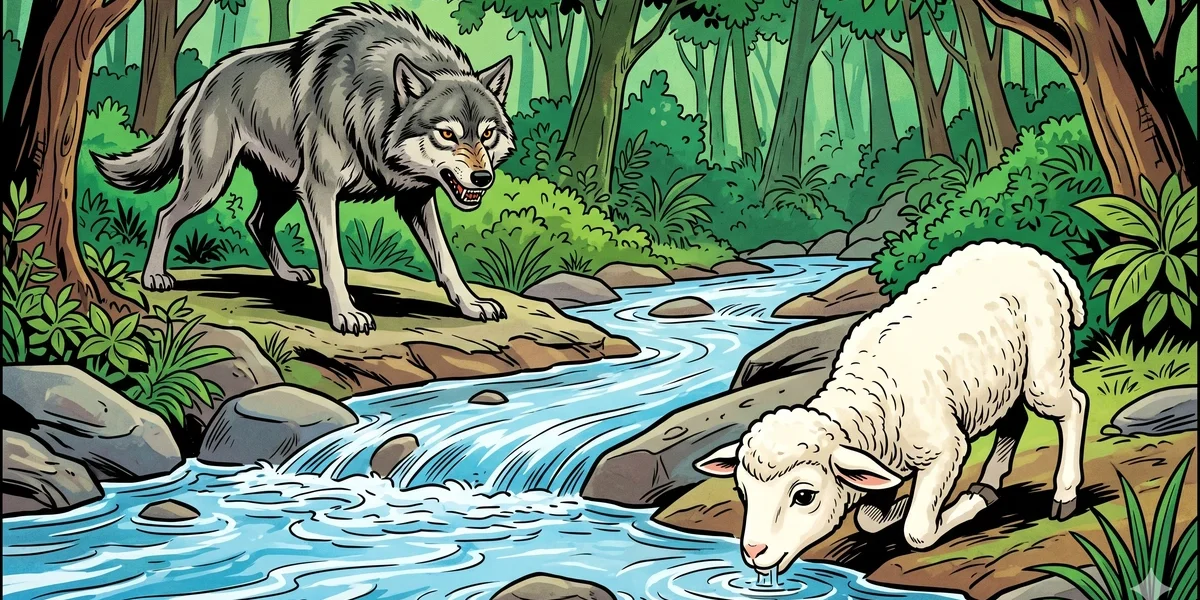
The Lamb and the Wolf: In a bustling town in ancient India, A young lamb encountered a hungry wolf at a stream. This tale, beloved across generations, carries
The Wolf’s Argument: When Power Invents Its Own Justice
Of all the fables in Aesop’s corpus, The Lamb and the Wolf (Fable 155, Perry Index) is among the most unsettling precisely because of its formal structure: the wolf does not simply devour the lamb — it first constructs a series of elaborate justifications for doing so, each of which the lamb calmly refutes with fact and logic, before the wolf acknowledges that argument is irrelevant and proceeds to eat the lamb anyway. The fable’s final verdict — “The tyrant needs no excuse” — is among the most economical summaries of predatory power ever written. In Indian retellings, this structural analysis of how power creates false justifications acquires additional depth through the lens of adharmika-nyaya (unjust reasoning) and the Arthashastra’s analysis of how weak parties interact with strong ones.
The wolf’s argumentative strategy is a textbook example of what Indian logicians call vitanda — destructive argument whose purpose is not to establish truth but to disable the opponent’s position, regardless of the arguer’s own commitment to any alternative truth. The wolf has no genuine grievance against the lamb; its “grievances” are manufactured post hoc to provide a justification for action it intends to take regardless. This pattern — power acting first and justifying second — is one that Indian political philosophy from the Arthashastra through the Mahabharata analyzes with unflinching clarity.
Vitanda and Jalpa: The Indian Analysis of Sophistic Argument
The Nyaya school of Indian philosophy, in its Nyayasutras (c. 2nd century CE), distinguishes between three types of debate: vada (honest inquiry seeking truth), jalpa (contentious debate seeking victory rather than truth), and vitanda (destructive disputation seeking to refute without offering any positive alternative). The wolf’s successive accusations — “You muddied my water upstream,” “Your father insulted me last year,” “You are a sheep and therefore guilty” — are pure vitanda: each accusation is refuted by the lamb’s calm factual response, yet the wolf simply produces another accusation. No genuine inquiry is occurring; the wolf is performing the social form of justification without its substance.
Indian legal theory (dharmashastra) was acutely aware of this phenomenon in juridical contexts. The Arthashastra’s chapters on legal procedure explicitly warn against allowing powerful parties to use the form of legal argument to disable weaker parties’ legitimate claims. Kautilya specifies that judges must recognize vitanda — argument that refutes without constructing — and discount it accordingly. The lamb’s situation is that of a weaker party facing a stronger one who has co-opted the language of law and reason while violating its spirit. This is a situation the Arthashastra considers endemic to all societies and attempts to address through procedural safeguards — safeguards the lamb, in the wilderness, has no access to.
The Weak and the Powerful: Niti for Unequal Encounters
The Panchatantra’s very first book (“The Loss of Friends”) opens with the analysis of why the strong prey on the weak and what the weak can do about it — identifying four possible responses: flight, alliance, appeasement, and diplomacy. The lamb, alone at the stream, has no ally, no means of flight (the wolf has cornered it), and appeasement has failed (the lamb has successfully refuted every charge, yet this makes no difference). The lamb’s situation is, within Panchatantra strategic logic, a worst-case scenario: all four responses are unavailable. The tale does not pretend otherwise.
Indian political philosophy is notably unsentimental about such situations. The Arthashastra does not suggest that a weaker party who reasons correctly will necessarily survive an encounter with a stronger party who has decided to act unjustly. What it does suggest is that the structural analysis of such encounters — understanding why the wolf argues as it does, recognizing vitanda when you see it, knowing that power under such circumstances will manufacture justification regardless of its quality — is essential preparation for navigating a world in which such encounters are inevitable. The lamb’s calm refutations are not futile; they are a demonstration of the quality of mind that, in other contexts and with better odds, would survive.
The Fable’s Uncomfortable Realism and Its Indian Resonance
What makes The Lamb and the Wolf unusual in the fable tradition is its refusal of poetic justice: the lamb does everything right — remains calm, argues logically, refutes every false accusation with facts — and is eaten anyway. Most fables reward virtue and punish vice; this one documents a situation in which virtue and intelligence are insufficient against overwhelming force. The Indian tradition, unlike some Western moralizing traditions, is comfortable with this realism. The Mahabharata’s central tragedy — Yudhishthira’s righteous kingdom lost despite his dharmic conduct — encodes the same uncomfortable truth: righteousness does not guarantee worldly success in a world where power distributes itself independently of desert.
What Indian tradition adds to this realism is not consolation but perspective: the lamb’s conduct preserves its dharmic integrity even as it cannot preserve its life. The wolf’s argument may prevail in the wilderness, but in the cosmic ledger of karma, the wolf’s vitanda accumulates as adharma, and the lamb’s calm truthfulness as a form of satya-vrata (truth-vow) maintained even under mortal pressure. The tale thus operates simultaneously as a realistic political analysis and as a karma-ledger entry, in which the apparent winner and the apparent loser are evaluated on separate axes.
“The lamb answered every charge with truth and reason — and the wolf listened with patience and care, then ate the lamb. Some arguments are not about winning; they are about remembering who you are while losing.”
Why This Story Lasted
The Lamb and the Wolf endures because the situation it depicts — power manufacturing justification for actions it intends to take regardless — recurs in every human institution and every era. Legal systems, corporate hierarchies, political structures, and interpersonal relationships all contain versions of the wolf’s argument, deployed against versions of the lamb. The fable’s value is not comfort but clarity: it names the pattern with such precision that anyone who has encountered it recognizes it immediately. And recognition, even when it cannot prevent what follows, is the first step toward building systems in which the wolf’s argument does not get to be the last word.
Frequently Asked Questions
What is vitanda in Indian philosophy and how does the wolf use it?
Vitanda (from the Nyaya school’s Nyayasutras) is destructive disputation — argument that refutes without offering any positive alternative, seeking to disable rather than establish truth. The wolf’s successive accusations — each refuted by the lamb, each replaced by a new one — are pure vitanda: the form of justification without its substance. No genuine inquiry occurs; the wolf manufactures the social performance of reason while acting from pure appetite.
What does Kautilya’s Arthashastra say about powerful parties using legal argument against weaker ones?
The Arthashastra explicitly warns against powerful parties co-opting legal argument to disable weaker parties’ legitimate claims. Kautilya specifies that judges must recognize vitanda (argument that refutes without constructing) and discount it accordingly. The lamb’s situation — facing a wolf who has co-opted the language of justice while violating its spirit — is exactly the scenario Kautilya’s procedural safeguards were designed to prevent.
Why is the lamb eaten despite arguing correctly?
The fable refuses poetic justice: correct argument is insufficient against overwhelming force. The Panchatantra’s strategic analysis shows all four responses (flight, alliance, appeasement, diplomacy) are unavailable to the lamb in its worst-case scenario. Indian tradition is notably unsentimental about this: the Mahabharata’s tragedy encodes the same uncomfortable truth that righteousness does not guarantee worldly success when power distributes independently of desert.
Does Indian philosophy offer any consolation for the lamb’s situation?
Indian tradition offers not comfort but karma-perspective: the lamb’s calm truthfulness maintains satya-vrata (truth-vow) even under mortal pressure, accumulating dharmic integrity in the cosmic ledger; the wolf’s vitanda accumulates as adharma. The apparent winner and apparent loser are evaluated on separate axes. The lamb’s conduct preserves its integrity even as it cannot preserve its life — which Indian narrative considers a form of victory.
Why is recognizing the wolf’s argument pattern valuable even when it cannot prevent the outcome?
Recognition of the vitanda pattern — power manufacturing post-hoc justification for predetermined action — is the first step toward building institutions in which this pattern does not prevail. The fable’s value is clarity, not comfort: naming the structure of predatory argument precisely enough that it can be recognized, challenged procedurally, and ultimately constrained by the kind of institutional safeguards Kautilya’s Arthashastra was attempting to build.
You May Also Like
 Aesop's Fables
Ages 3-5
Aesop's Fables
Ages 3-5
The King Of Crocodiles
The King Of Crocodiles: Once upon a time a farmer went out to look at his fields by the side of the river, and found to his dismay that all his young green
 Aesop's Fables
Ages 3-5
Aesop's Fables
Ages 3-5
The Magic Shoes And Staff
The Magic Shoes And Staff: Far, far away in a town of India called Chinchini, where in days long gone by the ancient gods in whom the people believed are said
 Aesop's Fables
Ages 9-12
Aesop's Fables
Ages 9-12
The Goose That Laid Golden Eggs
The Goose That Laid Golden Eggs: In a modest farmstead nestled in a valley where green fields stretched to the horizon and wildflowers bloomed in abundance