Nasreddin Hodja & the Smoke Seller – Folktales from Turkey
Nasreddin Hodja & the Smoke Seller – Folktales from Turkey: One day a poor man was passing through the market of Aksehir. He came across the shop of a grilled
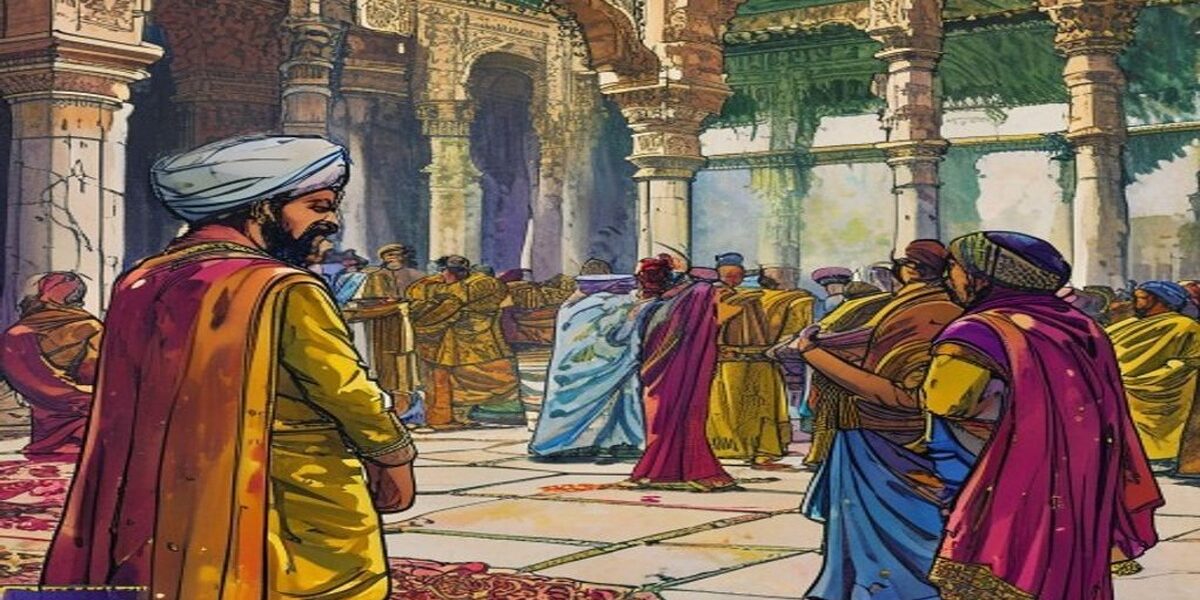
Nasreddin Hodja and the Smoke Seller: The Sound of Money for the Smell of Food
Nasreddin Hodja: The World’s Most Beloved Wise Fool
Nasreddin Hodja — known as Molla Nasreddin in Persian tradition, Juha in Arabic tradition, and Afanti in Chinese Uyghur tradition — is one of the most widely distributed trickster-sage figures in world folk literature. Thousands of tales attach to his name, and the tales have been told and retold across a region stretching from Morocco to China, from the 13th century to the present day. He is simultaneously a fool and a sage, a buffoon and a judge, a man who rides his donkey backwards and a man whose seemingly absurd judgments contain genuine wisdom.
The Hodja embodies a form of intelligence that every folk tradition values but finds difficult to produce through ordinary channels: the wisdom that sees through social convention, through legal technicality, through the pretensions of the educated and powerful, to the underlying truth of a situation. He is, in this sense, a comic prophet — the person who says the thing that everyone knows but no one will say, dressed up in absurdity so that the powerful cannot take offence and the foolish can laugh without understanding what they are laughing at.
In the tale of the Smoke Seller, the Hodja is cast in his most characteristic role: not as protagonist in an adventure, but as judge in a dispute. Someone has come to him with a complaint; someone else must answer for it; and the Hodja must render a judgment. The wisdom tradition around Nasreddin consistently places him in this judicial posture because it allows the tale to function as a legal parable — a compact, memorable illustration of a principle of justice or equivalence that the audience can carry away and apply.
The Dispute: The Baker’s Complaint and the Poor Man’s Pleasure
The structure of the Smoke Seller tale is simple and has been told in variants across the Hodja tradition. A baker — prosperous, proprietorial, with a sharp nose for both bread and business — notices that a poor man has taken to standing near his shop at mealtimes. The poor man does not buy bread; he cannot afford to. But he stands near the window or doorway, breathing deeply, taking pleasure in the warm, fragrant smoke and steam that pours from the baker’s oven — the smell of bread baking, of oil and sesame and warm yeast. For the poor man, the smell is his meal, or at least its pleasantest supplement.
The baker decides this is theft. The poor man is extracting value from his establishment — the value of the smell, the product of his fuel, his labour, his ingredients — without paying for it. He demands compensation and brings the matter to the Hodja. This is the complaint in its essentials: a claim that the use of an intangible — a scent, a sensory experience, an atmospheric quality of a place — constitutes a form of taking that must be compensated.
The complaint is not, on its face, entirely absurd. The concept of unjust enrichment — gaining a benefit at another’s expense without compensation — is a real principle in legal traditions worldwide. If one person’s pleasure is produced by another person’s labour, is there not some argument for compensation? The baker’s complaint has a certain internal logic that makes the Hodja’s task more interesting than a simple dismissal: he must find a response that is proportionate to the actual nature of the transaction, not merely its surface appearance.
“The baker sells bread. The smell of bread is not bread. If the poor man has taken the smell, let the baker take the sound of money — and we are even.”
The Judgment: Sound for Smell, Equivalence Made Visible
The Hodja hears both sides. Then he asks the poor man if he has any money at all. The poor man produces a few small coins — all he has. The Hodja takes the coins and holds them near the baker’s ear, clinking them together. He shakes them, rattles them, lets the baker hear the sound of money in his hand. Then he gives the coins back to the poor man and pronounces his judgment: “The baker has been paid. The smell of food has been paid for with the sound of money. Court is dismissed.”
The judgment is a perfect philosophical joke. It accepts the baker’s premise — that a sensory experience can be traded, that intangibles have value — and applies it with strict equivalence: if the smell of bread has value and can be extracted without purchase, then the sound of money also has value and can serve as payment without transfer. The transaction is complete: sensation for sensation, intangible for intangible, zero net exchange.
The underlying principle is what logicians call reductio ad absurdum: the baker’s argument is shown to be absurd not by contradicting it directly but by applying it with full rigour to a case the baker did not anticipate. If you can charge for the smell of your food, then you can be paid in the sound of money. The argument refutes itself when extended consistently. This is the Hodja’s characteristic method: not argument but demonstration, not refutation but performance.
Value, Intangibles, and the Philosophy of Exchange
The Smoke Seller tale engages, in its comic way, with questions that have occupied economists and legal philosophers for centuries: What is value? Can intangible goods — experiences, sensations, aesthetic pleasures — be owned and sold? What distinguishes legitimate exchange from unjust enrichment? The baker’s argument anticipates, by several centuries, the modern concept of intellectual property: the idea that intangible products of labour (a smell, a design, a song) are as proprietary as physical goods.
The Hodja’s judgment implicitly rejects this argument — or rather, dissolves it by taking it too seriously. By accepting that the smell has value and showing that the “payment” in sound is equivalent, he demonstrates that the whole framework of the baker’s complaint is category-confused: it is attempting to apply the logic of commodity exchange to something that exists outside that logic. The smell of bread was not produced for the poor man; the poor man did not divert it from another use; the baker’s customers were not deprived of it; the baker suffered no loss. The complaint was not about loss at all — it was about control, about the baker’s desire to own not just his bread but the entire sensory atmosphere of his enterprise.
This is why the Hodja’s judgment is satisfying as both comedy and wisdom: it identifies the real nature of the complaint — an attempt to extend property rights into the atmosphere — and dismisses it with the only coin appropriate to such a transaction. The laughter the story generates is the laughter of recognition: of course the baker cannot own the smell of his bread. Of course. But it took the Hodja’s absurd literalism to make that obvious.
For children, the story delivers a simple and memorable lesson about fairness and proportion: if you want to charge for nothing, you can expect to be paid in nothing. For adults, the story is a more complex meditation on the nature of value, the limits of property, and the kind of intelligence that resolves disputes not by force or technicality but by illuminating the absurdity of the claim itself.
Why This Story Lasted
Nasreddin Hodja tales have survived and spread across a dozen cultures and eight centuries because they perform a function that formal legal and philosophical traditions often cannot: they make justice memorable, portable, and funny. The Smoke Seller tale endures because its central insight — that you cannot price intangible experience without accepting payment in equivalent intangibles — is both genuinely wise and immediately amusing. Every telling produces the same moment of delighted recognition: of course. Of course that is the right answer. The Hodja’s genius, like all great comic wisdom, is to make the obviously correct answer seem surprising until the moment it is spoken — and then inevitable.
Frequently Asked Questions
Who is Nasreddin Hodja and where do the tales come from?
Nasreddin Hodja (also spelled Nasreddin Hoca in Turkish, or Molla Nasreddin in Persian) is a semi-legendary wise-fool figure whose tales are told across Turkey, Central Asia, the Middle East, the Balkans, and beyond. Tradition places him in 13th-century Anatolia, often specifically in Akşehir (in modern Turkey), though similar figures exist in Arabic tradition (Juha), Persian tradition (Molla Nasreddin), and Uyghur/Chinese tradition (Afanti). UNESCO has listed the Nasreddin Hodja tales as part of the Intangible Cultural Heritage of several countries. There are estimated to be several thousand tales attached to the Hodja name, of varying ages and origins.
What is the moral of the Nasreddin Hodja Smoke Seller story?
The primary moral is one of proportional equivalence: if you wish to charge for intangible value (like the smell of food), you must accept payment in equally intangible value (like the sound of money). More broadly, the story argues against the attempt to extend property rights into the sensory atmosphere — to charge for experiences that the other party did not deliberately acquire from you, that cost you nothing to provide, and that did not deprive any other customer. The Hodja’s judgment shows that the baker’s complaint is not about genuine loss but about an unwarranted desire for control.
Are there similar “sound for smell” judgments in other folk traditions?
Yes. The “sound of money for smell of food” judgment appears in various forms across Middle Eastern, Central Asian, and South Asian folk traditions, often attributed to different wise-fool or judge figures. In Arabic tradition, variants are attributed to Juha; in Persian tradition, to Molla Nasreddin. The tale type is classified in the Aarne-Thompson-Uther index and has parallels in Eastern European Jewish (Chelm stories) and Indian (Birbal, Tenali Raman) trickster-judge traditions. The wide distribution of the tale confirms that the underlying philosophical insight — the joke about symmetrical intangibility — is genuinely cross-cultural.
What makes Nasreddin Hodja different from other trickster figures?
Most trickster figures in world folk literature — Anansi, Coyote, Loki, the fox in European tales — operate through deception for personal gain. Nasreddin Hodja is distinctive in that his “tricks” are usually in service of justice or truth rather than personal advantage, and his apparent foolishness is consistently revealed to be wisdom in disguise. He is less a trickster than a Socratic figure dressed in the clothes of a fool — someone who uses apparent absurdity to expose the absurdity already present in a situation. His tales typically reward the poor, expose the pretentious, and confound the rigid. This combination of comic fool and moral sage is unusual in world folklore and explains the Hodja’s exceptional longevity.
What can children learn from Nasreddin Hodja stories?
Nasreddin Hodja tales offer children several valuable lessons: that wisdom sometimes comes in unexpected packages (the apparent fool who turns out to be wiser than the learned); that fairness involves proportionality and consistency (applying the same rules to both sides of a dispute); that clever thinking can resolve situations that force cannot; and that the obvious “right answer” often seems surprising until someone actually says it. The tales also implicitly teach critical thinking — the ability to examine the premises of an argument and follow them to their logical conclusions, which is exactly what the Hodja does in the Smoke Seller tale.
Frequently Asked Questions
**Q: Why is this story important?**
You May Also Like
 Aesop's Fables
Ages 3-5
Aesop's Fables
Ages 3-5
Infidelity – A Short Story
Infidelity – A Short Story: I looked through the partly opened door. I found her sliding through our old pictures. Her fingers paused on each one. Her light
 Aesop's Fables
Ages 3-5
Aesop's Fables
Ages 3-5
The Ruby Prince
<p>Read ‘The Ruby Prince’ — a classic Aesop’s Fables story about honesty. In this classic Aesop’s fable, a ant, a king, and a prince take center stage in a…</p>
 Aesop's Fables
Ages 9-12
Aesop's Fables
Ages 9-12
The North Wind and the Sun
The North Wind and the Sun: In the time when the gods still walked among mortals and the forces of nature were personified as powerful beings with their own