Ranavirasing
A dying king leaves his young son in the care of his faithful servant Ranavirasing, for a greedy minister is waiting to seize the throne for himself.
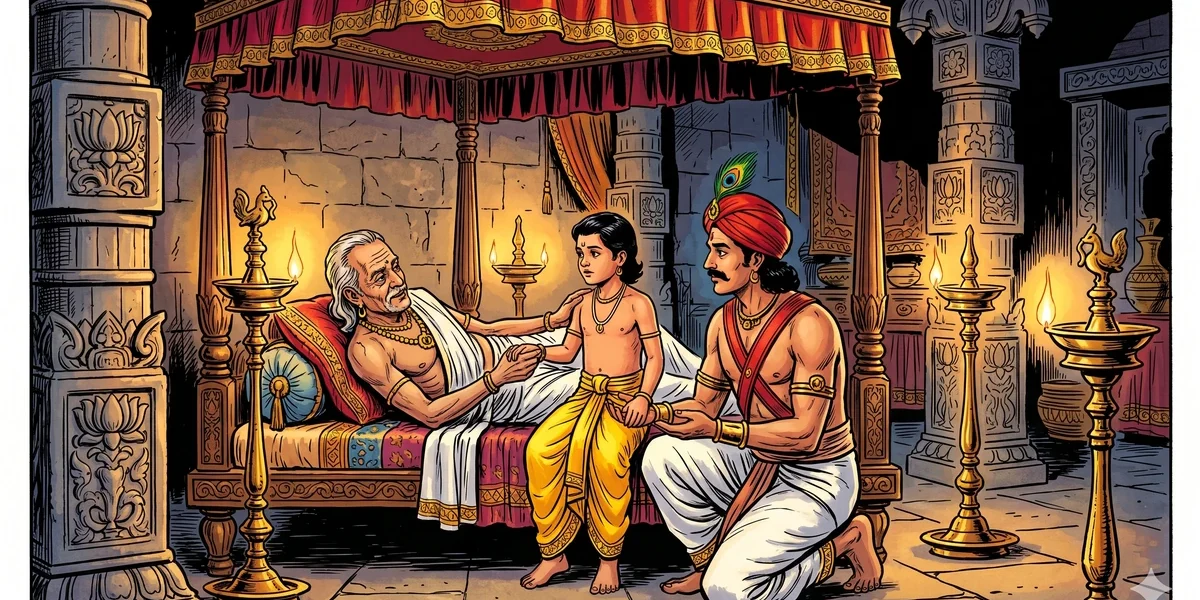
Long ago, in the town of Vanjaimanagar, there ruled a king named Sivachar. He was so just and ruled so well that it was said no stone thrown into the air ever fell back to hurt anyone, no crow pecked at freshly drawn milk, and the lion and the bull drank side by side from the same pond. Peace and plenty filled the kingdom. Yet in spite of all these blessings, the king’s face was always clouded with care, for he had no son. The tale explains his fear through a belief that a man without a son would fall after death into a dark place called Put, from which a son could save him. So the king spent his days and nights praying for one. Wherever he found a sacred pipal tree, he had Brahmins, the priests, walk around it in prayer. Whatever medicine the doctors ordered, however bitter, he swallowed. He tried everything, but nothing worked.
Sivachar had a minister named Kharavadana, as wicked and cruel a man as ever lived. Seeing that the king had no heir, and no hope of one, the minister began to dream of winning the throne of Vanjaimanagar for his own family. The king knew this very well, but what could he do? All he could do was pray harder.
At last fortune smiled on Sivachar, and in his sixtieth year a son was born to him. His joy was beyond words. Hundreds of thousands of Brahmins were fed to celebrate the birth, the prisons were opened and every prisoner set free, and cattle and land were given away in charity. On the eleventh day the king saw his son’s face for the first time, and in it he read the signs of good fortune, learning, courage and goodness.
The ceremonies of swinging the cradle and giving the child his name were held in the proper way, and the elders named the prince Sundara, which means “the fair one”. The whole kingdom rejoiced, and only one man was sorry: the minister, whose hopes had been dashed. But he said to himself, “Let me wait and see. The old king is close to his grave. If he dies while his son is still a child, I shall rule for the boy for a while. Won’t that give me chance enough to win the throne for my family for ever?” So he kept quiet for the time being.
Sivachar was a shrewd man and often read the minister’s thoughts. “This cruel devil may kill my only son,” he sighed. “I don’t care if he steals the throne. What I fear is that he will murder my boy. But there is no god greater than Shiva, and if this is what is written on my son’s forehead, I cannot change it.” The worry made him thinner day by day, and exactly ten years after Sundara’s birth, the king fell ill and lay dying.
The king had a servant named Ranavirasing, whom he had always found to be honest and faithful. He called this servant to his bedside and sent everyone else from the room except Sundara, who was weeping by his father’s pillow.
“My dear Ranavirasing,” said the king, “I have only a little time left. Listen to me and do as I say. There is one God above us all, who punishes the wicked and rewards the good. If greed for money ever makes you betray the trust I am about to give you, God will surely punish you. You know how hard it was for me to have this son, how many temples I built, how many Brahmins I fed, how many hard penances I made. And God gave me a son at last.”
Here grief overcame him, and he began to weep aloud.
“Don’t cry for me, Father,” said the prince. “We cannot rub out what is written on our foreheads. We must take the happiness or the sorrow that Brahma has written there.”
Ranavirasing was deeply moved. He took the boy on his lap and wiped his eyes with the end of his own shawl.
The old king went on. “So you know everything, my faithful Ranavirasing. Now I almost wish I had not done all those things to have a son, for when I die, who will look after him? Kharavadana may try one plot after another to get rid of my boy and take the kingdom. You are my only hope. I give him into your hands.” Ill as he was, the old father raised himself a little, took his son’s hand, kissed it for the last time and placed it in Ranavirasing’s.
“Never mind if he does not get the kingdom,” he said. “If you only keep him safe from that wicked minister, whom I have long seen longing for the throne, you will do a great service for your old master. From this moment I make you lord of my palace. From this moment you are father, mother, brother, servant and everything to my son. Take care that you never betray your trust.”
Then the king sent for the minister. “Kharavadana,” he said, “look at me. Yesterday I sat on the throne, and in a few minutes I must die. That is how uncertain life is. Only a man’s good deeds follow him into the next world. Take my signet ring.” And he drew the ring from his finger and gave it to the minister. “The throne is yours for now, while the prince is too young to rule. Govern the kingdom well, and when the prince turns sixteen, give the throne back to him. Look after him like a father, and find him a good and clever princess for a wife.”
Before he could finish, the king felt death upon him. The minister, looking wise and solemn, promised him everything, and Sivachar breathed his last. His funeral was held with all the usual mourning, and the minister himself saw to every ceremony.
So Kharavadana sat on the throne of Vanjaimanagar, and Ranavirasing became lord of the palace and kept faith with his promise. He never left Sundara’s side. So that the prince would not lose the joys of boyhood in his studies, Ranavirasing brought twenty well-behaved and well-taught boys from good families to the palace to study and play with him, and he hired a teacher for every subject. Sundara grew up with a fine education, but he was never allowed to leave the palace.
Ranavirasing had good reason to guard him so strictly. As soon as Kharavadana became king, he had secretly let it be known that whoever killed Sundara would be paid ten million gold coins, and already every greedy hand was itching for the prince’s head. Before this, the minister had found a girl and married her to the prince, and she lived with her husband in the palace. But because the minister had chosen her, Ranavirasing watched her closely and would not let Sundara talk with her. He even told the prince never to accept so much as a betel leaf from her hand. The prince resented this restriction and grumbled about his guardian, but had to obey.
Sundara turned sixteen, but nothing was said about handing over the kingdom. The prince, almost a prisoner in the palace, had forgotten about it, and Ranavirasing wanted to wait until he was better fitted to rule. Eight full years passed after Sivachar’s death, and Sundara was eighteen, and still he had not been given his kingdom. His only pleasure was the company of his friends, for Ranavirasing’s fatherly care felt to him like a wall shutting out all the fun of youth.
One evening in spring, the prince sat with his friends on the seventh storey of his palace, looking out over the town as dusk fell and the people finished their work and went home. In the eastern part of the town he saw a large building, and to break the silence, he asked his friends what it was.
“That is the king’s court,” said one of them, “where you ought to have been sitting these last two years. That wretched minister Kharavadana has stolen your seat. If he had meant to give you the kingdom, he would have done it two years ago, when you turned sixteen. We can only be thankful that God has kept you alive, in spite of the reward promised to whoever brings your head. At least people are beginning to forget about it now.”
These words pierced Sundara like arrows. His face changed colour with shame, and his friends saw it and were sorry they had spoken. The prince quickly put on a cheerful face and turned the talk to happier things, but before they parted late that night, he asked them all to come to the council hall early the next morning. And he told Ranavirasing to have horses ready for himself and his friends to ride through the town the next day.
“I have been waiting to hear such an order from your own lips, my dear prince!” said Ranavirasing. “You were so quiet that I feared you had no spirit. The horses will be ready.” And he ordered twenty-one horses to be saddled and decked out, and appointed some of his men to ride ahead of the party.
In the morning the friends gathered, and after a light breakfast they mounted. Horsemen rode in front and behind, the prince and his friends rode in the middle, and Ranavirasing rode beside the prince with his sword drawn. They passed through the four main streets of the town, and everyone stood up and bowed to the son of their old king. But when they passed the minister’s mansion, Kharavadana showed no respect at all. Ranavirasing could hardly bear the insult. He bit his lip, ground his teeth and wrung his hands. The prince saw how upset his faithful guardian was and laughed to himself at the old man’s simple ways. At midday they returned to the palace, and the prince, after the ceremonies of the new-moon day, ate a little and lay down to rest.
But though he had laughed at Ranavirasing, the insult had sunk deep into his own heart. That night, after a light supper, he shut himself in his bedroom early, while Ranavirasing kept watch outside as usual. His wife was fast asleep, and without waking her, the prince paced up and down. Then something like a thread in a corner of the room caught his eye. He looked closer and found that it was a rope ladder. He did not stop to wonder how it had got there. Ranavirasing had just gone off for a few minutes to eat his supper.
“The old fool has gone to eat, and God has put this ladder in my way,” thought Sundara. “Now I can escape.” He slipped out without his guardian seeing him and climbed to the top of the seventh storey. From there he threw the ladder towards a big tree in East Main Street, pulled it and found it held fast. “Let me climb down, and God will help me,” he prayed, and before the first watch of the night was over, he was standing in the street. Ranavirasing’s guard had made it so hard for him ever to go out that he felt God himself had helped him escape on that dark, moonless night.
“Life is dear to everyone,” he thought. “What shall I do if the minister’s men find me and kill me? But there is no god greater than Shiva, and he will help me.” He sat down on the stone bench outside the nearest house and waited for the noise of the town to die down.
He did not wait in vain. From where he sat, he heard the man and woman of the house talking. “Comfort yourself, my wife,” the man was saying. “What can we do? It is our fate. When the old king was alive, he valued my learning and paid me well for my knowledge of the holy books at every festival. Now a tyrant rules over us. I have stayed here hoping that Sivachar’s son would one day take the throne and end our troubles. Now that hope is gone, I have decided to leave this wretched city and go to some place where the king knows the value of learning.”
Sundara heard every word, and the words were like fuel on the fire of shame and anger already burning inside him. “I will try to win back my kingdom,” he said to himself. “If I succeed, I shall save others. If I die, only I shall die. May God help me.” And he walked out of the town through the east gate. The night was as dark as could be, clouds were gathering and it looked like rain.
On the way stood a temple of Ganesha, and as it had begun to drizzle, the prince went inside to wait for the rain to stop. No sooner had he stepped in than he saw two men coming towards the same temple. From their talk they seemed to be shepherds who had been watching their flocks in a nearby field and were coming to shelter from the rain. Sundara trembled for his life and crept further inside. The shepherds sat down on the porch, took out their bags and began to chew betel nut. A lizard chirped in a corner.
To break the silence, one shepherd said to the other, “Well, Ramakon, I’ve heard you are a great one for reading the meaning of birds’ calls and lizards’ chirps. Tell me what that lizard was saying just now.”
“This is news I would never tell at any other time,” said Ramakon. “But since nobody else is likely to be about on a rainy night like this, I will tell you. The lizard says that the prince of this town is hiding here in this very temple. I am glad that nobody has been tempted to harm him yet, although such a high price has been put on his head. The very fact that he has lived so long unhurt in the tiger’s den is a good sign for his future.”
Ramakon had hardly finished when the lizard chirped a second time, and Ramakon asked his friend, whose name was Lakshmanakon, what it meant.
“This is sad news for the prince,” said Lakshmanakon. “The lizard says that the minister and the chief officer of the realm are coming here in a few moments to talk over something secret.”
At that very moment they saw a light in the distance. “It’s the minister’s carriage. Let’s be off,” they said. “Only God can save the prince now.” And they both ran away.
Inside, the prince felt like a man being led to the gallows. His bitterest enemy was coming to the very place where he was hiding. “How foolishly I blamed my old guardian, Ranavirasing,” he thought. “Now I see how good his intentions were. Only Shiva knows how I can be saved from this.” He hurried to the innermost part of the temple, crouched behind the image of Ganesha and sat as still as a tree stump, hardly daring to breathe in case his breathing gave him away. As he waited, he had time to marvel at the shepherds’ wisdom in reading the lizard’s chirps, and at their simple honesty, for if they had been otherwise, they could easily have seized him and handed him over to the minister.
Just as the second shepherd had said, a carriage stopped in front of the temple, and out stepped the minister and his chief officer. Apart from the two of them, the driver and the prince hidden behind Ganesha, nobody was there. They had chosen this lonely spot in the dead of night for their secret talk.
The minister spoke first, and it was easy to hear how angry he was. “Why is the prince allowed to ride freely through my streets? Of all the servants who eat my salt, was there not one to cut off that cheeky head?” he roared.
“My king, my lord,” said the chief officer, “forgive me for what I am about to say. We have taken a kingdom that we have no right to. If the prince had asked for the throne two years ago, we should rightly have given it back. He never asked, and we did not give it. He never troubles us with demands but lives quietly in his own rooms like any poor subject. So why should we kill him? Why should we murder the only son of our old and well-loved king, Sivachar? My advice is that we stop troubling ourselves about him.”
Seeing that the minister did not like these words, the officer stopped, though he had much more to say.
“You miserable wretch!” bellowed the minister. “How dare you preach to your master? You shall see what comes of this before morning!”
The officer saw that the minister would not listen to his advice. Afraid for his own life, he begged a thousand pardons and promised to bring the prince’s head within a week. Since that was all Kharavadana wanted, he spared him. They talked of other things for a while and got ready to leave.
Behind the image, the prince was almost suffocating. Every short breath he took felt as though it might kill him, and the terrible words he had heard made it worse. Still he stayed hidden. When the minister and the officer had climbed into the carriage, Sundara gathered his courage. “Shiva has saved me so far, and he may save me to the end,” he thought. He crept silently out of the temple and climbed onto the back of the carriage as it rolled away. “I will follow them, come what may,” he said to himself, “and find out what other plots they are making against me.”
The carriage drove to the far side of the town, out through the west gate and into a large park. In the middle of the park lay a fine lake, its banks lit up as bright as day. In the middle of the lake was a small island with a splendid mansion, with pillars of gold, couches of silver and doors set with diamonds, like the palace of Indra in heaven. A broad road lined with sweet-smelling flowering trees joined the island to the shore.
Before the carriage stopped, the prince jumped down and hid in the shadow of a tree, where he could see everything that happened. The minister got out and sent the officer home. The prince was surprised to see no menservants anywhere in that garden. Instead, twenty young women of great beauty waited at the head of the road and led the minister through the flowering trees to the mansion. There he sat down on a richly cushioned golden couch and ordered the women to fetch the queen. Ten of them took their places on each side of an ivory palanquin and went off with it.
“These women are as lovely as the dancers of heaven,” thought the prince. “A woman more beautiful than they are must be the loveliest in the world. Let me see her.” And he waited eagerly for the palanquin to come back.
In a few minutes it came, and a charming young woman sprang lightly out of it. The minister ran to give her his hand. And what a horror the prince saw then! It was his own wife, the very girl the minister had married to him years before.
“Are my eyes deceiving me? Let me look again,” he thought, rubbing his eyes over and over to clear them. But he saw it plainly: it was his own wife.
“Oh, how foolishly I blamed that grey-haired guardian of mine for not letting me be friends with my wife!” he thought. “Now I see what he saw long ago. If I had spent more time with her, perhaps I would have been brought here by some secret way these villains seem to have into the heart of the palace. If I had taken anything from her hands, I would have died that very day. It is my dear old Ranavirasing who has saved me from all of this.”
As these thoughts and a thousand more ran through his mind, he saw his wife sit down beside the minister and scold him for being so slow to get rid of her husband, and for letting the chance slip during the morning ride. The minister made a thousand excuses and told her what had passed between him and his officer, and what the officer had promised. Then they went to their rest.
At that moment an owl hooted, and one of the serving women, who was clever at reading the meaning of owls’ hoots, hoping to win the minister’s favour, told him that the prince was hiding behind a tree in that very garden. Knowing the price on Sundara’s head, even the women rushed to catch him, and everyone ran with torches to search the garden.
The words fell on the prince’s ears like thunder. Before the search began, he was off. He leapt over a high wall and fled as swift as a kite, and before the minister and the women had even left the road to the lake, Sundara was in the north street of the town.
By now the news that the prince was out that night had spread like fire through the whole town, and greedy people were already hunting the streets for him. Sundara thought it too dangerous to go on through the streets and looked for somewhere safe to hide. Luck led him to an old, ruined almshouse, where in his father’s day food had been given to the town’s beggars, and where the beggars still came to sleep, though no rice was given there any more. The prince went in and lay down among them without anyone noticing. From there he could hear the people searching outside. In the garden, the minister searched in vain, blamed the serving woman for misreading the owl and went to bed.
Outside the north gate, three ghatikas’ walk away, which is a little over an hour, there lived a robber. Once every seven years he went out to rob. From the houses and mansions he broke into, he took only jewels, such as topaz, diamonds and cat’s eyes, for he thought gold and silver beneath him. Because he thought himself too grand to carry his own loot, he always took a porter with him to carry it, and that porter never came home from the robber’s cave, for once the job was done, the robber killed him so that he could never tell the robber’s secret.
As bad luck would have it, that moonless night was the night of the cruel robber’s expedition. When he came out and saw people hunting for the prince, he guessed that the prince was not in his palace and decided to rob it. Wanting a porter, he went into the ruined almshouse to pick one out from among the beggars. He passed over the others and came to the prince, and seeing that he was strong and sturdy, he thought, “This beggar will serve me well tonight. I will break my custom for once and reward him richly.” And he tapped Sundara on the back with his cane.
The prince had just closed his eyes, and in his short sleep he dreamed that the minister’s servants were chasing him and one of them had caught him. Just then the robber’s cane landed on his back, and he woke up in terror.
“Tell me who you are,” said the stranger.
“A beggar,” said the prince.
“How does the night look to you?” asked the robber.
“As dark as dark can be,” said the prince.
The robber rubbed a kind of black paint on the prince’s eyelids and asked, “How does the night look now?”
“As bright as if ten million suns were in the sky,” said Sundara.
Then the robber put a mark on the prince’s forehead and said, “I am a robber, and I am going to rob the palace while the prince is away. Follow me, and I will reward you richly. The paint has turned the night into day for you, and the mark on your forehead will let you go wherever you like without being seen.”
He took the prince by the hand and led him off to the palace. Wherever a door was locked, the robber touched the lock with a leaf he carried, and the lock sprang open and the door swung wide. The prince was astonished. In a few minutes the robber had opened every gate and every chest and taken out all the precious stones. He tied them up in a bundle, put it on the prince’s head and told him to follow. So Sundara helped to rob his own palace and carried the loot behind the robber, who, foolishly, never once suspected that his porter was a prince. Instead, he admired the young man’s good looks and decided to spare his life and make him his son-in-law, for he had a beautiful daughter and had long been looking for a good husband for her.
With this in mind, he reached his cave. He took the bundle from the prince’s head and ordered him into a large cell, and he closed its mouth with a huge stone, which he lifted by saying a magic spell over it. Then he took the jewels to his wife and told her how handsome the porter was and what a good match he would make for their daughter. But his wife did not like the idea and told him to do with this porter what they always did. And the robber, who never went against his wife’s wishes, went to fetch his sword.
Meanwhile the robber’s daughter, a good girl and very beautiful, had overheard everything. She ran to the cell where the porter was shut in, spoke a single word over the stone, and it opened. The prince, who had given up all hope, saw a lovely girl coming towards him.
“Whoever you are, dear porter,” she said, “run for your life! My father has named you as my husband, but my mother doesn’t like it, and he has gone to get his sword to kill you. Nobody but the three of us can open these gates once they are shut, not even Brahma himself. Since I have heard you called my husband, I must always think of you as my husband. Now run, and escape my father’s sword. If you are a true man, marry me, in memory of the help I have given you. If you do not, I shall never marry anyone.”
She hurried him out, and he only had time to hug her quickly and whisper in her ear that he was the prince and that he would surely marry her. Then he ran for his life.
Afraid that the robber would come after him, he did not go back the way he had come but ran across unknown fields until he reached the south gate of the town. By then the search for him had almost died down, and thanking God for saving him, the prince came to the south street. The night was nearly over. Before going back to the palace, he wanted to rest for a few minutes to get his breath back, so he sat down on the stone bench of an old, half-ruined house.
It was the house of a poor Brahmin who did not even have enough clothes to wear. As the prince sat in a corner of the bench, the door opened and the old man came out, while his wife stood in the doorway holding a pot of water for him. The Brahmin, whose name was Subhasastri, looked up at the sky for a few minutes, then sighed deeply and said, “Alas! The prince, the only son of our old protector Sivachar, will not live more than two ghatikas more. A black serpent is going to bite him. What can we do? We are poor. If we could begin a serpent sacrifice now, we could bind the snake’s mouth and offer it up in the fire, and so save the prince.” And the poor Brahmin wept.
Sundara heard every word. He jumped down and threw himself at the Brahmin’s feet, and when the old man asked who he was, he said, “I am a herdsman from the palace. Save my master’s life!”
But Subhasastri was so poor that he could not even buy a little ghee, clarified butter, to begin the sacrifice. He begged from his neighbours, but they all laughed at him and mocked his star-reading. The prince wrung his hands in despair, and as he did so, he felt his ring. He pulled it off and gave it to the Brahmin, asking him to pawn it. Subhasastri hurried to the nearest market, woke up the shopkeeper and got a little ghee in exchange for the ring. He ran home, bathed in cold water and sat down to perform the sacrifice. The prince, afraid of the snake, wanted to sit inside the house, some way from the fire.
At the very hour the Brahmin had foretold, a great black serpent shot down out of the sky and fell on the prince’s head. But it could not bite him, and it fell into the sacrificial fire and died there.
“This is no herdsman,” said the Brahmin’s wife. “This is the prince himself.”
Sundara stood up and walked three times around them in respect, and he said, “You alone are my parents and protectors. This has been a night of terrible adventures for me. I might have escaped every other danger, and so I did, but no power but yours could have saved me from this snake. I owe my life to you alone. I have no time to lose now, for I must get back to the palace before daylight without being seen, but before long you shall see how I will reward you.” And he ran to his palace and went in.
Ranavirasing was half dead with worry. He had heard the rumour that the prince was out and could not imagine how he had got out. He had searched the whole palace and found to his horror that every room had been opened and robbed. “Has someone carried off the prince by some wicked trick?” he thought, and he was drowning in such a sea of sorrow that he had given up all hope. So imagine his joy when he saw the prince come in at dawn!
“My dear prince,” he cried, “where have you been all night, throwing away the advice of your poor servant? You do not yet know how many enemies you have in this world.”
“I know them all now,” said the prince. “Only listen to me and do as I say. I have won the crown without striking a blow. I thank the day that gave you to me as my protector, for only last night I found out how right you were. My adventures would make your hair stand on end, but thank God, I came through them all unhurt. If you have a few men ready now, the kingdom is ours.” And he told Ranavirasing everything that had happened. “If we seize the minister now, the thing is done,” he said.
“I could never have imagined that in one night you could see and do so much,” said Ranavirasing. “Since heaven has shown you the way, I will obey you.”
So Sundara gave his orders. He described the house with the stone bench where he had first stopped the night before and sent a servant to bring its owner to the court. Ranavirasing brought in the chief officer, who was overjoyed at the prince’s good plans, and he was offered the minister’s place. Two men were sent for the shepherds. Twenty were sent to the park to bring the minister and his secret ally, the prince’s wife, to court in chains, and the serving women too. The robber and his cruel wife were not forgotten. The prince described the cave in detail and told his men to catch the robber by surprise, before he had time to use his tricks, his lock-opening leaf and his magic paint. The royal palanquin was sent for the robber’s daughter, whom the prince had firmly made up his mind to marry, and the palace elephants were decked out and sent with great ceremony to fetch Subhasastri and his wife.
So, without a single blow, Sundara won his kingdom. Ranavirasing was amazed at how boldly and wisely the prince had faced so many dangers in one night and overcome them all, and the chief officer was overjoyed. He opened the court himself, and everyone who had played a part in the night’s adventures was brought in.
The prince bathed, said his prayers and came to the council. When Subhasastri and his wife arrived, he seated them on the throne and stood before them while he told the whole court the story of his night. He rewarded the poor Brahmin and the shepherds. He banished the serving woman who had tried to give away his hiding place, knowing that people wanted his head. He sentenced his wife, the minister, the robber and the robber’s wife to death. He heaped rewards on Subhasastri, his protector, and he married the robber’s daughter, won over by her goodness and truth. He made the chief officer his minister, and with his old guardian, the faithful Ranavirasing, at his side, the prince ruled the kingdom of Vanjaimanagar for many years.
About this story
This tale comes from Tales of the Sun; or, Folklore of Southern India by Mrs. Howard Kingscote and Pandit Natesa Sastri, published in London by W. H. Allen & Co. in 1890. The book’s footnotes explain that Vanjaimanagar is the classical name of Karur, a small but very ancient town in what the book calls the Koyambatur (Coimbatore) District of the Madras Presidency, and that Sundara means “the fair”.
Some things are told more gently here. In the original, the old king’s many queens die with him on his funeral fire, following the custom of sati, which is left out of this retelling. The minister’s relationship with the prince’s wife is described simply as a secret alliance, and the sentence of beheading at the end is given as a sentence of death. The robber’s helper is called a porter here, in place of an old word for a hired labourer that is now considered offensive.
Read the original: Kingscote and Natesa Sastri, Tales of the Sun (Project Gutenberg #37002, Ranavirasing)
Reading guidance: Older teen and adult readers; includes a child targeted for murder, an early arranged marriage, a spouse’s murder plot, repeated execution threats and four final death sentences. The source note also mentions an omitted sati episode.
A closer reading
The dying king divides authority between two people: the minister receives the signet ring and temporary rule, while Ranavirasing receives responsibility for the child’s safety. The conflict begins when the official holder of power refuses its limits. The guardian keeps the prince alive, but his secrecy and restrictions also leave Sundara frustrated and poorly informed about the world outside.
The night journey becomes an education through listening. A scholar’s complaint reveals the effects of the minister’s rule; the shepherds identify danger; the officer exposes a disagreement inside the regime; and the garden scene gives direct evidence of the plot. Sundara returns with more than courage: he can identify people, places and motives that allow coordinated action.
The helper and enemy categories are not determined by family or occupation. The robber’s daughter rejects her parents’ plan and frees the captive, while the prince’s own wife supports his murder. The chief officer protests the murder but then promises it when threatened. His later appointment raises a question about compromised officials rather than proving that every rewarded person behaved consistently well.
The narrative combines practical observations with supernatural knowledge from animal calls, stars, ritual and magical objects. Those devices belong to this tale’s world; they are not evidence that such methods can predict or prevent harm. Sundara’s ring matters in a concrete way as well: exchanging it obtains the material that the ritual scene requires.
Winning the throne without a battle does not mean the ending is without violence. Four death sentences follow the restoration of rule. Readers can examine the evidence described and the lack of an account of defence or appeal, rather than treating royal punishment as automatically just. The prince’s early arranged marriage and the opening preference for a son also reflect assumptions the narrative does not require readers to share.
Try this with the story
Draw the prince’s night route, placing each encounter in order. Beside it write one thing he learns and one later decision it enables. Use a different mark for information supplied by magic. At the court scene, compare the conduct of the chief officer and the robber’s daughter before judging the rewards.
Questions to ask
- How do the minister’s official duties differ from his private intentions?
- What does the prince learn by listening outside the palace?
- How does the robber’s daughter act independently of her parents?
- Why is the chief officer’s conduct morally complicated?
- What does ‘without a single blow’ leave out about the ending?
Related stories
- The Soothsayers Son — another South Indian tale of a hero who comes through many dangers
- The Faithful Prince — another Indian story about faithfulness and loyalty
- Charity Alone Conquers — another tale from the same book
Frequently Asked Questions
Why does Sivachar entrust the prince to Ranavirasing?
Why does Sivachar long for a son?
How does the night outside change Sundara?
Is the ending nonviolent?
You May Also Like
 Indian Folk Tales
Ages 9-12
How Raja Rasalu Swung the Seventy Fair Maidens, Daughters of the King
A rescued cricket helps Rasalu separate millet from sand. His next encounter with Sarkap's daughters turns violent before poisoned food reveals the king's treachery.
 Indian Folk Tales
Ages 9-12
The Hermit’s Daughter
A hermit’s daughter who talks with forest animals marries a king, until a jealous lady and a scheming barber convince him she is a poisoning witch.
 Indian Folk Tales
Ages 9-12
The Foolish Weaver
A new shepherd misapplies instructions with serious consequences; later, seven travelling weavers share a counting mistake because each leaves himself out.