How Raja Rasalu Swung The Seventy Fair Maidens Daughters Of The King
How Raja Rasalu Swung The Seventy Fair Maidens Daughters Of The King: The story of Raja Rasalu has echoed through the ages in Indian folk tradition, capturing
In the long Punjabi epic of Raja Rasālū, no episode is more compactly explosive than the morning the young prince arrived at the gate of King Sarkap’s city, found seventy laughing maidens waiting in the road, and sent them all into the air at the end of his bow. How Raja Rasālū Swung the Seventy Fair Maidens, Daughters of the King is the bardic prologue to the more famous chaupur match: it is the test that establishes the prince’s strength, his moral severity, and the small mercy he showed earlier on the road that turns, two scenes later, into his deliverance. The episode is short, brutal, and tender by turns — a cricket rescued from fire, a hundredweight of millet and sand, a swing fastened to a strung bow, a single sword-cut, and a dish of poisoned sweetmeats refused with a single line of contempt. In its compressed form it contains, in folk-bardic shorthand, the entire ethic of the Rasālū cycle.
Origin and Canonical Sources
The episode belongs to the cycle of the Punjabi prince Rasālū of Sialkot, traditionally identified by R. C. Temple and by later folklorists with the historical king Sālivahana (or his son Sālibāhan) of the early Common Era, although the figure of the legend has long since loosened from any single historical anchor. The cycle was carried for centuries by the Mirāsī bards of the Sialkot, Gujrāt and Pothohar regions of what is today Pakistani Punjab and was first set into continuous English by Flora Annie Steel in Tales of the Punjab Told by the People (Macmillan, London, 1894), arranged with annotations by R. C. Temple and illustrated by John Lockwood Kipling. In Steel’s arrangement the swing-and-cricket episode forms the third movement of The Adventures of Rajah Rasalu, falling between the prince’s departure from his graveyard counsellor and his sit-down at the chaupur board with Sarkap.
Sir Richard Carnac Temple’s parallel three-volume The Legends of the Panjāb (Bombay and London, 1884–1900) preserves the Mirāsī bardic original in rhymed Punjabi couplets and records, with characteristic philological care, three substantially different performances of the swing scene. In one performance the maidens are seventy, in another they are sixty-and-nine plus a youngest beloved (the count Steel adopts), and in a third they are described simply as sattā-vahut — “the great seventy” — without enumeration. The cricket of the burning forest appears in every recension; the millet-and-sand task appears in two of three; the broken drums and gongs appear in all three. The poisoned-sweetmeats coda is a stable closing motif that recurs almost verbatim wherever the bards sing the approach to Kot Bithaur, and is preserved in much the same wording by the early-twentieth-century compiler Charles Swynnerton in his Romantic Tales from the Panjab (Constable, 1903).
For folklorists the tale clusters several international tale-types and motifs at once. The grateful-cricket episode is a textbook instance of ATU 554 (“The Grateful Animals”) and its sub-motif B392 (“Hero feeds animal: animal grateful”), with the cricket itself catalogued under B481.3 (“Helpful cricket”). The millet-and-sand sorting task is the unmistakable signature of ATU 554† – the impossible task of separating mixed grains, a motif that appears almost identically in the European Cinderella cycle (Cendrillon, Aschenputtel, KHM 21), in Apuleius’s Metamorphoses (Psyche’s ant-helpers in Book VI, c. 160 CE), and in the Tamil Sītkāli tradition where ant-armies sort sesame from sand. The swing-and-rope passage corresponds to motifs K950 (“Treacherous murder”) inverted — here the hero turns a treacherous swing-task into a mass tumble — and to F636 (“Mighty bowman lifts immense weight”). The dog-poisoning coda is motif K1610 (“Deceiver falls into own trap”), and Temple notes its kinship with the Jātaka tale of the poisoned cake (Jataka No. 39, “Nanda-Jātaka”), a story certainly known in Buddhist Gandhāra within easy reach of medieval Sialkot.
Beat One — The Cricket in the Burning Forest
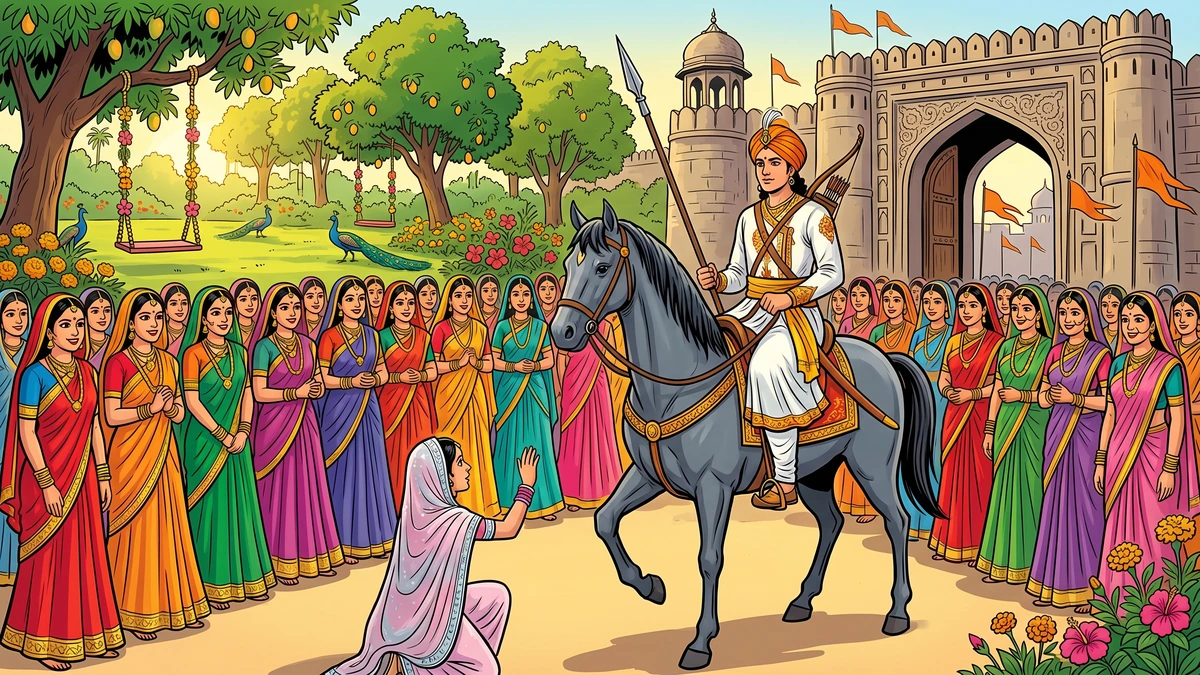
The chapter opens with Rasālū riding at his ease toward Kot Bithaur, where he has sworn to play chaupur with King Sarkap for the kingdom of the Punjab. The road passes through a stretch of dry sal-grass forest that has caught fire — a perfectly ordinary danger of the pre-monsoon Punjabi summer, when the hot west wind drives flame through the brush at the speed of a galloping horse. From the heart of the burning forest a small voice cries out: “O traveller, for God’s sake save me from the fire!” Rasālū reins in Bhaûnr Irāqī, dismounts, and walks into the smoke. The voice belongs to a tiny brown cricket too small to leap clear of the flames, and the prince — in the epithet the bards always attach to him in this scene, tender-hearted and strong — lifts the insect onto his palm and carries it to clean ground.
The cricket, in gratitude, plucks one of its long thread-fine antennae and presses it into the prince’s hand. “Keep this,” it says; “and should you ever be in trouble, put it into the fire, and instantly I will come to your aid.” Rasālū smiles his characteristic young-man’s smile — he knows the formula and is too courteous to refuse the gift — pockets the feeler, and rides on. The Mirāsī bards always linger on the smile and the pocketing, because they want their listeners to register that Rasālū does not yet believe the small kindness will return. In the moral arithmetic of the cycle, this is precisely what makes the kindness real: a mercy that calculates its return is not mercy. The cricket’s antenna goes into the prince’s pocket alongside the kitten’s gift from the potter’s kiln (the previous episode in the cycle) and the bone dice carved in the graveyard. By the time he reaches Sarkap’s gate his pocket is heavier with small mercies than his saddle is with weapons, and the bards know — though the prince does not yet — that the pocket will weigh more in the contest than the sword.
Beat Two — The Seventy at the Gate
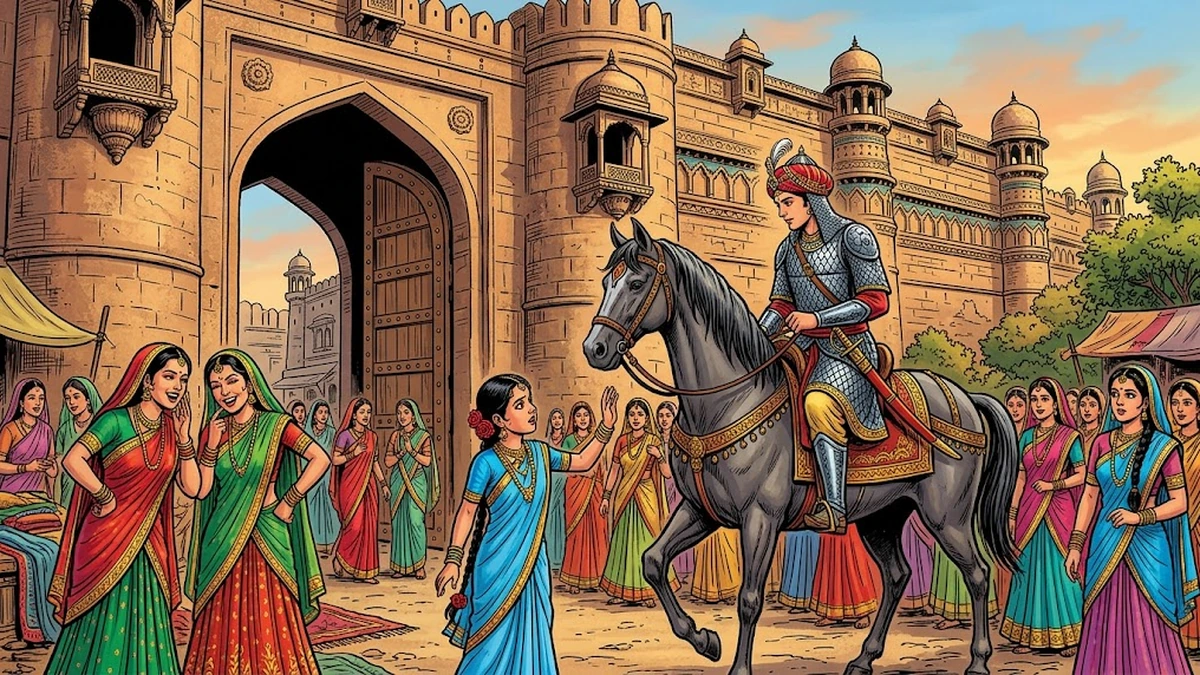
At the city gate of Kot Bithaur seventy young women come down the road to meet Rasālū — the daughters of King Sarkap, sent in groups to greet visitors and, in the older readings of the bardic original, to soften the nerve of the men who come to play their father’s deadly game. The bards always describe them with the same triple formula, “seventy fair maidens, merry and careless, full of smiles and laughter,” and the repetition is not idle: it sets up, by sheer sonic accumulation, the gravity of the sentence three pages later in which the same maidens fall headlong from the air. Among the seventy is the youngest, unnamed in Steel but called variously Hir Bai or Kokilān in different bardic recensions. She alone, when she sees the gallant young Prince riding on Bhaûnr Irāqī going gaily to his doom, is filled with pity, and calls out to him in the famous warning verse:
“Fair Prince, on the charger so gray,
Turn thee back! turn thee back!
Or lower thy lance for the fray;
Thy head will be forfeit to-day!
Dost love life? then, stranger, I pray,
Turn thee back! turn thee back!”
— warning of the youngest maiden, Steel 1894 p.231.
Rasālū answers in matched metre but reversed sentiment: “Fair maiden, I come from afar, / Sworn conqueror in love and in war! / King Sarkap my coming will rue, / His head in four pieces I’ll hew; / Then forth as a bridegroom I’ll ride, / With you, little maid, as my bride!” The verse-duel is part of the courtesy of approach in Punjabi heroic narrative; what matters is not the rhyme but the fact that the prince answers the youngest by name — she alone has been taken seriously among the seventy — and that he answers her by promising not death but marriage. From this moment, in bardic logic, the youngest maiden is already inside the prince’s small circle of mercy; the other sixty-nine, who have laughed and turned away, remain outside it, and what happens to them at the swing will be a function of where they have placed themselves on the moral diagram of the scene.
The sixty-nine, jealous of the youngest, set Rasālū the first of two brideprice tasks. They mix together a hundredweight of millet seed with a hundredweight of fine river sand — an impossible task by hand, designed to keep the suitor occupied through the night and into the day of the chaupur match, when his nerves and concentration would have been long exhausted. They give him the mixed sack and tell him to separate it grain by grain.
Beat Three — The Cricket Army at Midnight
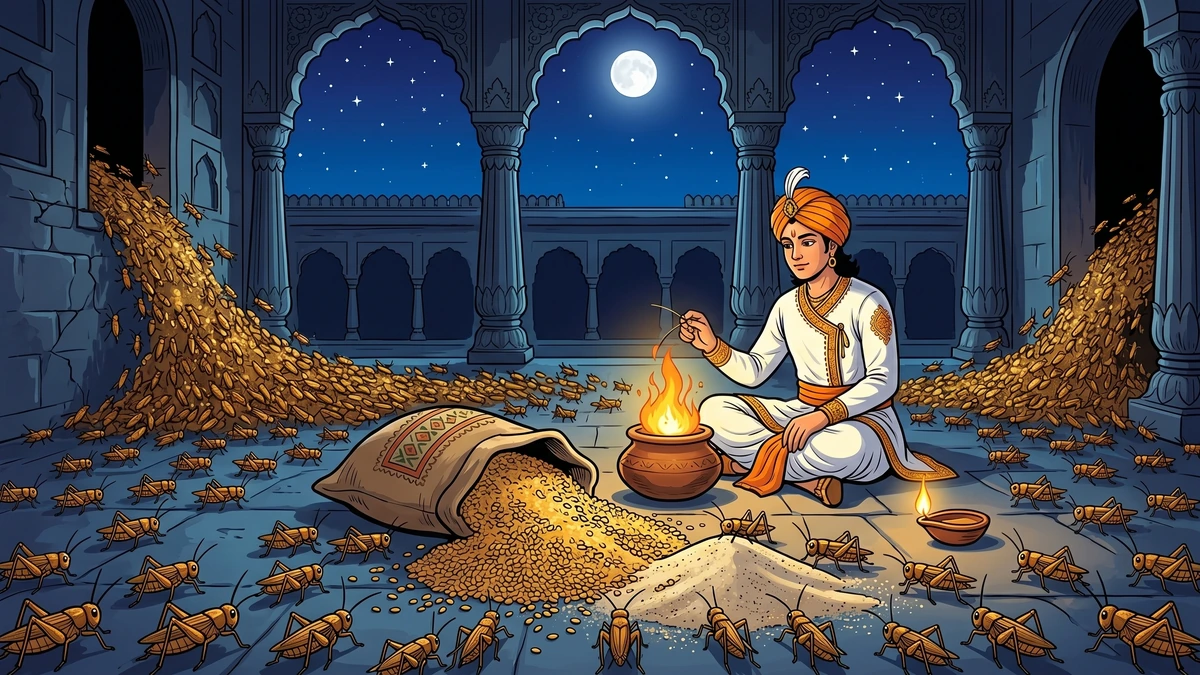
Rasālū sits down with the sack and remembers, at last, the small thread-fine feeler in his pocket. He pulls it out, kindles a small fire in the corner of the courtyard, and drops the antenna into the flame. There is a whirring noise in the night air, and from every cracked wall and every dust-pile of the city a great flight of crickets rises and converges on him, settling around him in a brown carpet. Among them is the cricket whose life he saved at the burning forest. “Separate,” Rasālū tells them, “the millet from the sand.”
The cricket answers with the line that Punjabi children still know by heart: “Is that all? Had I known how small a job you wanted me to do, I would not have assembled so many of my brethren.” The line is the cricket-army’s small joke and the Mirāsī bards always paused for a laugh after delivering it; modern Punjabi parents still use it as a household formula for any task that turns out to be easier than feared. The crickets fall to work. By the time the dawn call sounds from Sarkap’s palace, the millet is heaped in one neat hill and the sand in another. The crickets vanish back into the cracks of the city, and Rasālū sleeps for an hour in the cleared courtyard with the two hills beside him.
The structural meaning of this beat is identical to the meaning of the kitten-at-the-kiln scene in the previous episode: a small mercy on the road has produced a small army at the moment of need. The Rasālū cycle teaches a folk-physics in which mercy is not stored as a virtue in the heart of the merciful but as a debt in the body of the rescued, and the debt comes due at the precise moment the rescuer is in trouble. The cricket’s feeler in the prince’s pocket is, in this physics, a sleeping promissory note that the burning forest itself signed; the dropping of the feeler into fire is simply the act of presenting the note for payment. Folklorists call this pattern the magic helper economy, and the Punjabi tradition develops it more fully than almost any other folk literature in the world.
Beat Four — The Bow-Bent Swing
In the morning the sixty-nine return, find the millet and sand in their separate hills, and are obliged to set Rasālū a second task. They lead him to the gardens behind the palace, where seventy painted swings hang from the māngō-tree branches in the long Punjabi style of Teej-festival swinging, each swing painted a different colour and each rope tasselled in red and gold. The maidens climb into their swings and tell the prince that he must push each of them, one by one, until each is tired. The Mirāsī bards always emphasise the sweetness with which the task is delivered: it sounds like a courtesy, almost a flirtation, and is in fact a calculated way to occupy the suitor for two more days, fatigue him to the bone, and arrange his arrival at the chaupur board in a state of complete physical exhaustion. By the rules of Sarkap’s court, a suitor who declines the swings forfeits his right to the youngest’s hand.
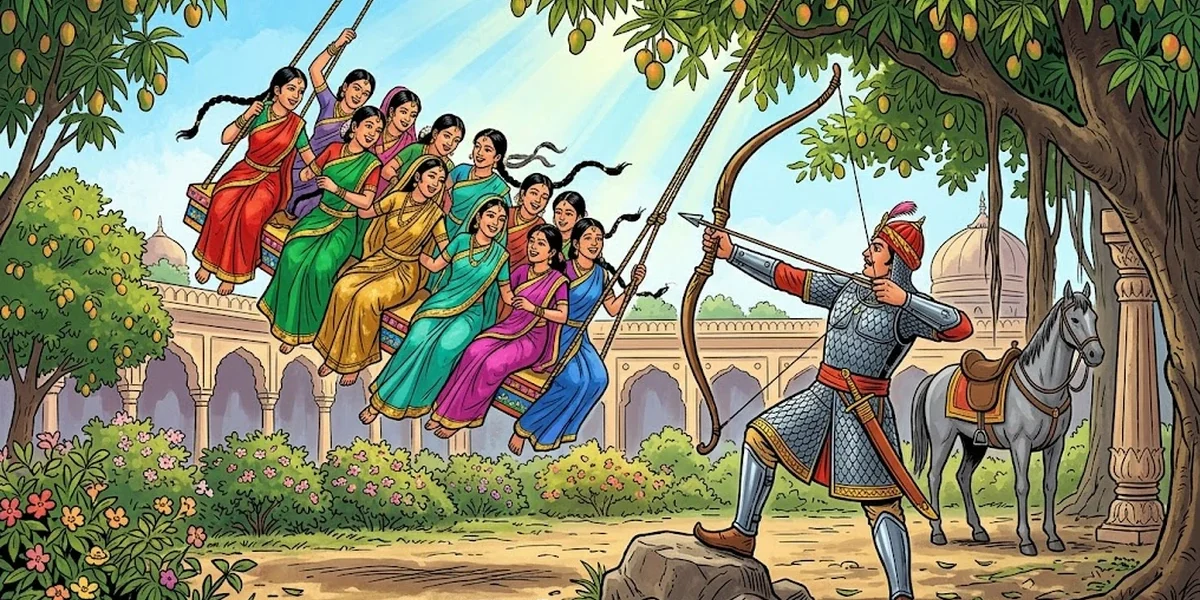
Rasālū does not decline. He laughs. “There are seventy of you,” he says, “counting my little bride yonder, and I am not going to spend my life in swinging girls; yet, by the time I have given each of you a swing, the first will be wanting another! No — if you want to swing, get in, all seventy of you, into one swing, and then I will see what I can compass.” The youngest maiden, who has been hovering at the edge of the garden, is reluctant; the other sixty-nine, careless and full of smiles, scramble into the largest of the painted swings — built to hold three women at most — and crowd in until the seat groans and the ropes creak. The youngest, refusing the warning of her own sisters and trusting the prince, climbs in last on top of the others.
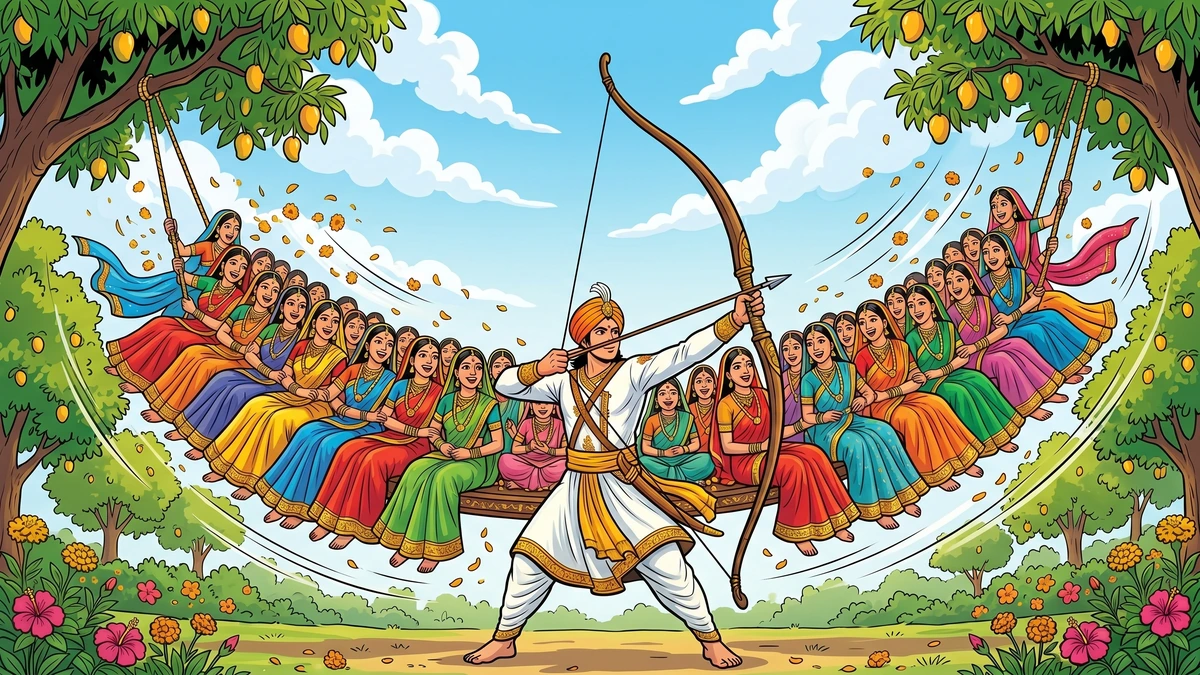
What happens next is the moment around which the entire chapter is built. Rasālū takes the heavy ropes of the swing and ties them, not to the māngō branch, but to the great horn-tipped war-bow he carries on his back. He sets one foot on the ground, plants the other against a stone, and draws the bow to its fullest bent — the bards always specify “to the ear,” the standing archer’s full draw — with the swing and its seventy laughing passengers stretched along the bowstring like an enormous arrow. Then he releases. The swing shoots into the air. It rises high above the palace garden, above the painted gallery, above the topmost māngō branch, with its burden of seventy fair maidens, merry and careless, full of smiles and laughter — the Mirāsī bards always repeat the triple formula here, because what is about to happen will turn the laughter into something else.
As the swing reaches the top of its arc and begins to swing back, Rasālū in his shining armour draws his sharp sword and severs the ropes in a single cut. The seventy maidens fall to the ground headlong. Some are bruised, some are broken, and the only one who escapes unhurt is the youngest — the maiden who loved Rasālū and climbed in last, on top of all the others — for she falls cushioned by the bodies of her sisters and rises shaken but uninjured. The sixty-nine who laughed at the gate are the sixty-nine who lie groaning in the grass; the one who pitied the prince is the one who walks back to the palace on her own feet.
Beat Five — The Drums, the Gongs, and the Poisoned Sweetmeats
After the swing, Rasālū strides on fifteen paces — the bards always count the paces, because they mark the prince’s rhythm of approach — and comes to the seventy ceremonial drums that Sarkap requires every chaupur visitor to beat in turn before being granted audience. Rasālū beats them so loudly that he breaks them all. Fifteen paces beyond stand the seventy bronze gongs, and these too he hammers until they crack to pieces. The seventy drums and seventy gongs are the formal counter-magic with which Sarkap intimidates approaching suitors; by destroying both ranks in twenty paces of advance, Rasālū signals to the watching court that the audial architecture of the king’s power has just been scrapped.
The youngest maiden, who is the only one of the seventy able to run after her tumble, races to her father in the audience hall and warns him in another rhyming couplet: “A mighty Prince, Sarkap! making havoc, rides along, / He swung us, seventy maidens fair, and threw us out headlong; / He broke the drums you placed there and the gongs too in his pride, / Sure, he will kill thee, father mine, and take me for his bride!” Sarkap, who has heard the noise of the broken bronze for himself, masks his fear in a boasting verse of his own — “Silly maiden, thy words make a lot of a very small matter; for fear of my valour, I wot, his armour will clatter; as soon as I’ve eaten my bread I’ll go forth and cut off his head!” — but his hands shake, and as soon as the maiden has left the hall he sends a slave with a tray of sweetmeats and fruit to the old woman’s house where Rasālū is resting. The food is poisoned.
The prince, recognising the false courtesy at a glance, rises to his full height in the small kitchen, and refuses the tray with the line that has rung down the Punjabi tradition for six centuries: “Go, tell your master I have nought to do with him in friendship. I am his sworn enemy, and I eat not of his salt.” He tosses the sweetmeats to the dog that has followed the slave into the courtyard, and the dog dies on the spot. Rasālū turns to the slave with the closing line of the chapter: “Go back to Sarkap, and tell him that Rasālū deems it no act of bravery to kill even an enemy by treachery.” With those words the bards end the swing-chapter and prepare the listener for the chaupur game in the next.
Moral — Mercy Is Counted Twice
“Aag vichhōn bachāeī jind,
sau lashkar vāng hokh ke vapas āundī hai.”
— The life you lift out of the fire returns to you as an army.
(Punjabi proverb attached to the Rasālū cycle by R. C. Temple, Legends of the Panjāb I.53.)
The lesson the bards drew from the swing-episode is not the obvious lesson of strength — nobody listening to a Mirāsī recital ever doubted that Rasālū could draw a war-bow with seventy maidens on the string — but the harder, more specifically Punjabi lesson of mercy’s reciprocity. The story is built to teach the listener that the cricket in the burning forest, the kitten at the potter’s kiln, and the youngest maiden at the city gate are all the same scene played three times in a row: a small creature in distress, a prince who could ride past and does not, a debt of mercy quietly recorded, and a deliverance at the moment of greatest need that nobody but the prince and the small creature could have arranged in advance. The cricket separates the millet at midnight; the kitten will face the rat at the chaupur cloth in the next chapter; the youngest maiden will, twenty years later in the larger cycle, be either Rasālū’s bride or his bride’s mother, depending on which Mirāsī lineage the listener is hearing. In every case, the mercy that the prince extended on the road comes back to him in a form he could not have predicted — and could not, in good conscience, have engineered.
The harder edge of the moral, and the one the cycle does not flinch from, is that mercy comes back only to the merciful. The sixty-nine sisters who laughed at the youngest at the gate are the sixty-nine who lie broken in the grass under the swing. The poisoned dog dies and Sarkap is unmasked. The cycle has no patience with the modern reading that would require Rasālū to spare every life equally; what it requires is that he distinguish, with a clear eye, the merciful from the cruel, and dispense his protection accordingly. The lesson is not be kind to everyone; it is be kind to whomever is kind, and have the hard-won discrimination to tell the two apart at the gate. That is a strict ethics, and the Punjabi tradition has always known it is strict; but it is the ethics of a frontier kingdom whose princes had to ride into the courtyards of poisoners every other week, and softness without discrimination would have got them killed.
Why The Story Has Lasted
The swing-of-seventy episode has been recited at Punjabi village festivals, painted on shrine walls, and performed in the night-shadow puppet theatre of Bahawalpur for at least six hundred years, and probably much longer. It has lasted because it does, in the space of roughly a thousand bardic words, three things that almost no folk-tale anywhere in the world manages to do at once. It demonstrates physical strength in a way no listener can forget — a swing fastened to a war-bow is the kind of image the imagination reaches for the first time it is heard and never lets go. It demonstrates moral discrimination — the sixty-nine fall, the one is unhurt, and the diagram is drawn so cleanly that the youngest listener can read it. And it demonstrates mercy as infrastructure rather than as a virtue: the cricket’s antenna in the prince’s pocket, like the kitten in the same pocket the next chapter, is a working piece of moral engineering, an installed fail-safe that fires precisely when needed because it was put there by an act of generosity that asked nothing in return at the moment of installation.
The episode has also lasted because it answers, with the directness of folk speech, a question that civilised societies often answer too softly: what should be done with cruelty when one has the means to crush it? The Rasālū cycle’s answer is twofold and is delivered in the swing and the dog-poison together. To the seventy maidens who laughed at their own sister and set the impossible task to humiliate a stranger, the answer is the cut rope: cruelty in laughter is rewarded in proportion. To Sarkap, who attempts assassination by tray of sweetmeats, the answer is the dead dog and the line about the salt: cruelty in policy is met with a contempt that refuses even to use cruelty in return. The two answers, spoken in the same chapter, frame the prince’s ethic with unusual precision — he will use force, freely, against unkindness, but he will not use treachery against treachery. The combination has kept the chapter morally alive across many generations who have had reason to think very seriously about both halves.
Finally, the episode has lasted because the central image — a war-bow drawn full, with a swing of seventy laughing girls strung along it like a single arrow, against the painted māngō trees of a Punjabi pleasure-garden — is the most cinematic single tableau in the whole of north Indian folk literature. Every Punjabi miniaturist from the eighteenth century onward has painted it, every shadow-puppet master has built a cut-out for it, and every village mother who has ever told the tale has made the gesture of the drawn bow with her own arm at the right moment in the recital. A story that produces an image of that quality is a story the storytelling tradition will refuse to let die, and the Punjabi tradition has not let it die.
Reflection & Discussion
- Rasālū rescues the cricket from the fire long before he knows he will need its help. What does the story say about acts of kindness that are performed without any expectation of return? Have you been the recipient of such a kindness, and did you remember the giver later?
- Of the seventy maidens at the gate, only the youngest gives Rasālū an honest warning. The other sixty-nine laugh. By the end of the chapter, only the youngest is unhurt. Is this fair? What is the story trying to teach about the cost of laughter at the wrong moment?
- The crickets’ line — “Had I known how small a job you wanted me to do, I would not have assembled so many of my brethren” — is the moment of comic relief in the chapter. Why does the bardic tradition place a joke at the precise centre of an otherwise grim story?
- Rasālū refuses Sarkap’s poisoned sweetmeats with the line, “I deem it no act of bravery to kill even an enemy by treachery.” He has just severed the swing-rope of the seventy maidens without warning. Is the prince inconsistent? Or is the story drawing a careful line between violence-against-cruelty and treachery-against-an-enemy?
- The youngest maiden trusts Rasālū and climbs into the swing on top of her sisters. Her trust saves her. In other folk tales the trusting figure is the one who is harmed. Why does the Rasālū cycle reverse this convention, and what does the reversal say about the prince’s honour?
Did You Know?
- The Teej festival, on which the swings of the Rasālū episode are modelled, is still celebrated each monsoon across the Indian and Pakistani Punjab. Painted swings are hung from māngō-tree branches in courtyards, women sing in groups while pushing one another, and children chant the rhyme jhoolan geīyān jeīyān — “the swings have come, the swings have come.” The bardic image of seventy painted swings in Sarkap’s garden is therefore the magnification of an entirely real Punjabi springtime scene.
- Bhaûnr Irāqī, the iron-grey Iraqi-bred warhorse that Rasālū rides in the Mirāsī recension, is so important a character in the cycle that some bards give him his own genealogy stretching back to the horses of the Mughal stud at Bhaīpūr. In the swing chapter he is mentioned only twice, but his presence at the gate is what marks the prince as a person of consequence to the seventy maidens before they have heard a single word from him.
- The motif of separating millet from sand is found in folk tales at least as far apart as Punjab, Tamil Nadu, Mongolia, Sicily, France and Germany. Apuleius’s second-century Latin novel Metamorphoses uses it as Psyche’s first task set by Venus; the Brothers Grimm use it as Aschenputtel’s task at the hearth; the Tamil Sītkāli tradition uses it with sesame and gravel and an army of red ants. The Punjabi version’s contribution is the cricket army, an animal helper not used elsewhere in this motif.
- The line “I eat not of his salt” belongs to a Punjabi (and broader north Indian) honour code in which sharing salt with another person creates a quasi-sacred bond of mutual loyalty. To eat an enemy’s salt was to enter into a non-aggression pact for the duration of the meal; to refuse was to declare oneself permanently outside the host’s circle of obligation. Rasālū’s refusal of the sweetmeats is therefore not a personal squeamishness but a formal political declaration, and Sarkap, hearing it reported, would have understood it as such.
- The poisoned-cake episode is so close in detail to the Jātaka tale of the Nanda-Jātaka (Pali Canon, Jātaka No. 39) that several twentieth-century Punjabi folklorists, including the Lahore-based scholar Kazim Ali, have argued the Rasālū cycle inherited the motif directly from the Buddhist storytelling tradition of Gandhāra and Taxila in the early centuries of the Common Era. The Buddhist monasteries of Taxila were within sixty miles of Sialkot and remained active until the eleventh century.
The Cricket, the Kitten, and the Bone Dice — A Triptych of Punjabi Mercy
Read in the order the bards sing them, the three preparatory episodes of the Rasālū cycle — the bone dice carved in the graveyard, the kitten rescued from the potter’s kiln, and the cricket lifted from the burning forest — form a single triptych on the theme of small mercy that returns as great deliverance. Each scene begins with a creature or object in some kind of trouble that the prince could plausibly ignore; each scene ends with the prince placing into his own pocket a thing that looks worthless at the moment but will, two or three episodes later, be precisely the resource needed to defeat an apparently unbeatable opponent. The graveyard’s bone dice will defeat Sarkap’s enchanted dice. The kitten will defeat Sarkap’s magic rat Dhol Rājā. The cricket army separates the millet from the sand. In each case the bards are inviting the listener to notice the same lesson three times: that the items you collect by mercy are not coincidence and are not luck, but the working tools of the moral universe, deposited in your hand by your own kindness and waiting only for the right hour to unfold their use.
This patterning is what makes the Rasālū cycle a teaching cycle rather than a mere adventure cycle. The Punjabi village uncle who sang it to a circle of nephews on a charpoy was not entertaining them, he was instructing them, in a method of preparing for the world that is the cycle’s deepest contribution: do not arrive at the contest empty-handed, but do not pack your saddlebags either; let the road equip you, and let the road equip you only as a function of what you give to the road. By that prescription the prince arrived at the gate of Kot Bithaur with bone dice, a kitten, and a cricket’s antenna in his pocket, and Sarkap’s seventy daughters could not see a single one of them as he walked, smiling, into their swing-garden. By the time the dust of the swing settled and the broken gongs lay in the grass, all three of those small mercies had begun to do their unfolding work, and the headquarters of cruelty in the Punjab was already coming apart from the inside before the chaupur game even began. The bards are quite clear about this, and a careful listener of the swing-episode will already understand the chaupur match before the dice are rolled.
Reading the Story With Children
For modern parents, teachers and grandparents this is one of the most rewarding Punjabi folk tales to share with young listeners, because its surface is bright and physical — a cricket, a sack of millet, a swing in a māngō garden, a war-bow and a cut rope — and its moral architecture is unusually layered. A child of six or seven will be drawn at once to the tiny voice from the burning forest, the cloud of crickets at midnight, and the spectacular flying swing. A reader of nine or ten will start to notice the pattern: that the prince is rewarded for kindness in a way that is, on closer inspection, not random but specifically calibrated; that the youngest maiden alone, who behaves kindly, is alone unhurt; that the prince refuses Sarkap’s sweetmeats not because he distrusts food in general but because he understands the specific moral physics of salt and treachery. By the time the same listener returns to the story as a young adult, the harder edge of the moral becomes visible: the cycle is teaching that mercy is a discipline of discrimination as much as a discipline of softness, and that a prince who cannot tell the youngest maiden from the older sixty-nine is a prince who is going to die at chaupur the next morning.
One useful way to read the chapter aloud is to pause at the moment Rasālū pockets the cricket’s antenna and to ask the child: what would you have done with that gift? Children almost always answer that they would have thrown it away, because at that point in the story it looks worthless — and the answer opens the conversation about the difference between value-as-it-appears and value-as-it-emerges, a conversation it is hard to start by any other route. A second useful pause comes after the swing falls and the youngest maiden walks back unhurt: why does the story make sure she is the one who is safe? That conversation, about the long arc by which kindness at the gate becomes unhurt at the swing, is the one the Mirāsī bards always wanted their listeners to have, and it is a conversation that books on their own rarely supply.
You May Also Like
 Indian Folk Tales
All Ages
Indian Folk Tales
All Ages
The Charmed Ring
The Charmed Ring: In a remote village at the foot of the Himalayan mountains, there lived a poor but honest widow and her only son, Ramu. They owned nothing
 Indian Folk Tales
Ages 3-5
Indian Folk Tales
Ages 3-5
Dorani
Dorani: Once upon a time there lived in a city of Hindustan a seller of scents and essences, who had a very beautiful daughter named Dorani. This maiden had a
 Indian Folk Tales
Ages 6-8
Indian Folk Tales
Ages 6-8
The Jewelled Arrow
The Jewelled Arrow: In the city of Vardhamana in India there lived a powerful king named Vira-Bhuja, who, as was the custom in his native land, had many wives