The Story Of Appayya
The Story Of Appayya: In a remote village there lived a poor Brâhmaṇ and his wife. Though several years of their wedded life had passed, they unfortunately had
The Story of Appayya is one of the most beloved comic tales preserved in Pandit Sangendi Mahalinga Natesa Sastri’s Folklore in Southern India (Bombay: Education Society’s Press, 1884–1888, four parts; reissued in London by W. H. Allen and Co. in 1890 as Tales of the Sun, or Folklore of Southern India, edited and translated jointly with Mrs. Howard Kingscote, née Georgiana Wolff). Recorded from a Tamil teller in the Madras Presidency in the early 1880s, it stands at the head of the great pan-Indian “lucky cowardly hero” cycle catalogued by Hans-Jörg Uther as ATU 1640 — The Brave Tailor (Uther 2004, vol. II, pp. 326–328), the same international tale-type that produced Brothers Grimm Das tapfere Schneiderlein (KHM 20, Berlin 1812), Joseph Jacobs’s English “Jack the Giant-Killer” (1890), the Russian “Foolish Wolf,” and dozens of African and Central-Asian retellings. What makes the South-Indian version unforgettable is the linguistic joke at its climax: the Brahman’s terrified cry “appa, ayyo!” — “O father, O dear!” — is misheard by an invading emperor as the Brahman’s own war-name, “Appayya,” and an entire enemy army flees in terror from a syllable.
How a Tamil Brahman Became Son-in-Law to a King
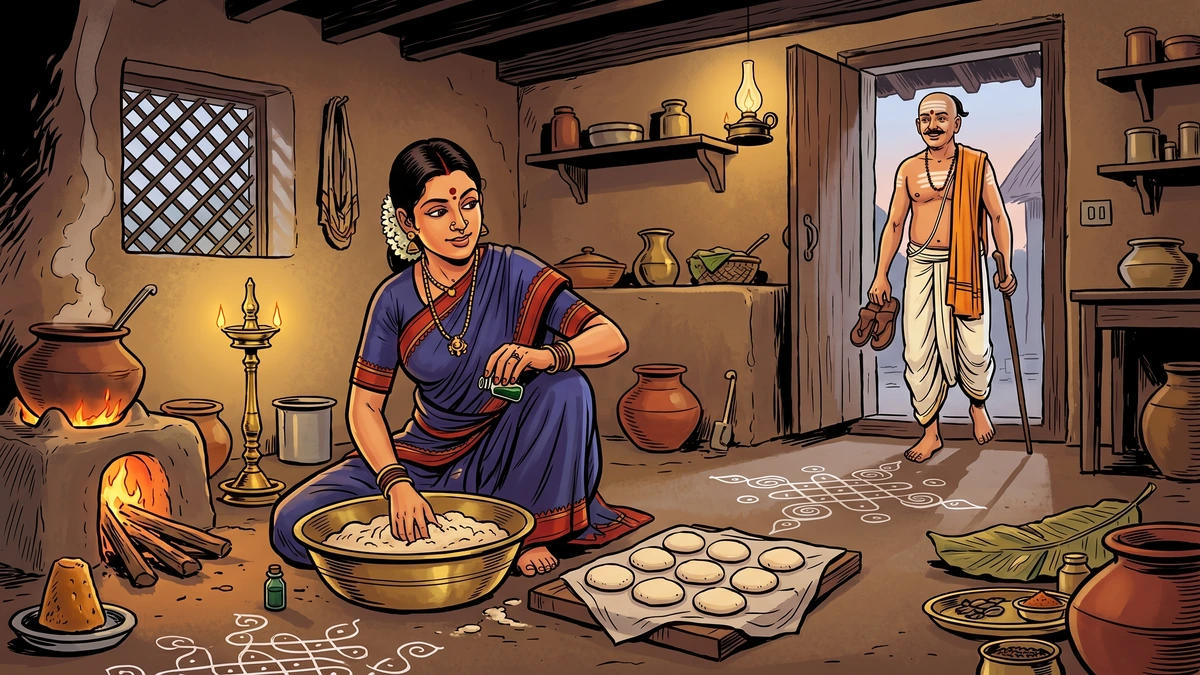
In a remote village of the Coromandel coast, near the Cauvery delta, there lived a poor Brahman of the Smarta Vadama sub-caste and his wife. Years of married life had passed without children, and so, eager for a son, he took a second wife — a beautiful Brahman girl who came to live in the same house. The first wife outwardly consented but inwardly resolved to do away with her rival. When the second wife became pregnant and went, in her sixth month, to her mother’s house for confinement, the Brahman grew restless after a fortnight and asked his first wife when he might visit her. The first wife, smiling, said it was unlucky to visit children, kings, or pregnant women empty-handed, and she would prepare one hundred apupa cakes — fried wheat-and-jaggery sweets — for him to carry to her in a brass vessel. She made two batches: one for the second wife, mixing poison into the sugar and rice-flour; one separate, in a kerchief, for her husband, blameless and clean.
The Brahman set out at dawn with the brass vessel balanced on his head, walking through the toddy-palm avenues until evening. Exhausted, he reached a wayside shed beside a stone kulam tank, performed his evening sandhyavandanam, ate every cake from his kerchief in one famished sitting, drank from the tank, and fell asleep in the shed with the brass vessel under his head. He had pushed it aside in his sleep, and it lay an arm’s length from his pillow.
That very night, near the same shed, a hundred robbers crept into the king’s palace at the chieftain’s command. The king had refused his daughter’s hand to a robber-chief’s son, and the chief had sworn to take her by force. The hundred men lifted the sleeping princess in her cot and carried her, bed and all, into the woods, halting at the very shed where the Brahman lay snoring. The midnight road had made them thirsty, but before drinking from the tank they smelled the apupas. They searched the shed, found the brass vessel, found exactly one hundred cakes — “one for each of us,” said their leader — and each man swallowed his greedily. Within minutes the gang lay dead on the earth around the cot.
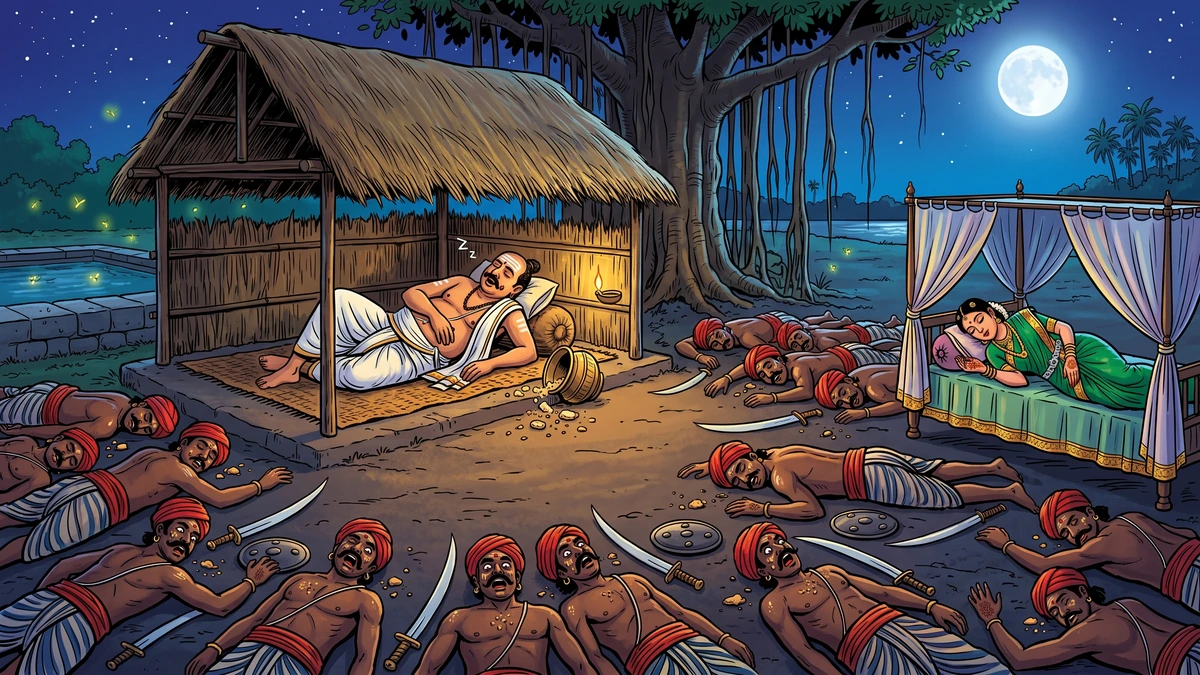
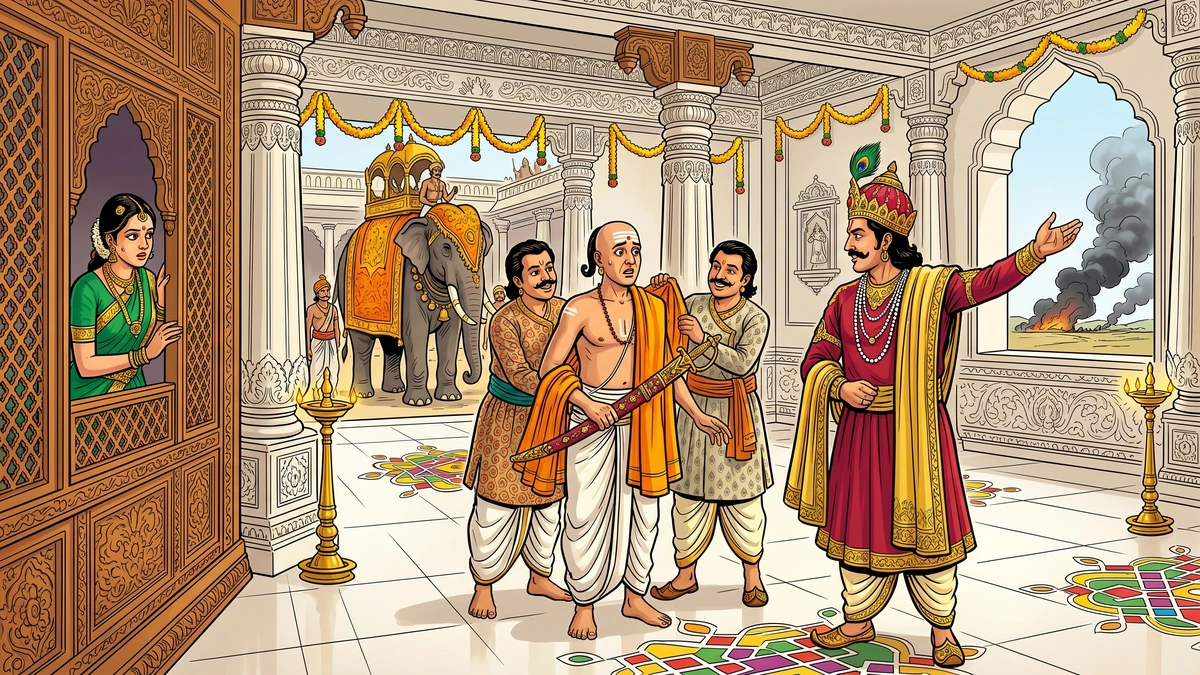
At dawn the Brahman awoke, dreaming of his second wife, and reached for his brass vessel. Finding it gone and seeing one hundred wild-looking men sleeping in a ring around him, he assumed they were robbers who had robbed him in the night. Furiously he picked up a sword from a fallen hand and, in revenge for his stolen cakes, struck off the head of every sleeping figure — supposing all the while he was killing one hundred living men single-handed. When the last head rolled away, his eye fell on the cot and on the loveliest princess he had ever seen, asleep beneath a silken canopy. He woke her gently. “Behold the hundred robbers who carried you off in the night. I fought them all and killed them all.” The princess, who had glimpsed her abductors before sleep took her, fell at his feet and said, “Friend, never till now have I heard of a warrior who single-handed fought one hundred robbers; I will be your wife in remembrance.” The king’s army, marching behind, found the heads, found the daughter, found the trembling Brahman, heard the tale and the princess’s vow, and gave him her hand and a place at court. Thus, by accident upon accident, the Brahman became son-in-law to a king.
Why Two Syllables Routed an Empire
For a season the Brahman lived in quiet glory, tending the king’s elephants and reciting the Tiruvaymoli at festivals. Then ill news came: a powerful emperor named Appayya Raja, master of a hundred provinces, had declared war on the king and was advancing with an army that filled the horizon. The king at once turned to his son-in-law, the slayer of the hundred robbers. “Defend us, O hero,” he said. The Brahman, knowing himself for what he was, could not refuse without confessing the truth. He was placed on a great war-elephant draped in saffron, given a sword too heavy to lift, and sent at the head of the king’s army to meet the emperor.
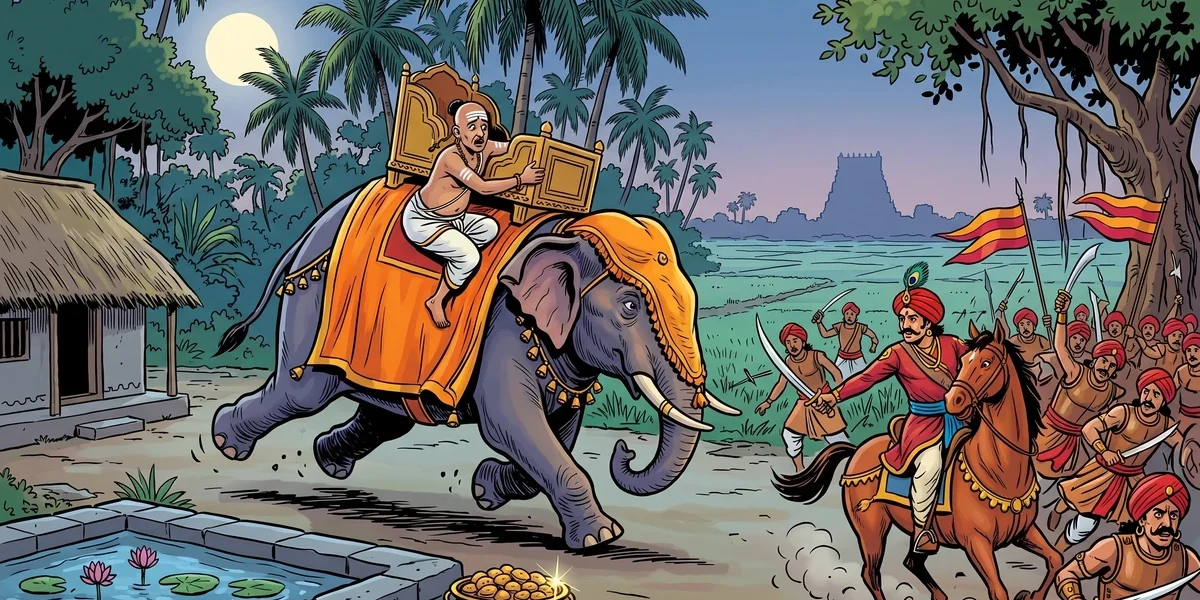
The two armies came in sight of each other on a plain of red earth and prickly-pear scrub. The Brahman’s elephant, smelling the enemy’s elephants, broke into a charge he could not control. He clung to the howdah, the saddle-cloth flapping, and as the great beast bore down on the imperial line he opened his mouth and screamed, in pure Tamil terror, “Appa! Ayyo!” — “Oh father! Oh dear!” The emperor, hearing his own name shouted from the charging elephant, turned pale. “He calls my name!” he cried. “He singles me out by name! It is I, Appayya, he comes for!” Imagining a champion who had named him from a mile away, the emperor wheeled his horse and fled. His army, seeing him flee, fled with him. The hundred provinces emptied themselves down the road in panic, leaving behind elephants, treasure, and a banner-pole striped saffron and crimson.
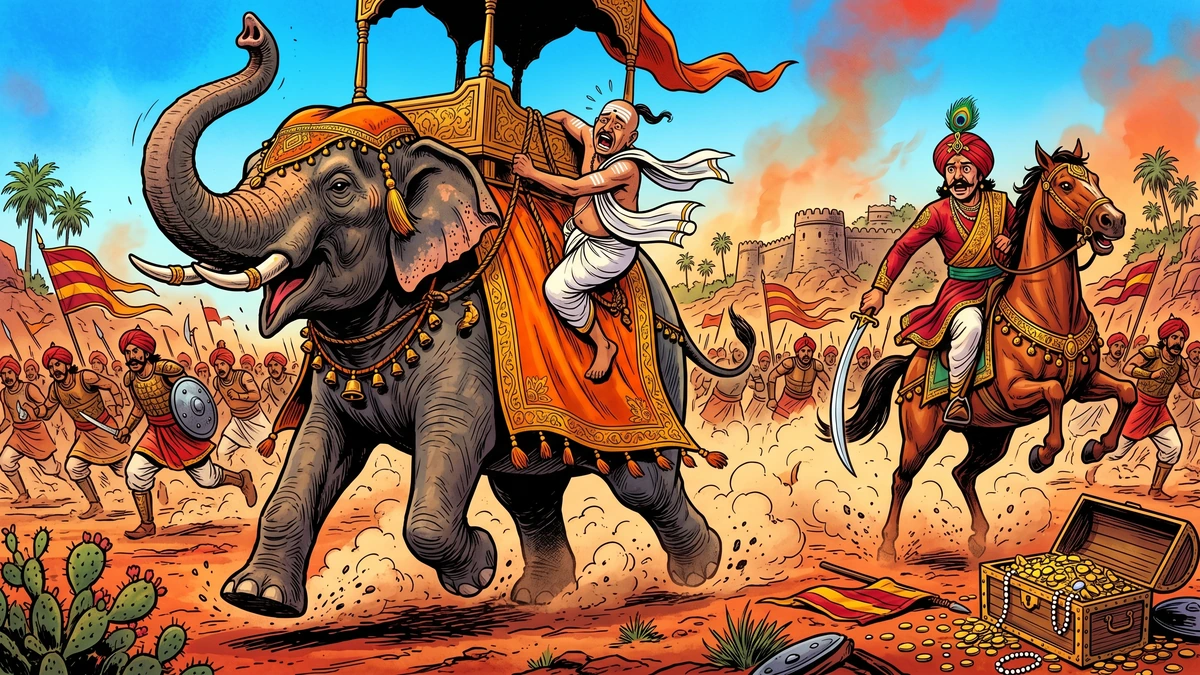
The Brahman’s elephant, having no enemy left to charge, slowed and grazed peacefully. The Brahman climbed down trembling, found the abandoned imperial chest, and rode home a conqueror. The king embraced him; the kingdom embraced him; the princess embraced him; and the chronicler of the kingdom solemnly recorded that “by the valour of one Brahman, the empire of Appayya was overthrown without a single blow.” The teller of the tale closes, eyes twinkling: “Such are the ways of luck and language: a kind word can build a kingdom, and a frightened cry can topple one.“
How Natesa Sastri Recorded This Tale
“The Story of Appayya” appears as Tale I in Part I of Natesa Sastri’s Folklore in Southern India (1884), and again as the opening tale of Tales of the Sun (Kingscote and Sastri, London 1890), which has been digitised as Project Gutenberg ebook #37002. Natesa Sastri (1859–1906), a Tamil polyglot who had served Robert Caldwell as a research-pandit and corresponded with Edward Tylor and Andrew Lang, was the first Indian-born scholar to apply the comparative method of the European folklorists to Dravidian oral material. He recorded this tale in Tamil from a village teller in the Tanjore district, then translated it into the careful, slightly archaic English that gave Mrs. Kingscote her editorial framework. The Tamil original used the proverb “pongi valnthal nilai illai” — “what rises by puffery does not last” — but the English version omitted it, perhaps because the editors preferred their irony silent. The presence of the brass-vessel tola, the apupa cake (Sanskrit apupa, “wheat fritter,” already mentioned in Rigveda 3.52.7 as an offering to Indra), the kulam tank, and the sandhyavandanam ritual fix the story firmly in the Tamil-Brahman milieu of the late nineteenth century, even as its plot belongs to a wandering international tradition.
The International Tale-Type: ATU 1640 and Its Cousins
In Hans-Jörg Uther’s revision of the Aarne-Thompson-Uther index (FFC 284, Helsinki 2004), this is type 1640: The Brave Tailor — a humble protagonist accidentally performs a great feat (kills seven flies at one blow, slays a hundred robbers in their sleep, frightens an emperor with a cry) and is rewarded with the princess and the kingdom because witnesses interpret his luck as valour. Stith Thompson’s Motif-Index of Folk-Literature (1932–1936, revised 1955–1958) catalogues the constituent motifs as K1951 — The boastful coward; K1955 — Sham warrior; K1741 — Tricksters made to flee by sham preparations; J2415 — Foolish imitation, with the specific Indian variant tagged K1956.1 — Cowardly Brahman becomes hero by accident. The closest European cognate is Grimm Das tapfere Schneiderlein (KHM 20, “Seven at one blow”), and the closest Sanskrit cognate is the Pancatantra tale of “The Weaver as Vishnu” (Book I, Mitra-bheda, Edgerton 1924, vol. II, pp. 232–238), where another hapless craftsman is mistaken for a god by the king and rewarded as a god. Comparative folklorist W. R. S. Ralston, writing to Andrew Lang in 1885 about Natesa Sastri’s first part, observed that “the Tamil Appayya is a brother of the German tailor,” a phrase later cited by Joseph Jacobs in the introduction to his Indian Fairy Tales (London: Nutt, 1892) when he discussed the migration of the type along the silk roads.
Moral
Pongi valnthal nilai illai — “What rises by puffery does not last.” (Tamil proverb attached by Natesa Sastri to this tale, drawn from the Konrai Vendan didactic verses of Auvaiyar, c. ninth century CE.)
The story does not condemn the Brahman; it condemns, gently, every system that mistakes accident for excellence. Twice the Brahman is honoured for what he did not do — once for slaying corpses, once for shouting in fright — and twice the world bows to the rumour rather than the man. The Tamil sages who preserved this story were warning their listeners (and themselves) about the difference between shaurya, real courage, and shauryabhasa, the appearance of courage. Auvaiyar’s verse insists that puffed reputations collapse the moment the wind of luck shifts. The sweetness of the tale lies in the fact that the Brahman never lies on purpose; the world keeps misreading him, and his own modesty and bewilderment shield him. He is the small good-hearted man who, by remaining small and good-hearted, accidentally sits on the throne. The lesson, gentler than the proverb, is that fortune favours those who do not press their luck — and that a kingdom built on a misunderstanding is, sooner or later, repaid by a richer misunderstanding.
Why This Story Has Lasted
The Brahman of the Cauvery delta, the tailor of Hesse, the cobbler of Brittany, the carpenter of the Caucasus — every culture that has ever known the gap between reputation and reality has invented this story, because every culture needs to laugh at that gap. The Tamil version is finer than most because of its second act: the linguistic accident of “appa, ayyo” colliding with “Appayya” turns the joke into a meditation on the power of names. The emperor flees not because of a sword but because of a syllable; the kingdom is saved not by force but by phonetics. The story has lasted in Tamil Nadu for at least four centuries — Natesa Sastri’s village informant told him the tale in 1882 and said his own grandmother had told it to him — and it has lasted because it consoles the timid. Every reader who has ever felt unequal to a great task can recognise the Brahman trembling on his elephant, and every reader who has ever been praised for the wrong thing can recognise the king embracing his accidental hero. The tale is, in the end, an act of permission: you do not need to be brave; you only need to be lucky enough not to be found out, and kind enough that the world wants to believe you. That permission, freely given by an old Tamil grandmother to her grandchildren on a hot evening under a banyan tree, has now travelled through Natesa Sastri’s pen, through Kingscote’s London edition, through Project Gutenberg, into the present moment and into your reading. May it console you too.
References
Natesa Sastri, S. M. Folklore in Southern India. 4 parts. Bombay: Education Society’s Press, 1884–1888 — Part I, Tale I. ‖ Kingscote, Mrs. Howard, and Pandit Natesa Sastri. Tales of the Sun, or Folklore of Southern India. London: W. H. Allen and Co., 1890 — opening tale; Project Gutenberg ebook #37002. ‖ Uther, Hans-Jörg. The Types of International Folktales, FFC 284–286, Helsinki: Suomalainen Tiedeakatemia, 2004 — type 1640. ‖ Thompson, Stith. Motif-Index of Folk-Literature, 6 vols., revised edition, Bloomington: Indiana University Press, 1955–1958 — motifs K1951, K1955, K1741, J2415. ‖ Grimm, Jacob and Wilhelm. Kinder- und Hausmärchen, vol. I, Berlin: Realschulbuchhandlung, 1812 — KHM 20, Das tapfere Schneiderlein. ‖ Edgerton, Franklin (ed./trans.). The Pancatantra Reconstructed, 2 vols., New Haven: American Oriental Society, 1924 — Book I, “The Weaver as Vishnu.” ‖ Jacobs, Joseph. Indian Fairy Tales. London: David Nutt, 1892 — comparative notes. ‖ Auvaiyar. Konrai Vendan, ninth-century Tamil moral verses, ed. G. U. Pope, 1893.
The Cultural World of the Tale: Apupa Cakes, Brass Vessels, and Tamil Brahman Life
The texture of “Appayya” is dense with the everyday objects of late-nineteenth-century Tamil-Brahman life, and recovering them adds a small but important second layer to the story’s pleasure. The apupa at the centre of the plot is one of the oldest sweets in the subcontinent, mentioned by name in the Rigveda (3.52.7) as a fritter offered to Indra together with parched grain; in Tamil-Brahman kitchens of the Tanjore district in the 1880s the same word survived for round wheat-flour cakes deep-fried in clarified butter (ney) and dipped in jaggery syrup. Brides carried apupas in brass panchapatra vessels to their pregnant sisters, and the gesture in our story — the first wife packing one hundred cakes for her co-wife — would have been instantly legible to a Tamil listener as both an act of ritual hospitality and a quiet reproach. To poison such a gift was to invert the most sacred of Brahman exchanges. The brass vessel itself, broad-bellied and lipped, was a household reliquary: stamped with the family’s gotra mark, polished daily with tamarind and ash, passed from mother to daughter at marriage. When the Brahman pushes it from beneath his head in his sleep, an alert listener already knows something has gone slightly wrong with the universe. The kulam tank where he performs sandhyavandanam — the twice-daily Vedic prayer at dawn and dusk — is the same village reservoir where every Brahman boy was taught to recite the Gayatri mantra, and Natesa Sastri’s listeners would have placed the action in the long shadow of the Cholan-period stone tanks that still dot the Cauvery delta today.
Echoes in Children’s Literature and Modern Retellings
“The Story of Appayya” entered English children’s literature through Mrs. Kingscote’s 1890 edition and never left it. Joseph Jacobs lifted a shorter version into Indian Fairy Tales (London: David Nutt, 1892, no. 22, pp. 156–162) under the title “How the Raja’s Son Won the Princess Labam,” merging it with another Tamil tale. A. K. Ramanujan’s masterful Folktales from India: A Selection of Oral Tales from Twenty-Two Languages (New York: Pantheon, 1991, pp. 132–137) included Natesa Sastri’s “Appayya” verbatim, calling it in his introduction “the funniest and most disarming Tamil tale of cowardice in print.” The Children’s Book Trust of India retold the story for young readers under the title The Hundred-Robber Slayer in their Stories from South India series (New Delhi, 1965), and Anant Pai briefly considered a comic-book adaptation for Amar Chitra Katha in 1972 before rejecting it on the ground that a story about a Brahman who shouts “appa ayyo” might confuse children outside Tamil Nadu. Sujatha Rangarajan’s Tamil short-story collection Atho Antha Pala Maram (Chennai, 1979) reprints the tale as Appendix B with a delightful note on the linguistic joke. In every retelling, the spine of the story remains intact: the cakes, the cot, the cry. Modern Tamil schoolchildren, asked to compose an essay on the tale, are still set the question: “Was the Brahman a hero or a coward, and does it matter?” — the very question Natesa Sastri’s village teller wanted them to ask.
Frequently Asked Questions
**Q: Why is this story important?**
You May Also Like
 Indian Folk Tales
Ages 9-12
Indian Folk Tales
Ages 9-12
Dark Original Stories Behind 5 Disney Movies
Five Disney films rest on older, darker sources—Andersen’s mermaid, Grimm Rapunzel and Snow White, Barrie’s Peter Pan, and the real Pocahontas. Honest contrasts for readers 12+.
 Indian Folk Tales
All Ages
Indian Folk Tales
All Ages
The Wrestlers
The Wrestlers: There was, once upon a time, long ago, a wrestler living in a far country, who, hearing there was a mighty man in India, determined to have a
 Indian Folk Tales
Ages 3-5
Indian Folk Tales
Ages 3-5
The Mother And The Daughter Who Worshipped The Sun
The Mother And The Daughter Who Worshipped The Sun: Once upon a time there lived a mother and a daughter who worshipped the Sun. Though they were very poor