Princess Pepperina
A princess hatched from a bulbul’s green egg is raised by a gentle Jinn and marries a king, but jealous rivals wait for her truth-telling emerald to slip.
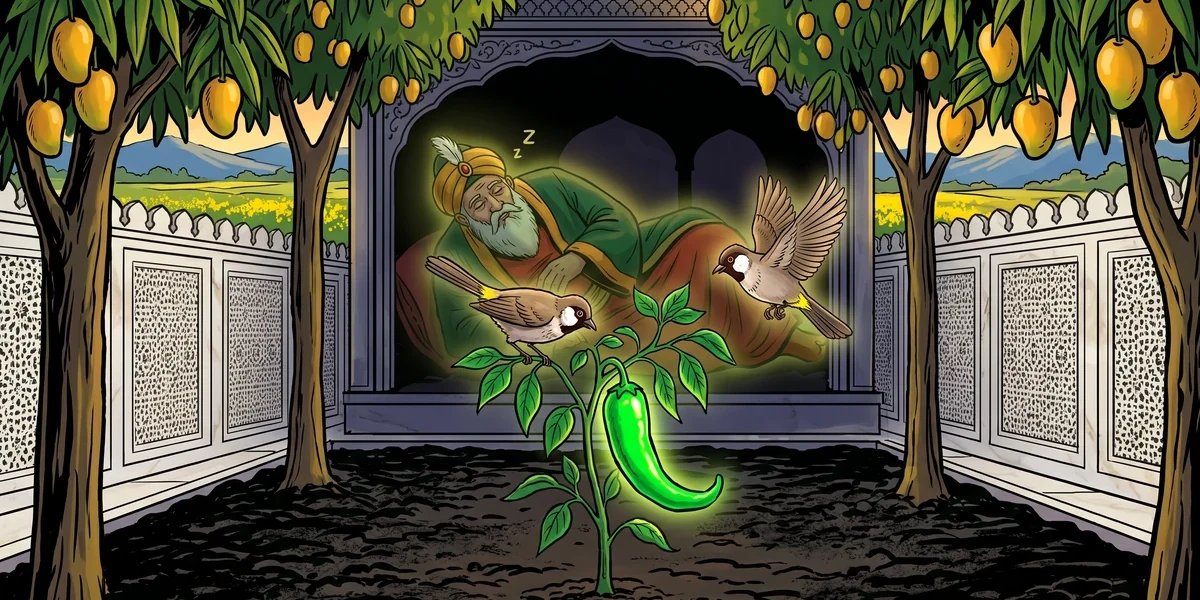
A bulbul once lived in a forest and sang to his mate all day long, until one morning she said, “Oh, dearest husband, your singing is beautiful, but I would so love a nice green pepper to eat!”
The obliging bulbul flew off at once to find one. He flew for miles, peering into every garden he passed, but he could not find a single green pepper. Either the bushes had no fruit at all, only tiny white star-shaped flowers, or the peppers were all ripe and crimson.
At last, far out in the wilderness, he came to a garden with high walls. Tall mango trees shaded it on every side, keeping out the fierce sun and the rough winds, and inside grew countless flowers and fruits. But there was no sign of life within the walls: no birds, no butterflies, only silence and the scent of flowers.
The bulbul landed in the middle of the garden, and there grew a single pepper plant, and among its shiny leaves gleamed one enormous green pepper, glowing like an emerald.
Overjoyed, the bird flew home and told his mate that he had found the most beautiful green pepper in the world. He brought her back with him to the garden, and she began at once to eat the delicious treat.
Now, the garden belonged to a Jinn, and all this while he had been asleep in a summer house. He usually stayed awake for twelve whole years and then slept for another twelve, so naturally he was very sound asleep and knew nothing of the bulbuls coming and going. But the time for him to wake was close, and while the green pepper was being pecked to pieces, he had dreadful nightmares. He grew restless and woke just as the bulbul’s wife, having laid one glittering emerald-green egg under the pepper plant, flew away with her husband.
As he always did, the Jinn yawned and stretched and then went to see how his beloved pepper was doing. He was heartbroken and furious to find it pecked to bits. He could not imagine what had done the damage, since he knew that no bird, beast or insect lived in his garden.
“Some horrible creeping thing from that dreadful world outside must have crept in while I slept,” the Jinn said to himself, and he began at once to hunt for the intruder. He found nothing but the glittering green egg. He was so astonished by it that he carried it to his summer house, wrapped it in cotton wool and laid it carefully in a carved alcove in the wall.
Every day he went to look at it, sighing over his lost pepper, until one morning the egg was gone, and in its place sat the loveliest little girl, dressed from head to toe in emerald green. Around her neck hung one large emerald, shaped exactly like the green pepper.
The Jinn was fond of children, and he was delighted, for this was the daintiest little thing he had ever seen. So he gave his whole life to looking after Princess Pepperina, for that, the little girl told him, was her name.
When twelve years had passed in the flowery garden, it was time for the good-natured Jinn to go to sleep again, and he worried greatly about what would become of his princess when he could no longer look after her. But it happened that a great king and his minister, out hunting in the forest, came upon the walled garden. Curious to see what was inside, they climbed over the wall and found the lovely Princess Pepperina sitting beside the pepper plant.
The king fell in love with her at once and, in the finest words he could find, begged her to be his wife. But the princess lowered her head shyly and said, “Not so! You must ask the Jinn who owns this garden. Only, he has an unfortunate habit of eating men now and then.”
Still, when she saw the young king kneeling in front of her, she could not help thinking him the most handsome and splendid young man in the world, and her heart softened. When she heard the Jinn’s footsteps, she cried, “Hide in the garden, and I will see whether I can persuade my guardian to listen to you.”
As soon as the Jinn appeared, he began sniffing around and crying, “Fee! Fa! Fum! I smell the blood of a man!”
Princess Pepperina soothed him. “Dear Jinn,” she said, “you may eat me if you like, for there is nobody else here.”
And the Jinn, hugging and kissing her, replied, “My dearest life! I would sooner eat bricks and mortar!”
Then the princess cleverly turned the talk to the Jinn’s long sleep, which was coming soon, and wondered tearfully what she would do all alone in the walled garden. The kind-hearted Jinn grew very troubled, until at last he said that the best plan would be to marry her to some young nobleman. But, he added, a worthy husband would be hard to find, especially since he would need to be as handsome among men as Princess Pepperina was beautiful among women.
The princess seized her chance and asked the Jinn whether he would promise to let her marry anyone who was as beautiful as she was. The Jinn promised faithfully, never guessing that she already had someone in mind, and he was utterly astonished when she clapped her hands and the splendid young king stepped out of a thicket. But when the two stood side by side, hand in hand, even the Jinn had to admit that no one had ever seen such a handsome pair. So he agreed to the marriage, and it was held in a great hurry, for the Jinn was already beginning to nod and yawn.
Yet when he said goodbye to his dear little princess, he cried so much that his tears kept him awake. His thoughts followed her, until his longing to see her face one more time grew so strong that he turned himself into a dove and flew after her, fluttering over her head. She looked perfectly happy, talking and laughing softly with her handsome husband, so he flew home to sleep.
But he kept seeing his little princess’s green cloak floating before his eyes and could not rest, so he turned himself into a hawk and sped after her, circling high above. She was smiling at her husband’s side, so the Jinn flew home to his garden, yawning terribly.
But his dear Pepperina’s gentle eyes seemed to gaze into his and chase his sleep away. So he became an eagle and soared high into the blue sky, and with his sharp, piercing eyes he saw the princess entering a king’s palace far away on the horizon. Then the good Jinn was content, and he fell fast asleep.
In the years that followed, the young king stayed deeply in love with his beautiful bride. But the other women of the palace were bitterly jealous of her, and even more so after she had a baby son, the loveliest little prince you could imagine. They made up their minds to ruin her, and they spent hours plotting how to kill her or trap her.
Every night they crept to the door of the queen’s room and whispered, to find out whether she was awake, “Princess Pepperina is awake, but all the world is fast asleep.”
Now, the emerald that the young queen still wore around her neck was a real talisman, and it always told the truth. If anyone so much as whispered a lie, it spoke up straight away with the truth and put the liar to shame without mercy. So each time the emerald answered, “Not so! Princess Pepperina is asleep. It is the world that is awake.”
Then the wicked women would slink away, for they knew they had no power to hurt the princess as long as the talisman hung round her neck.
But one day, when the young queen went to bathe, she took off the emerald and forgot it in the bathing place. That night, when the jealous women came whispering at the door as usual, “Princess Pepperina is awake, but all the world sleeps,” the truthful talisman called out from the bathing place, “Not so! Princess Pepperina sleeps. It is the world that wakes.”
From the sound of its voice, the women could tell that the talisman was not in its usual place. They crept softly into the room, and they took the life of the baby prince as he slept in his little cradle. Then they made it look as though his mother had done it.
Early the next morning they ran to the king, weeping and wailing, and begged him to come and see the terrible sight.
“Look!” they cried. “The beautiful wife you loved so much is an ogress! We warned you about her, and now she has killed her own child to eat him!”
The king was full of grief and anger. He loved his wife, yet he could not deny what he saw, so he ordered her to be driven out of his kingdom and then put to death. So the lovely young queen was chased out of the land and killed, while the wicked, jealous women rejoiced at the success of their evil plot.
But when Princess Pepperina died, her body became a tall wall of white marble. Her eyes became clear pools of water, her green cloak became stretches of green grass, her long curling hair became beautiful climbing plants and tendrils, and her red lips and white teeth became a lovely bed of roses and narcissus. And her soul took the form of a pair of sheldrakes, paired birds that represent faithful love in this tale. They floated on the pools and mourned all day long for the sad fate of Princess Pepperina.
After many days, the young king, who could not stop grieving for his beautiful bride in spite of the crime he believed she had done, went out hunting. He found no game and wandered far, until he came to the tall white marble wall. Curious to see what it enclosed, he climbed over onto the green grass, where the tendrils waved gently, the roses and narcissus bloomed and the loving birds floated on the pools, mourning all day long.
Tired and sad, the king lay down to rest in that lovely place and listened to the birds. As he listened, their meaning seemed to grow clear, and he heard them tell the whole story of the wicked women’s treachery.
Then one bird said to the other, weeping, “Can she never come back to life?”
And the other answered, “If the king caught us and held us close, heart to heart, and cut through both our necks with one stroke of his sword, so that neither of us died before the other, Princess Pepperina would live once more. But if one of us dies first, she must stay as she is for ever.”
With his heart pounding, the king called the birds to him. They came quite willingly and stood heart to heart, and with one blow of his sword he struck so that both fell dead at the very same moment.
In that instant Princess Pepperina appeared, smiling and more beautiful than ever. But strangely, the pools, the grass, the climbing plants and the flowers all stayed just as they were.
The king begged her to come home with him. He swore that he would never doubt her as long as he lived and that he would put all the traitors to death. But she refused. She said she would much rather stay inside the tall white marble walls, where nobody could trouble her.
“Just so!” cried the Jinn, who had that very moment woken from his twelve years’ sleep and flown straight to his dearest princess. “Here you shall live, and I will live with you!”
Then he built the king and queen a magnificent palace, where they lived very happily, and since nobody knew anything about it, nobody was jealous of the beautiful Princess Pepperina.
About this telling
Flora Annie Steel collected this tale for Tales of the Punjab. R. C. Temple’s notes say that in the original the heroine is called Shahzadi Mircha or Filfil Shahzadi, after the chilli, and that the sheldrakes are ruddy geese, known in India as Brahmani ducks. He explains that their sad cry at night gave rise to a legend of two lovers turned into these birds and made to spend each night apart on opposite banks of a river.
Steel’s version describes the murder of the baby prince and the queen’s whipping and death in grim detail. Here those events are told briefly, without the details, and the baby is not brought back, because he is not in Steel’s version either.
Read the original: Flora Annie Steel, Tales of the Punjab (Project Gutenberg #6145, Princess Pepperina)
Reading guidance: Older teen and adult readers; includes marriage after twelve years of childhood, murder of an infant, a false accusation, execution of the mother and the killing of birds to restore her.
A closer reading
The emerald tells the truth but does not decide who should hear it. Its correction first reassures the plotters that Pepperina is protected, then its voice from the bathing place reveals that the protection has been removed. The same truthful answer has a different consequence because its location changes. This is a sharper distinction than simply saying truth defeats lies.
The king sees a scene arranged by the killers and treats it as a complete explanation. His grief is real, but he orders Pepperina’s death without establishing who did the harm. The birds later supply the missing account. Being deceived explains his mistake without removing his responsibility for the punishment he ordered.
The transformation turns Pepperina’s body into a place of refuge and a voice that can finally be heard. Her restoration does not restore the murdered child: the story leaves that loss untouched. Nor does her return erase the betrayal. She refuses the old palace and chooses the marble-walled place, with her guardian returning to support her.
The opening places her marriage after twelve years in the garden. That fairy-tale timing should not be treated as an appropriate age for marriage. The ending’s assurances of future trust also deserve scrutiny: a promise never to doubt is less concrete than listening, investigating accusations and respecting her choice of where to live.
Try this with the story
Compare the emerald’s two locations and the king’s two discoveries: the staged room and the birds’ account. For each, identify what information is available, what is missing and what decision follows. Finish by listing what the restoration repairs and what it cannot undo.
Questions to ask
- Why does the emerald’s truthful answer become dangerous in the bathing place?
- What does the king assume from the staged scene?
- Which loss is not repaired when Pepperina returns?
- Why does her choice of a new home matter?
Related stories
- Princess Aubergine — another Punjabi tale of a magical princess and jealous enemies
- Dorani — another Punjabi tale of a bride with a magical link to the fairy world
- The Ivory City And Its Fairy Princess — another Indian fairy tale about a king and a princess from a magical place
Frequently Asked Questions
How does Pepperina enter the story?
How do the plotters learn her emerald is absent?
Is the baby restored with Pepperina?
Does Pepperina return to the old palace?
What reading guidance applies?
You May Also Like
 Indian Folk Tales
Ages 6-8
Indian Folk Tales
Ages 6-8
Diamond Cut Diamond
When a crafty shopkeeper refuses to give back a merchant’s box of jewels, a cheerful young trickster thinks up an even craftier plan to get them back.
 Indian Folk Tales
The Wonderful Mango Fruit
A pet parrot fetches youth-giving mangoes from beyond seven oceans; a rash king’s cruelty costs the bird, though age and sight are restored.
 Indian Folk Tales
Ages 9-12
Indian Folk Tales
Ages 9-12
How Raja Rasalu Killed the Giants
In Nila city Rasalu meets a weeping mother whose last son is due to be handed to the giants, and he rides off in the young man’s place to face them himself.