Mr. Bunny’s Carrot Soup
Mr. Bunny’s Carrot Soup: Once upon a time Mr. Bunny picked four carrots. I will make carrot soup, he thought. Rat asked, “May I have a carrot please?” Mr.
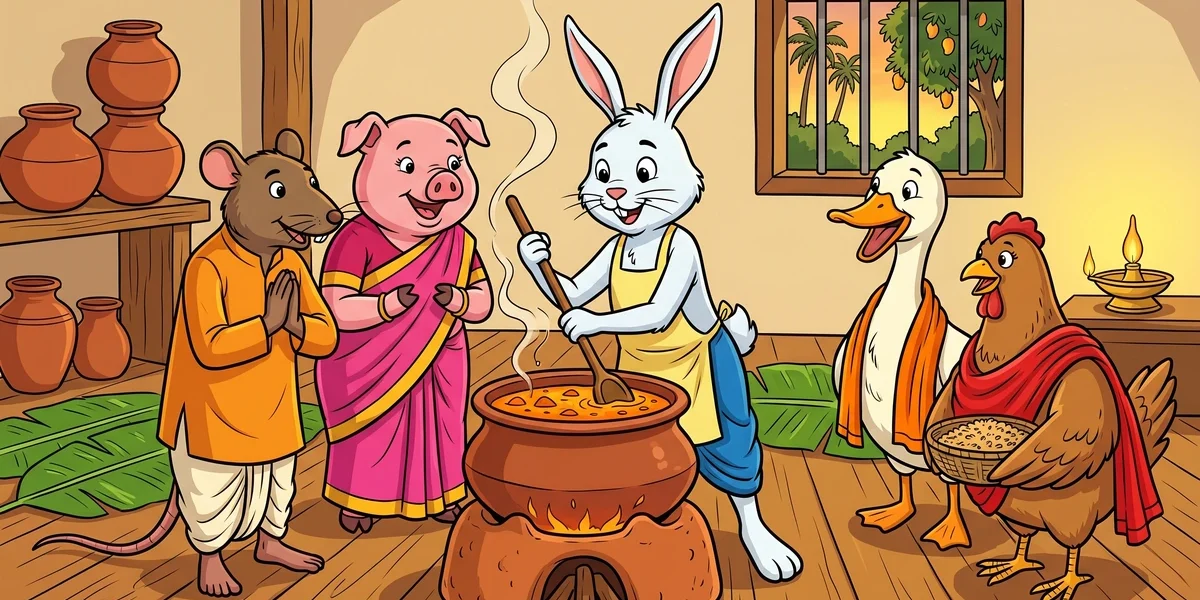
“Atithi devo bhava” — the guest is a god. This brief Indian children’s primer compresses centuries of Vedic teaching about dāna (giving), annadāna (the gift of food), and the conviction that an empty larder shared in good faith is never empty for long.
The Story Behind the Story
“Mr. Bunny’s Carrot Soup” is a deceptively small tale. A rabbit picks four carrots, intends to make soup for one, and finds himself instead opening his garden gate four times — to Mr. Rat, Miss Pig, Mr. Duck and Miss Hen — each asking the same modest question: “May I have a carrot please?” Each time Mr. Bunny answers with the same modest sentence: “Yes, take one.” When he walks home with empty paws and the doorbell begins to ring, the story refuses to end the way the math predicts. The animals return — not for taking, but for giving. A potluck arrives. The carrot soup he could not make alone becomes a feast he could not have made alone.
Indian children meet this story in their earliest English-medium primers, alongside thumbnail Panchatantra fables and one-page Jataka birth-stories. Its language is purposefully plain (eight repeated lines, a four-beat refrain, and a single onomatopoeic surprise — ding-dong, ding-dong) because it is meant to be the first folk-tale a child reads aloud. Behind the simplicity sits an inheritance of remarkable depth. The structure belongs to the international tale-type cataloguers call ATU 1548 “The Soup-Stone”, the same root-pattern found in the European “Stone Soup”, the French Soupe au caillou, the Russian Каша из топора (“Porridge from an Axe”), and a dozen South Asian cousins about a wandering sannyasi or sadhu who turns a single grain of rice into a village banquet. The Indian retelling chooses a rabbit because the hare is the trickster-kindly figure of countless Jataka and Panchatantra stories — a small creature whose quietness carries the weight of the moral.
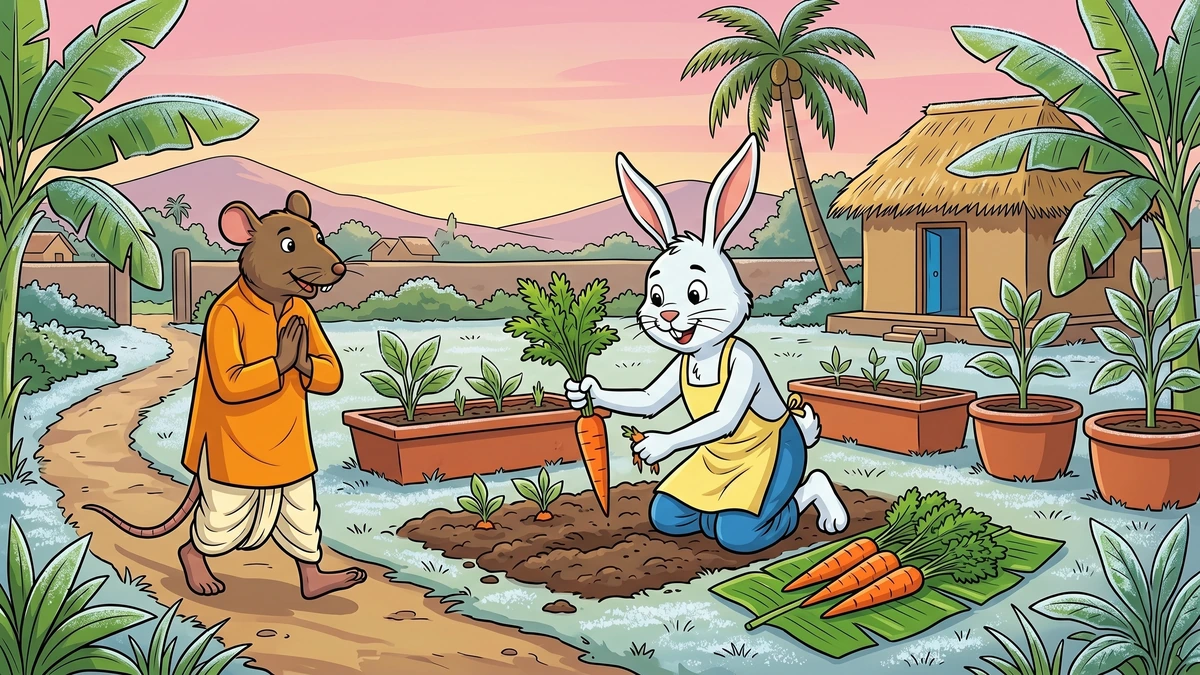
Scene I — The Garden, Four Carrots, and an Open Hand
Morning in the rabbit’s garden. The frost has only just lifted; the soil is still cold against Mr. Bunny’s paws as he tugs four carrots from their beds. Four — exactly enough for soup. He counts them carefully, because rabbits count carrots the way merchants count gold: with appreciation. He carries them inside, where the kettle waits and the wooden spoon is already laid across the bowl. He has planned this dinner for himself.
The first knock comes before the water boils. It is Mr. Rat — a rat in the village sense, not the city sense, the kind who minds the rice barns and keeps an eye on the moon. “May I have a carrot please?” he asks. Mr. Bunny does not hesitate. The reply is immediate and uncalculated: “Yes, take one.” The Sanskrit ethical tradition has a word for this immediacy — sahaja-dāna, or “spontaneous giving.” It is the form of generosity that does not pause to weigh the giver’s reserves. The Rig-Veda’s hymn to the annada (food-giver) celebrates exactly this kind of unhesitating reach: “Let the rich satisfy the poor implorer, and bend his eye upon a longer pathway.” Mr. Bunny’s “Yes, take one” is its child-sized form.
Miss Pig comes next, then Mr. Duck, then Miss Hen — and each time the answer is the same. The story’s rhythm is the rhythm of an unbroken yes. By the time Miss Hen asks, only the last carrot remains, and the formula shifts by exactly one word: “Yes, take the last one.” That single adjective is the entire hinge of the story. To say “the last one” is to know it is the last one — to give with full knowledge of cost. This is what Sanskrit philosophy calls tyāga, renunciation; not the performance of giving when there is plenty, but the willingness to give when there is nothing else.
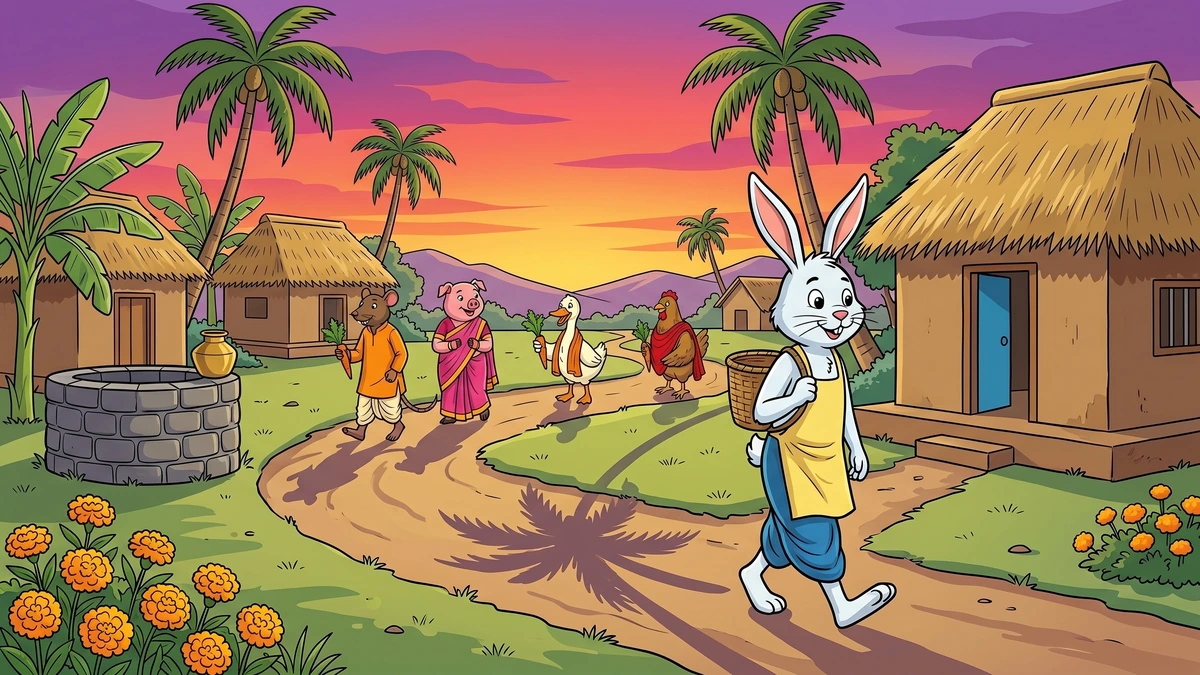
Scene II — The Empty Larder, the Quiet Walk Home
Mr. Bunny goes home without any carrots. Most children’s books would frame this as a moment of regret — “and then he was sad” — but the original primer leaves the line bare: Then Mr. Bunny went home without any carrots. No commentary. No rueful sigh. The story trusts the child to feel the weight of an empty hamper without being told what to feel.
This sparseness is itself an Indian narrative inheritance. The Jataka collections, especially the Sasa-jātaka (Birth-Story of the Hare, Jataka No. 316), end their most famous scene of self-giving with the same kind of restraint. In that earlier story, a hare resolves to feed a hungry traveller, can find no berries to offer, and so leaps into the fire to roast his own body — and the verse that follows simply says the moon rose with the figure of a hare upon it, marking the gift forever. Indian moral teaching trusts the silence after the gift. It does not need to explain.
Mr. Bunny, modern, secular, and very small, does not leap into a fire. He walks home. He hangs up his apron. He looks into the empty pot. The kitchen is the same as it was an hour ago, except that the four carrots are gone and four neighbours are warmer. The Bhagavad Gita’s third chapter calls this state the action without attachment to fruit: karmaṇy evādhikāras te mā phaleṣu kadācana — “Your right is to action alone, never to its fruits.” Mr. Bunny acted. The carrots are not his anymore. He is allowed to be tired, and the story allows him to be tired in peace.
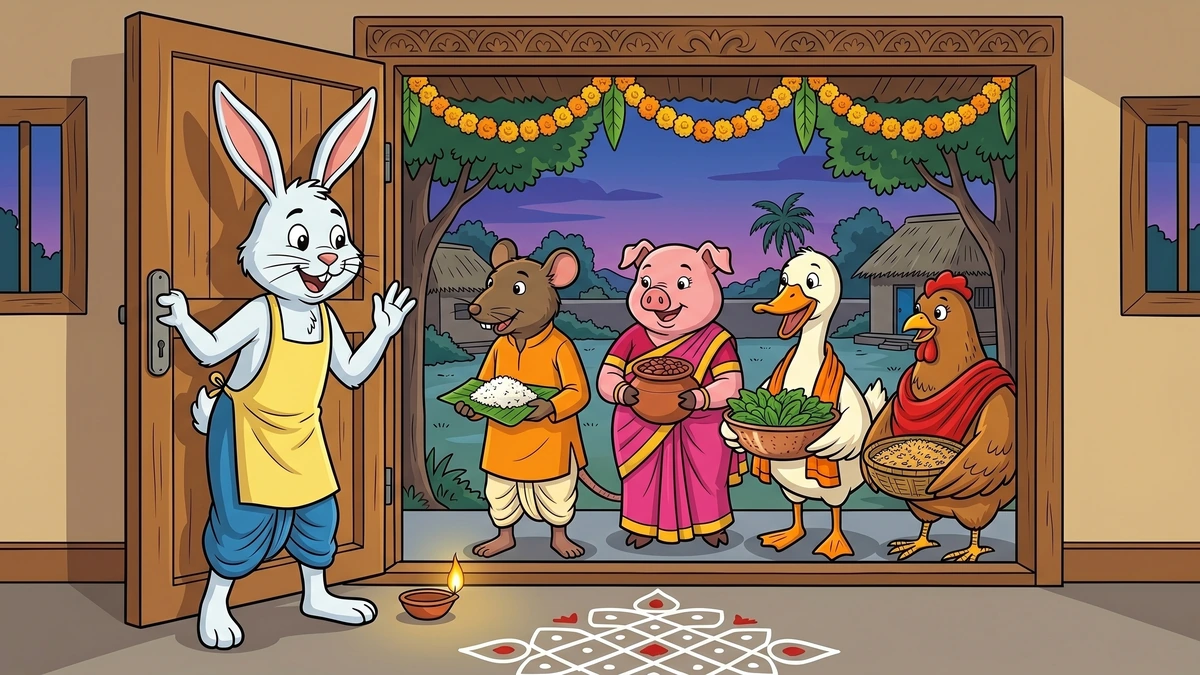
Scene III — The Doorbell, the Procession, the Overflowing Pot
And then: ding-dong, ding-dong.
The doorbell is the story’s small thunderclap. Mr. Bunny answers it. On the threshold stands a procession — Mr. Rat with a bowl of rice, Miss Pig with a basket of beans, Mr. Duck with a fistful of fresh greens, Miss Hen with an apron-full of barley. Each of them brings what their own household has, and each of them brings it because they remembered the rabbit who said “yes” without weighing the cost. The same hands that received the four carrots have come back loaded with the makings of a feast.
This is the moment in which “Mr. Bunny’s Carrot Soup” reveals its kinship with the great cycle of ATU 1548 “The Soup-Stone”. In the European version a hungry traveller boils a stone and persuades each villager to add “just one thing” — an onion, a carrot, a knuckle of ham — until the cauldron is full. In the Russian Кашa из топора a soldier convinces a stingy old woman to stew his axe, and so on. In the Tamil Konjam Pongal story a Vaishnavite saint cooks pongal with one grain of rice. In every version, the moral is the same: a community contains more than any one of its members, and the act of asking and the act of giving each draw out what was already there. Mr. Bunny does no trick. He simply gave first, and the reciprocity catalogued for centuries by anthropologists as “the gift economy” begins to turn.
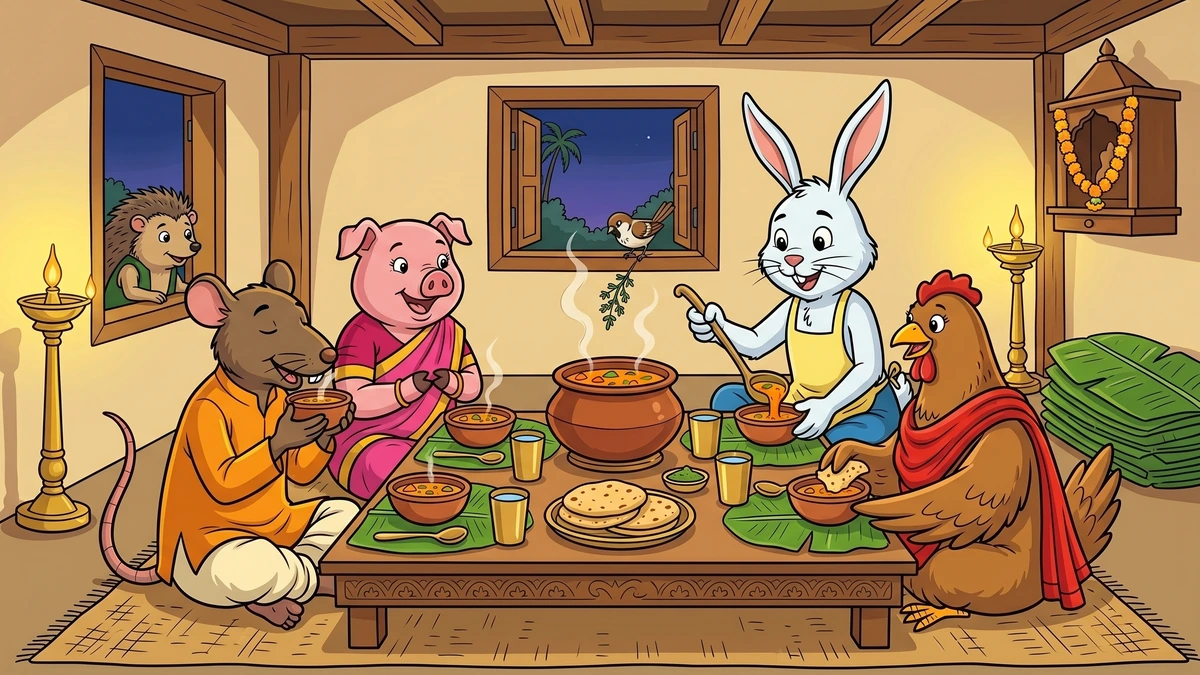
The four neighbours come into the kitchen. The pot is set on the fire. The rice goes in, the beans go in, the greens go in, the barley goes in, and someone — probably Miss Hen, who has the best memory — produces a pinch of salt. The water that was meant for one rabbit now feeds five. The carrots that were given away come back, in spirit, as the soup that bears their name.
Scene IV — The Table, the Steam, the Lesson Without a Lecture
They sit at Mr. Bunny’s small table. Six bowls. Wooden spoons. A loaf of black bread that nobody quite remembers bringing. The steam rises and curls under the rafters and the room — a moment ago the saddest kitchen in the village — is suddenly the warmest. The hedgehog who pressed his nose to the window is invited in. The sparrow on the sill drops a sprig of thyme into the pot for flavour. Outside, the frost holds. Inside, the soup goes around twice.
The Sanskrit word for this is annaprāśana, the rite of first feeding — the moment a community recognises a member by sharing rice with them. The word for the broader idea is sahabhojana, “eating-together”, the meal that turns strangers into kin. Indian villages have practised it for at least three thousand years, in the temple annadāna halls where pilgrims of every caste eat the same dal off the same banana leaves, in the Sikh langar where the meal is the prayer, and in the small private kitchens where any visitor — invited or not, expected or not — is set a place. Atithi devo bhava, the Taittiriya Upanishad’s instruction, is not a metaphor. It is a recipe.
The carrot soup is finished. Bowls are scraped. Mr. Rat falls asleep in the corner. Miss Hen washes the pot with the small fastidiousness of grandmothers. Mr. Bunny, last to be served, eats slowly, and notices that this is the best soup he has had in years — not because of its ingredients, but because of its company.
Moral
दानेन तुल्यो निधिरस्ति नान्यः
dānena tulyo nidhir asti nānyaḥ
“There is no treasure equal to giving.”
— Hitopadesha, Mitralābha 1.11
The lesson of “Mr. Bunny’s Carrot Soup” is not that generosity is rewarded. The story does not promise that every act of giving will return four-fold the next afternoon; sometimes the rabbit really does eat plain water. The lesson is that the act of giving is itself the meal. Mr. Bunny was already richer at the moment he handed over the last carrot than he had been when he was deciding what to put in his pot. The doorbell that rings in Scene III is not a reward; it is a confirmation of something that was already true. Generosity creates the world in which generosity is possible. The pot fills because the door was open before anyone knocked.
This is why the story closes with a meal rather than a moral aphorism, and why generations of Indian primer-teachers have introduced the tale to six-year-olds learning their first English consonants. A child does not need to be told, in the abstract, that “sharing is good.” A child needs to feel the warmth of the soup the rabbit and his friends are eating. The narrative withholds its own commentary because the steam in the kitchen is the commentary.
Why It Has Lasted
“Mr. Bunny’s Carrot Soup” is barely a hundred and fifty years old in its written English form, and yet it stands on a foundation that is much, much older. Its DNA includes the Vedic annadāna hymns; the Jataka Sasa-jātaka; the Hitopadesha couplet on the supremacy of giving; the Aesopic Stone Soup; the Russian Каша из топора; the Korean Dol Guk (“Stone Stew”); the Chinese Sān Wèn Sān Dá village-pot; and the modern primer’s own quiet conviction that small children should meet their first moral idea in the form of a recipe rather than a rule. ATU 1548 has survived because it answers a permanent human anxiety — what if I do not have enough? — with a permanent human discovery: that generosity, performed in small unhesitating sentences, is the most reliable form of abundance.
Read the story aloud once and it sounds like a children’s nursery piece. Read it aloud twice and it sounds like the Hitopadesha. Read it aloud three times — perhaps to a child of your own, perhaps to a tableful of friends with a real pot of carrot soup on the stove — and it begins to sound like an instruction. “May I have a carrot please?” “Yes, take one.” The whole moral curriculum of the Indian household, and very nearly the whole moral curriculum of the world, is folded into that exchange. The rest, including the doorbell, takes care of itself.
Cultural Parallels Across South Asia
Walk into any temple in Tamil Nadu at noon and you will find the annadāna hall: long rows of pilgrims sitting cross-legged on the floor, banana leaves spread before them, and an unbroken procession of cooks ladling out rice, sambar, and a small ladle of buttermilk. The meal is free. The temple has fed the village this way for, in some cases, more than a thousand years. The principle is identical to Mr. Bunny’s: the kitchen does not refuse anyone who walks through the door, because the act of refusing is a poverty greater than the act of giving.
In Punjab, the same instinct produced the Sikh langar, the community kitchen attached to every gurdwara, where rich and poor sit on the same floor and share the same dāl. In Bengal, every wedding feast carries a small portion of prasāda for the household sweepers and watchmen — they eat what the bride and groom eat, on the same plates. In coastal Karnataka, the sahasra-bhojana (feeding-of-a-thousand) is still a household milestone. Across the subcontinent the lesson Mr. Bunny’s Carrot Soup teaches in three minutes is being lived, in three thousand temples and ten million kitchens, every single day.
Children read the story and absorb the rule before they have a name for it. By the time they are old enough to ask “where did this story come from?” the answer is already in their bones: it came from us, from this kitchen, from the door my grandmother always left open.
Frequently Asked Questions
1. Is “Mr. Bunny’s Carrot Soup” a traditional Indian folk tale? It is a modern Indian children’s primer story whose narrative skeleton belongs to ATU 1548 “The Soup-Stone”, an international tale-type with extensive South Asian variants. The “rabbit” protagonist draws on the Jataka-Panchatantra tradition of the small kindly hare (compare Sasa-jātaka, Jataka No. 316), and the moral framework is the Sanskrit ethic of dāna (giving) and annadāna (the gift of food).
2. What is the original-language moral, and where does it come from? The line cited above — dānena tulyo nidhir asti nānyaḥ, “there is no treasure equal to giving” — is from the Hitopadesha, the 12th-century Sanskrit fable collection compiled by Narayana Pandita, in the section Mitralābha (“The Acquisition of Friends”), verse 1.11. The Hitopadesha drew this teaching directly from the older Panchatantra tradition.
3. How is this story related to the European “Stone Soup”? Both tales belong to ATU 1548 in the Aarne–Thompson–Uther index of folk-tale types. In each version, what looks like an inadequate beginning (a stone, a pebble, an axe, four carrots) becomes a community feast through the contributions of others. South Asian variants typically frame the protagonist as a wandering sadhu or a small generous animal; European variants frame the protagonist as a clever traveller. The moral architecture is identical.
4. Why a rabbit, and not a peacock or a lion? The hare is one of the most beloved figures in South Asian moral storytelling. The Sasa-jātaka celebrates the hare who offers his own body to feed a guest; multiple Panchatantra stories cast the hare as the cunning-but-gentle equaliser of stronger animals. Choosing a rabbit (or hare) signals to a young Indian reader that the story belongs to the same shelf as Buddhist birth-stories and Panchatantra fables — even if its English-language language and gentle suburban setting feel modern.
5. Why does the story end at the meal rather than at a stated moral? Indian narrative tradition generally trusts the image rather than the lecture. The Hitopadesha and the Panchatantra do close their stories with a Sanskrit verse, but the verses crystallise an emotion the story has already produced. “Mr. Bunny’s Carrot Soup” follows this pattern in primer form: the steam, the table, the procession at the door, and the doorbell — these images carry the lesson. The child is asked to feel the moral, not memorise it.
Frequently Asked Questions
**Q: Why is this story important?**
You May Also Like
 Indian Folk Tales
All Ages
Indian Folk Tales
All Ages
The Royal Thief-Catcher
The Royal Thief-Catcher: In a bustling town in ancient India, A king appointed a clever man to catch thieves, but the methods were unconventional. This tale
 Indian Folk Tales
All Ages
Indian Folk Tales
All Ages
The Barbers Clever Wife
The Barbers Clever Wife: In a vast and ancient forest in the heart of India, there lived four inseparable friends: a crow named Kala, a mouse named Chuhiya, a
 Indian Folk Tales
All Ages
Indian Folk Tales
All Ages
The Interesting Journey
The Interesting Journey: Once upon a time, a little boy named Rohan lived near the foot of the Mt. One day Rohan’s dad woke up bright and early and woke up