Rain of Tears – A Greek Mythological Fiction
Why does it rain? Read Rain of Tears—a modern Greek mythological fiction about Calandra, Orestes, and tears that become rain. Moral: pity and compassion. Free kids’ story.
Genre: Modern Greek Mythological Fiction Ages: 7–12 (read-aloud or independent) Read time: ~6–8 minutes
Themes: Kindness & Compassion · pity · grief that becomes a gift · origin-of-rain fiction
Honest framing: This is modern mythological fiction — an original children’s story that uses Olympian names and a Greek-style tear→weather motif. It is not a Homeric or Ovidian tale, and not a traditional Indian folk tale.
Intro
Why does it rain? In this modern Greek mythological fiction, rain is Calandra’s tears. Daughter of Hades, she loved Orestes, son of Zeus; when the gods tore them apart, her grief rose into the sky—and her pity fell as rain that feeds the earth.
Story
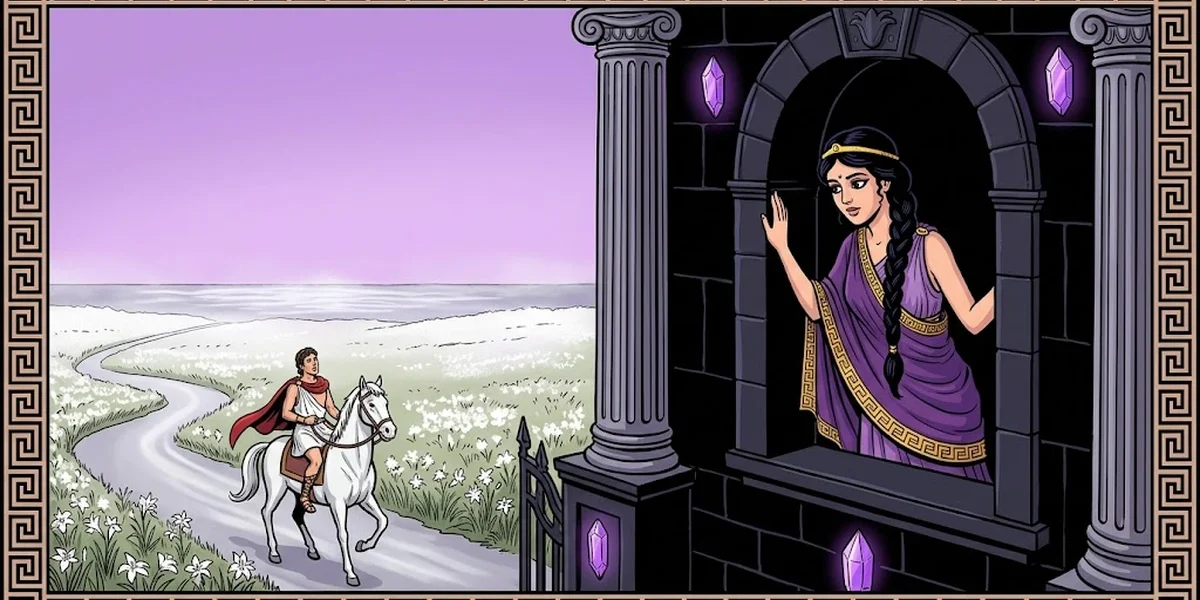
Long ago—in a story told for modern readers, not copied from Homer—there lived a princess named Calandra in the palace of the Underworld. Her father was Hades, lord of that shadowed realm. Calandra was kind, bright, and curious. She spent hours at a high window, watching the dark roads that led to her father’s gate, and she dreamed of a world with sun and open sky.
One day a young prince rode up on a fine horse. The guards let him through. Calandra watched him walk straight to Hades and bow.
“Lord Hades,” said the prince, “I am Orestes, son of Zeus. I ask for your daughter’s hand. I love her more than anything in the world.”
Hades rose, cold as stone. “Zeus’s son? In my house? No. You will not take her. Guards—remove him.”
“Wait!” Calandra cried, running forward. “Father, please. You never ask whom I like. He came all the way to the Underworld for me. Give him a chance.”
“I said no.” Hades ordered the guards to lock Calandra in her room and escort the prince out. Through the window she saw Orestes ride away—and her heart ached.
Not long after, a soft psst came from the shadows. Orestes had slipped back into the palace.
“I cannot leave without you,” he whispered. “You mean too much to me.”
“Where will we go?” Calandra asked.
“To Mount Olympus. Perhaps my father, Zeus, will bless our marriage.”
He lifted her onto the horse, and together they rode up from the dark into the bright halls of the gods.
Olympus shone with gardens and golden light. Calandra had never seen the outdoors like this; the Underworld had kept her close. Orestes led her before Zeus.
“Father,” he said, “I love Calandra and wish to marry her.”
Zeus frowned. “Who is her father?”
“Lord Hades,” Orestes answered, voice small.
Thunder muttered. “What were you thinking? From this moment you are not to see her. Forget her—or I will make you both sorry.”
“She is nothing like the cold of her realm,” Orestes pleaded. “Look—she is standing there.”
Zeus’s face darkened. “Get her out! She is not welcome on Mount Olympus!” Lightning cracked. Orestes seized Calandra’s hand, leapt for the horse, and fled back toward the Underworld.
On the road Calandra wept. “We can never be together.”
“Yes, we can,” Orestes said. “I will do anything to keep us side by side. I promise.” He thought hard. If neither father would agree, they would run far away—beyond Olympus, beyond the dark palace—until no one could find them.
He shaped a doll that looked like Calandra sleeping and left it on her bed to fool the guards. Then the two of them slipped away by sea and by land, hoping distance would be enough.
It was not. Hades soon discovered the empty bed and the false doll. He sent word to Zeus. Zeus grew furious. He told Poseidon to watch the waters; if the runaways crossed the sea, the waves should rise. Zeus himself would shake the sky with storm.
When Calandra and Orestes sailed, the sea began to heave. Thunder rolled. Wind tore at the sail. A great wave climbed toward their small boat.
“Orestes!” Calandra cried as the deck tilted. He caught her hand—but the water pulled hard. Her fingers slipped. She fell into the dark sea.
“Calandra!” Orestes shouted. He thought he had lost her forever. He shook his fist at the storm. “I hate what you have done!”
Then the sea calmed—and the skies themselves lifted Orestes toward Olympus. When he arrived, Zeus and Hades stood waiting. Behind them, wet and shivering, stood Calandra. She had been pulled from the water and brought here. She was alive.
“Calandra!” Orestes ran toward her.
Zeus raised a hand. A bolt of lightning struck—not with cruelty for cruelty’s sake, but as a father’s harsh judgment. Orestes fell. Softly, like ash in the wind, he was gone from the world of the living.
“Orestes!” Calandra’s cry tore the hall. Tears poured down her face. “We only wanted to be together. Why must love be punished?”
“It is for your own good,” Hades said, though his eyes were hard.
Zeus pointed at Calandra. The air lifted her high. “You will dwell in the skies. The watchers of heaven will guard you. You will mourn for Orestes all your days.”
Calandra begged her father for mercy. Hades looked away. Up into the high blue Zeus set her—where no one on earth could see her face.
There Calandra wept for the prince who had promised they would stay together, and who had given everything he could. Her tears fell through the clouds. On the ground below, people looked up and called that falling water rain.
Wherever her pity and her grief touched the dry earth, green things drank. Fields soft with dust grew soft with life. Rivers found their voices again. So the world learned a quiet truth: sorrow that remembers love can still become a gift.
Remember, when rain taps your window—in this story—it is Calandra, the goddess of rain, crying above the world she still cares for.
Moral of the Story
Pity is stronger than revenge: tears shed in compassion can become rain that feeds the earth.
Grief without cruelty, love without triumph—that is the heart of Rain of Tears. Calandra’s tears do not destroy Zeus or Hades; they nourish strangers she will never meet. Kindness and compassion outlast the lightning.
Echoes of Older Myths
This fiction borrows a very old weather-and-tears idea, then tells a new children’s plot. In classical stories, Niobe weeps until she becomes a stone that still drips tears; the Heliades cry for their brother until their tears harden into amber; the Hyades are rain-nymphs whose rising was linked to wet weather. Rain of Tears is not those myths—it is modern mythological fiction that lets Calandra’s pity fall as rain. For classical Hyades notes, see a scholarly source such as Theoi on the Hyades; do not treat this page as a Homeric retelling.
Discussion Prompts
- Why are Calandra’s tears more powerful, in the end, than Zeus’s lightning?
- What does the story want us to feel when rain “feeds the earth”—anger, pity, or both?
- If you could speak to Hades or Zeus for one minute, what would you ask them to understand about Calandra and Orestes?
FAQ
Is Rain of Tears a real Greek myth or fiction?
A: It is modern mythological fiction—an original children’s story inspired by Greek names and motifs (underworld romance, tear→weather). It is not a Homeric tale, not Ovid, and not the classical Hyades or Niobe myths themselves.
Why does it rain in this story?
A: After Zeus’s punishment, Calandra is set in the sky. Her tears of grief and pity fall to earth as rain—and that rain nourishes the world.
What is the moral of Rain of Tears?
A: Pity and compassion matter more than winning. Tears shed with a caring heart can become a gift (here, rain) that helps life grow. This matches the page theme Kindness & Compassion—not “intelligence and quick thinking.”
Who are Calandra and Orestes?
A: In this fiction, Calandra is the daughter of Hades, kind and curious; Orestes is a prince, son of Zeus, who loves her and tries to stay with her despite both fathers’ refusal.
What ages is this story for?
A: About ages 7–12 for read-aloud or independent reading. The conflict (gods’ anger, loss, soft-told lightning) is kept family-friendly; it is not a preschool animal fable and not an academic essay.
You May Also Like
Explore more modern mythological fiction and Kindness & Compassion stories.
Frequently Asked Questions
Is Rain of Tears a real Greek myth or fiction?
Why does it rain in this story?
What is the moral of Rain of Tears?
Who are Calandra and Orestes?
What ages is this story for?
You May Also Like
 Panchatantra Stories
Ages 3-5
Panchatantra Stories
Ages 3-5
The Monkey and The Wedge – For Children
The Monkey and The Wedge – For Children: Once upon a time in a town, a rich merchant decided to build a temple in his courtyard. He assembled many skilled
 Korean Folk Tales
Ages 9-12
Korean Folk Tales
Ages 9-12
The King Of The Flowers
The King Of The Flowers: Korea is the land of beautiful scenery and lovely flowers. Snow white and ruby red are their chief colors. In the spring time when the
 Chinese Folk Tales
Ages 9-12
Chinese Folk Tales
Ages 9-12
The God Of War
The God Of War: Guan Di, was really named Guan Yu. At the time when the rebellion of the Yellow Turbans was raging throughout the empire, he, together with two