The King of the Flowers
To warn a pleasure-loving king, the great scholar Sul Chong tells of a royal peony who forgets his garden kingdom for the charms of a spicy cinnamon rose.
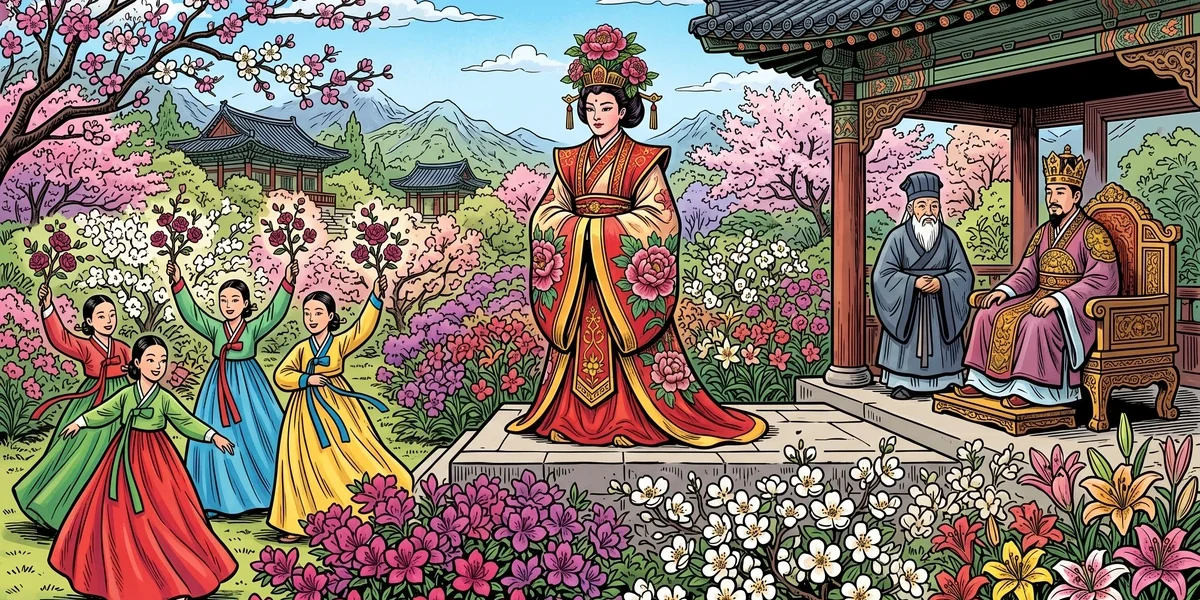
Griffis introduces this tale with an idealised picture of Korea’s scenery and flowers, favouring snow white and ruby red. In spring, when the ice has melted and the rivers have poured their floods into the sea, the whole country blushes pink with azaleas, the valleys turn white with lilies of the valley, and every breeze carries perfume across the land.
In Griffis’s introduction, girls follow the seasons and months through flowers, for they knew the calendar of blossoms by heart. Much-loved daughters were named after flowers, and a fond husband might call his wife his plum tree. In one old song, a homesick husband far from his family asks a traveler from his hometown whether the plum tree by his old front door is in bloom. The traveler answers that it is blooming, though pale, and sad from waiting so long for him.
Griffis describes a language of flowers, much like the Scotsman who calls his sweetheart his “bonnie briar bush.” Every plant and blossom carried a meaning, pleasant or unpleasant. To call a girl a pear blossom was a compliment, for the pear tree is glorious and its flowers lovely. But it would never do to call her a cinnamon rose, for that flower stood for the dancing girls of the court, and the wise men of old told this story to explain why.
The tale introduces the celebrated Silla scholar Sul Chong, praising him as a great learned man. His head was as full of knowledge as a persimmon is of pulp, and his ideas were as many as the seeds in a pomegranate. He taught his people everything in the books of China, and Griffis describes his portrait as honoured in a Confucian temple.
Griffis surrounds the scholar with a picture of prosperous Silla, busy harbours and valuable goods such as ginseng, porcelain and silk. His broad comparison with the world of the Arabian Nights is literary scenery, not evidence of a particular trading voyage during King Sinmun’s reign.
In those days King Sin Mun of Silla was living in luxury and filling his palace with pretty dancing girls, who distracted him from the business of ruling. So Sul Chong warned his master by telling him this story.
One spring, the Peony, king of the flowers, bloomed so gorgeously that everyone in the country who loved beauty came to admire it. Hundreds of people made long journeys to the capital of Silla to see the bright blossoms. In the royal gardens, the branches on their tall stalks were heavy with big red flowers. They were lovely, but the true king of the garden was a single peony grown on one stem, so that all the strength of the plant went into that one royal bloom. Everyone hailed this flower as king.
When the other flowers heard of their king’s glory, they came to pay their respects at his court. All the trees sent their finest blossoms as ambassadors. In one splendid parade of color and fragrance came the Peach, the Plum, the Pear, the Apple and the Persimmon, each bowing low to the monarch of all flowers. These tree blossoms were very proud of being useful to people, since they promised the delicious fruit to come.
Next, among the bright crowd, came the lively young flowers of the garden: the Tea Rose in a pearly gown, the Azalea in pink, the Lily in white, the Strawberry Blossom and a score of other pretty things. Last of all came the Cinnamon Rose, tripping along in a green skirt and a red jacket, with a proud air and a breath of spice.
One after another, they were presented to King Peony and made their graceful bows. But of them all, the King seemed to like Miss Cinnamon Rose best. He let the others leave the court but lingered with his spicy visitor, as if charmed by her. Soon he invited her to come and live in the palace, and leaving his ministers to run the government, he spent all his time with her. She was given a place close to His Majesty and always seemed to have his ear, even when the Prime Minister had to wait a long time for a meeting or even a word. Miss Cinnamon Rose seemed to be the real ruler instead of the King.
But one day the flower called Old Man came to the palace. He looked exactly like an old beggar in sackcloth leaning on a staff. Bowing respectfully, he asked if he might share the hospitality of the King’s palace. He was welcomed and fed from the royal table. When at last he was brought before King Peony and invited to speak, he said:
“Out on the road, Your Majesty, I heard about your rich feasts and fine food. Now I hear that you need medicine. You dress in Chinese silk, and no one can match the splendor of your robes or your court, yet you have needs just as I do. You need plain, useful things as much as I do. Is that not so?”
“You are quite right, Old Man,” said the King. “And yet I like this Cinnamon Rose and want her with me. I can’t do without her.”
“Yes, Your Majesty. But is it not true that if you keep company with the wise and careful, your reign will be long, strong and glorious, and if you keep company with the foolish, your house will fall? Did not three dynasties of the emperors of China fall because beautiful favorites made those rulers forget their duties? If that was so in ancient times, how much more so now?”
King Peony blushed a deep crimson. He admitted his faults and mended his ways.
And it is said that the real, human King took the lesson to heart as well. He sent away the crowds of dancers from his palace and ruled wisely for the rest of his life.
About this story
“The King of the Flowers” is retold from William Elliot Griffis’s Korean Fairy Tales (1922). The tale within the tale is a famous fable called Hwawanggye, “Advice to the Flower King,” which the historical scholar Seol Chong (Sul Chong) is said to have told King Sinmun of Silla around the year 690.
The Old Man flower is the pasqueflower, a humble wildflower with drooping, silvery hairs that make it look like a white-bearded old man. Fables like this let a wise adviser criticize a king without saying anything directly.
Read the original: Korean Fairy Tales (Project Gutenberg)
Best for ages 9–12 — a royal peony neglects his garden kingdom for a flashy flower, until a humble old bloom speaks up.
The king makes the choice
Cinnamon Rose receives the king’s attention, but he decides to neglect government and keep his ministers waiting. Blaming the beautiful visitor alone would excuse the ruler’s responsibility. Old Man’s plain appearance also separates useful counsel from courtly display: the advice matters because of its substance, not the speaker’s clothes.
Rewrite the advice without blame
Give King Peony two concrete changes he could make to how he hears advisers and allocates time. Support each with a detail from the garden court. Can he meet his duties without treating beauty or entertainment as inherently bad?
Think about it
- Why did Sul Chong tell the King a story about flowers instead of speaking plainly?
- What did the Old Man flower mean when he said the King needed medicine?
- What makes a good adviser to a leader?
Related stories
- Whom the King Honours — another Korean king who values wisdom and duty
- Topknots and Crockery Hats — another tale from Griffis about old Korea
- The King of the Sparrows — another Korean tale of a king among creatures
Also known as: Hwawanggye
Frequently Asked Questions
Why does Sul Chong use a flower story?
What is King Peony's failure?
What happens to the human king in this version?
You May Also Like
 Korean Folk Tales
Ages 9-12
Korean Folk Tales
Ages 9-12
The Wild-Cat Woman
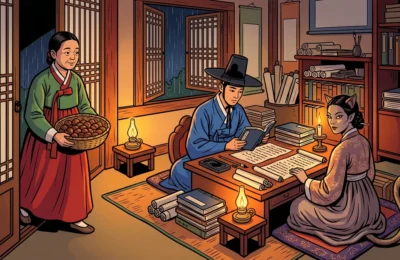
Late one night a young scholar is eating roasted chestnuts brought by his wife when the door opens and a second wife walks in, carrying the very same basket.
 Korean Folk Tales
Ages 9-12
Korean Folk Tales
Ages 9-12
The King of the Sparrows
A kind man mends the broken leg of a young sparrow, and the grateful bird flies off to tell the Sparrow King, who sends back a seed packed with treasure.
 Korean Folk Tales
Ages 9-12
Korean Folk Tales
Ages 9-12
Pigling and Her Proud Sister
Bullied by her stepmother and called Pigling, a magistrate’s daughter gets help from pigeons, a sooty imp and a kindly black cow when given impossible tasks.