The Monkey and The Wedge – For Children
The Monkey and The Wedge – For Children: Once upon a time in a town, a rich merchant decided to build a temple in his courtyard. He assembled many skilled
The Monkey and the Wedge — Panchatantra, Book V: Aparīkṣitakāraka (Ill-Considered Action)
This tale belongs to the fifth and final book of the Panchatantra, compiled by Vishnu Sharma around 300 BCE. Book V — Aparīkṣitakāraka, meaning “Acting Without Due Consideration” — collects cautionary tales about the catastrophe that follows impulsive interference in matters one does not understand. The Monkey and the Wedge is the book’s signature story: short, brutal in its consequences, and perfectly constructed to illustrate why the Panchatantra warns so insistently against meddling without knowledge. It appears across virtually every translation of the Panchatantra, from the Pahlavi Kalīlah ud Dimnah to the medieval European Directorium Humanae Vitae.
Beat I — The Construction Site and the Curious Monkey
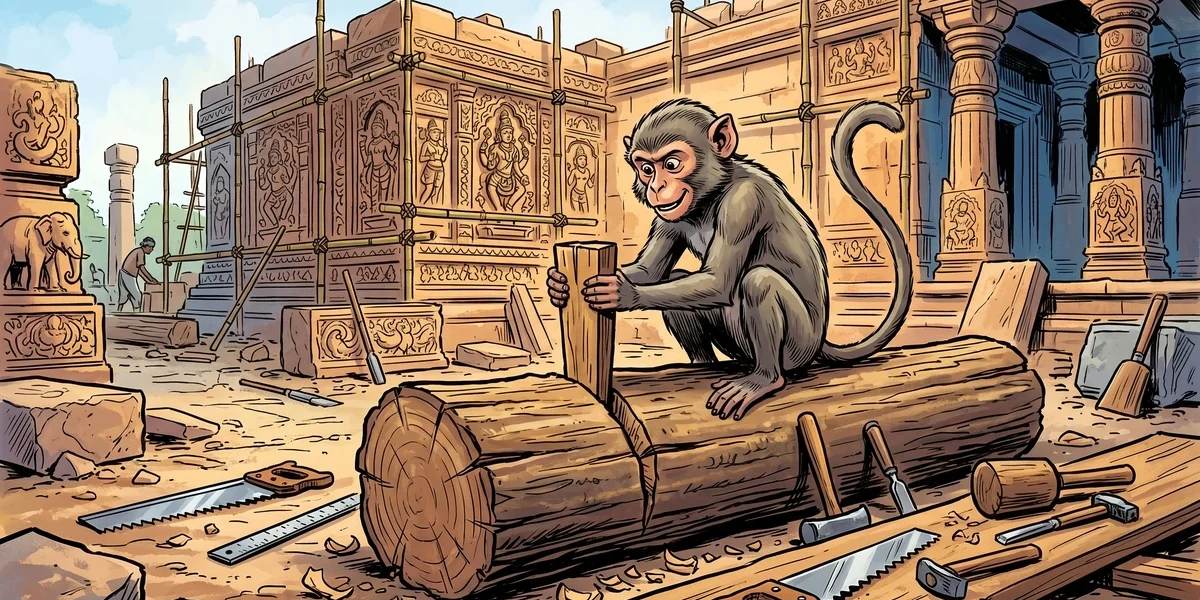
A merchant was building a large temple on the outskirts of a city. Each morning the carpenters arrived, laid out their tools, and began the long work of shaping massive beams of teak and sal wood. At midday, when the sun stood directly overhead, the foreman would call a halt, and the entire crew would walk to the bazaar for their meal, leaving their tools and half-finished work unattended for an hour.
It was during one of these midday intervals that a troop of monkeys descended from the trees at the forest’s edge. The site was fascinating — new smells of sawdust and resin, piles of timber in various stages of cutting, tools of unfamiliar shapes scattered everywhere. The monkeys leaped and chattered and picked up chisels and squares and examined them with intense, purposeless curiosity.
One large monkey, bolder than the rest, was drawn to a half-sawn log lying in the center of the clearing. The carpenters had made a long cut partway through the log and had wedged the cut open with a stout wooden peg so that the log would not spring shut around the saw. The wedge sat in the gap, holding the two halves apart, waiting for the afternoon’s work to resume.
The monkey straddled the log — one leg dangling on each side of the cut — and seized the wedge with both hands. He pulled and twisted and wrenched at it with all the considerable strength of his arms. He had no purpose. He was not hungry, not building a nest, not defending territory. He was simply curious, and curiosity, the Panchatantra notes without sentiment, is not in itself a virtue.
Beat II — The Wedge Yields
After considerable effort, the wedge came free. The log snapped shut instantly, with the tremendous force of compressed wood released — and the monkey’s legs, which had been dangling into the cut, were caught between the two halves and crushed. He could not free himself. His cries brought his companions rushing over, but there was nothing they could do. By the time the carpenters returned from their meal, the monkey had died.
The Panchatantra tells the story in exactly this many words — no more. There is no extended suffering, no moral speech from a passing wise man, no intervention by a king or sage. The consequences flow from the act with the simple inevitability of physics. The monkey pulled the wedge; the log closed; the monkey died. Vishnu Sharma was teaching young princes, and princes needed lessons that could not be argued away: some mistakes have no appeal and no remedy.
The log itself is the teacher. It does not care about the monkey’s intentions. It does not distinguish between the interference of a fool and the interference of a wise man. Forces of tension and compression obey no ethics. This is precisely why, the Panchatantra implies, ethics must be learned before one encounters such forces — not after.
Beat III — The Anatomy of Ill-Considered Action
Book V of the Panchatantra is obsessed with a specific type of error: not cruelty, not cowardice, not greed, but the confident interference of an actor who does not understand the system he is touching. The monkey is not malicious. He is not even unusually foolish by the standards of his kind. He is simply a creature of immediate curiosity operating in a context whose rules he cannot see.
The wedge holds the cut open because the natural forces in the wood are working to close it. Remove the wedge and those forces act instantly. The monkey, seeing only a piece of wood stuck in a log, perceives a puzzle — and puzzles, in a monkey’s experience, are for solving. What he cannot perceive is the invisible tension, the stored energy, the mechanical consequence of his solution. He acts on what he sees and is destroyed by what he cannot see.
The Arthashastra makes an adjacent argument in its counsel to administrators: before intervening in a dispute or system, a minister must understand the forces currently holding that system in equilibrium. The wedge in the log is an image of equilibrium — uncomfortable, provisional, deliberately maintained. A minister who removes such a wedge from a political dispute, thinking he is solving a problem, may find that the forces he released crush him rather than the problem.
Vishnu Sharma’s genius is to show this principle not in a political intrigue — which might be dismissed as special pleading — but in the starkest possible physical demonstration. The lesson is not “be careful in politics.” It is: before removing any peg from any system, understand what that peg is holding apart.
Beat IV — What the Story Teaches About Curiosity and Competence
The Panchatantra does not argue against curiosity. Several of its tales — including the story of the jackal and the drum — celebrate investigation over paralysis. What the Monkey and the Wedge teaches is the necessary companion to curiosity: the discipline of parīkṣā, examination before action. Look, the tradition says. Think. Understand the system you are about to disturb. Then act — or choose not to act, which is itself a form of wisdom.
The monkey’s error was not that he was curious about the wedge. His error was that he resolved his curiosity through manipulation rather than observation. He could have watched the carpenters return and seen what the wedge was for. He chose instead to pull it and discover the answer kinesthetically. In a world of ropes and wheels and saws, this is merely painful. In the world of statecraft that Vishnu Sharma’s royal students would inherit, it could be catastrophic.
“Do not disturb what you do not understand; the forces you cannot see are often larger than the ones you can.”
Why This Story Has Lasted 2,300 Years
The Monkey and the Wedge survives because its lesson cannot be dated. Every age produces people who remove wedges they do not understand — in machines, in institutions, in relationships, in ecosystems. The story requires no translation from animal to human: the monkey’s mistake is entirely recognisable as a human mistake, made with the monkey’s face to remind us, gently, how easily intelligence and curiosity can operate without the wisdom to restrain them. Two minutes of reading, one death, one lesson — this is the Panchatantra at its most concentrated.
About the Panchatantra
The Panchatantra (“Five Treatises”) was composed by Vishnu Sharma circa 300 BCE as a manual of nītiśāstra — statecraft, ethics, and worldly wisdom — expressed through animal fables. Its fifth and final book, Aparīkṣitakāraka, warns specifically against acting without adequate consideration of consequences. Translated first into Pahlavi in the 6th century CE, then into Arabic, Syriac, Hebrew, Latin, and all major European languages, the Panchatantra became one of the most widely read books of the pre-modern world. The Monkey and the Wedge appears in virtually every version, its physical clarity making translation effortless and its lesson impossible to miss.
Frequently Asked Questions
**Q: Why is this story important?**
You May Also Like
 Panchatantra Stories
Ages 6-8
Panchatantra Stories
Ages 6-8
The Elephants and the Hares
The Elephants and the Hares: The weak must make use of all tactics to survive.” Deep in the jungle, there lived a big group of elephants. The elephants lived
 Panchatantra Stories
Ages 3-5
Panchatantra Stories
Ages 3-5
The Talking Turtle
A chatty turtle flies high in the sky holding a stick between two clever geese, but his talking tongue will bring him crashing down in this funny Panchatantra fable.
 Panchatantra Stories
Ages 3-5
Panchatantra Stories
Ages 3-5
Tale of The Golden Droppings
Tale of The Golden Droppings: On a big tree in the lap of a mountain lived a bird named Sindhuka. His droppings used to turn into gold as soon as they hit the