1003+ Stories from Ancient India — Free to Read! Explore all stories →

The Snake Woman And King Ali Mardan

The Snake Woman And King Ali Mardan: Once upon a time King Ali Mardan went out a-hunting, and as he hunted in the forest above the beautiful Dal lake, which

Origin: Fairytalez
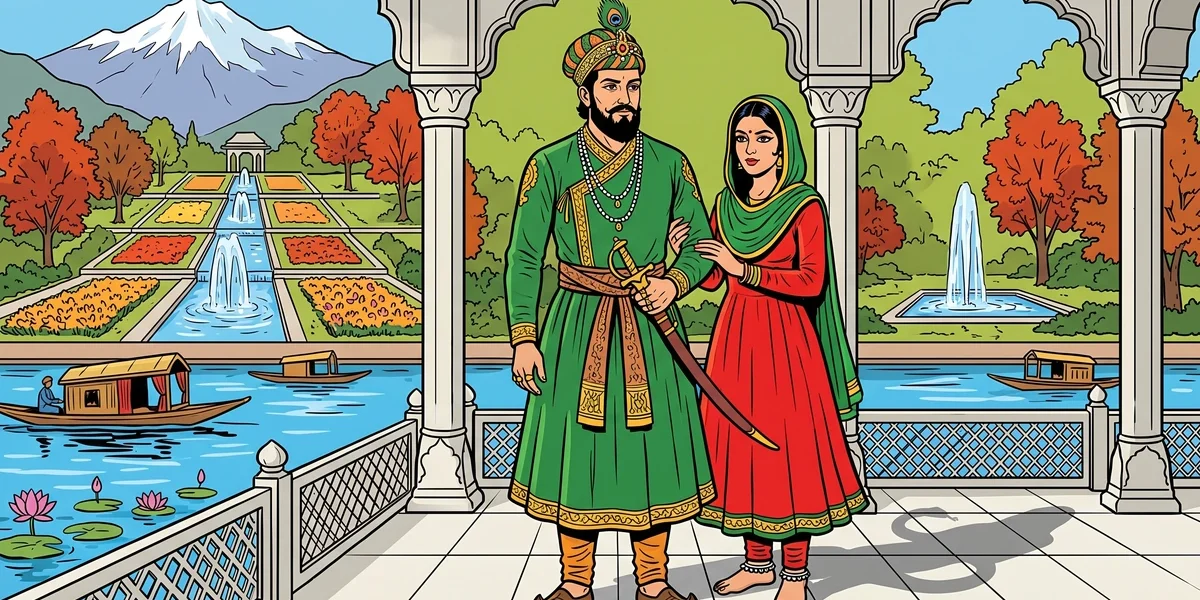
Cover: King Ali Mardan and the snake-woman in Shalimar Bagh, Kashmir — bold ACK-style illustration.
Ad Space (header)

The Snake-Woman and King Ali Mardan is one of the great Kashmiri tales of false love and revealed truth — a story in which a real seventeenth-century governor of Kashmir is woven into a far older snake-bride legend the Pandit and Muslim storytellers of the Vale of Srinagar had been telling one another for at least a thousand years. The text on which all later English retellings depend is the version printed by the Reverend James Hinton Knowles, a Church Missionary Society man stationed at Srinagar in the 1880s, in his Folk-Tales of Kashmir (London: Trübner & Co., Trübner’s Oriental Series, 1888; second edition, London: Kegan Paul, Trench, Trübner & Co., 1893). Knowles spent eleven winters listening to tales told around the kangri-braziers of Srinagar — from boatmen on the Dal and Wular, from the Pandit families of Habba Kadal, from the Sunni weavers of Naushahra, and above all from a Brahmin pandit named Anand Kaul who supplied perhaps half the texts in the printed collection. The tale of the snake-woman who deceived Ali Mardan is among the most distinctively Kashmiri things in the volume: it could not have been told anywhere else. Folklorists place the narrative within the international motif group ATU 411 “The King and the Lamia” (the snake-bride exposed by a holy man), with strong contamination from ATU 433B “King Lindorm” (the serpent-spouse), and the central Stith-Thompson motifs B29.2.1 (nāginī, snake-woman as bride), B91.5 (Lamia, half-woman half-serpent), G302.3.2 (serpent-spirit takes shape of woman), D191 (transformation: human to serpent), D1825.1 (magic sight given by ointment), K2213.1 (treacherous wife exposes husband to enemy), D1500.1.4 (magic healing balm of an ascetic), and F771.4.4 (palace of magical pleasure that drains the soul of its inhabitant). The Kashmiri storytellers themselves had a precise local term for this kind of being: nāginī (Sanskrit नागिनी) in the Pandit tradition, shesh-bibi (“serpent-lady”) in Kashmiri, and the Persian-Islamic loan luháshá from the Arabic lámíyá in the Muslim quarters along the Jhelum.

King Ali Mardan finds the weeping maiden under a chenar tree above Dal Lake — Kashmiri folk-tale, J. Hinton Knowles 1888.

I. The Vale, the Lake, and the King Who Hunted There

The tale is set in a real place at a real time, and to read it well one needs to feel both. The historical Ali Mardan Khān (علی مردان خان; Persian; d. 2 April 1657 in Lahore) was a Kurd of the Zīg tribe who had been Safavid governor of Qandahār before defecting to the Mughal emperor Shāh Jahān in 1638. From 1650 until his death he served as the Mughal governor of Kāshmir Subah, with his summer residence in the imperial garden complex above Srinagar that Jahāngīr had laid out in 1619 for Nūr Jahān — the Shalimar Bagh on the eastern shore of the Dal Lake. He was the most cultivated builder of the late Mughal frontier: he constructed the Chashme Shāhī spring-garden in Srinagar, the Verinag waterworks, the great Lahore canal that carries Ravi water to the Lahore Shalimar, and the covered bazaar at Peshawar that inspired Shāh Jahān’s Chhatta Chowk. His tomb stands beside his mother’s on the Grand Trunk Road in Lahore.

The Kashmiri storytellers, working two centuries after his death, knew Ali Mardan only as the foreign king who had loved their valley enough to plant gardens in it — a man around whom legend had quietly accreted, in the way legend accretes around any historical figure who builds something beautiful in a place where the older gods are still half-remembered. They placed his palace not in Lahore but in Shalimar, on the lake; they placed his hunting-grounds in the cedar-forests above the lake, on the slopes of Mahadev and Haramukh; and they let the tale begin where every Kashmiri tale begins, with a king out riding under the chenars in the lengthening light. “Once upon a time,” Knowles writes, transcribing the storyteller, “King Ali Mardan went out a-hunting, and as he hunted in the forest above the beautiful Dal lake, which stretches clear and placid between the mountains and the royal town of Srinagar, he came suddenly on a maiden, lovely as a flower, who, seated beneath a tree, was weeping bitterly.” The opening sentence carries, in its plain prose, the entire moral geography of the story: a king above the lake; a beautiful weeping woman in the wood; a hunter who has not yet seen the trap.

II. The Stranger Beneath the Tree

The maiden the king finds is one of the great deceptive figures of South Asian narrative. She is exquisite in the standard Persian register — eyes like a doe (Persian chashm-i āhū), brows like the new moon, a voice like a flute — and she is alone in a forest where no traveller should be. The story she tells is plausible enough to be believed and just exotic enough to be flattering: she claims to be a handmaiden of the Emperor of China who lost her way in the imperial pleasure-grounds and has wandered, somehow, eight thousand krosa across the Himalaya to a Kashmiri wood. “O great King,” she answers, “I am the Emperor of China’s handmaiden, and as I wandered about in the pleasure-grounds of his palace I lost my way. I know not how far I have come since, but now I must surely die, for I am weary and hungry!”

The Kashmiri narrative tradition has a precise vocabulary for this kind of speech. It is what the Pandits call māyā-vād (Sanskrit māyāvāda, “a speech that is illusion”), the formula in which a supernatural creature offers a perfectly self-consistent biography that requires only a slight failure of curiosity to be accepted as truth. A Kashmiri king of the period would have recognised the form of the speech instantly — the China provenance was a stock courtly compliment, used by Persian poets to indicate dazzling beauty (khatá-yi-Chín, “the line of China”) — and would have known to ask precisely the question Ali Mardan failed to ask: how, in fact, does a Chinese palace handmaiden travel from Beijing to a wood above Srinagar? The king does not ask. He looks at her face. “So fair a maiden must not die while Ali Mardan can deliver her,” he says, gazing “ardently” on her, in Knowles’s precise word, and orders his retinue to carry her to his summer palace. The hinge of the entire tale is in that one verb. Gazing is the act of a man who has already chosen not to think.

The king brings her, by closed palanquin, to his pavilion in the Shalimar Bagh. The Kashmiri storyteller pauses here for a long, lyrical, set-piece description of the gardens — the four terraces rising up the slope from the lake, the Diwān-i ‘ām (public hall) and Diwān-i khās (private hall) divided by black marble, the cascading chini-khanas (lamp-niches) cut into the waterfalls, the eight hundred fountains laid in axial sequence between beds of saffron and almond. The technical Persian-Mughal term for such a garden is chārbāgh (Persian چارباغ, “four-fold garden”), the geometric paradise that figures in Qān 47 of the Qur’ān as the form of Heaven and that Babur first imported into India in 1526. The Kashmiri storyteller’s description rests, with great precision, on the conviction that the more beautiful the setting in which a deception is laid, the more terrible the eventual disclosure will be. “And there, amid the flowers and sunshine, she lived with the King, who speedily became so enamoured of her that he forgot everything else in the world.”

III. The Stony Eyes of the Beloved King

The first sign that something is wrong is given to us in a single sentence, and the storyteller’s art is in how he delays it. For weeks — vassante vāsaraḥ, “in the days of spring,” the Sanskrit phrase the Pandits used for this part of the year — the king is happy in the way the Persian poets call masta-i ‘ishq, “drunk with love.” He has stopped going to council; he has stopped administering justice; he has stopped riding out to hunt. The tale does not condemn him for this, exactly — it is not a moralising tale — but it begins, very quietly, to record what is happening to his body. “Yet he was not happy, and a strange look came over his face, and a stony stare into his eyes.” That is all. One sentence in Knowles’s text. But anyone who has lived in Kashmir would understand at once what was being described.

The Kashmiri tradition has long maintained a specific belief that the nāginī or snake-woman feeds, very slowly and almost imperceptibly, on the prāṇa (Sanskrit प्राण, “life-breath”) of the man she takes as husband. Each night, while he sleeps, she draws a single breath of his vital essence into herself and replaces it with a measured exhalation of cold serpent-air. The Pandit physicians of the valley, working in the eclectic Ayurvedic-Yunani tradition that prevailed in seventeenth-century Kashmir, had a name for the resulting condition: shaitanic kshaya, “demonic wasting,” characterised by gradual pallor, a fixed and glassy expression of the eyes (the “stony stare” Knowles records), loss of bodily warmth, slow weight loss, and the inability to feel pleasure in the ordinary things one used to love. It is the same syndrome the European Witches’ manuals call maleficium amatorium and the Persian Sufi physicians of Herat called khamūsh-suwārī (“the silent ride”). The doctrine, in all three traditions, is the same: a being not of human kind that loves you for what is in you to be drunk will not love you with the human emptiness of leaving you whole.

The signs accumulate week by week. The king’s servants, summoned to dress him in the morning, notice that his hands are cold even at noon. The court astrologer, whose duty under Kashmiri custom was to take the king’s pulse in eight places once a fortnight, finds that pulses three and seven (the vāta and prāṇa pulses, in the Ayurvedic system) are barely traceable. The royal cook reports that the king has eaten almost nothing for sixteen days. None of this is reported to the king himself, because the snake-woman has by this stage taken the precaution of dismissing the astrologer, replacing the cook, and forbidding the servants to look the king in the face. She is, as the storytellers say in the Kashmiri proverb, tselith dimich, na az váraván: “She has set the trap; she does not now mean to release.”

The snake-woman beside Ali Mardan in the marble pavilion of Shalimar Bagh; her shadow is faintly serpent-coiled.

IV. The Holy Man on Mount Haramukh

The instrument of rescue, when it arrives, is one of the most distinctively Kashmiri figures in South Asian folk-narrative: the Jôgi of Mount Haramukh. The historical and geographical anchor of this figure is exact. Haramukh (Sanskrit हरमुख Haramukhaḥ, “Shiva’s face”; 5,142 m) is the great snow-peak that stands at the northern edge of the Vale of Kashmir, visible from the lake on a clear morning. On its southern shoulder lies Gangabal Lake (also Harmukh-Ganga), the most sacred of all Kashmiri waters, to which Pandits make an annual tirth in late August at full moon to immerse the bones of their dead. The lake is held by tradition to have been formed when Shiva struck the rock of Haramukh with his trident; its water is held to be identical with that of the Ganges; and it is from this lake that the holy ascetic of our tale draws the water in which he performs his daily rites.

The figure is what the Pandits called a jōgi (Sanskrit yogī, the realised practitioner of yoga) and what the Sunni weavers of Naushahra called by the Persian-Arabic pīr-i kuhístán (“the mountain elder”). In the seventeenth-century Kashmiri religious geography both traditions could share the same figure: an ascetic who lived in a cave above the snow-line, neither precisely Hindu nor precisely Muslim, eating only what could be gathered from the rock, dependent on a single servant who descended once each year to fetch him a vessel of the holy water. The Persian-Arab traveller Muḥammad ‘Aۿim, who passed through Kashmir on the way to Yarkand in 1654 and whose Tuḥfat al-Mulk Knowles cites in his preface, recorded a meeting with such a hermit on Haramukh, and noted with some astonishment that the man could speak Sanskrit, Persian, Tibetan, and Arabic with equal fluency, and refused all titles offered him by Mughal ambassadors.

The tale’s entry into the jôgi’s world is by way of a single small object: a tiny box of magic ointment. The jôgi’s servant, returning from his annual pilgrimage to Gangabal with a brass kalash of holy water on his shoulder, passes by Ali Mardan’s walled garden and notices, over the high wall, the silver crowns of the leaping fountains. He sets down his vessel of water, climbs the wall, and wanders, dazzled, through the terraces. Eventually he sleeps beneath a chenar tree, his right hand still gripping the small lacquer box his master entrusts to him each year. In that box is the holy ointment of Gangabal — the aushadh (Sanskrit औषध) of the Pandits, the marham of the Persian medical tradition — whose virtue is not, as one might expect, to heal physical injury, but to restore true sight to a man who has been deceived. Smeared upon the eyelids it parts the veil that supernatural beings cast across human perception. With it the servant can travel from Srinagar to Gangabal and back in a single night; without it, the same journey takes him two and a half years.

V. The Box, the Promise, and the Long Walk Home

The king, walking in the garden, finds the servant asleep, sees the closed fist, gently uncurls the fingers, and takes the box. The servant wakes, weeps, and is comforted only when the king promises to return the box if its true purpose can be told. The servant tells the king, as Knowles records, “O great King, the box belongs to my master, and it contains a holy ointment of many virtues. By its power I am preserved from all harm, and am able to go to Gangabal and return with my jar full of water in so short a time that my master is never without the sacred element.”

The king’s curiosity, once awakened, is the second of his moral failures — a smaller one than the first, but the failure on which the entire rescue will hinge. He puts the box in the breast of his jama robe and refuses to give it back. “Go home to your master,” he says, “and tell him King Ali Mardan has his box, and means to keep it until he comes to fetch it himself.” The motive is the standard Indo-Persian motive of the king who has heard a rumour of a wonder-worker and means to summon him to court — the same motive that brought the Sufi pīrs of Multan to the Delhi durbárs of Muhammad bin Tughluq, the same motive that brought the wandering Brahmin tantrikas to the courts of the Vijayanagara emperors. It is a king’s curiosity, and it has saved many lives at the cost of complicating others.

The servant’s walk home, deprived of the magical box, is a small narrative gem. “He was two years and a half in reaching home, because he had not the precious box with the magical ointment.” The Kashmiri storytellers liked to dwell on the practical details of that journey: the servant crossing the Banihal Pass on foot in early winter, sheltering with the salt-traders of Doda, fording the Chenab below Akhnoor, sleeping in the dharmasálás of the Pandit pilgrim-stations between Srinagar and Hardwar — the long road of Indian holy travel as it was in the seventeenth century, undertaken by a man whose only protection had been taken from him. And while the servant walks, in Srinagar, the snake-woman draws her measured breath each night from the body of the king, and the king grows thinner and quieter and his eyes grow stonier, and the gardens of Shalimar grow ever more beautiful around the stone-eyed body that is no longer quite alive in them.

King Ali Mardan finds the Jôgi's sleeping servant clutching the tiny lacquer box of holy Gangabal ointment.

VI. The Jôgi at the Court — “Have You Always Had Those Stony Eyes?”

The jôgi who finally arrives at Ali Mardan’s court at the end of the third year is one of the great figures of Kashmiri folk-narrative, and the storytellers Knowles listened to plainly enjoyed describing him. He is white-bearded, ash-smeared from forehead to navel, naked but for a goat-skin lāngoṭi, his hair matted in the long single braid called jaṭā that the Kashmiri Shaivites wore, his eyes half-closed and his voice very low and very slow. He carries no possessions but a hollow-gourd kamanḍalū for water and a string of rudrāk۳a beads — the seeds of the blue marble tree (Elaeocarpus ganitrus) sacred to Shiva. He is, in the storyteller’s precise framing, the only kind of human being a snake-woman cannot deceive: a man who has spent forty years on a snow-peak with no possessions other than what the gods have given him to carry has no surface for an illusion to settle on.

The king receives him with all the courtesy of the Mughal court — rosewater, sweetmeats, a robe of honour (khilat), the formal seating on a Persian carpet — and faithfully returns the box. The jôgi, who was at first inclined to take his property and leave, looks at the king’s face. He looks at it for a long time, with the half-closed eyes that see what is not surface. Then he speaks the one sentence around which the whole tale turns. “O King,” he says, “you have been gracious unto me, and I in my turn desire to do you a kind action. So tell me truly, — have you always had that white scared face and those stony eyes?”

It is the question of a true seer to a man under enchantment, and it is asked with the formal politeness of one who is offering, not accusing. The Kashmiri storytellers Knowles listened to admired this question greatly — they would repeat the formula, in the Kashmiri original, before going on with the narrative: “Maharaj, kya tas tyutha sapadyov, gulami baigayav?” (“O King, was your face always such, or did it turn so in slavery?”). It is the question of someone who has noticed the truth and is leaving the king the dignity of being the one to confess it. The king, taken back to himself by the question for the first time in three years, weeps. He tells the jôgi the whole tale of the China handmaiden, the gardens, the long sleep, the slow withdrawal from the world. The jôgi listens. Then he opens the lacquer box of Gangabal ointment and smears a little of it on the king’s eyelids.

VII. The Sight Returns: A Coiled Body in a Silken Sari

What the king sees, when his eyes are anointed and he looks at the woman lying beside him in the marble pavilion of Shalimar, is the central revelation of the tale — and Knowles, perhaps mercifully, leaves it to the listener’s imagination. The Kashmiri storytellers were less reticent. In the Pandit version Anand Kaul gave Knowles, the king sees, beneath the silken shalwār and the embroidered peshwāz, the long coiled body of a great rock-python (Python molurus, which lives, very rarely, in the warm caves of the Liddar valley), with a thin film of woman-skin stretched gauzily over its scales. Where she had seemed to recline gracefully on a bolster, he now sees the heavy serpent-coils of her real body. Where she had seemed to look at him with eyes “like a doe’s,” he sees the slit pupil of a viper. Where the soft hand had rested on his sleeve, he sees the long-fingered hand of a being whose nails are slightly too pointed and slightly too dark.

The jôgi’s instructions are precise. He builds a great fire of dry chenar wood in the middle court of Shalimar — the kind of fire the Kashmiri Pandits used in the yajnṁa ritual of expulsion — and orders the snake-woman to step into it. Fire, in the Kashmiri-Sanskrit tradition, is the great revealer of satya (truth): no being not in its true form can endure flame. The snake-woman, hearing the order, knows herself exposed. She rears up — the king, watching from behind the jôgi, sees the human face dissolve and the long banded snake-form unfurl in the morning light — and she fled, the storytellers say, in a single great rush down the marble water-channels of Shalimar to the lake, where she vanished beneath the still water at the foot of the chenar tree under which the king first found her.

In some Kashmiri retellings — Anand Kaul’s among them — the nāginī was not destroyed at all, but returned to the lake, where she joined the older nāga court of which she had always been part. (The Nilamata Purāṇa, the eighth-century sacred history of Kashmir, lists by name the nāga springs and pools of the valley — Verinag, Anantanag, Sheshnag, Nilanag, all places where the older serpent-deities of Kashmir still live in the underwater courts beneath their own springs.) The king, restored to himself, is set on a regimen of forty-day rest by the jôgi, fed only on goat-broth and the medicinal herbs of Pahalgam, and at the end of forty days walks out into his gardens with the colour returned to his face and the warmth returned to his hands. The jôgi, having no further business with kings, returns to his cave on Haramukh.

The Jôgi anoints the king's eyes and reveals the snake-woman's true serpent-form before the stricken king — Kashmiri folktale.

VIII. The Moral: That Which Is Truly Loved Does Not Drain

The Kashmiri storytellers Anand Kaul listened to ended this tale with a single Sanskrit-Kashmiri proverb, transmitted to Knowles in 1888 and printed by him in his collection of Kashmiri sayings A Dictionary of Kashmiri Proverbs and Sayings (Bombay: Education Society’s Press, 1885) and again in his folk-tales volume of 1888. The proverb runs, in the Sanskrit-Kashmiri original and in transliteration:

Yo bhaktiḥ sa deśaḥ karoti, na śo۳ayati.
Yo śo۳ayati, sa na bhaktiḥ; sa shaitanam.

“That which is truly love makes you whole; it does not drain you.
That which drains you is not love — it is the demon, and the trap.”

— Kashmiri Pandit closing proverb to The Snake-Woman and King Ali Mardan, transmitted by Anand Kaul to J. Hinton Knowles, in Folk-Tales of Kashmir (London: Trübner, 1888), with parallel in Knowles, A Dictionary of Kashmiri Proverbs (Bombay, 1885).

The doctrine the proverb encodes is the central ethical doctrine of the Kashmiri Shaiva and Sufi traditions both, and is precisely this: genuine love restores the lover to himself; counterfeit love takes him away from himself. The Kashmiri Shaiva poet-saint Lal Ded (Lalleśwarī, c. 1320–1392) had given the doctrine its first and still most beautiful expression three centuries before our tale was set, in her vākh: “The fire that warms is not the fire that consumes” (tap kya zalan, tat kya zalan?). Her near-contemporary, the Sufi sheikh Nūrud-Dīn Nūrānī (Nund Reshi, 1377–1440), reached the same doctrine from the other side: “A face that you cannot stop looking at and from which you wake exhausted is not a beloved — it is a draught of wine in which you are the wine.” (Shruks 27). The Persian Sufi tradition called it ‘ishq-i mahrūm, “forbidden love,” a love that imitates the form of devotion while reversing its function. The Kashmiri tale of the snake-woman is the narrative form of this doctrine.

The point, for the Kashmiri storyteller, is not that women are dangerous (the Kashmiri Pandit and Muslim narrative traditions are both deeply respectful of human women, and contain dozens of tales of true brides and faithful queens). The point is that the test of any deep attachment — to a person, to a habit, to an ambition, to a fantasy — is whether one comes back from it more oneself or less. The king of our tale, in three years of living with the snake-woman, has lost his rule, his appetite, his judgement, his colour, his speech, and at length even the shape of his own face. He recovers them only in the moment when an outside truth-teller has the courage to ask him whether his condition is really what he had wanted. The jôgi’s question — “have you always had those stony eyes?” — is the diagnostic question of all wise outside witnesses, in any age.

IX. Why It Has Lasted: A Snake-Bride at the Frontier of Worlds

The international family of which our tale is part is enormous. Hans-Jörg Uther’s revised Types of International Folktales (FFC 284–286, Helsinki, 2004) records over two hundred attestations of the snake-bride / lamia type from Iceland to Japan. The closest European cognate is the medieval French Roman de Mélusine by Jean d’Arras (c. 1393), in which Raymondin of Poitou marries the half-serpent fairy Mélusine on the condition that he never look at her on Saturday; when he breaks the prohibition, her serpent-tail is revealed and she flies away weeping. The closest Iranian cognate is the figure of Shāhmarān (Persian شاهماران, “Queen of Snakes”), who lives in a cavern under Tarsus and whom a young man called Jamasb deceives in the medieval Persian Qẃẃa-yi Shāhmarān. The closest Japanese cognate is Dojôji, the Buddhist Noh play of the nága-woman who pursues a faithless monk to his death. The closest Greek cognate is the Lamia of Apollonius of Tyana, recorded by Philostratus in the Vita Apollonii (Book IV, ch. 25; second century CE), in which the philosopher Apollonius rescues a young man called Menippus from a beautiful demon by exposing her at the wedding feast in Corinth — the same plot, with the cauldron-fire transposed to the Greek symposium and the jôgi to a wandering Pythagorean.

What makes the Kashmiri version distinctive within this enormous family is the very precise way in which the storytellers localise the supernatural in the geography of their own valley. The lake is the Dal; the gardens are Shalimar; the holy mountain is Haramukh; the pilgrim-lake is Gangabal; the rock-python is the local Python molurus; the salt-trader caravans the servant joins on his long walk are the Doda traders the Kashmiri storyteller actually saw passing through Banihal each autumn; the jôgi is the same kind of mountain hermit one could still meet, in the 1880s, in the upper villages of the Sind Valley. Every supernatural element in the tale is anchored to a real place in the Vale of Kashmir — the mountain you can see from the lake, the lake you can see from the city, the spring whose water you can taste, the python whose tracks you can follow in the sand-bars of the Liddar.

This is the genius of Kashmiri folk-narrative. It is what Sir Aurel Stein, in his great commentary on Kalhaṇa’s Rājataraṅgiṇī (Westminster: A. Constable & Co., 1900, 2 vols., the standard scholarly edition of the canonical history of Kashmir), called “the radical embedding of myth in topography.” A Kashmiri story is never set in a vague kingdom of the imagination; it is set in a specific named valley with a specific named lake under a specific named peak, and the supernatural beings in it inhabit specific real springs whose names are still on the modern map. The tale of Ali Mardan and the snake-woman is, by virtue of this localising habit, a story you could still walk into. The chenar trees of the upper Shalimar are still there. The marble water-channel down which the snake fled to the lake is still there. The lake is still there. So is Haramukh, and so are the springs of Verinag and Anantanag where the older nāga court still keeps its watch.

X. Iconography: Garden, Box, and the Cold Coiled Body

Three iconic visual scenes of the tale — the king finding the weeping maiden under the chenar above the lake, the jôgi asking the king at court “have you always had those stony eyes?”, and the moment of revelation in the marble pavilion when the human form dissolves into the coiled python under its silk — entered Kashmiri popular iconography first through the engravings in the 1893 second edition of Knowles, drawn by an unnamed artist of the Kegan Paul press, and from there into the Kashmiri Pandit calendar-prints of the late nineteenth century. The Lahore lithographic press of Munshi Naval Kishore issued a full-colour Urdu chapbook of Kahāniyān-i Kashmīr in 1908 with a striking cover illustration showing the king starting back from the coiling serpent in the moonlit pavilion. The greatest iconographic treatment of the tale, however, was the Kashmiri court-painter Ram Chand’s set of six gouache miniatures of 1934, painted for the Maharaja of Jammu and Kashmir, which are now in the collection of the Sri Pratap Singh Museum in Srinagar; Ram Chand’s rendering of the jôgi, with his ash-smeared body and half-closed eyes, has become the canonical image of the truth-teller in modern Kashmiri visual culture.

The Amar Chitra Katha series, drawing on the same iconographic tradition, gave the tale its widest twentieth-century circulation in its 1989 issue “Kashmiri Folk Tales” (ACK No. 521), in which the artist Pratap Mulick’s rendering of the snake-woman’s revelation — a single panel showing the king starting back as the human face of the woman dissolves and the python-coils unfurl across her divan — remains, for many older readers in northern India and Pakistan, the indelible image of the story. ACK’s editorial team made one significant change to Knowles: they omitted the “handmaiden of the Emperor of China” speech (which felt to them too unstable for an Indian children’s comic in 1989), and substituted a story of a princess lost from a caravan crossing the Karakoram, the change being intended to make the deception more plausible to a modern reader and less ethnically targeted at any particular living group.

XI. Reading with Children

For parents and teachers reading The Snake-Woman and King Ali Mardan aloud, three details from the Knowles text repay slowing down for. First, the king’s gaze. The opening scene at the chenar tree turns on the verb gazing — Knowles uses it twice in five lines — and children old enough to follow the tale can be invited to ask, very gently, why the king does not ask any questions of the woman before deciding to take her home. The point is not to blame him: it is to notice the shape of the moment when curiosity stops, and to ask what kinds of moment in our own lives might have that shape. Second, the stony eyes. The image of the king growing whiter and stiller and more silent as the months pass while everyone around him is afraid to speak is one that older children will recognise from their own observations — the friend who has gradually changed, the relative who is no longer quite himself, the teacher who has gone quiet. The story is teaching, in the gentlest way, the social grammar of noticing when something has begun to drain a person, and the discipline of caring enough to ask. Third, the jôgi’s question. The phrase “Have you always had those stony eyes?” is worth memorising. It is, very precisely, the form of the kind of question one true friend may ask another. It is not an accusation; it is a courteous opening that leaves the other person free to say everything or nothing. To know how to ask such a question is, in the Kashmiri storyteller’s view, the beginning of the kind of friendship that can save a life.

XII. A Note on Sources

The version preserved on this page rests on the standard text of James Hinton Knowles, Folk-Tales of Kashmir (London: Trübner & Co., Trübner’s Oriental Series, 1888; second edition revised, London: Kegan Paul, Trench, Trübner & Co., 1893). Knowles received the tale — like most of the texts in his collection — from Pandit Anand Kaul of Habba Kadal, Srinagar, in the winter of 1886; the Pandit himself had heard it as a boy from his maternal grandmother, who had heard it from a Sunni boatwoman of the Dal who had heard it (the chain ends here) from her own father. The historical figure Ali Mardan Khān’s biography is treated authoritatively in John F. Richards, The Mughal Empire (Cambridge: New Cambridge History of India I.5, 1995), pp. 143–144, and in S. R. Bakshi, Kashmir Through Ages, vol. I: History and People (New Delhi: Sarup & Sons, 1997), pp. 126–133. For Kashmiri sacred geography the indispensable reference remains M. A. Stein, Kalhaṇa’s Rājataraṅgiṇī: A Chronicle of the Kings of Kāśmīr, 2 vols. (Westminster: A. Constable & Co., 1900); for the Nilamata Purāṇa, Ved Kumari (ed.), The Nīlamata Purāṇa, 2 vols. (Srinagar: J&K Academy of Art, Culture and Languages, 1968–73). For the Pandit-Sufi joint religious tradition of seventeenth-century Kashmir, see Mohammad Ishaq Khan, Kashmir’s Transition to Islam: The Role of Muslim Rishis (Manohar, 1994). For the comparative folklore, the indispensable references are Stith Thompson’s Motif-Index of Folk-Literature (revised ed., Indiana University Press, 1955–58), entries B29.2.1, B91.5, G302.3.2, D191; Heda Jason, Types of Indic Oral Tales (FFC 242, Helsinki, 1989); and the late Marina Warner’s From the Beast to the Blonde: On Fairy Tales and Their Tellers (London: Chatto & Windus, 1994), chapters 11–12 (on serpent-brides). Above all the retellings stands the testimony of Anand Kaul, the Kashmiri Pandit storyteller of Habba Kadal, who carried the tale from his grandmother to a young English missionary’s notebook on a winter evening in 1886 and so to us.

Read time: about 11 minutes. Suitable for ages 8 and up; suitable for read-aloud from age 6 with the snake-revelation rendered, in the Kashmiri storytellers’ gentler phrase, simply as “the lady was not what she had seemed, and the king saw at last that she had not loved him.”

Ad Space (in-content)
Moral of the Story
“Honesty and truth will ultimately prevail.”

Frequently Asked Questions

**Q: Why is this story important?**

This classic tale from the fairy tales collection teaches timeless lessons about virtue that remain relevant today.nnQ: What age group is this story for?nnThis story appeals to readers of various ages who enjoy traditional folklore and moral tales with deeper meanings.nnQ: How does this story reflect its cultural origins?nnAs part of the fairy tales collection, this story carries the wisdom and values of its cultural tradition through universal themes.nn
Ad Space (after-content)

Get a New Story Every Week!

Join thousands of parents and teachers who receive our hand-picked folk tales every Friday. Stories with morals your kids will love.

Free forever. No spam. Unsubscribe anytime.