The Legend Of Gwashbrari The Glacier Hearted Queen
The Legend Of Gwashbrari The Glacier Hearted Queen: Once upon a time, ever so long ago, when this old world was young, and everything was very different from
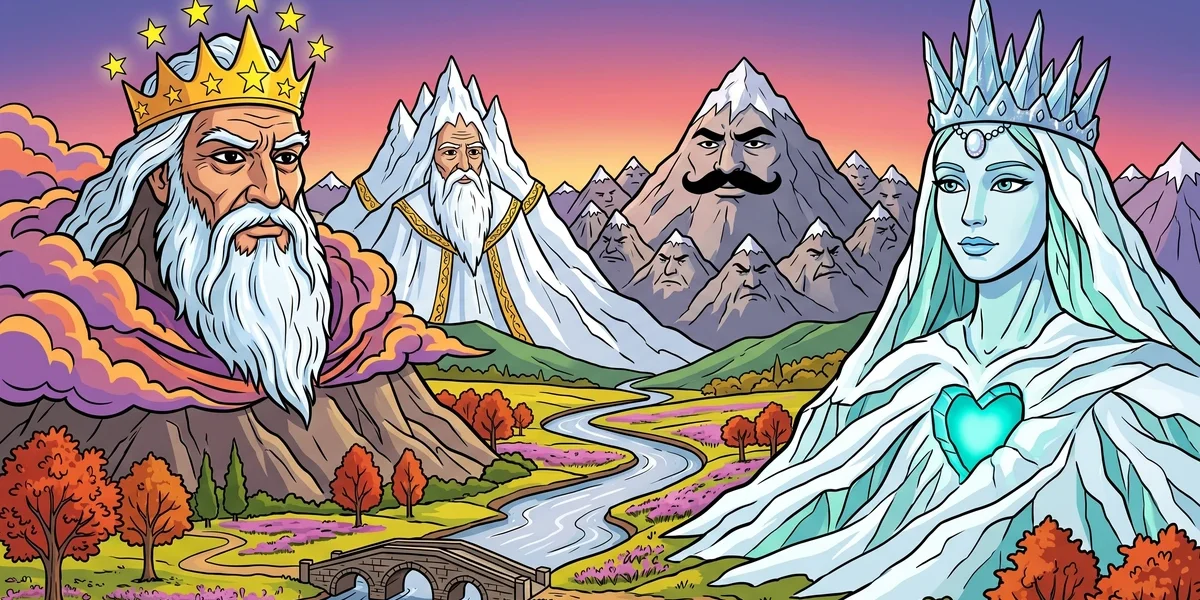
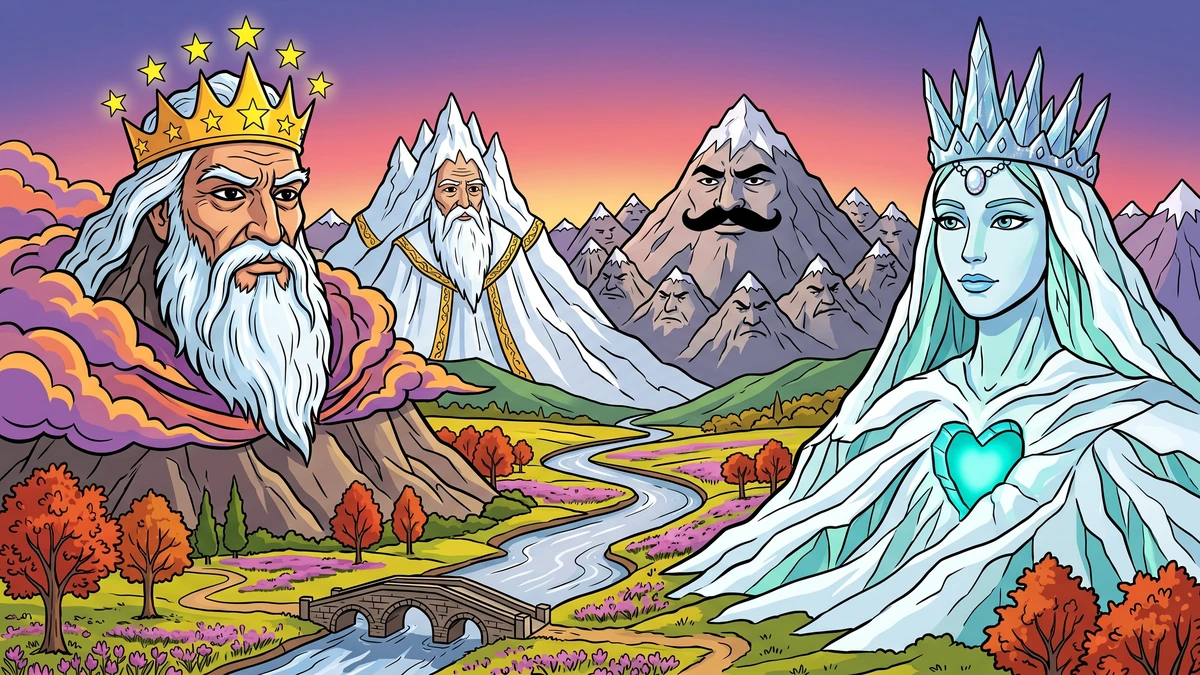
The Legend of Gwâshbrâri, the Glacier-Hearted Queen is one of the most strange and beautiful of all Kashmiri folk tales — a cosmological love story in which the great mountains of the Vale of Kashmir are not landscape but characters, not geology but proud and jealous beings, and in which the long, low ridge that lies stretched across the heart of the valley is explained as the body of a fallen mountain-king, brought to his knees by the glacier-cold beauty of a queen who would not stoop. The tale was first recorded in English by Flora Annie Steel and Major Richard Carnac Temple in their landmark collection Tales of the Punjab: Told by the People (Macmillan & Co., London, 1894), illustrated with line drawings by John Lockwood Kipling, the curator of the Lahore Museum and father of Rudyard Kipling. Steel collected it from the lips of a Kashmiri pandit-storyteller during her summer travels above Pahalgam, where the mountains it names rise visibly on every horizon.
This is a Kashmiri origin myth — a sthala-kathā, a “place-story” — that uses the language of romance to explain why the sacred mountain Wāstarwān (the modern Wāstarvan ridge near Khrew, identified in the Nīlamata Purāṇa and Kalhaṇa’s Rājataraṅgiṇī as the seat of the wealth-god Vaiśravaṇa) lies down across the floor of the Kashmir Valley while every other peak — including the holy Harāmukh and the great Nangā Parbat — stands proudly erect. The folklorist’s classification is ATU 750E* (“The Punishment of Pride”) crossed with the broader Indo-European motif of personified mountain-lovers (Stith Thompson Motif A964 — Mountains from transformation); but the deeper resonance is uniquely Kashmiri, drawing on the Trika-Shaiva metaphysics of vimarśa (passionate self-recognition) that pervades the spiritual literature of the Valley.
Westarwân, the Star-Crowned King of the Mountains
The story opens in the deep cosmological time of Kashmiri myth — “when this old world was young, and everything was very different from what it is nowadays,” as Steel renders it. In that long-ago age, Westarwân — known to modern Kashmiri geographers as the long Wāstarvan ridge that stretches some thirty kilometres east-west across the central Vale, separating the Lidder Valley from the Aripal — was not a ridge at all. He was a peak. Not just a peak: the peak. The highest of all mountains, towering so far above the world that when the summer monsoon clouds rolled in across the Pir Panjal, they closed only upon his shoulders, leaving him alone beneath the blue dome of heaven.
The Kashmiri pandits had a word for this kind of solitary loftiness: uttuṅgatā, “lifted-upness,” and they meant it as a danger as much as a glory. To rise so far above the rest of creation is to lose sight of creation. Westarwân, in the high cold of his pride, no longer looked down at the green Valley with its lotus lakes and saffron fields and almond orchards. He looked only at the sun by day and at the seven stars of the saptarṣi-maṇḍala (the Great Bear) by night. The earth beneath him was beneath his notice. He was a king without a kingdom because he refused to see his subjects.
And below him the other mountains — Harāmukh with his five sacred peaks above the Gangabal lakes, Nangā Parbat with his shining snow-crown, and a vast ring of lesser hills stretching to the horizons of Tibet and Gilgit — stood like courtiers in eternal attendance upon a king who would not look at them. They grew bitter. When the summer cloud passed them by and rested only on Westarwân’s shoulders “like a royal robe,” they muttered “bitter, wrathful words of spite and envy.” They grumbled. They cursed. They asked aloud who had made him their king. The story is, at this stage, a perfect miniature of any earthly court under a vain monarch.
Gwâshbrâri, the Glacier-Hearted Queen
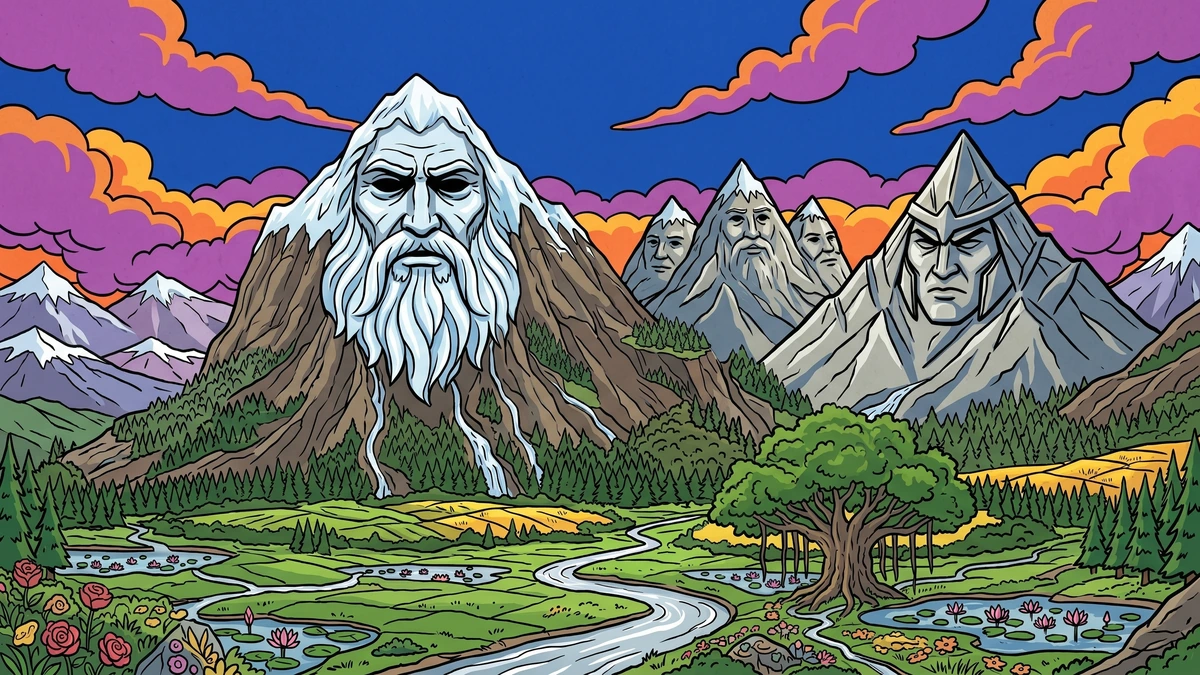
Only one mountain did not grumble. That was Gwâshbrâri — in modern Kashmiri Gāshbrāri, almost certainly identifiable with the radiant glacier-massif of Kolahoi (or alternatively the western face of Harāmukh), whose blue-and-white ice-fields glitter cold and remote above the high valleys of Lidderwat. Steel describes her in lines that have stayed with every reader of the tale: “cold and glistening amid her glaciers,” “self-satisfied, serene,” possessed of a beauty so absolute that “others might rise farther through the mists, but there was none so fair as she in all the land.“
She was the lowliest of the great mountains in altitude. She stood neither tallest nor mightiest. But she alone among the peaks possessed a glacier heart — a frozen blue crevasse-cold core that no sun warmed, no summer thawed, no flattery cracked. And from this glacier heart proceeded a strange Kashmiri kind of self-sufficiency. While the lesser mountains shouted at the sky and at each other, Gwâshbrâri smiled. When the cloud-veil wrapped Westarwân from sight one summer afternoon and the wrath of the courtiers rose in a wave, she silenced them with a single contemptuous flash:
“What need to wrangle? Great Westarwân is proud; but though the stars seem to crown his head, his feet are of the earth, earthy. He is made of the same stuff as we are; there is more of it, that is all.”
And then, when the others laughed at her presumption, she made the proudest declaration in all of Kashmiri folklore: “Tis I who am his Queen!” The lowliest of the mountains had crowned herself sovereign of the highest. The ring of peaks roared with scornful laughter. Gwâshbrâri only smiled her glacier smile and said: “Wait and see! Before to-morrow’s sunrise great Westarwân shall be my slave!” The Kashmiri original of this line — preserved in Pandit Anand Koul’s 1933 transcription as “kal so’baha hyondh, Wāstarwān myon banān ohyē” — has the same chill economy as Steel’s English. It is a vow made in ice, not in fire.
The Sunset and the Cry of Westarwân
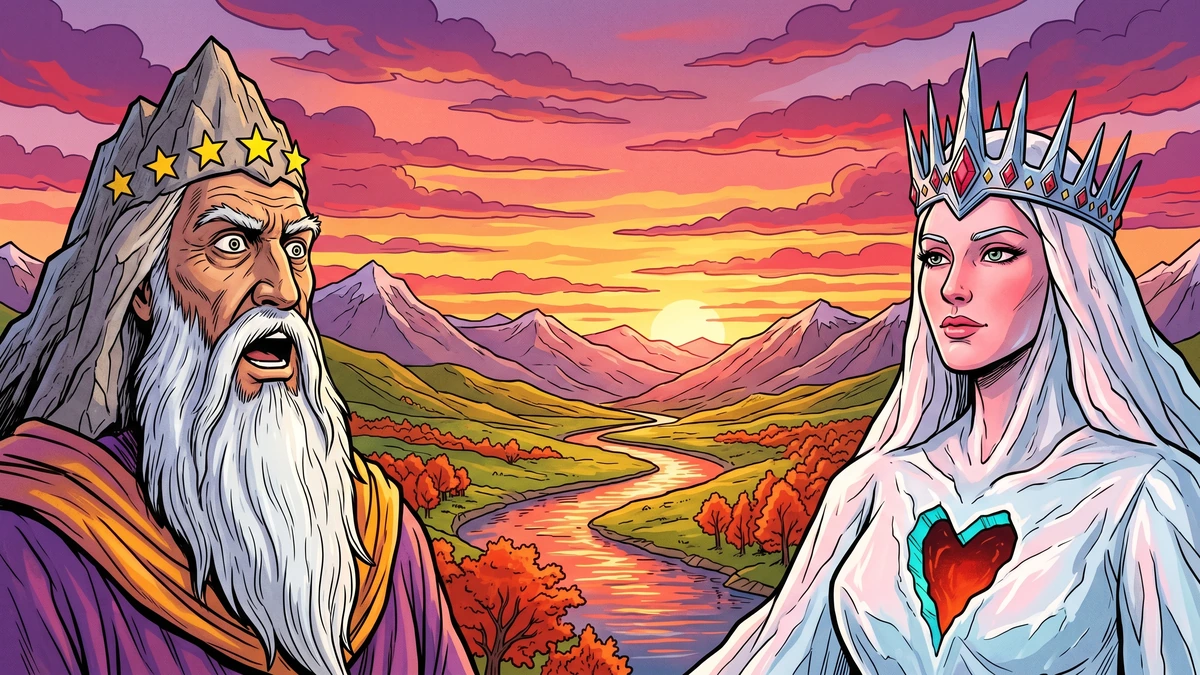
The day passed. Through the long sunlit hours of summer Gwâshbrâri kept her serenity. Steel notes a strikingly visual detail of high-Kashmir geomorphology that the storyteller had observed and transposed into the tale: “only once or twice from her snowy sides would rise a white puff of smoke, showing where some avalanche had swept the sure-footed ibex to destruction.” Anyone who has watched the Kolahoi or Harāmukh ice-fields in late afternoon knows the small puffs of dust from distant avalanches; the storyteller has woven a real Kashmiri geological observation into the cold psychology of the queen. Even her landscape-violence is small, distant, and quiet — the indifferent slaughter of mountain ibex by an avalanche the queen does not deign to register.
Then the sun began to set behind the Pir Panjal. And in that single moment of slanting alpenglow — the famous Kashmiri sānjh kī laalī, the “evening blush” — Gwâshbrâri’s pale glacier face flushed into rose and crimson. “Trans-figured, glorified, she shone on the fast-darkening horizon like a star.” Westarwân, who had spent the entire age of his kingship looking only at the sun and the stars, now noticed for the first time a terrestrial radiance that rivalled the celestial ones. He turned his proud star-crowned head — and saw her.
What followed was, in the Trika-Shaiva metaphysics that underlies all Kashmiri high love-poetry, the moment of camatkāra — sudden astonished recognition, the lightning-stroke of beauty that is also the lightning-stroke of bondage. Steel’s English captures it almost perfectly: “the perfection of her beauty smote upon his senses with a sharp, wistful wonder that such loveliness could be — that such worthiness could exist in the world which he despised.” The setting sun glowed redder still upon Gwâshbrâri’s face, and to Westarwân — who had never seen any face but his own reflected in the blue mirror of heaven — it seemed she blushed beneath his gaze. A great longing seized him. And it burst from his lips in the line that gives the legend its tragic shape:
“O Gwâshbrâri! kiss me, or I die!”
“Stoop, Then, and Kiss Me” — The Fall of the King
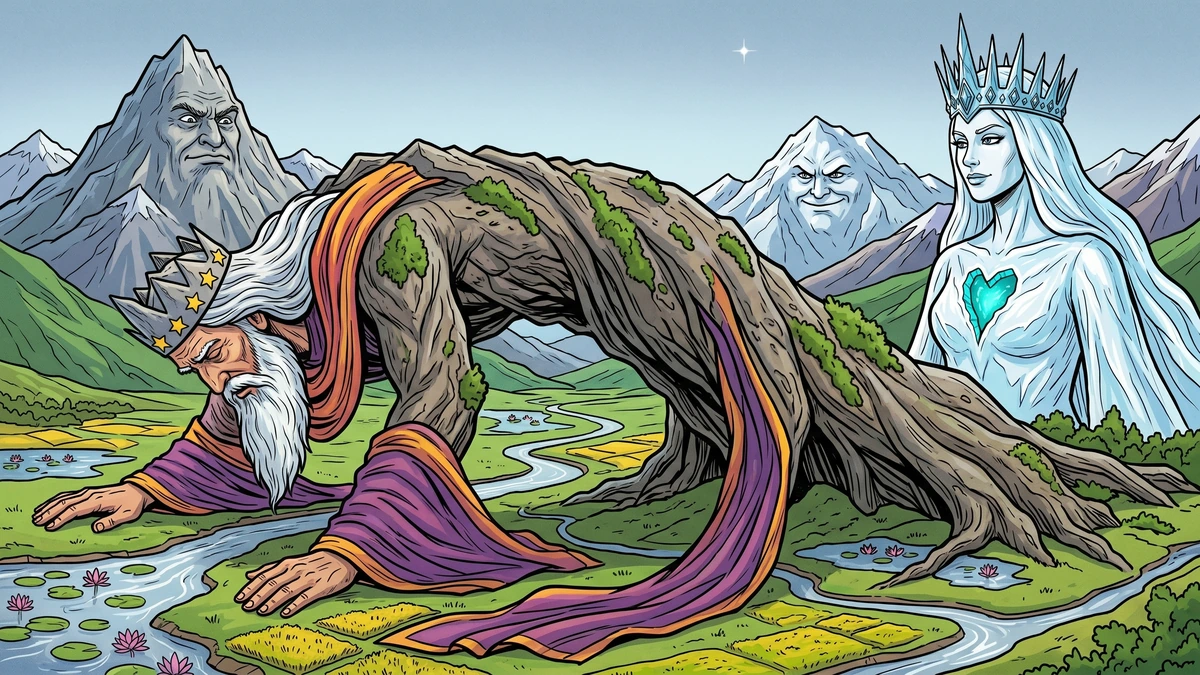
Gwâshbrâri did not lift her head. The whole gambit of her glacier-cold strategy was that she would not move. To her vow to the resentful courtiers — “Westarwân shall be my slave” — she now added the precise mechanism of his enslavement. She answered him in a voice as cold and pure as her ice: “If you would kiss me, mighty Westarwân, you must stoop, for I will not rise.” The Kashmiri original recorded by later folklorists has the same brutal grammar of one-way movement: ti zihā gārē panas, b’i nā vasiyē — “you bend, I will not rise.”
And Westarwân, the star-crowned king of all the mountains, in the agony of a love he had never known and could not refuse, stooped. He bent his lofty shoulders. He lowered his head. He sent the long line of his great body curving down across the valley floor, reaching, reaching toward the glacier queen on her cold throne. Lower he sank, and lower. The summer cloud that had wrapped him like a royal robe slid off and was caught on the ridges of Harāmukh and Nangā Parbat instead. The mountain courtiers around him watched in delighted vindictive silence. And still Gwâshbrâri did not move. Not once did she stoop, or rise, or soften. She watched him fall as one watches a slow avalanche on a far mountain. He stretched himself out across the entire Vale of Kashmir — and he could not reach her.
By dawn, when the first pale light came up behind the Zoji La pass, Westarwân lay where he had fallen. His head rested almost — but not quite — at Gwâshbrâri’s frozen feet. His body lay stretched the full length of the central Valley, separating the Lidder from the Aripal, separating the saffron fields of Pampore from the rice terraces of Tral. He has not risen since. The long Wāstarvan ridge that geographers today measure at thirty kilometres of nearly-uniform low silhouette is, in Kashmiri folk cosmology, the body of the fallen mountain-king, frozen forever in his stoop of unrequited love.
The Moral: Love Humbles Even the King of Mountains
“Premeṇa nicaiḥ kṛiyate api uccaḥ” — “By love even the lofty are made low.” (Sanskrit aphorism preserved in the Pandit oral commentary on the Kashmiri Mahānaya-prakāśa.)
The moral of The Legend of Gwâshbrâri is dual, and the duality is what makes it Kashmiri rather than merely Indian. On the one hand, it is a parable of the punishment of pride: Westarwân, who would not stoop to look at the world he ruled, is finally made to stoop forever to the one being he chose to desire. The star-crowned king is permanently humbled. On the other hand, it is a parable of the cold cost of self-love: Gwâshbrâri wins her vow — Westarwân is her slave — but she wins it by remaining glacier-frozen, untouched, untouching, alone on her ice-throne above her conquest. Her victory is also her perpetual solitude. She has demonstrated that “love humbles all” — and demonstrated it by refusing to be humbled by love herself.
This double moral is unmistakably the philosophical fingerprint of Kashmiri Trika-Shaivism, the Tantric monism of Abhinavagupta and his school, in which the supreme reality is simultaneously śiva (the still, witnessing one) and śakti (the moving, desiring one). The lover who falls and the beloved who does not is a metaphysical pair: each makes the other into what they are. Westarwân without Gwâshbrâri would be a still-proud peak; Gwâshbrâri without Westarwân would be merely the lowliest mountain. Together, in their failed reach, they become the explanation of the entire shape of the Kashmir Valley.
Why the Legend Has Lasted
It is now well over a century since Flora Annie Steel sat in a high pine-shaded camp above Pahalgam and wrote down the Kashmiri pandit’s words about Gwâshbrâri and Westarwân, and the tale shows no sign of fading. It is taught in Kashmiri-language readers in Srinagar schools. It is recited at the start of trekking expeditions to Kolahoi and Harāmukh. It is invoked in modern Kashmiri Sufi kalam as a metaphor for the soul’s relationship with the unmoving Beloved. The legend survives for at least four reasons.
First, it is geographically true to its landscape. The Wāstarvan ridge really is the longest low silhouette in the Vale of Kashmir. It really does lie down across the floor of the Valley while every other named peak rises. It really does end with its eastern head pointing toward the Kolahoi-Harāmukh glacier zone. The legend is, in the most exact sense, an etiological story — an explanation of why the world looks the way it looks. Anyone who walks the Mughal Road or the Pahalgam highway today and sees Wāstarvan stretching its long body across the southern horizon is, whether they know it or not, looking at a Kashmiri folk-tale frozen into geography.
Second, it is psychologically modern. The two-way dynamic — proud unreachable beauty meets proud unreaching king, and each unmakes the other — is recognisable in every age. T. S. Eliot’s Prufrock and Gabriel García Márquez’s Florentino Ariza would both have understood Westarwân. The cold-hearted self-sufficient woman of nineteenth-century European Romanticism — Keats’s La Belle Dame Sans Merci, the icy princesses of Hans Christian Andersen — find a Himalayan cousin in Gwâshbrâri.
Third, it is philosophically Kashmiri. The Trika-Shaiva insight that the still witness and the moving desire are inseparable, that śiva needs śakti and vice versa, is enacted in topographical form. The Valley of Kashmir is not merely a piece of geography in this story. It is the diagrammatic theatre of a metaphysical paradox.
Fourth, and most beautifully, the tale refuses an easy ending. There is no kiss. There is no marriage. There is no transformation of the cold heart by the warm one. Westarwân does not get up. Gwâshbrâri does not stoop. The story leaves the lover stretched and the beloved frozen, separated by inches, eternally. Most folk tales close their gap; this one preserves it. That preserved gap — the few feet of high mountain air between the king’s reaching head and the queen’s icy foot — is, in Kashmiri folk cosmology, the very space the Vale itself opens. We live, the storytellers seem to say, inside a never-completed kiss.
Story source: Flora Annie Steel and R. C. Temple, Tales of the Punjab: Told by the People (Macmillan & Co., London, 1894), pp. 155–158, with line illustrations by John Lockwood Kipling. Geographical context informed by M. A. Stein, Kalhana’s Rajatarangini: A Chronicle of the Kings of Kashmir (Westminster, 1900), and Pandit Anand Koul, Geography of the Jammu and Kashmir State (Lahore, 1925). Tale-type ATU 750E* / Stith Thompson Motif A964 — “Mountains from transformation.”
Frequently Asked Questions
**Q: Why is this story important?**
You May Also Like
 Indian Folk Tales
All Ages
Indian Folk Tales
All Ages
How Raja Rasalu Swung the Seventy Fair Maidens
How Raja Rasalu Swung the Seventy Fair Maidens: Now, as Raja Rasâlu, tender-hearted and strong, journeyed along to play chaupur with the King, he came to a
 Indian Folk Tales
Ages 3-5
Indian Folk Tales
Ages 3-5
How Raja Rasalu Went Out Into The World
How Raja Rasalu Went Out Into The World: Young Rasâlu lived on, far from the light of day, for eleven long years, growing tall and strong, yet contented to
 Indian Folk Tales
All Ages
Indian Folk Tales
All Ages
A Clever Thief
A Clever Thief: In the great city of Varanasi, during the reign of a wise but strict king, there lived a man known as Chatur, which means “the clever one.”