Why Brāhmaṇs Cannot Eat in the Dark
Why Brahma E1 B9 87s Cannot Eat In The Dark: Among Hindûs, especially among Brâhmaṇs of the Madras Presidency - and I now see from personal observation that it
In a great many Brāhmaṇ households of the old Madras Presidency — and as Pandit S. M. Natesa Sastri carefully observed in his Folklore in Southern India (Bombay, 1884), the same custom held in the Bombay Presidency too — it is a quiet rule that nobody finishes a meal in the dark. If, in the middle of supper, the wick gutters and the lamp goes out, every member of the family rises at once, leaves the rice on the leaf, washes the hands, and waits until a fresh light is brought. The leftover food on the leaf is fed to the cows or thrown out for the crows; nothing of it returns to the mouth. Children learn this without being told why; they only learn that the elders rise, and so they rise. But once upon a time, in the long Tamil twilight when stories were the only schoolbook, two tales were told to explain the rule. They are joined together here in the form Natesa Sastri wrote them down for British readers in the 1880s, and as Mrs. Howard Kingscote later reprinted them in Tales of the Sun, or Folklore of Southern India (W. H. Allen, London, 1890). One tale stars a hungry crocodile and a clever bride; the other, a poor woman and a hidden devil. Together they form a single etiological folktale, classified by Stith Thompson as Motif A1545.3 (origin of meal customs) crossed with Motif K577 (a man saved from a beast through his wife’s cleverness), and they have been told in Tanjavur, Madurai, Vellore and Chingleput villages for at least two centuries.
The Bridegroom and the Crocodile of the Tank
In a certain village along the green Cauvery delta there lived a Brāhmaṇ who had only one daughter. She was as deeply read in Saṁskṛit as her father, knew the metres of Kālidāsa by heart, and was of the most charming beauty — the sort the village called padmākṣī, lotus-eyed. When she came of marriageable age her father searched the Tanjavur and Tiruchirapalli mathas until he found a bridegroom equal to her, a young scholar who could match her line for line. The astrologer set the muhūrta — the auspicious moment for the wedding — at the tenth ghaṭikā of a particular night. (One ghaṭikā is twenty-four minutes in old Indian reckoning, so the tenth ghaṭikā falls about four hours after sunset; the bridegroom would tie the tāli at the deep, holy hour of midnight.)
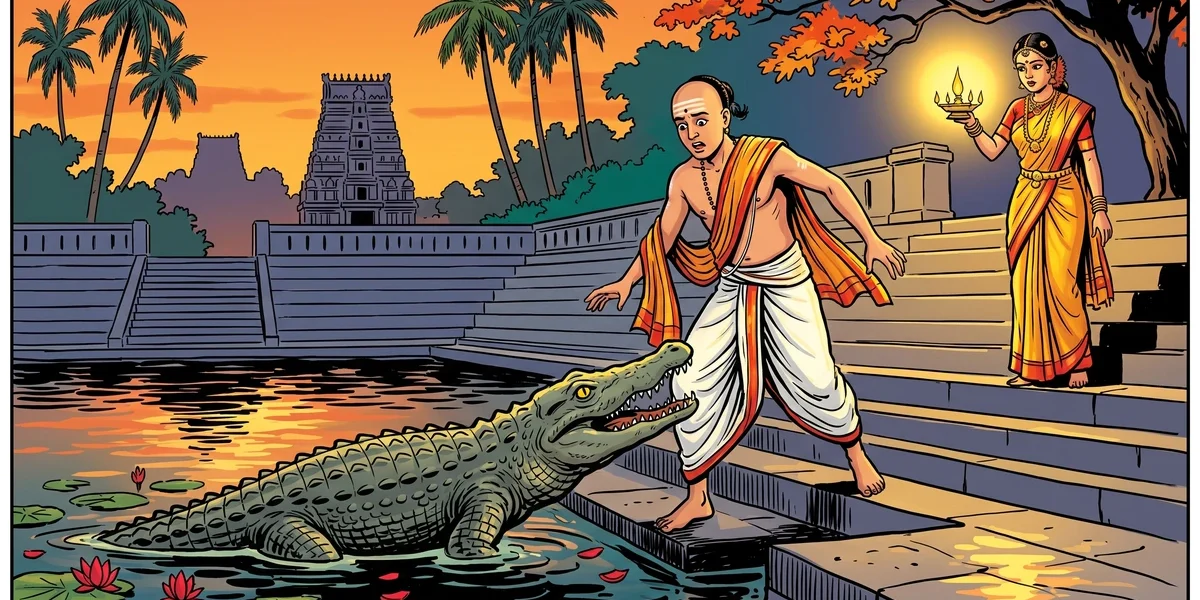
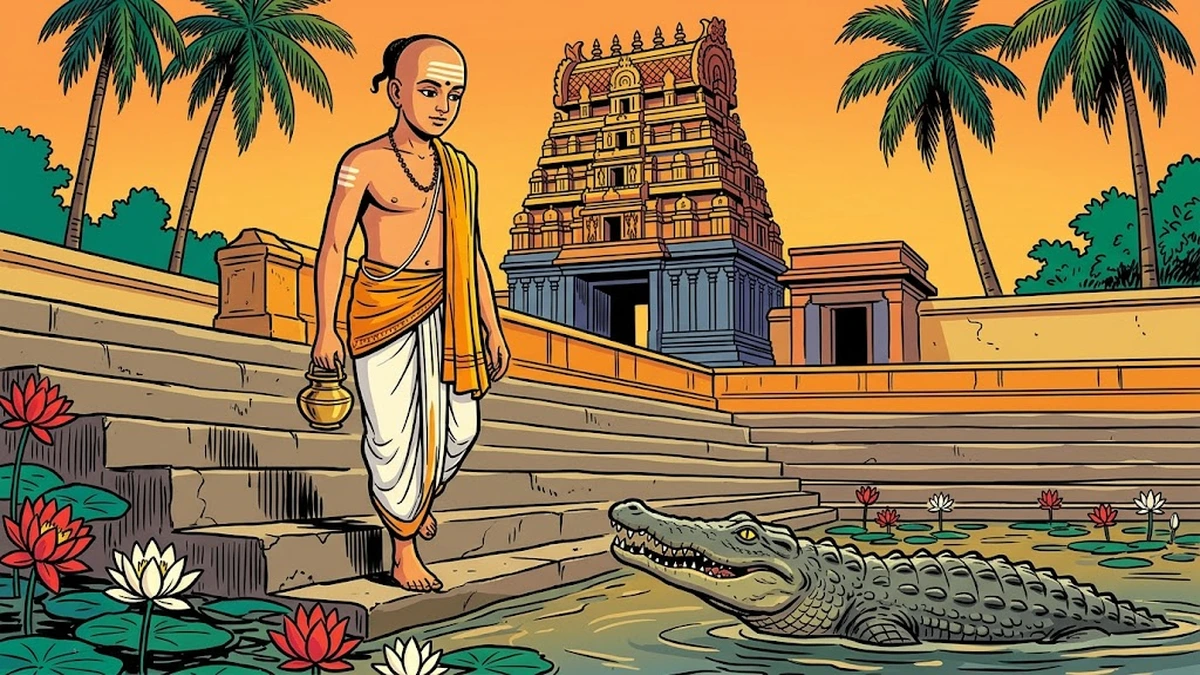
That very evening, before the wedding, the young man went to perform his sandhyā vandana, the twilight prayer that Brāhmaṇs offer at the joining of day and night. He needed water for āchamana, for the recitation of the Gāyatrī, and for the offering of arghya to the setting Sun. He chose, not knowing better, the great walled tank at the edge of the village. The villagers had given that tank a wide berth for years, for crocodiles — great muggers, Crocodylus palustris, with grey-green hide and yellow eyes — lay coiled among its lily pads. But the bridegroom was a stranger, no one was on the bund to warn him, and the lotus flowers and the long green steps looked inviting in the orange light of evening. He set his foot upon the bottom step. At the second step, a crocodile rose from the deep, fastened its jaws upon his calf, and began to drag him into the water with that slow, patient pull which is more terrible than any sudden lunge.
The young Brāhmaṇ, fighting fear, fell back upon the one weapon a scholar carries everywhere — speech. “My friend the crocodile,” he said, in the gentlest of voices, “hear me a moment before you decide. There waits at home an old Brāhmaṇ and his daughter, the only daughter he has, and her wedding is fixed for the tenth ghaṭikā of this very night. I am the bridegroom. If you eat me now, the bride will sit alone before the homam fire; her father’s heart will break; the whole village will curse the tank and the creature in it. But if you let me go for five ghaṭikās, only five, I shall tie the tāli, take my last leave of my wife, and return to you of my own feet at the fifteenth ghaṭikā, swearing it upon the sacred thread, upon Agni, upon the Veda I have learned. Then you shall have your supper without a curse upon you.” The crocodile, ravenously hungry but flattered to be addressed as a moral being, exacted oath upon oath — satya-vacanam — and at last released the leg and slid back into the lotus shadows.
The Wedding Beneath a Sentence of Death
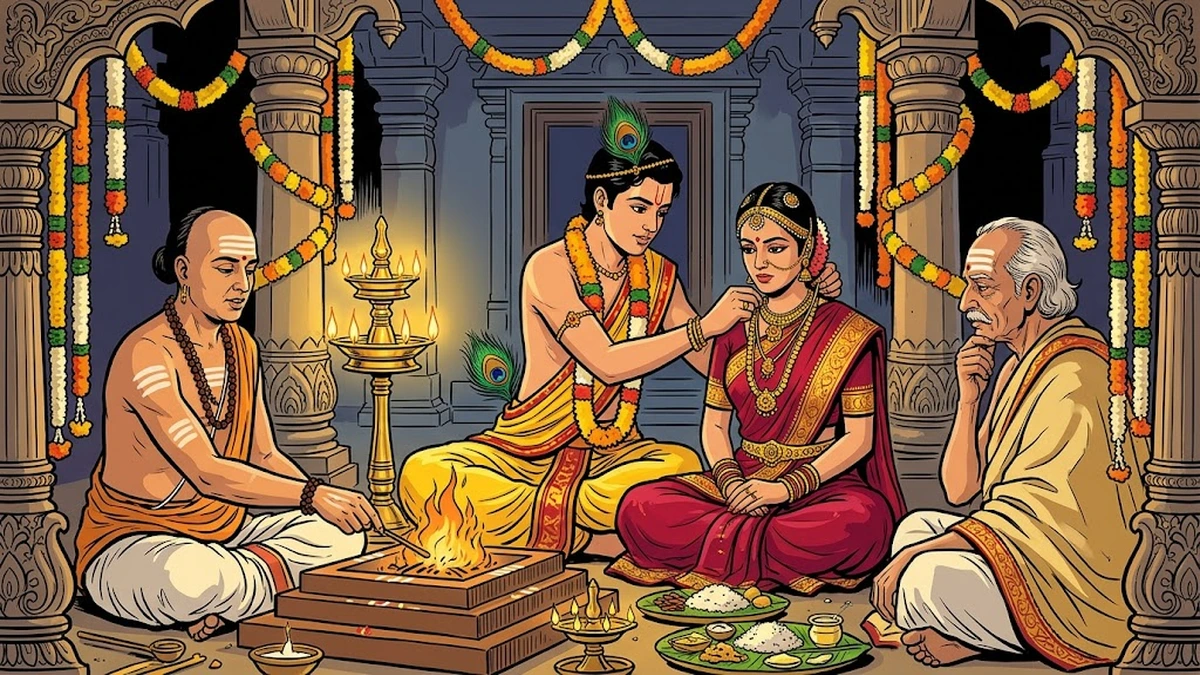
The bridegroom returned home with his foot bleeding and his soul heavier than the foot. To spare the old people, he said nothing of the crocodile. The conch was blown, the nādaswaram played at the doorway, the homam fire was lit, the bride and the groom circled it the seven prescribed times. He tied the yellow tāli around her neck. The Brāhmaṇs of the village ate the wedding feast. To everyone else the wedding was perfect; only inside the bridegroom did the ghaṭikās tick away like the tail of a fish flapping out of water.
When the last guest had gone and the lamps in the courtyard had been trimmed for the night, he drew his bride aside and told her everything — the tank, the crocodile, the oath. She did not weep. She did not call her father. Like the women of the Tamil Pūranic tradition, like Sāvitrī before her, she answered first with the calm wisdom of dharma. “What is written on the forehead must be read,” she said quietly, in the words of an old Tamil proverb — vidhi vali vandhāl madhi vali pōkādhu, ‘when fate’s strength comes, the strength of cleverness will not fail to meet it.’ “Go where you have sworn to go. I will not hold you back from your truth.” She bound the wound on his leg with a strip of her bridal silk, gave him her blessing, and watched him leave the house. But she did not stay behind. She filled a small brass lamp with sesame oil, lit it, hid it in a covered earthen pot, took the pot in her hand, and followed her husband through the dark mango lanes, walking unseen at a careful distance.
The Lamp on the Tank Bund
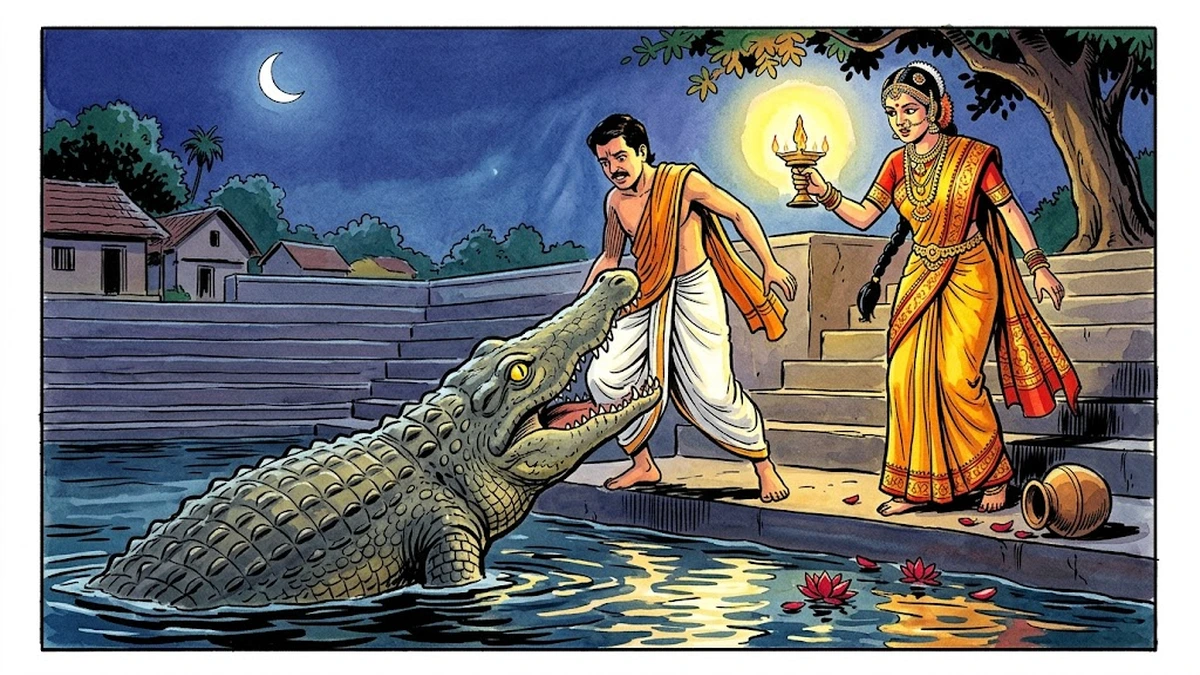
The bridegroom reached the tank an entire ghaṭikā before the appointed time, called out softly, and the crocodile heaved itself from the water as gladly as a hungry guest answers a dinner bell. Its jaws closed upon the same calf they had bitten before. Just then a brilliance broke the night — a single small flame of sesame-oil light, held high beside the crocodile’s yellow eye. The bride had stepped out of the shadow of the gulmohar tree, lifted the brass lamp from the pot, and let it shine for one heartbeat full into the crocodile’s face. Then, before the creature could move, she pursed her lips and blew the flame out.
The tank fell darker than before. The crocodile loosened its jaws. It withdrew its great head a fraction. It lay still upon the steps and spoke in a low, stunned voice, as crocodiles do in stories where they speak at all. “Go your way, young Brāhmaṇ,” it said. “I will not touch you. I will not touch any man, woman or child upon whom a lamp has been put out at the moment of his meal. To eat after a light has been quenched is to eat with a curse on the tongue. Let it be a rule for me, and let it be a rule for your kind — the kind who call yourselves more reasonable than beasts.” And it slid back into the lotus pads and was gone. The husband stared first at the empty water and then at his wife — astonished, he said later, less by his own escape than by the steadiness of an unreasonable beast in keeping a self-made rule. The two of them walked home through the dawn of the wedding morning, and from that night onwards the husband told the tale to every Brāhmaṇ household he visited; and the rule, born of a crocodile’s superstition, took root in the kitchens of men.
The Devil who Sat at the Dark Meal
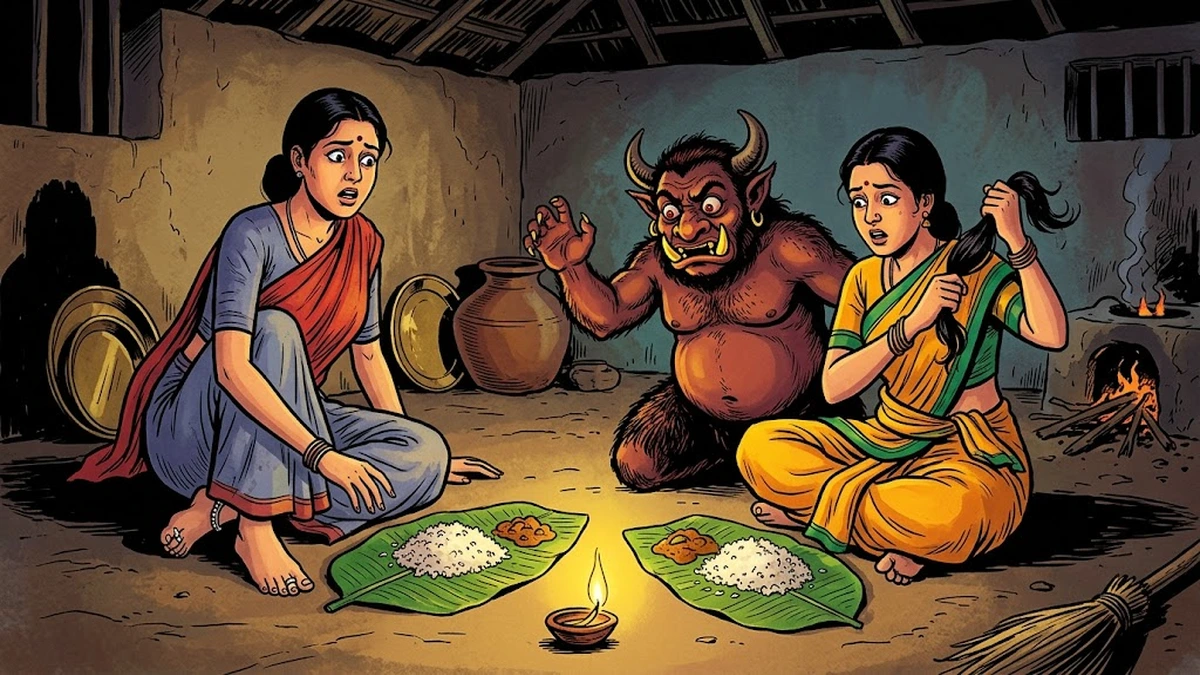
But the rule did not stand on the strength of one tale alone. The same Madras grandmothers told a second story, sister to the first, to explain why the rule was wise as well as ancient. In a remote village there lived a poor woman who hired herself out from morning until night in other people’s houses for a wage of two measures of rice — iru padi arṣi in Tamil, enough for ten ordinary persons. Yet she was always hungry. She kept no lamp because she could not afford the oil; she cooked her rice by the light of the fire; and when she sat to eat, even the fire-light died, and she ate in the dark. Two whole measures she swallowed each night, and rose no fuller than before. Hunger gnawed her like a thread inside the belly.
One day her younger sister, who lived in a slightly better house and would never sit to a meal without lamplight, came to spend the night. The younger sister marvelled, “Sister, where is the lamp?” The elder, ashamed, took a few handfuls of rice from her precious two measures, sold them to the village shop for a quarter-cup of eṇṇai (sesame oil), and lit a small mud lamp for the first time in years. She cooked with what rice was left and feared the worst, for less than two measures had never sufficed her alone. Two banana leaves were spread. The sisters sat down. Yet they ate barely a quarter of what was in the pot, and rose contented. The elder sister stared, “What magic is in you, sister? Every night I cook two full measures and rise still hungry. Tonight the same pot has filled two of us.” The younger said nothing, but resolved to find out.
The next evening she asked her sister to serve the meal in the dark, just as she had always done. The two of them sat down on the bare floor. Neither put a hand to the rice. Instead, the younger sister stretched out her arm sideways — and her fingers caught a great, oily lock of hair. She gripped it tightly, did not let go, and called sharply, “Sister, light the lamp!” The elder lit the lamp with shaking hands. Between the two banana leaves, on the third spread which neither of them had laid, sat a horned bhūta — a hairy black devil with red eyes and yellow tusks — one fat hand already half-raised toward the rice. He had no choice but to confess: every dark meal eaten in that house, he had shared. He had bolted whole fistfuls down his throat before his hostess’s hand could even reach the leaf, and that was why she rose hungry. The sisters drove him out with a brand from the fire. The elder lit her mud lamp every night thereafter, and she had food to spare. The bhūta never returned.
So in the Tamil country, when a meal-time lamp is put out, the rule is to rise. A crocodile once spared a Brāhmaṇ at the sight of a quenched flame, and a poor woman once caught a devil by the hair when the flame returned. Between those two warnings, the household lamp of South India learned its careful place beside the eating-leaf.
Moral
The deepest teaching of this tale is that truth and attention are themselves a kind of light. The crocodile keeps its word because the bridegroom kept his; the bhūta is exposed only when light returns. Both episodes turn on the same Sanskrit dharma quoted in the Muṇḍaka Upaniṣad — truth alone reveals, and falsehood always feeds in the dark.
satyam eva jayate nānṛtam — satyena panthā vitato devayānaḥ
“Truth alone triumphs, never untruth; by truth is laid the path the gods walk.”
— Muṇḍaka Upaniṣad III.1.6 (the line stamped on India’s national emblem)
The same teaching pulses through the Tamil Tirukkuṛaḷ couplet 297 of the poet Tiruvalluvar: poyyāmai aṇṇa pukalŇdru aṇdu oppa nallavai pira illā — “there is no virtue greater than truthfulness, and no praise greater than its praise.” A house lit by a steady lamp at meal-times is, in this tradition, a house honest enough to be seen at dinner; and a house fed in the dark is a house where invisible hungers come and steal the rice from the leaf.
Historical & Cultural Context
The two tales above are best known to Western readers from the work of Pandit S. M. Natesa Sastri (1859–1906), the Telugu-Tamil scholar from Madurai who, more than any other person, carried South Indian folktale into print. His Folklore in Southern India appeared in four parts between 1884 and 1888 from the Society for the Resuscitation of Indian Literature in Bombay; the present pair was Tale XXIX in Part II of that collection. In 1890 the same tales were re-edited by Mrs. Georgiana Howard Kingscote and re-issued as Tales of the Sun, or Folklore of Southern India (W. H. Allen, London) — the volume that brought them to Joseph Jacobs, who in turn excerpted them in Indian Fairy Tales (David Nutt, 1892). The full Madras text is preserved in Project Gutenberg e-book number 37002 and remains the working source for this retelling.
Etiological tales — tales that explain why a custom exists — are one of the oldest narrative genres in the world, and they sit very thickly in Indian folklore. The folklorist Aurel von Gennep called them les contes des origines, ‘tales of beginnings’; the Indologist A. K. Ramanujan, in Folktales from India (1991), classed them as kāraṇa-kathā, ‘reason-stories.’ The Aarne–Thompson–Uther index lists this story under tale type ATU 178A (the helpful animal that exacts an oath) tangent to ATU 750 (origin tales of customs and observances), with motifs K577 (man saved from a beast through wife’s cleverness), D2161.4.10.2 (a lamp’s light wards off evil spirits) and F402.1.11 (a demon eats food taken in the dark). The crocodile-bridegroom motif also appears, in different costume, in the Sumsumāra Jātaka No. 208 of the Pāli canon and in Pancatantra Book IV (Labdhapraṇāśam), where the wit of a faithful spouse rescues a creature in the jaws of a marsh predator. The dark-meal-and-the-devil motif is paralleled in Tales of the Punjab (Steel & Temple, 1894), tale ‘The Bhuts’ Dinner’, and in Bengali Thakurmar Jhuli compiled by Dakshinaranjan Mitra Majumdar in 1907.
The custom itself rests on much older Sanskrit dharma-shastra. The Manusmṛti II.51 tells the householder to take his food “facing the east, with a light burning at his side,” and the Āpastamba Dharma Sūtra II.3.6.4–5 expressly forbids eating in the dark, where piśācas and bhūtas are said to share the leaf. The Viṣṇu-smṛti 70.1–2 likewise rules that “a meal taken without lamplight is unfit; rise, wash the hands, and wait for fresh light.” In the Mahābhārata’s Anuśāsana Parva (104.59–65), Bhīṣma instructs Yudhiṣṭhira that food should be eaten “in light, in cleanness, and in stillness, lest the unseen guest taste before the seen.” Natesa Sastri’s pair of tales are therefore not pious inventions; they are vernacular dramatisations of a literate dharma rule, told so that grandmothers could explain to grandchildren why the family rises when the wick burns out.
Read this way, the tale belongs to the same shelf as the Greek Persephone-and-the-pomegranate story, the Roman Vestal-fire myth, and the Hebrew rules of kashrut: each is a story that places a household custom inside cosmic time, so that the small daily motions of eating, lighting and waiting are felt to participate in a larger, shared order.
Reflection & Discussion
- The bride rescues her husband by giving the crocodile information — the sight of a quenched flame — rather than by force. Why is information the kind of weapon a Tamil folktale is most likely to give to a woman?
- The two tales have very different villains — one a real animal, one a magical bhūta — but they teach the same rule. What does that tell you about how customs are made: by reason, by fear, or by both?
- Is the custom of rising when a meal-time lamp goes out a superstition, a hygiene rule, or a poem about attention? Could it be all three at once?
- The tale rewards the woman who hides a lamp in a pot and the woman who grabs the devil by his hair. What kind of courage does the narrator value — physical, intellectual, or moral?
Did You Know?
- Pandit Natesa Sastri collected most of his Madras folktales orally between 1880 and 1885 from elderly women in his own family in Tirukkalukundram, near Chengalpattu, and from Telugu-speaking pilgrims at Tirupati.
- The marsh crocodile (Crocodylus palustris) was indeed common in South Indian temple-tanks until the early twentieth century; Indo-Saracenic engineers reduced its numbers when they began clearing irrigation tanks in the 1890s.
- The brass kūttu viḥakku, the South Indian standing oil-lamp lit at every Tamil meal, has five wicks — one for each of the five senses; the rule against eating in the dark is essentially a rule against feeding any one of those five senses while the others are blind.
- The line satyameva jayate, quoted in the Moral above, is taken from this same Muṇḍaka Upaniṣad III.1.6 and is now inscribed in Devanāgarī on the Lion Capital of Aśoka, the official emblem of the Republic of India.
- In some Tamil Brāhmaṇ households the rule is observed even today: when a power cut blackens the dining room mid-meal, the elder calls out eḣu, eḣu — ‘rise, rise’ — and everyone leaves the leaf untouched.
What This Tale Teaches Us Today
Old stories keep their power because the lessons buried inside them never stop being useful. Here is how this twin-tale still applies in the twenty-first century:
- Eat in the light. Modern dieticians repeat what the bhūta proved in this tale: meals eaten in the dark are wolfed down faster, chewed less, and oftener overeaten than meals eaten under a steady light. A small lamp, even an electric one, is a friend to digestion.
- Treat tradition as compressed wisdom. Before dismissing an inherited rule as superstition, ask what it is solving. The Tamil prohibition on dark meals turns out to encode food hygiene, mindful eating, and family togetherness in a single image of a flame. Most household customs are like this.
- Truth-telling is a household lamp. In Sanskrit dharma the same word, jyotis, names both physical light and the inner light of truth. Houses that hide things in the dark — debts, illnesses, quarrels — are houses where invisible hungers come to feed.
- Wit is a wedding gift. The bride solves the crocodile not with weapons but with timing and a small lamp. Modern partnerships still survive on exactly that combination — cleverness, calm, and the right thing brought at the right moment.
- Rituals teach children quietly. No child in the bridegroom’s house is ever lectured about truth-telling. They watch the elders rise when the lamp goes out, and twenty years later they cannot eat in the dark either. Quiet rituals are a slower, deeper kind of education than any classroom.
Why This Story Still Matters
Tales that explain ‘why we do what we do’ are the oldest classroom of every culture. India, with its long oral imagination, has hundreds of them: why the peacock cries before rain, why the cow is given the first morsel of rice, why a lamp is lit at twilight, why the elder is given the first plantain leaf at a feast. Why Brāhmaṇs Cannot Eat in the Dark is one of the most vivid of those tales, and the most loved in the Madras Presidency, because it joins two of the oldest fears in the human kitchen — the predator at the water’s edge and the unseen guest at the meal — into a single bright lesson about light, truth and attention. Modern readers might smile at a talking crocodile and a tusked bhūta, but the rule the tale defends is still good rule. Take your meals seriously. Eat in light. Pay attention to your food and to the people around it. The grandmothers of Tanjavur knew, and so did the rishis of the Muṇḍaka Upaniṣad: satyameva jayate — truth alone triumphs, and truth, like a lamp, is something you have to remember to light.
Frequently Asked Questions
**Q: Why is this story important?**
You May Also Like
 Indian Folk Tales
Ages 3-5
Indian Folk Tales
Ages 3-5
The Story of a Kind Hearted Little Girl Named Tara
The Story of a Kind Hearted Little Girl Named Tara: Once there lived a little girl named Tara with her mother in a small hut near the forest. Tara was
 Indian Folk Tales
All Ages
Indian Folk Tales
All Ages
The Ass in the Lion’s Skin
The Ass In The Lions Skin: In a dense forest near a small Indian village, there lived a washerman named Dhobi who owned a tired old donkey. The poor donkey had
 Indian Folk Tales
Ages 9-12
Indian Folk Tales
Ages 9-12
The Jackal And The Crocodile
The Jackal And The Crocodile: Once upon a time, Mr. Jackal was trotting along gaily, when he caught sight of a wild plum-tree laden with fruit on the other