Savitri and the Lord of Death
Savitri and the Lord of Death: In the kingdom of Madra, along the banks of the great Sutlej River, there lived a princess of unparalleled virtue and wisdom.

Sāvitrī and the Lord of Death
Sanskrit: सावित्री (Sāvitrī) |
Source: Mahābhārata, Vana Parva (Book III), adhyāyas 293–299, composed by Vedavyāsa |
ATU Type: 400* (inverted Quest — wife rescues husband from death) |
Motifs: H1385.4, D1850, H900 |
Oral Tradition: Vat Savitri Vrata (full-moon festival, still observed across North and West India)

Among all the tales preserved in the vast ocean of the Mahābhārata — that encyclopaedic Sanskrit epic redacted over eight centuries — none has generated more continuous veneration than the episode of Sāvitrī. Embedded within the Vana Parva, the “Book of the Forest” that chronicles the Pāṇḍavas’ twelve years of exile, the sage Mārkaṇḍeya tells it to the grieving Yudhiṣṭhira as proof that a woman’s devotion and intellect can overcome even the immutable dharmic law of death. It is not a simple love story. It is a philosophical treatise in narrative form, exploring the boundaries of dharma (cosmic order), satya (truth), and the relationship between conjugal love and metaphysical liberation — all wrapped in a tale of breathtaking dramatic suspense.
The story is set in the ancient Madra Kingdom along the Sutlej River (modern Punjab), a region steeped in Vedic literature and ritual. Its oral roots almost certainly predate its Mahābhārata redaction; comparative folklorists have noted structural parallels with Greek myths of Alcestis and Orpheus, suggesting a proto-Indo-European stratum in which a devoted spouse descends to or negotiates with a death deity. Yet the Sāvitrī episode is uniquely Indian in its resolution: she does not charm death with music (as Orpheus), nor sacrifice herself in substitution (as Alcestis). She out-argues Yama using his own dharmic principles — an intellectual and moral victory rather than a magical one.
I. The Princess Who Chose Her Fate

In the ancient kingdom of Madra, King Aśvapati (अश्वपति, “Lord of Horses”) reigned with justice but had no daughter. For eighteen years he performed the Sāvitrī-sūkta — a rigorous Vedic ritual dedicated to the solar goddess Sāvitrī — reciting the sacred syllables one hundred thousand times before each dawn, offering oblations into the sacred fire, and maintaining severe austerities. At last the goddess herself appeared in radiant form and granted him a daughter, declaring that the child would be extraordinary and must bear the goddess’s own name.
The child born of that divine gift grew into a woman of extraordinary refinement: trained in the four Vedas, accomplished in debate, fluent in Sanskrit and Prākrit, beautiful as an apsarā, and possessed of a gravity that made even the wisest court brahmins lower their eyes. When she reached marriageable age, every prince and king who came to her father’s court found himself unable to press his suit. The Mahābhārata is blunt about why: her brilliance and self-possession so outclassed ordinary men that they retreated in awe, mistaking her excellence for an ill omen.
King Aśvapati, despairing of finding a worthy match through the conventional svayaṃvara ceremony, sent her out with trusted ministers to seek her own husband — a radical gesture for its era, reflecting the epic’s nuanced view that a woman of Sāvitrī’s quality should exercise autonomous judgment. She returned from months of pilgrimage with a single name: Satyavān (सत्यवान्, “Possessor of Truth”), a prince living in forest exile with his blind father Dyumatsena, who had been robbed of his kingdom by a treacherous neighbour.
The sage Nārada, who happened to be in court, immediately interjected with a terrible warning: Satyavān was noble, strong, and pure of heart — but he would die exactly one year from the day of his marriage. King Aśvapati begged his daughter to reconsider. Sāvitrī replied with the line that would echo through Indian literary tradition for millennia:
“एकवारं व्रियते कन्या, एकवारं प्रतिज्ञा, एकं हन्ति आत्मानं योगवान्”
“A daughter is chosen once; a promise is made once; and a virtuous person takes a resolve only once.” — Mahābhārata, Vana Parva 293.10 (traditional rendering)
Her father, recognising that he was in the presence of a will that could not be bent, gave his blessing. Sāvitrī married Satyavān in a simple forest ceremony, exchanged her silks for tree-bark clothing, and began her life among the exiled royal family — counting, always counting, the days of the year that remained.
II. The Year of Grace and Its Terrible End
The Vana Parva describes the year of forest life in spare, evocative terms. Sāvitrī gathered fruits, tended her blind mother-in-law, served her exiled father-in-law Dyumatsena with the reverence due a king, and loved her husband with a constancy that the text likens to the Pole Star — fixed, unwavering, the point around which everything else revolves. Yet the Sanskrit narrative makes clear that her love was not passive devotion. She managed the household with practical intelligence, memorised the lunar calendar to track every passing tithi (lunar day), and spent the final three days before the fateful date in a vow of complete fasting, standing motionless through long nights, hardening her will for the confrontation she knew must come.
On the morning of the foretold day — the full-moon day of Jyeṣṭha month, which became the date of the annual Vat Savitri Vrata festival still celebrated across Maharashtra, Gujarat, Bihar, and Uttar Pradesh — Sāvitrī rose before dawn. She bathed, braided sacred jasmine into her hair, dressed in her finest red sari, and quietly completed every duty of the household. Then she asked permission to accompany her husband into the forest. Satyavān, sensing nothing, agreed. The brahmin forests of ancient India were not merely wilderness; they were the dwelling-place of ṛṣis and the arena of cosmic events, and the Mahābhārata treats the landscape with appropriate gravity.
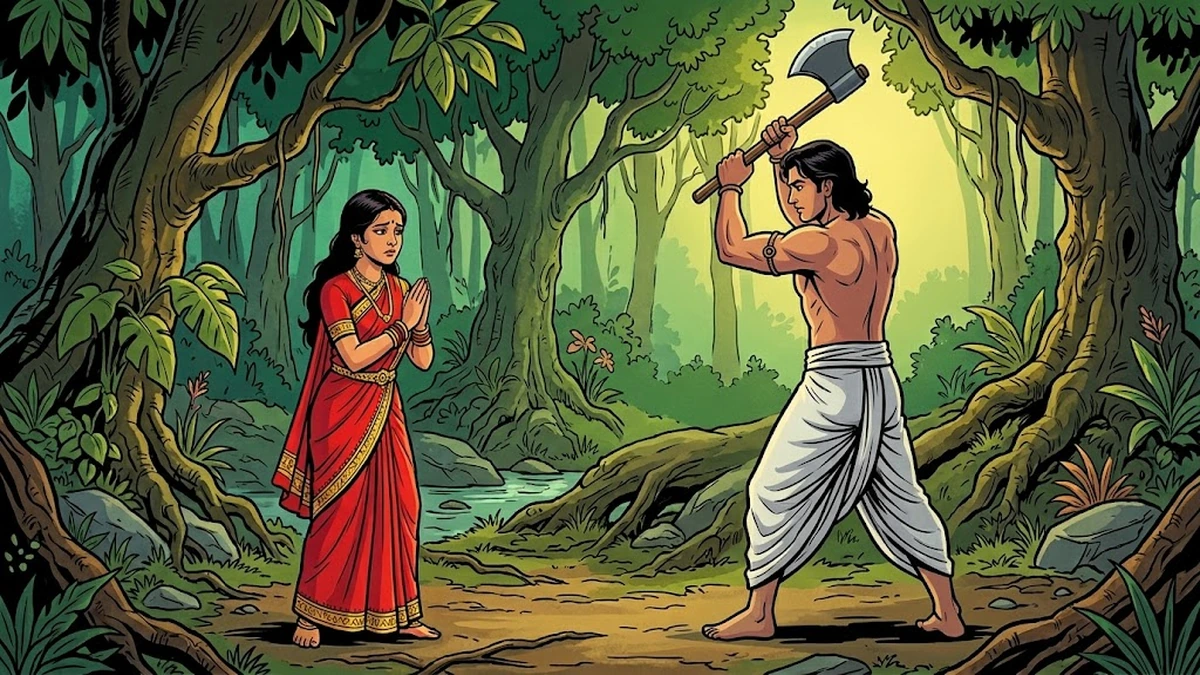
As Satyavān raised his axe to cut wood from a great aśvattha tree, a pain like a thunderbolt struck behind his eyes. He staggered, and Sāvitrī caught him before he fell. He described the pain as unbearable, his limbs as heavy as stone. Sāvitrī cradled his head in her lap on the forest floor. His breathing slowed. His eyes remained open — but the light in them dimmed and was extinguished like a lamp deprived of oil.
The Sanskrit text now shifts register, moving from warm domestic realism to cosmic grandeur. From the south — the traditional direction of death and the realm of the ancestors — came a figure no mortal could mistake: Yama (यम), the Dharmarāja (King of Righteousness), son of Vivasvān the Sun and twin to the goddess Yamī. He was dark as a monsoon cloud, clad in robes the colour of old blood, his eyes burning like sacrificial fires, his crown of black iron towering above the treeline. He carried a rope of cosmic hemp, and his presence drained the warmth from the air as surely as a winter eclipse drains warmth from the day. With careful, almost gentle precision, he separated Satyavān’s ātman — his essential self, the size of a thumb, glowing like a lamp-flame — from the cooling body, and set his face southward.
III. The Debate Beyond the World’s Edge

Sāvitrī rose and followed. This is the structural heart of the story: the Mahābhārata records a dialogue that unfolds over six exchanges, each one a miniature philosophical treatise. Yama repeatedly commands her to stop, citing the inviolable law that no living soul may enter his domain. She refuses, citing law right back at him — specifically the dharmaśāstra principle that a wife’s place is beside her husband in all worlds, in all circumstances. “I follow,” she says simply, “my dharma.”
Moved by her resolution, Yama offers her a boon — anything except Satyavān’s life. Sāvitrī asks that her father-in-law Dyumatsena receive back his sight and his kingdom. Granted. She continues walking. Yama offers a second boon — anything except Satyavān’s life. She asks that her father King Aśvapati be blessed with a hundred sons to preserve his lineage. Granted. Still she walks. The third boon: that she herself be given a hundred sons.
Here the debate reaches its celebrated climax. Yama has painted himself into a logical corner of his own dharmic architecture. He has granted a wife one hundred sons. But Satyavān is the only man who could lawfully be the father of Sāvitrī’s children, since she has taken the Saptapadi (seven sacred steps of marriage) with him alone. For the boon to be meaningful, Satyavān must live. The request contains within it the implicit condition of the husband’s survival — not as a loophole or a trick, but as a truth Yama himself has ratified by promising her sons. The Mahābhārata makes clear that this is not sophistry: Sāvitrī has used dharmic logic to demonstrate that Yama’s own laws require Satyavān’s restoration. She has not outwitted death; she has showed death that its own principles demand her husband’s return.
The Sanskrit of the great boon exchange is among the most celebrated passages in all of Mahābhārata: “Putrasatam dehi me bhoḥ — śatam putrān prayaccha me”. Each syllable has been memorised by Sanskrit students for two millennia. Commentators from Śaṅkarācārya’s school to modern Pune scholars have glossed these verses, arguing about the precise dharmic mechanism. Is Sāvitrī exploiting an ambiguity? Or is she demonstrating a higher truth that Yama, as Dharmarāja, must honour? The consensus of the tradition is the latter: genuine dharma is self-consistent, and Sāvitrī’s argument reveals a consistency that death itself cannot violate.
IV. The Restoration and Its Enduring Echo
Yama releases the ātman of Satyavān. The Mahābhārata describes the moment with characteristic restraint: the golden thumb-sized flame returns southward to northward, re-enters the cooling body, and Satyavān opens his eyes as if waking from deep sleep. “I must have slept a long time,” he says, disoriented. “Let us go home; the sun is low.” Sāvitrī says nothing of what occurred. She helps him rise, and they walk back through the forest together, hand in hand, the body that carried death’s mark now carrying life again.
The aftermath unfolds with the precision of fulfilled dharmic logic. Dyumatsena, sitting in the forest dwelling, suddenly finds his sight restored — both eyes opening clear after years of darkness. The usurper who stole his kingdom has been overthrown by the kingdom’s own ministers, who arrive in the forest the very same evening to escort their rightful king home. The restoration is simultaneous and structurally complete: not merely the husband, but the entire royal family’s fortunes are reversed on the day that Sāvitrī’s virtue was tested and found absolute.
The Mahābhārata’s narrator Mārkaṇḍeya, having told this story to Yudhiṣṭhira, draws an explicit connection: just as Sāvitrī preserved her husband through the power of satya (truth-in-action) and dharma (righteous resolve), so too will the Pāṇḍavas, if they hold fast to virtue through their own terrible exile, ultimately be restored to what is rightfully theirs. The story is not decorative. It is a worked philosophical example, placed by the epic’s architect exactly where a despairing hero most needs it.

Moral
“सत्यं ब्रूयात् प्रियं ब्रूयात् न ब्रूयात् सत्यम् अप्रियम्”
“Speak truth; speak that which is pleasing; do not speak truth that is unpleasing.” — but Sāvitrī’s deeper lesson reverses this: speak truth even when it is dangerous, especially when it is dangerous, for it is the one force that dharma itself cannot refuse. Courage without intellect is brute force; love without wisdom is helpless grief. Sāvitrī shows us that the combination of the two — love that thinks clearly under supreme pressure — is the only force capable of reversing the irreversible.
Why This Story Has Lasted 2,500 Years
The story of Sāvitrī has survived not because it flatters its audience but because it challenges them. In an era when women’s autonomy was circumscribed by elaborate codes of conduct, the Mahābhārata placed at its structural centre a woman who argues with a god and wins on intellectual grounds. Every generation has found in her a different mirror: medieval commentators saw a paragon of pativratā (wifely devotion); nationalist reformers of the 19th century, including Bal Gangadhar Tilak and later B.R. Ambedkar’s critics, saw her as evidence that the Sanskritic tradition itself contained the seeds of female agency; contemporary readers see a crisis negotiator of extraordinary skill operating under impossible time pressure.
The festival of Vat Savitri Vrata — observed on the full moon of Jyeṣṭha, when married women tie threads around banyan trees (the vaṭa, sacred in Indian cosmology for its longevity) and pray for their husbands’ well-being — translates the story’s abstract virtues into lived ritual. Anthropologists studying the festival across Maharashtra (where it overlaps with the Maharashtrian lunar calendar as Vaḍa Pauṇimā) note that women articulate the observance not primarily in terms of submission but of power: the power to change an outcome through unwavering intention. That subtle reframing — from self-sacrifice to strategic agency — is what keeps Sāvitrī alive and continuously relevant in a culture that has changed in almost every other respect.
At the comparative-folklore level, the story’s durability owes something to its structural elegance. The three-boon sequence creates dramatic irony that is pleasurable to re-experience because each exchange seems to be a defeat (Yama refuses to give the life) that is secretly an advance (each granted boon narrows Yama’s logical room until he has no space left). This architecture — the hero appearing to lose repeatedly while actually winning — is one of the deepest satisfactions storytelling can provide, and the Mahābhārata deploys it with consummate craft.
You May Also Like
 Indian Folk Tales
Ages 6-8
Indian Folk Tales
Ages 6-8
Si Tanggang: The Ungrateful Son and the Curse of Stone
Si Tanggang: The Ungrateful Son and the Curse of Stone: In a small fishing village nestled along the Malaysian coast, where the sea whispered ancient secrets
 Indian Folk Tales
All Ages
Indian Folk Tales
All Ages
Her Childhood
Her Childhood: Once upon a time in a small, quiet village, there lived a girl. She was obsessed with blue. Her room was blue, every dress she had was blue –
 Indian Folk Tales
Ages 3-5
Indian Folk Tales
Ages 3-5
Story of the Birth of Lord Krishna
The classic Indian mythological tale of Krishna's miraculous birth in Mathura — a story of tyranny, divine prophecy, and a father's courageous journey through stormy rain.