Koschei the Deathless
Koschei the Deathless: In the times before time itself was properly counted, when magic was as common as earth and water, there arose a sorcerer of such
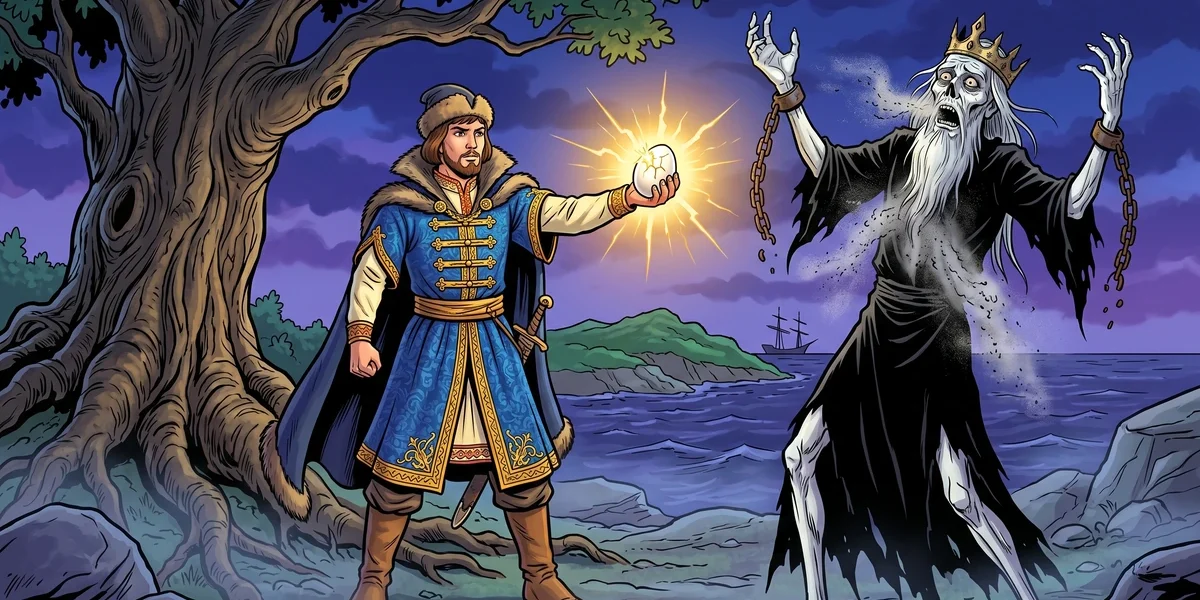
Origin & Canonical Sources. Russian wonder-tale, Кощей Бессмертный (Koshchéy Bessmértnyi, “Koschéy the Deathless”). The villain Koschéy is the antagonist of three tales printed back-to-back in the first edition of Alexander Afanasyev’s Народные русские сказки (St Petersburg 1855–1863), nos. 156, 157 and 158; he also drives no. 159 “Marya Morevna”, the version that became the standard text after Ivan Bilibin’s 1900–1902 lithograph cycle. Afanasyev re-numbered them in the 1873 second critical edition (Moscow), and they are usually quoted today from L. G. Barag and N. V. Novikov’s three-volume Nauka reprint of 1984–1985.
Tale type. ATU 302 “The Ogre’s (Devil’s) Heart in the Egg” (Hans-Jörg Uther, FFC 284–286, 2004), with East-Slavic catalogue numbers SUS 302, SUS 3021, SUS 3022 in Barag, Berezovsky, Kabashnikov and Novikov, Сравнительный указатель сюжетов: восточнославянская сказка (Leningrad, 1979). Stith Thompson motifs: E710 “External soul”, E711.1 “Soul in egg”, E713 “Soul hidden in a series of coverings”, D672 “Obstacle flight”, B313 “Helpful animal an enchanted person”, R11.1 “Princess(es) abducted by monster”, F771.4.4 “Castle of demons”.
First Western printings & translators. William Ralston Shedden-Ralston, Russian Folk-Tales (Smith, Elder & Co., London 1873), pp. 80–113, gives the earliest English-language summary, framed by his lecture “The Story of the Demigod Koshchei”. Leonard Magnus, Russian Folk-Tales (E. P. Dutton, New York 1916); Post Wheeler, Russian Wonder Tales (Century, New York 1912); Norbert Guterman / Roman Jakobson, Russian Fairy Tales (Pantheon, New York 1945, Bollingen XLI) — the last is the canonical American school-library text. Andrew Lang, The Red Fairy Book (Longmans, London 1890) gives “The Death of Koshchei the Deathless” via Ralston.
Etymology. Max Vasmer, Russisches etymologisches Wörterbuch (Heidelberg 1953–1958), connects кощей with Old East Slavic кошь “captive, slave” (and through it with Turkic қошчы / košči, “camp-servant”), as in the Slovo o polku Igoreve (c. 1187, “the khan dragged Igor as a koshčii”); a folk etymology links the name to кость, “bone”, giving the standard image of Koschéy as a skeletal cadaver. Roman Jakobson, “Slavic Mythology” (Funk & Wagnalls Standard Dictionary of Folklore, 1949), treats the figure as a fossilised chthonic deity overlaid by a historical memory of steppe raiders.
Scholarship. James G. Frazer, The Golden Bough, Part VII Balder the Beautiful, vol. 2, ch. xi “The External Soul in Folk-Tales” (Macmillan, London 1913), uses Koschéy as the canonical Indo-European specimen of motif E710. Vladimir Propp, Морфология сказки (Leningrad 1928; English: Laurence Scott, Indiana U.P. 1958) tabulates the tale as functions A¹ (villainy), C (departure), F (receipt of magical agent), H¹ (struggle), J (branding), K (liquidation), Ω (wedding). His later Исторические корни волшебной сказки (Leningrad 1946) reads Koschéy as a reflex of an Indo-European death-spirit and links the nested-container death to initiatory “death of the initiand”. Eleazar Meletinsky, Герой волшебной сказки (Moscow 1958), groups Koschéy with the “non-personal antagonist”. Linda J. Ivanits, Russian Folk Belief (M. E. Sharpe, Armonk 1989), pp. 39–43, treats him as a survival of the chthonic naví (the unquiet dead).
Visual & musical afterlife. Ivan Yakovlevich Bilibin’s six-plate Skazka o Mar’e Morevne (Ekspeditsiya Zagotovleniya Gosudarstvennykh Bumag, St Petersburg 1900–1902); Viktor Vasnetsov, Koschéy the Deathless oil on canvas (1917–26, House-Museum, Moscow); Nicholas Roerich set-designs for Sergei Diaghilev’s Paris season. Nikolai Rimsky-Korsakov, Кащей Бессмертный, “autumnal little-tale” in one act (premiered Moscow Private Opera, December 1902, libretto by the composer and his daughter Sofiya). Igor Stravinsky, L’Oiseau de Feu (Ballets Russes, Paris Opéra, 25 June 1910) — “Danse infernale du roi Kascheï” and the breaking of the egg. Aleksandr Rou, Кащей Бессмертный, Soyuzdetfilm, 1944 (released 9 May 1945, the day after V-E Day — a deliberate allegory of Hitler’s defeat).
The tale opens not with the villain but with the loss. In Afanasyev no. 159 the loss has a name and a face: Mar′ya Morevna, a warrior-queen who rides at the head of her own army, whom Ivan Tsarevich has just married after his three sisters were given in marriage to the falcon, the eagle and the raven. She rides off to a campaign and forbids her husband to open a single locked cellar door in her palace. He opens it. Inside hangs Koschéy the Deathless, bound with twelve iron chains. The prisoner begs for water. Ivan, taking pity, gives him three buckets. With each bucket Koschéy snaps four chains. With the twelfth he breaks free, seizes Mar′ya Morevna out of the air on his magic horse, and is gone. The whole machinery of the wonder-tale — the three brothers-in-law, the three trials at the hut of Baba Yaga, the foal that out-runs Koschéy’s horse, the death hidden in an egg — is set in motion by this one moment of pity.
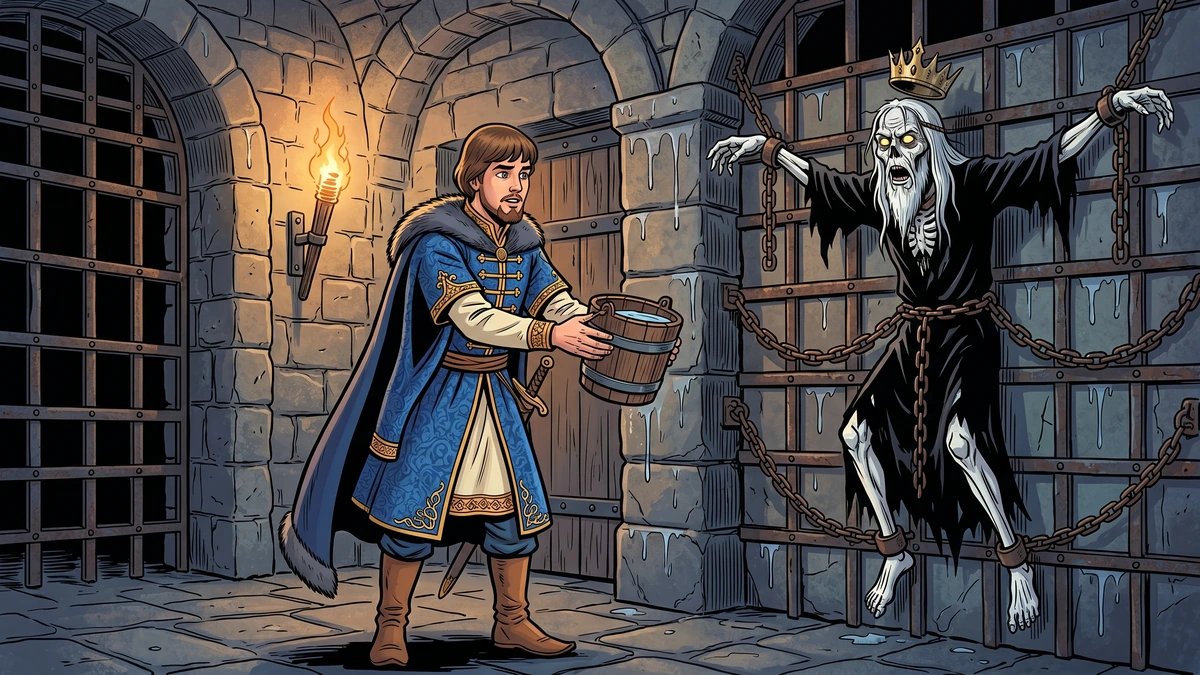
I. The Forbidden Door — how the prisoner was set loose
Afanasyev’s version is unsparing about the moral arithmetic. The opening line of no. 159, in V. Ya. Propp’s 1957 Goslitizdat re-issue, reads “В некотором царстве, в некотором государстве жил-был Иван-царевич; у него было три сестры” — “In a certain tsardom, in a certain land, there lived Ivan Tsarevich, and he had three sisters.” The three sisters are given to Falcon, Eagle and Raven respectively, each in the form of a knightly suitor who comes “with thunder and with whirlwind”. Ivan rides out, meets Mar′ya Morevna on a battlefield strewn with the corpses of her enemies, and marries her at her own request. The tale’s first cunning is that the hero begins as the consort of a stronger spouse; his great deeds are owed to her, not the reverse, and the recovery plot is restitution rather than acquisition. Linda Ivanits, Russian Folk Belief (Armonk 1989) p. 197 n. 14, treats Mar′ya Morevna as a literary survival of the polenitsa, the female warrior of the South-Russian byliny.
When Mar′ya leaves for war she gives Ivan the keys to “every room except this one”. The locked cellar — the зака́занный покой, “the forbidden chamber” — is Stith Thompson motif C611, the same forbidden room as Bluebeard (ATU 312), the chamber the third son enters in De Goldne Schlüssel (KHM 200), the unopened jar of Pandora. Mark Lipovetsky, Charms of the Cynical Reason (Brighton 2010), calls the door “the wonder-tale’s universal solvent”: once opened, the story can begin. Ivan opens it. The water Koschéy begs — one bucket, three buckets, twelve buckets in successive recensions — restores the drinker bucket by bucket; with the last, the twelve iron chains shatter and the captive whirls his abductor away through the window. Propp (1928, §5) catalogues this as function A¹ “the villain abducts a person”; Meletinsky (1958) calls it “the lapse of vigilance” and reads the bucket-by-bucket release as a calendrical reflex of spring breaking winter’s grip.
II. The Three Brothers-in-Law — magic transport across the bird-roads
Ivan sets out after her. He travels to the three palaces of his three brothers-in-law: Falcon, Eagle, Raven. At each, Mar′ya’s sister recognises him and welcomes him; each husband, returning, lays a silver knife or a silver fork on the table as a token to be watched — if it turns black, Ivan is dead. The brothers-in-law are Stith Thompson motif B313.1 “Helpful animal an enchanted person of noble birth”; the silver-token is motif E761.7.2 “Life token: silver turns black”. Roman Jakobson and Petr Bogatyrěv, “Folklore as a Special Form of Creation” (1929), single out this triad as the canonical “Slavic chain-helper”, paralleled in the wedding songs of Belorussia where the bride asks the falcon, the eagle and the raven to carry her to her brother. Each husband flies Ivan part of the way: by falcon to the mountain country, by eagle across the steppe, by raven to the edge of the bone-meadow where Baba Yaga’s hut on chicken’s legs spins. There he is given the three impossible tasks of the cattle-herding episode, succeeds with the help of bees, ants and the king of the fishes, and is given the foal that will be faster than Koschéy’s horse.
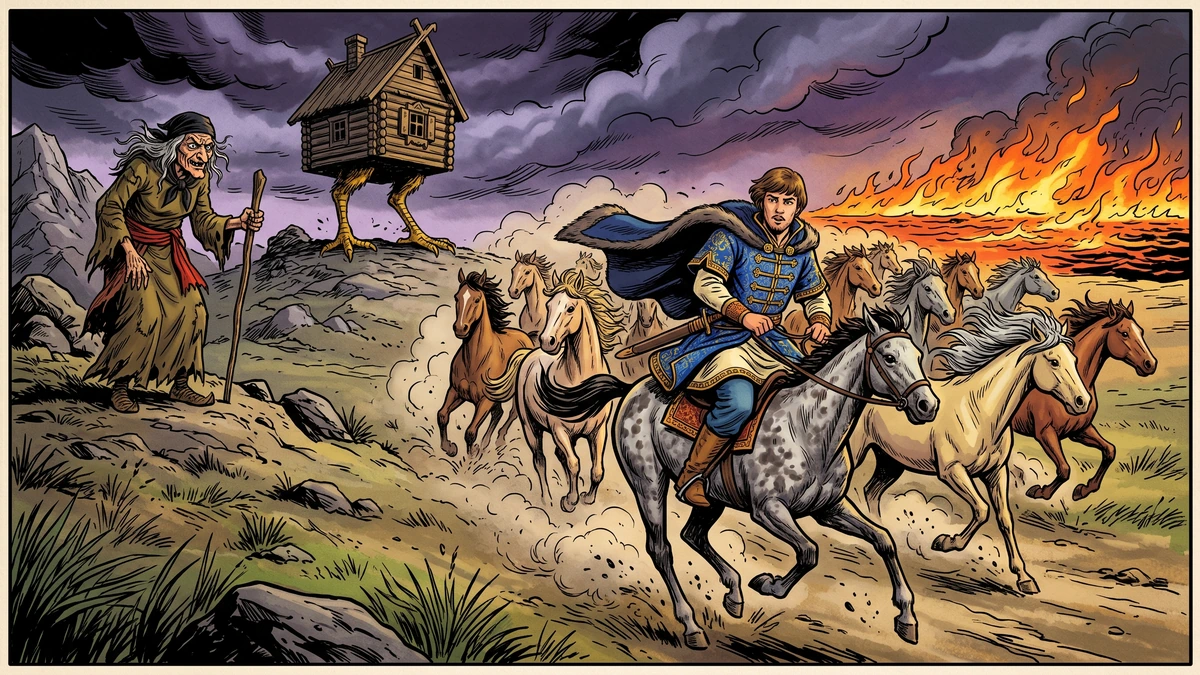
The horse is the crux. In Afanasyev no. 159 Koschéy rides a magic stallion fed on glowing coals which can outrun “all the winds of the world”; the only horse that can beat it is its own foal-brother, which must be earned from Baba Yaga by herding her mares (her storm-clouds) for three days at the brink of the sea-of-fire. Vladimir Propp (1946, ch. ix) reads the foal as the hero’s psychopomp — the animal that carries the soul back from the land of the dead — and notes the formula “конь о двенадцати крылáх”, “the horse of twelve wings”, in the recension printed by P. V. Kireevsky (Песни, vol. 4, 1862). The first two attempts at flight fail; Koschéy overtakes the lovers, chops Ivan into pieces, and rides off with Mar′ya again. The third attempt — with Baba Yaga’s foal, after Ivan’s pieces have been rebuilt with the living-and-dead water brought by the brothers-in-law as ravens — succeeds long enough to ride Koschéy down to exhaustion.
III. The Hidden Death — needle, egg, duck, hare, chest, oak, sea
This is the heart of the tale and the reason it became scholarship’s textbook specimen of motif E710. Koschéy, panting on the heath after the foal has crushed his stallion’s head, gloats over the dying Ivan: “My death is far away — on the sea, on the ocean, on the island of Buyán, there stands a green oak; under the oak is an iron chest; in the chest is a hare; in the hare a duck; in the duck an egg; in the egg my death — and to get there is impossible.” The taunt is Stith Thompson E711.0.1 “Villain reveals secret of his life to victim”; it is the same self-betrayal that destroys the giant in Asbjørnsen and Moe’s Risen som ikke hadde noe hjerte på seg (“The Giant Who Had No Heart in His Body”, Norske Folkeeventyr no. 36, 1843), the Egyptian Tale of the Two Brothers (Pap. d’Orbiney, 19th dynasty, c. 1185 BCE, ed. Gardiner LES 1932) where Bata’s heart is in a cedar flower, and the Hindu Sasti-cycle where the demon’s life is in a parrot in a cage at the bottom of a tank (J. C. Bowra, Bengal Folk-Lore, 1883).
Mar′ya recovers the secret by feigning love for Koschéy on three successive evenings; she hides the answer in her sleeve and gives it to Ivan when the foal carries her away the third time. Ivan rides to the seashore. At the shore the wolf (or the bear, in no. 156) seizes a hare that has bolted across his path; from the hare’s belly the duck flies up; the falcon (the brother-in-law repaying the debt) brings it down; the egg falls into the sea; the pike (or in no. 157, a crab) lifts it from the sand. Stith Thompson catalogues this as motif B175 “Helpful animals brought together by hero”. The chain — pike to oak to hare to duck to egg to needle — is the wonder-tale’s most perfect Russian doll. Vladimir Toporov, “Из наблюдений над загадкой” (1971) reads the nesting as a model of the world-tree: the oak on Buyán is the cosmic axis, the iron chest the under-world, the hare and duck the chthonic and the airy souls of pre-Christian Slavic anthropology, the egg the cosmogonic egg (яйце-перворождённое) of the dualistic creation myth recorded by S. M. Solovyev in 1879. The needle is the human soul as a thin, sharp, almost-not-thing — or, as Frazer put it in 1913, “the most concentrated and least vulnerable shape into which life can be folded”.
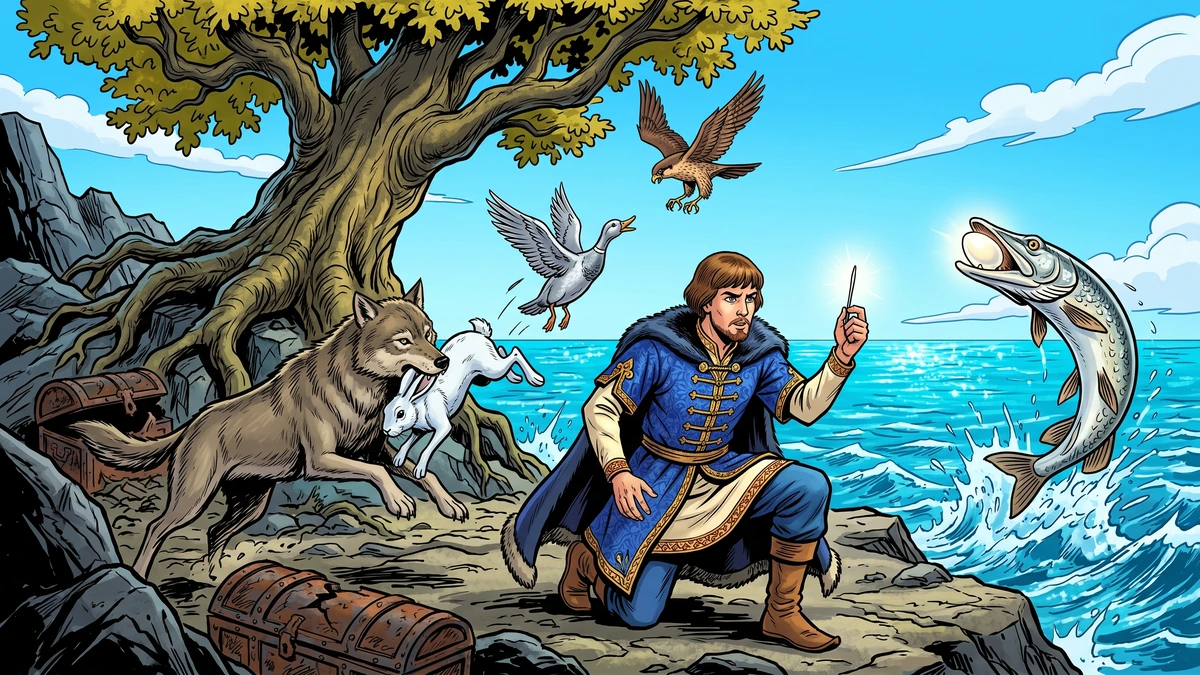
Ivan crushes the needle. In the southern (Ukrainian) Afanasyev variant no. 158 he breaks it across his knee like a green stick; in the Belorussian variant collected by E. R. Romanov (Белóрусский сборник, vol. 6, 1901) he bites the needle in half. Across the heath Koschéy gives “a great shriek that shook the iron mountain and shattered the iron forest”; his bones fall to powder; the wind takes the powder. Mar′ya rises from her swoon; the foal kneels; the lovers ride home. The closing formula is the standard Afanasyev cadence: “И я там был, мёд-пиво пил, по усам текло, а в рот не попало”, “I was there too, I drank the honey-mead; it ran down my whiskers but none got into my mouth”. The narrator’s exclusion from the wedding feast is itself a stock motif (Stith Thompson Z61), present in nearly every Afanasyev tale and used by Pushkin to close Skazka o tsare Saltane (1831).
IV. Why the External Soul — a comparative aside
Frazer’s chapter (1913, vol. 2, pp. 95–152) lays out forty parallels: Punchkin’s parrot in Maive Stokes’s Indian Fairy Tales (1880); the Sea Dyak ogre whose life is in a betel-nut; the Tatar ogre whose life is in a twelve-headed snake in a stone trunk; the Old Norse Nídhöggr-eaten roots of Yggdrasil; the heart of the giant in the Norwegian Risen som ikke hadde noe hjerte på seg; the death of Balór of the Evil Eye in the Irish Cath Maige Tuired; the apple of Ki Su Hyo in the Korean Samguk Yusa (Iry&ocaron;n c. 1281). What unites them is a cognitive intuition older than agriculture: that the most dangerous adversary is not the body in front of you but the secret it depends on. Folktale teaches the children listening that opaque, mountainous power is in fact a tower of dependencies — topple the bottom card and the tower falls. The Soviet folklorist V. P. Anikin, Русская народная сказка (Moscow 1959) p. 84, calls Koschéy “the schoolmaster of leverage” — the figure through whom Russian peasant children first learn that even immortality has a point of failure if you study long enough.
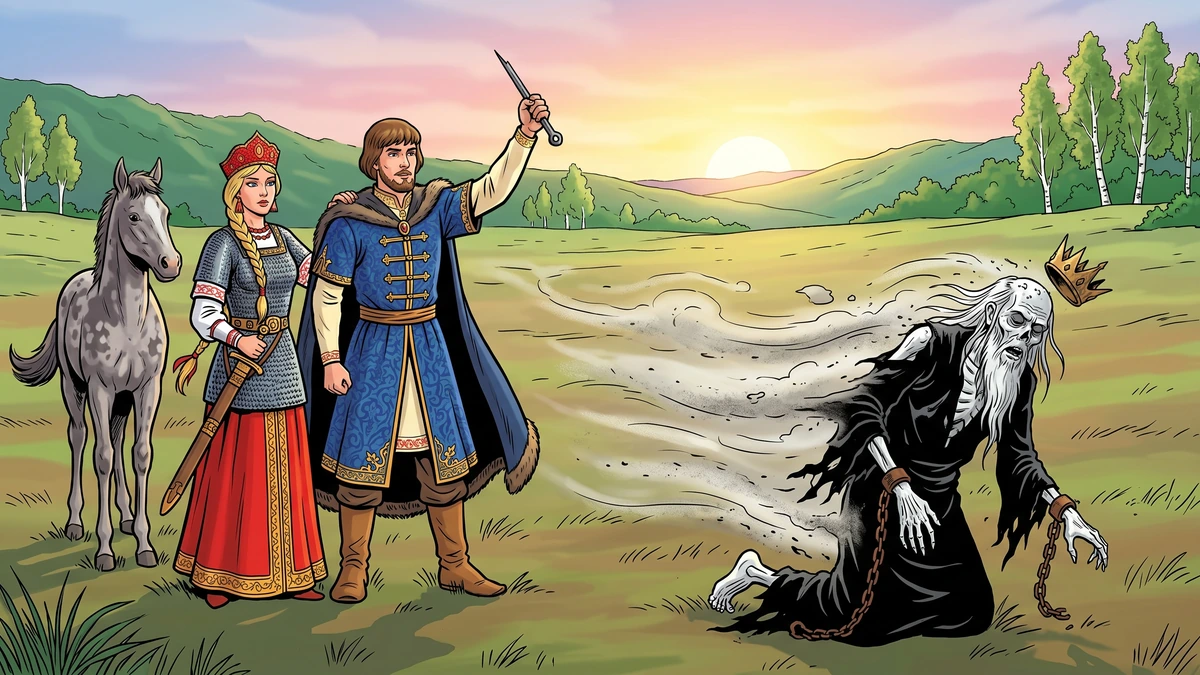
Moral — “Where strength fails, wit prevails”
«Где сила не возьмёт, там ум поможет.»
“Where strength cannot prevail, wit will help.” — Vladimir Dahl, Пословицы русского народа (Moscow 1862), no. 12345, in the section “Ум — глупость” (“Wit — Folly”).
The proverb predates Dahl’s collection by at least four centuries; a Novgorod birch-bark letter from the mid-14th century (gramota 419, ed. A. V. Arsiukhin, Лингвистическое источниковедение 2003) preserves the same antithesis in the form “силою не возьмеши, умом сотвориши”. The Koschéy tale is the wonder-tale’s most elaborate dramatisation of it: the immortal who cannot be killed by force is killed by attention — by a hero who listens to a woman’s whisper, who pays back a kindness to a wolf, a hare and a falcon, who knows that a needle is small and sharp and breakable. The moral runs in both directions. To the powerful it says: your invincibility is a tower of cards; somewhere a child is studying the deck. To the weak it says: your weakness is not a verdict; the secret is somewhere; learn to listen. Maxim Gorky, in his 1934 speech at the First Congress of Soviet Writers, made this the explicit ground for incorporating Afanasyev into the school curriculum: “The wonder-tale taught the Russian peasant boy that no oppressor is bottomless. Even the deathless can be reached.”
Why the tale has lasted
It has lasted because every component is portable. Bilibin’s 1902 lithographs — the iron-chained Koschéy in his cellar, the foal at the sea-of-fire, the broken needle on the rocks — became the visual template not only of Russian children’s books but of the Russian Pavilion at the 1900 Paris Exposition where they were exhibited; Diaghilev brought the same iconography to Paris in 1910 in the Bakst-Golovin sets for L’Oiseau de Feu. Rimsky-Korsakov’s 1902 “autumnal little-tale” opera made Koschéy the antagonist of an explicitly political fable in the closing year of the Russo-Japanese War; Aleksandr Rou’s 1944 Soyuzdetfilm Кащей Бессмертный, released the day after V-E Day, used him as Hitler in folk-tale costume, with the Cossack hero Nikita Kozhemyaka standing for the Red Army. C. S. Lewis took the chained ogre into Prince Caspian (1951); J. K. Rowling’s Horcrux mechanism in Harry Potter and the Half-Blood Prince (Bloomsbury, London 2005) is Koschéy in fragments. Andrzej Sapkowski’s Kosciej in the Geralt cycle (Krew elfów, 1994), Naomi Novik’s Marek the deathless in Spinning Silver (Macmillan, London 2018), and the BBC’s Hellboy: The Crooked Man (2024) all proceed from the same template.
The deepest reason is the one Propp identified in 1946 and Linda Ivanits restated in 1989: the tale gives narrative shape to the discovery, available to any village child by the age of seven, that adults too are afraid, that adults too have secrets they will not reveal, and that growing up is the long apprenticeship of finding out where the secrets are. Koschéy’s death is not the goal but the alibi. The story is really about the courage required to open the locked door, the loyalty required to be remembered by a wolf or a falcon to whom you once gave bread, and the patience required to ride three days at the brink of the sea-of-fire for the right foal. A thousand years of Russian peasant children have learned, in the firelight, that these are the only currencies that count. The tale outlasts empires precisely because they keep proving it.
You May Also Like
 Russian Folk Tales
All Ages
Russian Folk Tales
All Ages
Seven Simeons
Seven Simeons: [Illustration] In an empire, in a country beyond many seas and islands, beyond high mountains, beyond large rivers, upon a level expanse, as if
 Russian Folk Tales
All Ages
Russian Folk Tales
All Ages
The Language Of The Birds
The Language Of The Birds: [Illustration] Somewhere in a town in holy Russia, there lived a rich merchant with his wife. He had an only son, a dear, bright
 Russian Folk Tales
All Ages
Russian Folk Tales
All Ages
Baba Yaga
A canonical Russian wonder-tale from Afanasyev (tales 102-103, Narodnye russkie skazki, 1855-63; English re-telling Blumenthal 1903). Two orphan twins, sent into the forest by a wicked stepmother, find Baba Yaga the witch in her hut on chicken legs. They are saved by the small kindnesses they have given to mice, a hungry cat, forest birds, a rusty gate and a wounded birch tree; the cats gift of a towel and a comb becomes a river and a dark forest behind them in the magic flight. ATU 480 fused with ATU 313H*. With scholarly attribution to Propp, Johns, Hubbs and Forrester.