The Firebird, the Horse of Power, and Princess Vasilisa
The Firebird, the Horse of Power, and Princess Vasilisa: In the days when the Russian steppes stretched endless as the sea, there lived a poor archer named
Origin: Russian (East Slavic). Recorded by Alexander Nikolayevich Afanasyev (Александр Николаевич Афанасьев) in Народные русские сказки (Narodnye russkie skazki, “Russian Folk Tales”, St Petersburg 1855–1863, tale no. 168 — «Сказка об Иване-царевиче, жар-птице и о сером волке», “The Tale of Ivan Tsarevich, the Firebird and the Grey Wolf”). The “Horse of Power” variant translated here weaves the Afanasyev plot with the byline (былина) of Yermolai Zhar-Konya, the Horse-of-Fire cycle preserved in the Onega and Pinega regions and printed by Aleksandr Gilferding in Онежские былины (St Petersburg 1873). Post Wheeler used both strands when he composed his celebrated English retelling in Russian Wonder Tales (New York and London 1912), with the seventeen colour plates by Ivan Bilibin commissioned in 1898–1902. ATU 550 “Bird, Horse and Princess” (Uther FFC 284–286, Helsinki 2004); compound with ATU 531 “The Clever Horse”; SUS 550 + 531 in the East Slavic catalogue (Barag–Berezovsky–Kabashnikov–Novikov, Leningrad 1979). Stith Thompson motifs B11.2.12 Fire-breathing bird, B184.1.1 Magic horse from water, H1331.1.1 Quest for marvellous bird, R111.1.4 Rescue of princess from giant, and D1610.18 Speaking horse.
The Tale
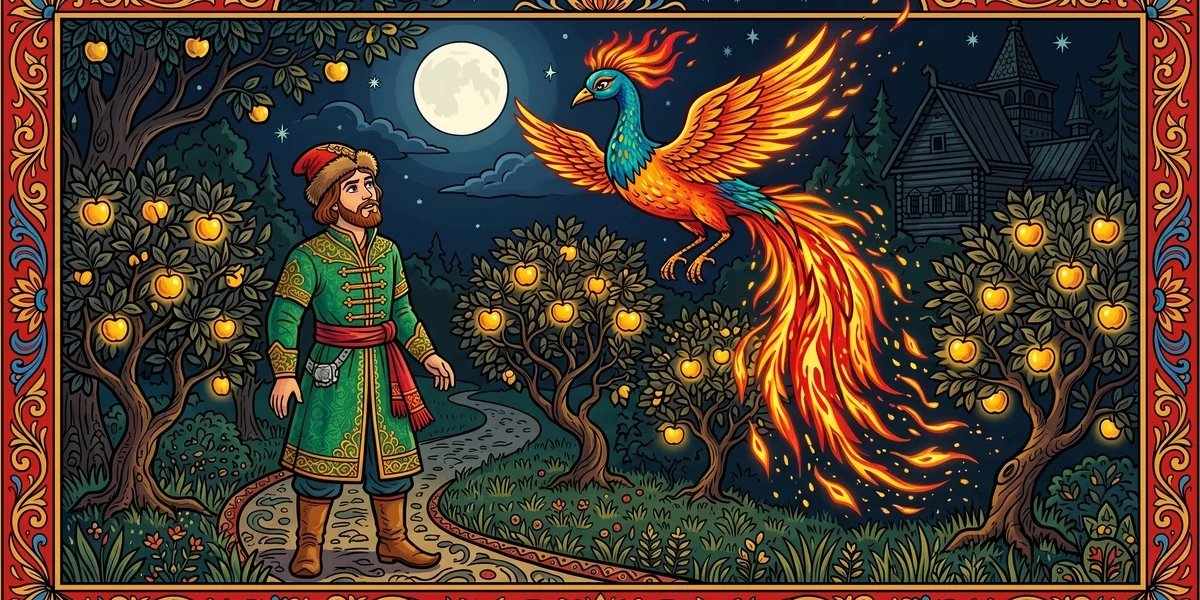
In a kingdom that lay where the steppe meets the dark fir-forest, far to the east of the Volga and far to the north of the Caspian, there reigned a Tsar called Vyslav Andronovich, whose orchard was the wonder of the world. In the centre of that orchard stood an apple-tree heavy with fruit of pure gold, and the Tsar set guards beneath its branches by day and by night. Yet still the apples were stolen, one by one, and no watchman could say what hand or wing had taken them. At last the Tsar summoned his three sons. “The thief who robs me,” he said, “robs the Tsardom of more than apples; he robs us of our honour. Let each of you keep watch in turn — and may the son who captures the thief have my crown when I am gone.”
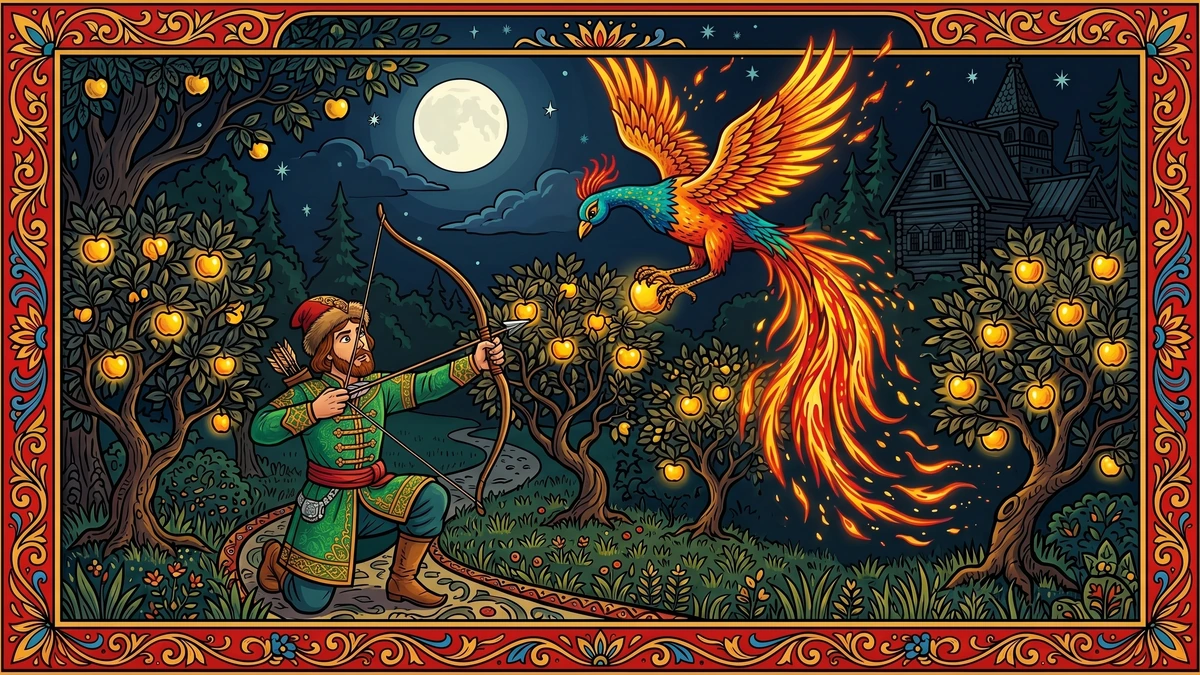
The eldest son and the middle son both fell asleep in the orchard at midnight and saw nothing. But the youngest, Ivan Tsarevich, kept himself awake with a thin willow-switch under his shirt-collar, and at the third stroke of midnight he saw the orchard fill with light brighter than the harvest moon. Down through the silver mist swept a bird with feathers of living flame — a great-winged creature whose tail blazed like a furnace of cathedral candles, whose eyes were the colour of molten amber, and whose every breath set the dew steaming on the grass. Ivan held his breath and drew his bow; but the Firebird — Жар-птица, Zhar-ptitsa — was too quick. As he loosed his arrow she sprang into the sky; only a single feather, broken from her tail, fell shining at his feet, lighting the orchard so that he could read by it as if it were noon.
The Road of Three Stones
At dawn Ivan carried the feather to his father. The court bent to look, and the courtiers said it was the rarest treasure in any treasury of Christendom; but the Tsar’s eyes had a hunger in them. “The feather is half a wonder,” he said. “The bird itself is the other half. He who brings me the Firebird whole and breathing shall sit at my right hand.” So the three brothers rode out, each in a different direction, and Ivan came at last to a great pillar of weathered stone, set where three roads divided. The pillar was carved with the old kirillitsa letters of the Russian highway: “Прямо поедешь — себя потеряешь. Налево поедешь — коня потеряешь. Направо поедешь — жив будешь, да женат не будешь.” (“Ride straight on, you will lose yourself. Ride to the left, you will lose your horse. Ride to the right, you shall live, but you shall not wed.”) Ivan, who in the Russian fairy tale is always called Иванушка-дурачок — “little Ivan the fool” — and is always wiser than the wise, chose the road that would cost him his horse, for he reasoned that a man without a horse may still earn another, but a man without himself is finished.
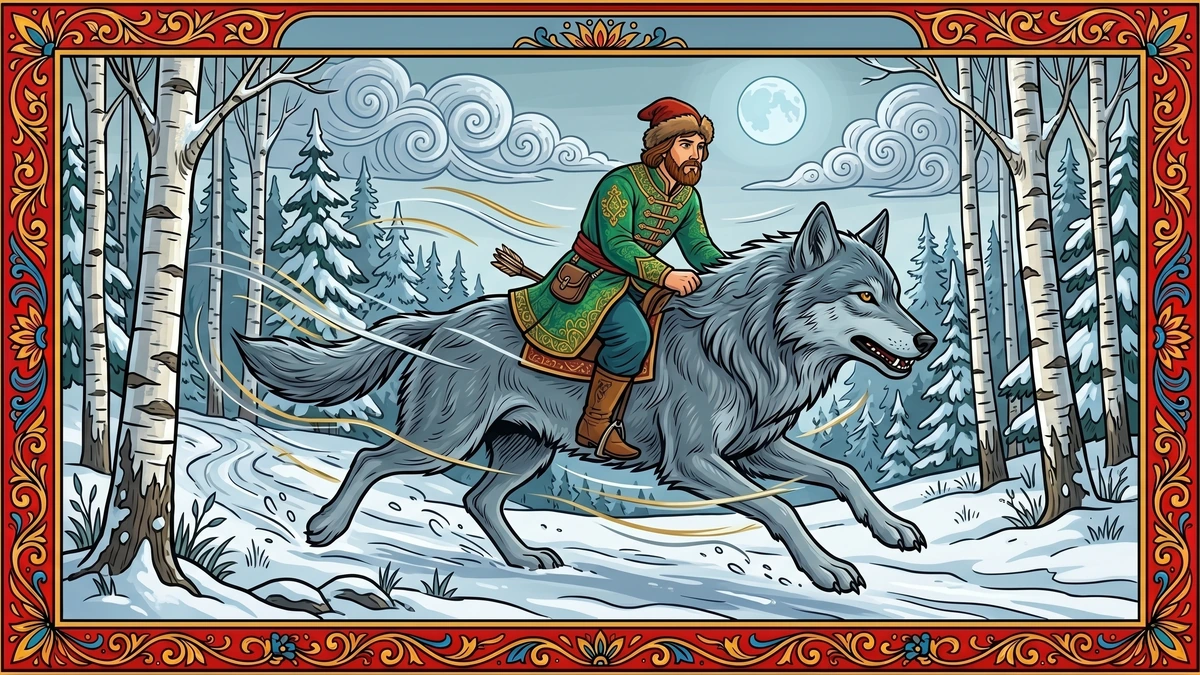
Before he had ridden a verst, a great Grey Wolf — Серый Волк, vast as a hayrick, his coat the colour of November sky — sprang from the birches and devoured Ivan’s chestnut steed at one swallow. Ivan sat in the moss and wept, less for the horse than for shame. Then the Grey Wolf, swallowing the last shoe, sat back on his haunches and spoke in a voice deep as the well of Kitezh: “Tsarevich, do not grieve. I ate your horse because the pillar said I must; I did not eat you because the pillar said I must not. Climb upon my back, and where you would go, I shall carry you faster than any horse of yours could run.” So Ivan, who had been raised to trust the strange politeness of forest beasts, climbed onto the wolf’s shoulders, and the wolf bounded away through the pine-tops at a speed that turned the world to a streak of green and silver.
The Three Cages — Iron, Silver, Gold
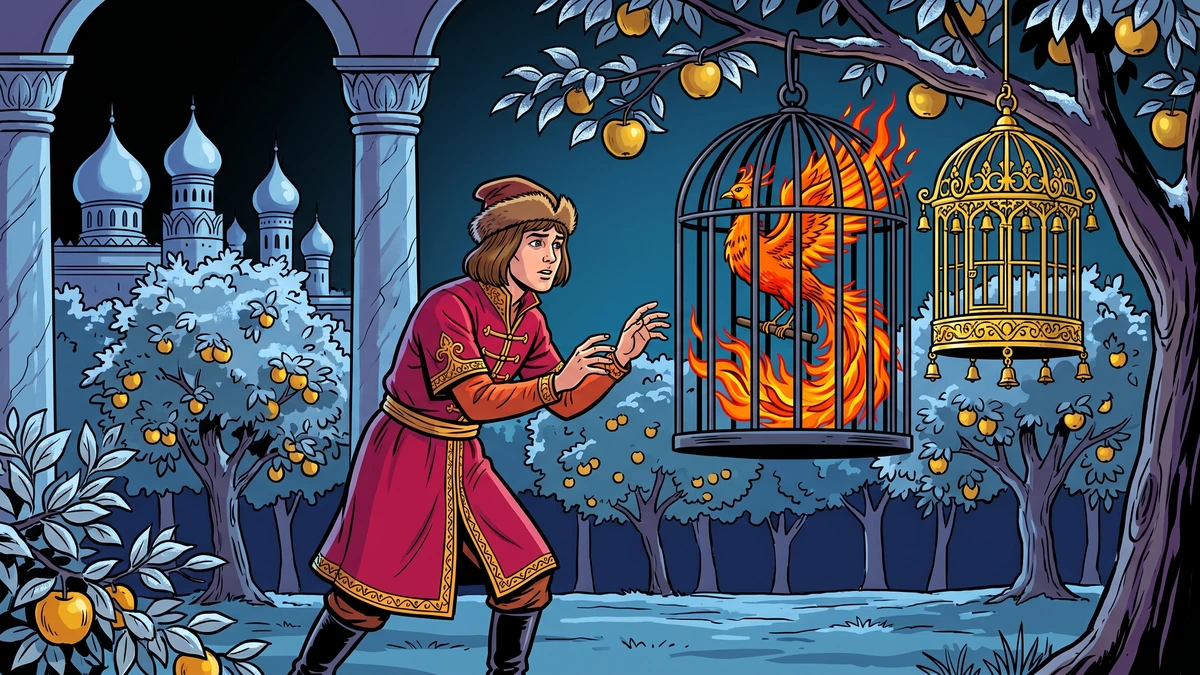
The Grey Wolf set Ivan down outside a high white wall: the orchard of Tsar Dolmat, in which the Firebird perched in a cage of plain iron. “Take only the bird,” said the wolf, “and never the cage; for the cage is hung with bells, and the bells will betray you. Make your peace with what is plain, Tsarevich, and do not be tempted by what shines.” But Ivan, gazing at the magnificent bird, saw the iron cage suddenly as too humble a vessel for so radiant a creature, and he reached for the gilded cage that hung beside it. At once the bells of the cage rang out like a battle-summons; guards seized him; and at sunrise he stood before Tsar Dolmat, who shook with grief and rage. “Ivan Tsarevich, son of Vyslav, I would have given you the Firebird for the asking,” Dolmat said, “for your father is my kinsman. But a thief is a thief. I will spare you only on one condition: ride to Tsar Afron in the country of the south, and bring me his Horse of Power — the steed called Конь-Огонь, the Horse-of-Fire, whose mane is the colour of dawn. Bring me that horse, and you shall have the Firebird and your honour besides.”
The Grey Wolf bore him to Tsar Afron’s stables, and again whispered the lesson: “Take the horse, but never the golden bridle that hangs beside him. The bridle has bells of its own, and a magic that wakes the grooms.” But Ivan, having forgotten nothing of last night’s shame but having learned nothing from it either, saw the bridle and could not help himself; he reached for it, and again bells clamoured, and again he was dragged before a Tsar. Tsar Afron said: “I will spare you only on this condition: bring me Princess Yelena Prekrasnaya — Helena the Beautiful — daughter of Tsar Dahnilo, who lives by the warm sea where the cypresses grow. Bring me Yelena to be my bride, and you shall have the Horse-of-Fire.” The Grey Wolf this time did not lecture Ivan; he merely sighed in the old-country way that great wolves do, and ran.
Yelena, the Wolf’s Cunning, and the Treachery of Brothers
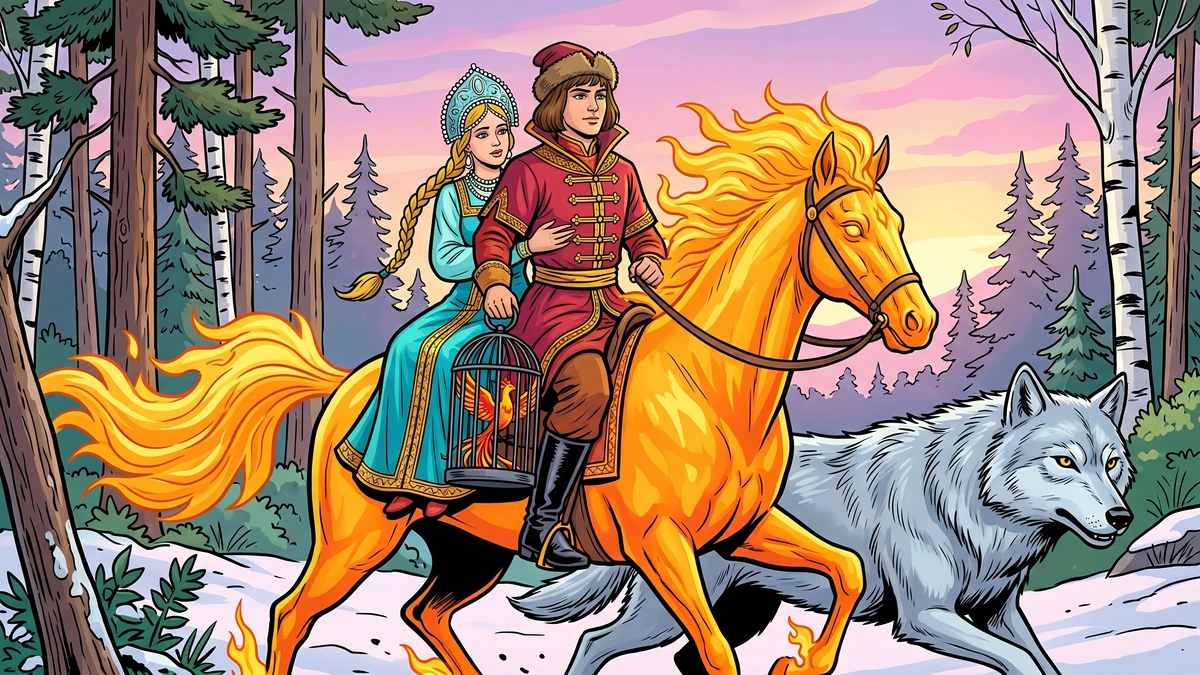
At the palace of Tsar Dahnilo, by the warm southern sea, the Grey Wolf himself stole into the garden where Yelena walked with her ladies; he caught her gently in his jaws and bore her, terrified, back to where Ivan waited beside a brook. There, on the long ride home, Ivan and Yelena fell so deeply in love that neither could bear to be parted. The Tsarevich’s heart broke at the thought of giving her up to Tsar Afron. But the Grey Wolf, watching, said: “Sorrow nothing, Tsarevich. I shall take Yelena’s likeness and ride to Tsar Afron in her place; you and the true Yelena shall ride away on the Horse-of-Fire.” And so, by an old shape-shifting that the Russian wolves of the Pinega still claim to remember, the Grey Wolf became Yelena, was given to Tsar Afron amid trumpets and pearls, and slipped away again in his own form the moment the gates of the bridal chamber closed. By the same trick, he became the Horse-of-Fire when Ivan needed to give Tsar Dolmat his price, and so Ivan rode home at last with the true Firebird, the true Horse-of-Fire, and the true Princess Yelena, while two Tsars combed their kingdoms for a wolf they could not find.
But on the last day’s ride to Tsar Vyslav’s gates, Ivan slept in a meadow, the Firebird in her cage of plain iron, the Horse-of-Fire grazing nearby, Yelena asleep with her cheek upon Ivan’s coat. There his elder brothers — who had wandered all those years without finding so much as a feather — came upon him; and seeing his treasures their hearts blackened. They drew their sabres and slew their younger brother in his sleep, and they hacked his body into pieces, and they buried him under the wild grass; and they swore Yelena to silence by threat of a like death. Then they bore the Firebird and the Horse and the weeping Princess home to Tsar Vyslav, who received them with such honour as drowned out for a while the sound of his missing son.
The Wolf’s Vigil, the Water of Life, and the Justice of the Tsar
For thirty days the Grey Wolf prowled the meadow where Ivan lay, and on the thirty-first day a young raven and his fledgling came down to feed upon him. The wolf caught the fledgling in his great jaws and said to the father raven: “Bring me the Water of Death and the Water of Life from the well at the end of the world, and your child lives. Bring me not, and you shall watch him die.” The old raven flew nine days and nine nights, and returned with two phials of dark and bright. The Grey Wolf sprinkled the Water of Death upon Ivan, and his hacked body knit itself together as wax knits in a candle-mould; he sprinkled the Water of Life upon the unbroken corpse, and Ivan sat up rubbing his eyes and saying, like the man in every Russian tale who has been dead a month, “How soundly I have slept!” “You would have slept for ever,” the Grey Wolf said, “had your brothers had their way. Mount me now: the wedding-feast at your father’s court is tomorrow, and we shall not be late.”
So Ivan arrived at his father’s palace at the hour when Yelena, white-faced as a candle, was to be married against her will to the elder brother. She saw Ivan, and a great cry went up from her throat that shattered the silence of the hall. The elder brothers, finding themselves named before the whole court, drew their sabres against Ivan; but the Grey Wolf in three strides was upon them, and where the wolf laid his paws there was an end of their treachery for ever. Tsar Vyslav embraced his youngest son, gave him Yelena to wife, and on his deathbed not long after laid the crown upon his head. The Firebird hung in the orchard in her plain iron cage and was fed pearls from Yelena’s hand; the Horse-of-Fire stood in a stable of polished oak and answered only to Ivan’s bridle; and the Grey Wolf, having received Ivan’s solemn thanks, vanished into the forest one twilight and was never seen by mortal eyes again. But the old Pinega woodcutters still say that on certain nights, when the moon is the colour of old amber, a vast grey shadow may be glimpsed running silently between the firs — and they cross themselves, and they wish him well.
Moral
«Не имей сто рублей, а имей сто друзей.»
— Ne imey sto rubley, a imey sto druzey — “Do not own a hundred roubles; own a hundred friends.” Vladimir Ivanovich Dahl (Владимир Иванович Даль), Пословицы русского народа (“Proverbs of the Russian People”), Moscow 1862, no. 2778.
The tale’s moral is plainer than its mechanics. Ivan Tsarevich is rewarded not because he is clever — he disobeys the Grey Wolf at every turn — but because he is loyal: loyal to his father’s command, loyal to Yelena’s love, loyal to the Wolf’s instruction even after he has broken it. Loyalty, the Russian peasant said, is a stronger horse than cleverness; and the friend who carries you on his back when your own steed has failed is the friend Dahl’s proverb names. The brothers’ fate is the inverse: they had no friend but their own ambition, and that friend devoured them.
Why This Story Has Lasted
The Firebird tale is, after “Vasilisa the Beautiful”, the best-known of all Russian magic tales abroad — and abroad is where its modern fame was made. Igor Stravinsky composed L’Oiseau de feu (the Firebird ballet) for Sergei Diaghilev’s Ballets Russes at the Théâtre national de l’Opéra in Paris in 1910, with choreography by Michel Fokine and stage designs by Aleksandr Golovin; the première launched both Stravinsky’s international career and the modern reception of Russian folklore in Western Europe. The libretto fused Afanasyev’s #168 with the Koschei-the-Deathless cycle, producing the ballet’s distinctive ending in which the Firebird destroys Koschei rather than being captured. Three years later Pyotr Verigin’s commercial folklore press in Petrograd issued Ivan Bilibin’s Сказка об Иване-царевиче, жар-птице и о сером волке (St Petersburg 1899, expanded edition 1913), whose seven colour plates with their gold leaf and lacquer-box borders fixed the visual image of the Firebird for an entire century: gold and crimson plumage, a peacock-blue eye, a flame-tipped tail.
The tale is also a textbook case of folklore-as-political-allegory. Vladimir Propp, in Морфология сказки (Morphology of the Folktale, Leningrad 1928), used Afanasyev’s #168 as one of his thirty-one core functions test-cases, demonstrating that the tale’s surface improvisation hides a rigid sequence — interdiction, violation, lack, departure, donor, helper, struggle, return — that recurs across the Russian magic-tale corpus. E. M. Meletinsky, Propp’s successor at the Gorky Institute, traced the Horse-of-Fire motif to a pre-Christian Slavic solar mythology in which the rider of the solar horse — variously called Khors, Dazhbog, or Svetovid — crossed the night-sky in pursuit of a bird of dawn. The Firebird, in this reading, is not a bird at all but the sun itself, captured at midnight in the orchard of human longing.
In English the tale entered the children’s canon through Andrew Lang’s Yellow Fairy Book (London 1894, no. 31, “The Story of Ivan, the Firebird, and the Gray Wolf”) and Post Wheeler’s Russian Wonder Tales (New York 1912); the Wheeler text, with Bilibin’s colour plates licensed from the Petrograd edition, is the version most American children met in the early twentieth century. Edmund Dulac contributed a competing visual tradition in his Fairy Book (London and New York 1916), giving the Firebird a Persianate exoticism that influenced Hollywood; both visual traditions converged in Disney’s Fantasia 2000 (1999), whose closing “Firebird Suite” segment set Stravinsky’s music to an animated re-telling that returned the bird to its earlier role as life-bringer rather than captive prize. Modern Russian readers still meet the tale first in Afanasyev — every Soviet schoolchild owned the eight-volume Народные русские сказки in its 1957 critical edition by V. Ya. Propp and N. V. Novikov — and still recognise the Grey Wolf as a national emblem of selfless friendship, perhaps the single most beloved animal helper in the Slavic fairy-tale tradition.
Frequently Asked Questions
Q1. Is the “Princess Vasilisa” in this title the same Vasilisa as in “Vasilisa the Beautiful”?
No, and the confusion is an artefact of English re-telling. In Afanasyev’s #168 the princess is named Yelena Prekrasnaya (Helena the Beautiful), daughter of Tsar Dahnilo of the southern sea. The name Vasilisa appears on the bride in several twentieth-century English re-tellings — including the Post Wheeler 1912 version and the Disney Fantasia 2000 storyboard notes — because translators conflated her with the more famous heroine of Afanasyev’s #104 (Василиса Прекрасная, “Vasilisa the Beautiful”, the doll-and-Baba-Yaga tale). The two princesses share a beauty-name (prekrasnaya, “the beautiful”) and a Russian sound but no narrative kinship; folklorists call them “the Two Vasilisas problem”, and the modern Penguin Classics edition of Afanasyev (translated by Norbert Guterman, with preface by Roman Jakobson, New York 1945) keeps them rigorously distinct.
Q2. What is ATU 550, and why is the Firebird tale catalogued there?
ATU 550 — “Bird, Horse and Princess” — is the international tale-type number for any story in which a youngest son is sent to fetch a marvellous bird, fails because he covets a cage, is sent on to fetch a marvellous horse, fails because he covets a bridle, is sent on to fetch a princess, and is rescued from each failure by a supernatural helper. Antti Aarne first catalogued the type in 1910, Stith Thompson revised it in 1961, and Hans-Jörg Uther re-edited it in 2004 (FFC 284–286, Helsinki). The Russian Firebird story is the textbook ATU 550 because it preserves the three-cage / three-bridle / three-attempt structure with unusual purity; Grimm’s “The Golden Bird” (KHM 57) is the German cognate, and “The Bird, the Horse, and the Sea-Maiden” is the Scottish Hebridean parallel collected by John Francis Campbell of Islay in Popular Tales of the West Highlands (Edinburgh 1860).
Q3. Why does the Grey Wolf eat Ivan’s horse and then carry him faster than any horse could run?
The sequence is a fossil of the older shamanistic stratum that Propp and Meletinsky identified beneath the Russian magic tale. In the pre-Christian Slavic cosmos, the supernatural helper had first to consume the hero’s worldly conveyance before becoming his otherworldly one; the act is a transformation, not a hostility. Compare the Buryat Mongolian tales in which the hero’s reindeer is swallowed by the world-tree before he is borne aloft by a shamanic eagle, or the Sámi tales in which the seal-skin boat must be devoured by the sea before the seal itself will carry the fisherman. The Grey Wolf, in Afanasyev’s #168, is a domesticated remnant of this older logic; he eats the horse because eating is what such helpers must do, and he runs faster than the horse he has eaten because he is now powered by it.
Q4. Did Stravinsky’s ballet change the Firebird story permanently?
For non-Russian audiences, yes — and for Russian audiences, surprisingly little. Stravinsky’s 1910 libretto, written with Fokine, fused Afanasyev’s #168 (the capture-the-Firebird plot) with Afanasyev’s #156 (Koschei the Deathless), and in the process turned the Firebird from a captive prize into the active liberator of Prince Ivan. That reading dominates the ballet stage and Disney’s Fantasia 2000 (1999, directed by Gaëtan and Paul Brizzi), and it shapes most English-language picture-book retellings since 1950. But in Russia the tale’s school-textbook canon remains Afanasyev’s #168 verbatim, with Bilibin’s 1899 illustrations; the ballet is read there as one inventive Western adaptation alongside Rimsky-Korsakov’s The Tale of Tsar Saltan (1900), not as the master text.
Q5. Why is the Firebird a symbol of Russia rather than of the orchard she stole from?
Because the Firebird, in Afanasyev’s reading and in every commentator’s after him, is a symbol of unreachable beauty — the object that demands quest rather than ownership. Afanasyev himself, in the second volume of his Поэтические воззрения славян на природу (The Slavs’ Poetic View of Nature, Moscow 1865–1869), explicitly linked the Zhar-ptitsa to the Slavic solar deity Khors and to the Vedic bird Garuda, arguing that her single dropped feather — light-giving, healing, never extinguished — was a folk-memory of a Bronze Age sun-cult. In post-Soviet Russia the bird has been adopted as an unofficial national emblem of artistic and spiritual aspiration; it appears on the medallion of the Russian Federation’s Order of Merit for the Arts, on the cover of every modern Russian schoolbook of folklore, and on the badge of the Bolshoi Ballet’s young dancers. The orchard’s golden apples are forgotten, but the Firebird is not — which is, after all, the deeper moral of the tale.
Reflection & Discussion
- Ivan disobeys the Grey Wolf twice (the iron cage, the plain bridle) and is forgiven each time. What does the tale say about a friend who is “loyal in spite of you”, and how is that different from a friend who is loyal because of you?
- The Firebird’s feather lights the orchard so brightly that Ivan can “read by it as if it were noon”. What in your own life lights up the dark — a person, a memory, a piece of work — and is it the whole bird, or only a single feather?
- Ivan’s elder brothers murder him in his sleep and steal his treasures; the Grey Wolf brings him back to life and restores them. What is the tale’s answer to the old question of whether the world is finally just?
You May Also Like
 Russian Folk Tales
Ages 6-8
Russian Folk Tales
Ages 6-8
Vasilisa the Beautiful
Vasilisa the Beautiful: There once lived a merchant of great wealth and standing who had a daughter of such exceptional beauty that men traveled from distant
 Russian Folk Tales
Ages 9-12
Russian Folk Tales
Ages 9-12
The Golden Mountain
The Golden Mountain: [Illustration] Once upon a time a merchant’s son had too much fun spending money, and the day came when he saw himself ruined; he had
 Russian Folk Tales
All Ages
Russian Folk Tales
All Ages
Baba Yaga
A canonical Russian wonder-tale from Afanasyev (tales 102-103, Narodnye russkie skazki, 1855-63; English re-telling Blumenthal 1903). Two orphan twins, sent into the forest by a wicked stepmother, find Baba Yaga the witch in her hut on chicken legs. They are saved by the small kindnesses they have given to mice, a hungry cat, forest birds, a rusty gate and a wounded birch tree; the cats gift of a towel and a comb becomes a river and a dark forest behind them in the magic flight. ATU 480 fused with ATU 313H*. With scholarly attribution to Propp, Johns, Hubbs and Forrester.