Seven Simeons
Seven Simeons: [Illustration] In an empire, in a country beyond many seas and islands, beyond high mountains, beyond large rivers, upon a level expanse, as if
Russian Original: «Семь Симеонов» (Sem’ Simeonov) — “Seven Simeons”
Canonical Source: Alexander Afanasyev, Народные русские сказки (Russian Folk Tales), tale numbers 145–147 in the 1873 critical edition; recorded from peasant narrators in the Perm and Voronezh provinces in the mid-19th century.
Tale-Type Classification: ATU 513A — “Six Go Through the Whole World” (the Aarne–Thompson–Uther index of extraordinary-companion tales).
Cultural Frame: A pre-Petrine peasant chronicle of guild trades, the artel (cooperative labour-band), and the moral arithmetic of brotherhood — a tale Pushkin praised and which Rimsky-Korsakov turned into a 1916 opera.
In an empire that lay beyond seven seas and seventy mountain ranges, where the wheat grew so tall a horseman could lose his cap in the ears, there ruled Tsar Archidei Aggeivitch — a sovereign of inexhaustible wealth and counsel, with twelve white-bearded advisers and forty-times-forty towns gleaming under silver doors and gold-coffered ceilings. He commanded armies that no scribe could enumerate; his treasuries swallowed tribute the way the Volga swallows snowmelt. And yet the Tsar was not happy. The golden armchair felt cold; the crystal windows looked out on an empire he could not love, because he had no bride worthy of his throne. So begins the tale of The Seven Simeons — a story Russian peasants told one another in low-ceilinged log cottages while the samovar hissed and the snow piled up to the window-sills outside.
The Seven Brothers in the Wheat Field
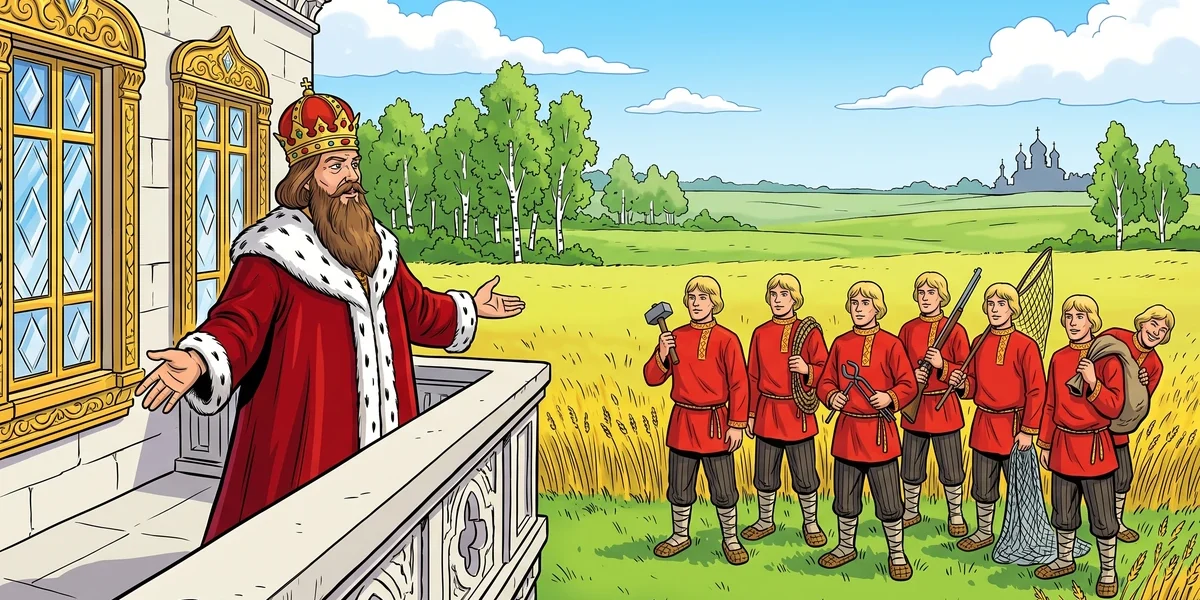
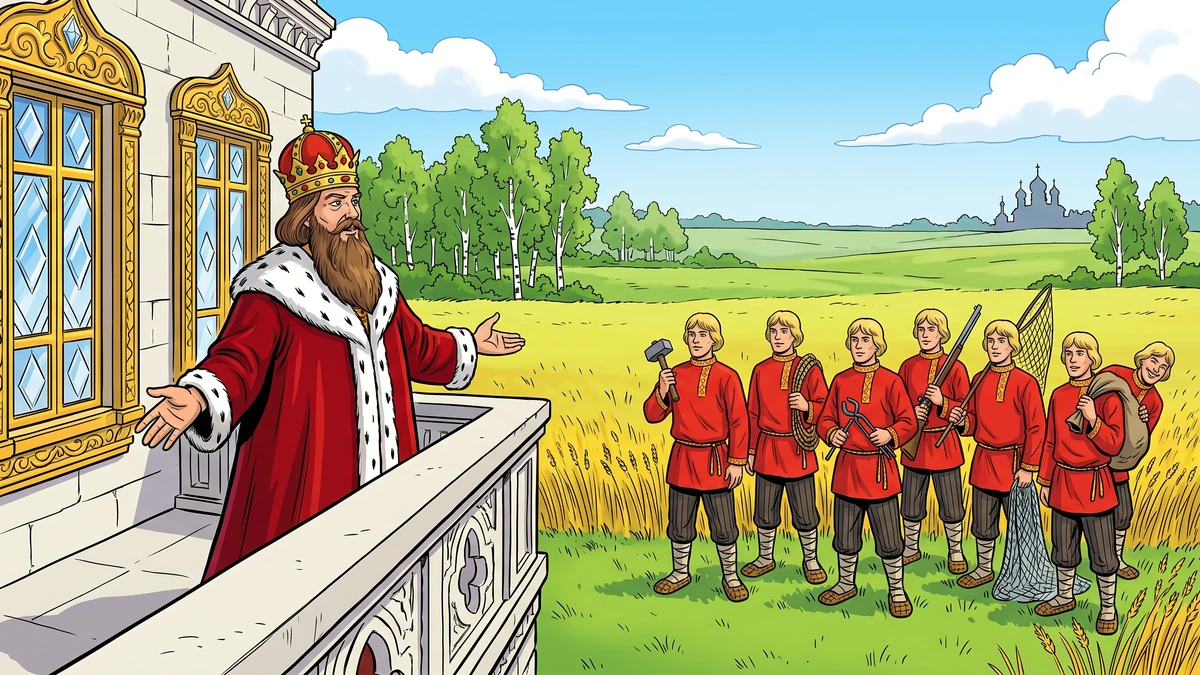
Driven into the open country by the restlessness that gnaws at all unmarried tsars, Archidei rode out to hunt with falconers and grooms. The horns of the chase sounded over the steppe, but his thoughts followed no quarry. At length he reined his horse on the crest of a low rise and looked down on a field where the wheat stood so ripe and golden that the wind through it sounded like a quiet bell. “Whoever ploughs such ground,” the Tsar said, “feeds my whole tsardom.” His outriders galloped to ask, and presently brought back seven young men in red rubakhas with gold galloon at the collar — seven brothers, all named Simeon, identical in feature, fair-haired, ruddy-cheeked, eating black rye bread and onions and drinking cold spring water at the field’s edge.
This image — seven identical brothers seated on the boundary of a productive field — is one of the great visual signatures of East-Slavic folklore. In Afanasyev’s transcriptions, the brothers are never given personal names beyond “Simeon,” because they are not individuals so much as a single peasant collective with seven specialised hands. The name itself is significant: Simeon derives from the Hebrew Shim’on, “the one who hears,” and in Russian Orthodox tradition the saint Simeon Stylites was the patron of those who stood watch from high columns — a detail that anticipates the first brother’s trade. Russian narrators understood the resonance, even if they could not have explained it: a tale about watching, building, diving, and seizing is woven through the very names of its heroes.
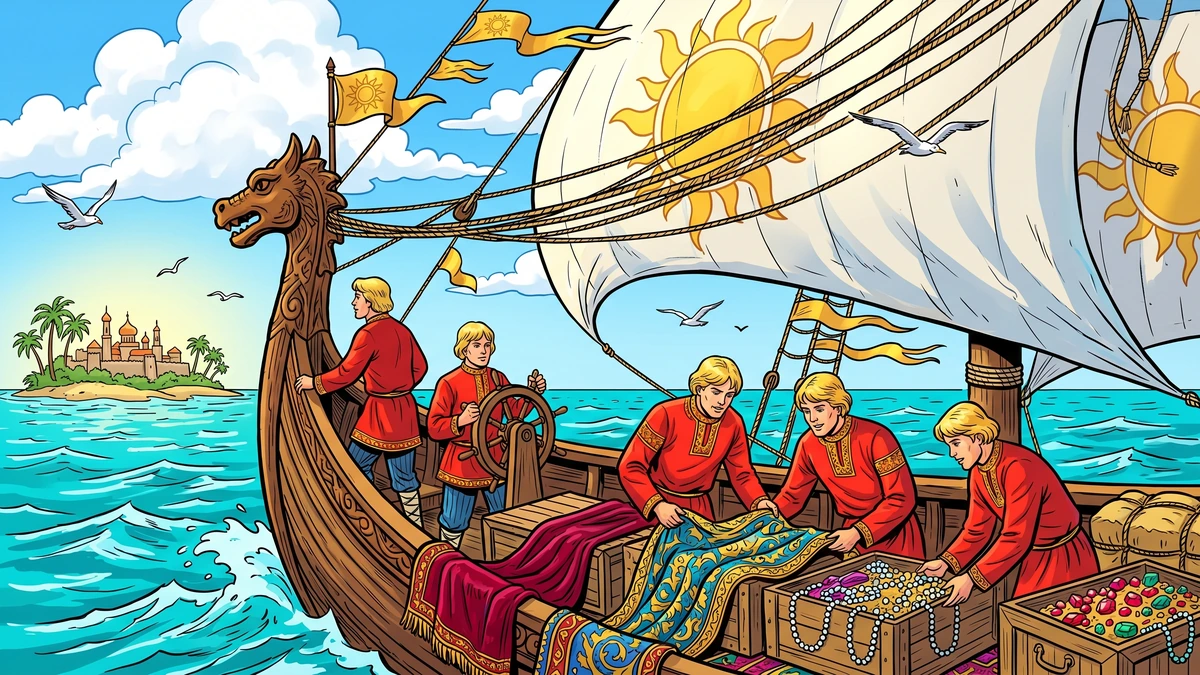
When the Tsar asked each brother his trade, the answers tumbled out with the practised humility of village craftsmen. The first Simeon would build a white stone column rising past the clouds. The second would climb that column and report on every kingdom under the sun. The third could fashion a ship faster than any vessel ever built. The fourth could plunge that ship beneath the waves and bring it up dry. The fifth was a blacksmith whose self-aiming musket would never miss its bird. The sixth could catch whatever fell from sky, sea, or forest before it touched the ground. And the seventh — the youngest, the beloved — was a thief, the kind for whom no lock was real and no treasure unreachable. Russian listeners would have understood at once that this was not a list of supernatural gifts but a catalogue of the peasant guilds that built the Russian state: kamenshchik (stoneman), kuznets (smith), plotnik (shipwright), okhotnik (hunter), and the shadow-trade that every village whispered about but never named aloud.
The Column to the Sky and the Vision of Helena
The Tsar’s anger at the seventh brother’s confession is a famous moment — and a moment the storyteller designs as a small parable in itself. Archidei threatens iron chains and a dungeon “where no sunny ray ever penetrates,” but the seventh Simeon answers with one of the oldest peasant proverbs in the Russian moral lexicon: «Не тот вор, кто крадёт, а тот, кто подсказывает» — “He is no thief who steals, but the one who instigates the theft.” The proverb is older than the tale; Afanasyev recorded variants of it in his separate collection of Russian sayings, and it survives in colloquial speech to this day. Russian listeners would have nodded knowingly — the brother had not committed the theft of which he was capable, and Russian customary law (the Russkaya Pravda of Kievan times) had long held that capacity is not crime. The Tsar relents to imprisonment without execution — the first sign that this story will turn on mercy as much as on cleverness.
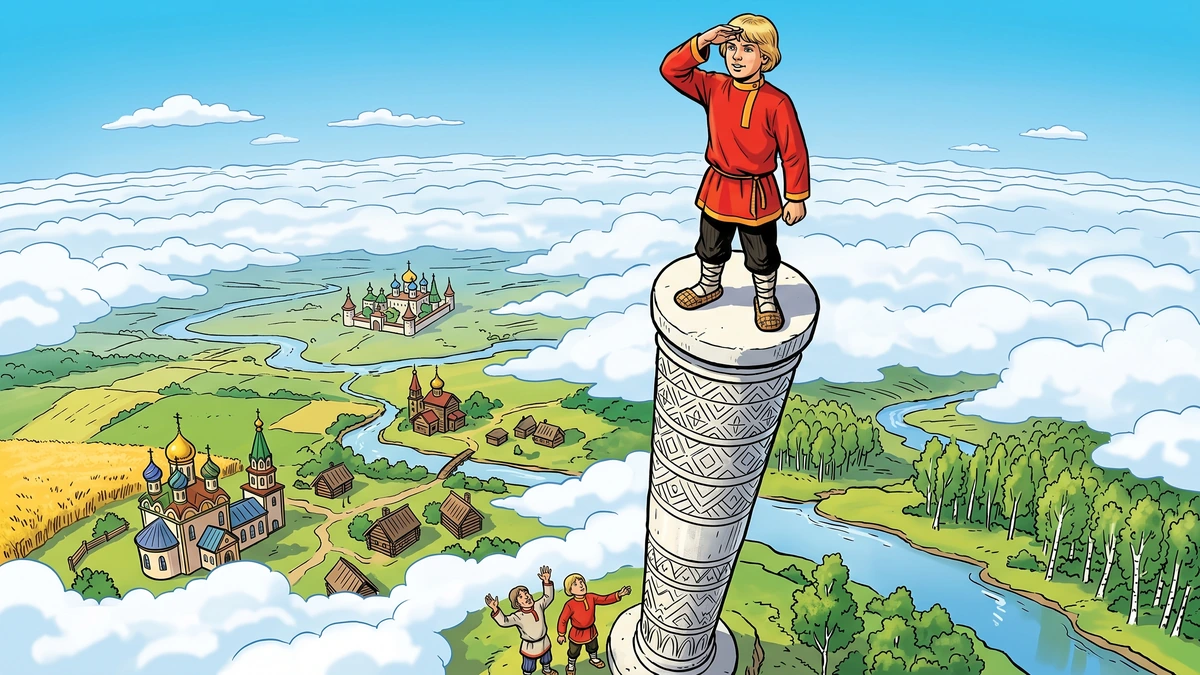
While the seventh Simeon sat in the dark, his elder brothers built their wonders for the court. The first raised his white column “as high as the great planets, the smaller stars beneath it, and from above the people seemed to be like bugs” — a hyperbole that Russian narrators delivered with the same straight face they used for chicken-legged huts and self-folding tablecloths. The second climbed and reported every war, every coronation, every wedding under the sun, “with deep secrets, surprising secrets, which made the Tsar smile.” Then, prompted by news of the Princess Helena of the Island of Buzan — daughter of a proud and merciless king, beauty unrivalled, suitor list empty — the Tsar fixed his desire and his diplomatic dilemma: Buzan lay ten years’ sail away, the king refused all envoys, and Helena would be a withered queen before any ordinary ambassador could return.
This dilemma — bride beyond a sea, father beyond persuasion — is the engine of countless East-Slavic tales. It appears in The Frog Princess, in Marya Morevna, in the Bylina cycles around Sadko and Vasilisa. Russian scholars from Vladimir Propp onward have identified it as the central “difficult task” of the bride-quest tale (Propp’s Function 25 in his Morphology of the Folktale). What makes the Seven Simeons distinctive is that the resolution comes not from a single heroic prince but from a collective — seven peasant brothers acting as a single mechanism. The Russian word artel, which described seasonal labour-bands of carpenters and dockworkers, is the social structure the tale dramatises.
The Voyage to Buzan and the Theft of the Princess
The court fool — a stock figure of medieval Russian comedy, the shut in his striped cap and many bells — supplies the solution the wise advisers cannot. “Have you already forgotten the seventh Simeon?” he shouts, jingling his cap. The chains come off, the dungeon door swings open, and the youngest brother walks out blinking into the light of a problem that fits his trade exactly. The five brothers — the column-builder and column-climber remain behind as hostages of good faith — load the wonder-ship with Venetian velvets, Persian rugs, brocades, pearls, and gems “such as had never been seen in Buzan.” The voyage that should take ten years takes seven days. The seventh Simeon’s stratagem is the cleverest thing in the tale: not violence, not sorcery, but shop window.
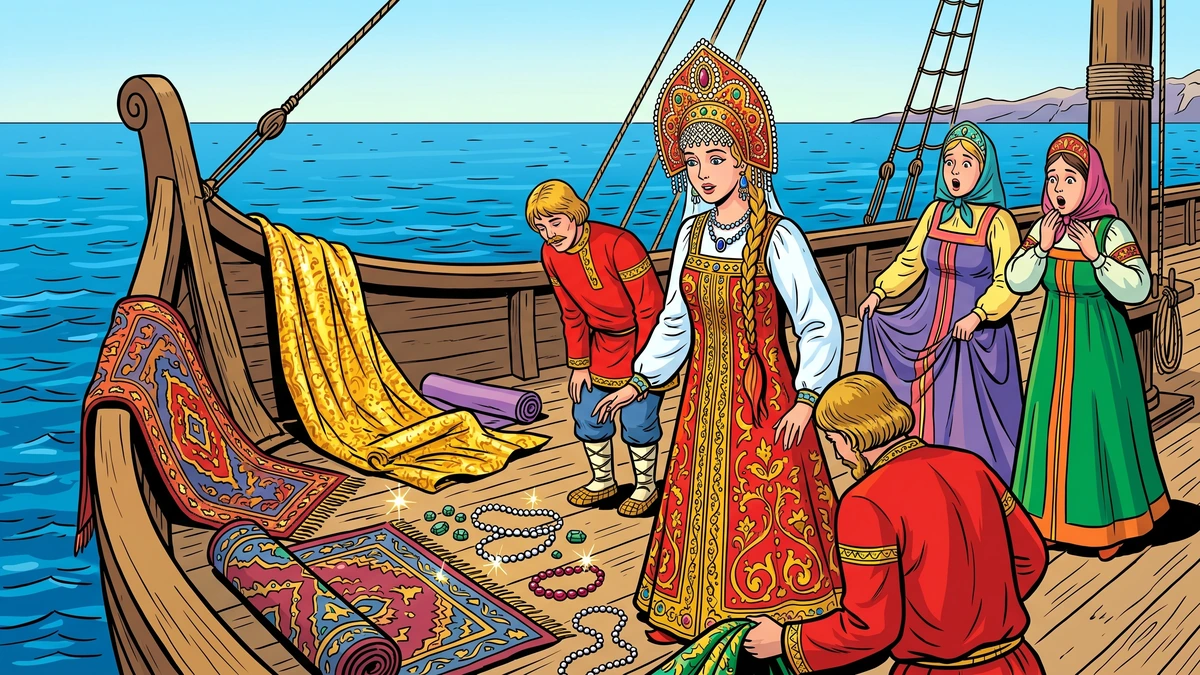
At Buzan the brothers anchor like peaceful traders and unfurl their goods. Princess Helena, watching from her terem — the upper-storey women’s chamber of medieval Russian palaces, where unmarried noblewomen lived in elaborate seclusion — sends her nurses to investigate. The seventh Simeon flatters and feigns: the goods on shore, he says, are mere trifles for serving-maids; the truly precious cargo remains aboard, lest the princess find it unworthy. The lure is exquisite, because it appeals not to greed but to connoisseurship. Helena, who has refused princes and emperors, cannot refuse the chance to evaluate. With her father’s reluctant permission and an escort of a thousand armed warriors, she boards the merchants’ ship — and at the moment when she is most absorbed in unfolding a length of brocade, the fourth Simeon snaps the prow and the entire vessel slides into the dark of the deep sea.
The detail of Helena’s three transformations on the homeward voyage — first to a white swan, then to a silver fish, then to a small mouse — is one of the oldest motifs in Indo-European folklore. It appears in Greek myth (Proteus, Thetis), in Celtic tales (the children of Lir), in the Welsh Mabinogion (Gwion Bach and Ceridwen), and in dozens of Russian variants collected by Afanasyev. Folklorist Stith Thompson catalogued it as motif D610 (“repeated transformation”), and the order of forms — bird, fish, small land animal — encodes the three realms (air, water, earth) the tale-hero must master. The fifth Simeon’s silver bullet, the sixth Simeon’s swift hands, are the peasant equivalents of the divine prophet who outpaces shape-shifting in the older myths. Russian villagers may not have known the comparative folklore, but they recognised the structural elegance of three transformations matched by three artisans.
The Wedding, the Reward, and the Peasant Refusal
When the ship returns to Archidei’s harbour, the Tsar comes out himself to meet the captive princess — and here the tale performs one of the small moral pivots that makes it more than an adventure. Archidei does not present Helena with a fait accompli. He tells her: “Though I admire thee, I do not want to separate thee from thy father. Say the word and my faithful servants will take thee back to him.” Russian narrators always lingered on this line, because it transforms the theft into a courtship. Helena chooses to stay. The wedding feast is prepared. Envoys carry a letter back to the king of Buzan — written in the princess’s own hand — asking his fatherly blessing. The king, who had been preparing the executions of his fool guards, halts the headsman’s axe and sends his blessing instead. The story refuses to end in war, refuses to end in grief, refuses even to end in spite. It ends in a wedding.
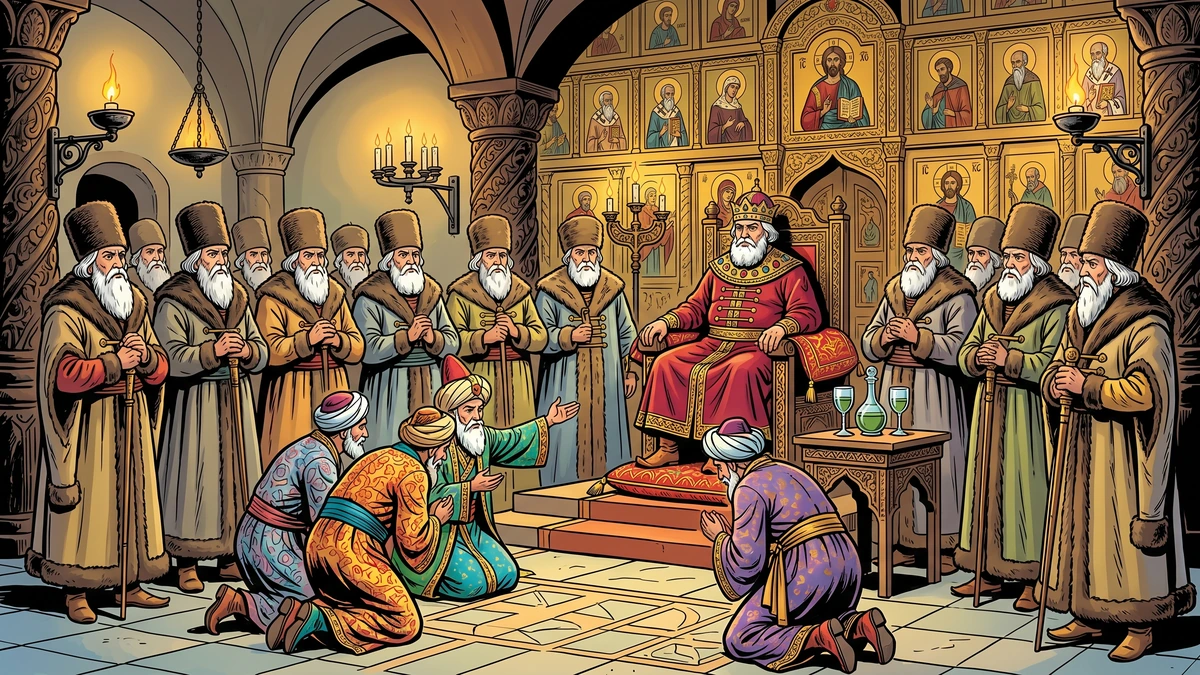
The final scene is the one that gives the tale its moral weight. Tsar Archidei summons the brothers and offers them anything in his power: noble titles, governorships, towns of their own, treasuries of gold. The first Simeon answers for all seven: “We are simple people and simple are our ways. It would not do for us to become boyars or governors. We do not care for thy treasures either. We have our own father’s field, which shall always give us bread for hunger and money for need.” They ask only three things: protection from corrupt judges, the Tsar’s word as their only court of appeal, and the pardon of their thieving youngest brother. They drink a tumbler of green wine, bow, and return to the wheat field where the story found them.
This refusal is the heart of the Russian peasant ethic. The brothers do not climb out of their class; they remain ploughmen by choice. The artel serves the Tsar and goes home. Afanasyev, who collected the tale in the 1860s amid the great debates over Alexander II’s emancipation of the serfs, understood this ending as a quiet political statement: that the peasant’s dignity lay not in promotion but in the land. Russian readers in the late nineteenth century — Tolstoy, Leskov, the early Chekhov — read Seven Simeons as a defence of the peasant commune (obshchina) and of artisanal labour against the absorbing ambitions of the imperial state.
Moral
«Ремесло не коромысло, плеч не оттянет, а само прокормит.» — “A trade is no yoke that drags the shoulders down; it feeds the man who carries it.”
— Russian peasant proverb, recorded in Afanasyev’s Russian Folk Sayings, 1862.
The tale’s moral is not the kind a single character delivers in a closing speech. It is delivered by the structure of the story itself. Seven men, each with one humble skill, accomplish together what no king, no army, and no single hero could accomplish alone. The column-builder is useless without the climber; the shipwright is useless without the diver; the marksman is useless without the catcher; and all six are useless without the thief who knows how to flatter a princess into stepping aboard. Russian listeners absorbed this lesson early. It is the lesson of the artel, of the obshchina, of the village barn-raising and the spring sowing — that the smallest skill, joined to six others, is enough to fetch a princess from the end of the world. Pride accomplishes nothing; cooperation accomplishes everything; and the wise man, having accomplished everything, goes home to his own field.
Why This Tale Has Lasted
The Seven Simeons has outlived empires. The tsardom that the tale described — Muscovy of the seventeenth century, with its boyars and its terems and its merchant fleets on the White Sea — was swept away first by Peter the Great’s westernising reforms, then by the Romanov dynasty itself, then by the Soviet revolution, then by the collapse of the Soviet Union. Through all of it, peasant grandmothers told the story of the seven brothers to their grandchildren, and Russian children of every generation grew up knowing that a person’s worth is measured not by the prestige of their trade but by the willingness with which they place it at the service of others.
The tale’s enduring power rests on three pillars that modern readers can still feel. First, the comedy of specialisation: there is something genuinely funny about a man whose only skill is climbing pillars, or about a sixth brother whose entire trade is catching things that fall. The humour is never cruel — Russian narrators clearly loved each brother — but it gently mocks the idea that any single human being is universally competent. Second, the romance of cooperation: the tale offers a deeply satisfying picture of what a working team looks like when each member trusts every other. Third, the dignity of refusal: in a world that constantly invites peasants, workers, and immigrants to abandon their origins for promotion, the brothers’ decision to return to the wheat field has a moral force that survives translation. Nikolai Rimsky-Korsakov, who composed his opera Семь Симеонов (1916) on this libretto, kept the ending exactly as Afanasyev recorded it, because he understood that the refusal of titles was the climax of the story, not the wedding.
For modern Indian families discovering the tale, the parallels with home-grown Indian stories are immediate. The Panchatantra‘s brothers who pool their skills, the Jataka cycles of artisan-bodhisattvas, the Akbar–Birbal stories of clever ministers — all share the conviction that the worth of a person is measured in the worth of what they can make, and that the highest virtue lies in making it for one’s neighbours. The Russian forest and the Indian river-bank produce different costumes for the same wisdom, and the meeting of the two traditions — Slavic snow and Gangetic warmth — across the page of a folk tale collection is a small reminder that the human imagination has fewer borders than the human passport. The Seven Simeons sit down at the same dinner table as the brothers of the Mahabharata, the panditas of the Jataka, and the wise fool Birbal. They are all hungry, and they all have something to teach.
You May Also Like
 Russian Folk Tales
All Ages
Russian Folk Tales
All Ages
Ivanoushka The Simpleton
Ivanoushka The Simpleton: [Illustration] In a kingdom far away from our country, there was a town over which ruled the Tsar Pea with his Tsaritza Carrot.
 Russian Folk Tales
Ages 9-12
Russian Folk Tales
Ages 9-12
The Golden Mountain
The Golden Mountain: [Illustration] Once upon a time a merchant’s son had too much fun spending money, and the day came when he saw himself ruined; he had
 Russian Folk Tales
Ages 9-12
Russian Folk Tales
Ages 9-12
The Snow Maiden (Snegurochka)
The Snow Maiden (Snegurochka): In a remote village at the edge of the great Russian forests, where winter lasted longer than summer and snow lay thick upon the