The Golden Mountain
The Golden Mountain: [Illustration] Once upon a time a merchant’s son had too much fun spending money, and the day came when he saw himself ruined; he had
Russian Original: «Золотая гора» (Zolotaya Gora) — “The Golden Mountain.” A classic Russian wonder-tale of the merchant’s ruined son, the iron-beaked crows, the gold-bearing summit and the magical flint and touchstone. The story belongs to the small but vivid group of волшебные сказки (wonder-tales) in which a Russian hero is sewn into the carcass of a slaughtered horse and carried to an inaccessible mountain-top by birds of prey.
Canonical Source: Verra Xenophontovna Kalamatiano de Blumenthal, Folk Tales from the Russian (A. C. McClurg & Co., Chicago, 1903), tale VIII (chapter 8) of the nine-tale collection — the same volume that supplied the Baba-Yaga, Dimian-the-Peasant, and Woe-Bogotyr re-tellings already published on this site. Blumenthal’s Russian originals are drawn from the great mid-nineteenth-century gathering of folklore by Alexander Afanasyev, Народные русские сказки (Narodnye russkie skazki / Russian Folk Tales), 8 vols., St Petersburg, 1855–1863, where the parallel tale appears as no. 243 («Золотая гора») in the third volume of the canonical 1873 edition.
Tale-Type Classification: The story is catalogued in the Aarne-Thompson-Uther index as ATU 936* “The Gold Mountain”, a sub-type of the wider ATU 935 (“The Prodigal’s Return”) family. In the East-Slavic SUS catalogue (Сравнительный указатель сюжетов восточнославянской сказки, Leningrad 1979) it appears as SUS 936* («Золотая гора»), with eighteen recorded Russian variants. The central motifs — the hero sewn into a horse-hide and carried up by birds, the false-master who feeds workers to the carrion-eaters, the magical flint summoning helpers — are classified in Stith Thompson’s Motif-Index of Folk-Literature as N776 (“Light seen from tree (mountain) at night guides hero to adventures”), K963 (“Rope cut and victim dropped” family), B552 (“Man carried by bird”), and D1470.1.15 (“Magic flint provides helpers”).
Cultural Frame: A pure Russian волшебная сказка of the merchant-class — the genre that flourished in Russia’s river-port towns and trade-fair cities, where the storytellers were neither court poets nor peasant grandmothers but the travelling clerks, sailors and apprentices of the great merchant houses. The hero is not Ivan the Tsarevich and not Ivan the Fool but a third Russian type: купеческий сын, the merchant’s son — the young man of trade rather than of throne or plough. The treasure is not a magical bird and not a kingdom but heavy, weighable gold; the villain is not a Tsar and not a dragon but a richer, prouder fellow merchant. It is in every respect a tale of the marketplace, told for an audience that understood credit, debt, ships and ruin.
Once upon a time, or perhaps not so very long ago at all — the Russian storyteller, in the patient manner of all Slavic wonder-tales, refuses to fix the date — there lived in a busy Russian port-town a merchant’s son who had been given everything and had wasted it all. His father, the storyteller hints in a single brisk line, had been a man of substance; the son, having inherited the warehouses, the rubles and the good name, had spent the lot in the pleasures of a young man with too much money and too little sense. By the time the tale opens he has reached the end of the road. The house is empty. The cellar is empty. He himself, in the storyteller’s blunt phrase, has “nothing to eat, nothing to drink.” And so — this is the small, hard moment that every Russian folk-tale audience would have recognised — he picks up a shovel and walks down to the market square to see if any householder will hire him for the day.
The picture is precise. A shovel was the badge of the day-labourer in the Russian provincial town; a young man standing in the square with a spade across his shoulder was advertising that he had no other trade to sell. He had come down, in the merciless economic vocabulary of the period, from купеческое звание (the merchant estate) to чёрный труд (black labour, manual day-work). The fall was both visible and humiliating, and the storyteller does not dwell on it. He merely opens the door of the tale and lets the morning sun show us the merchant’s son standing alone at the corner of the marketplace, waiting.
A Hundred Rubles a Day — The Bargain in the Marketplace
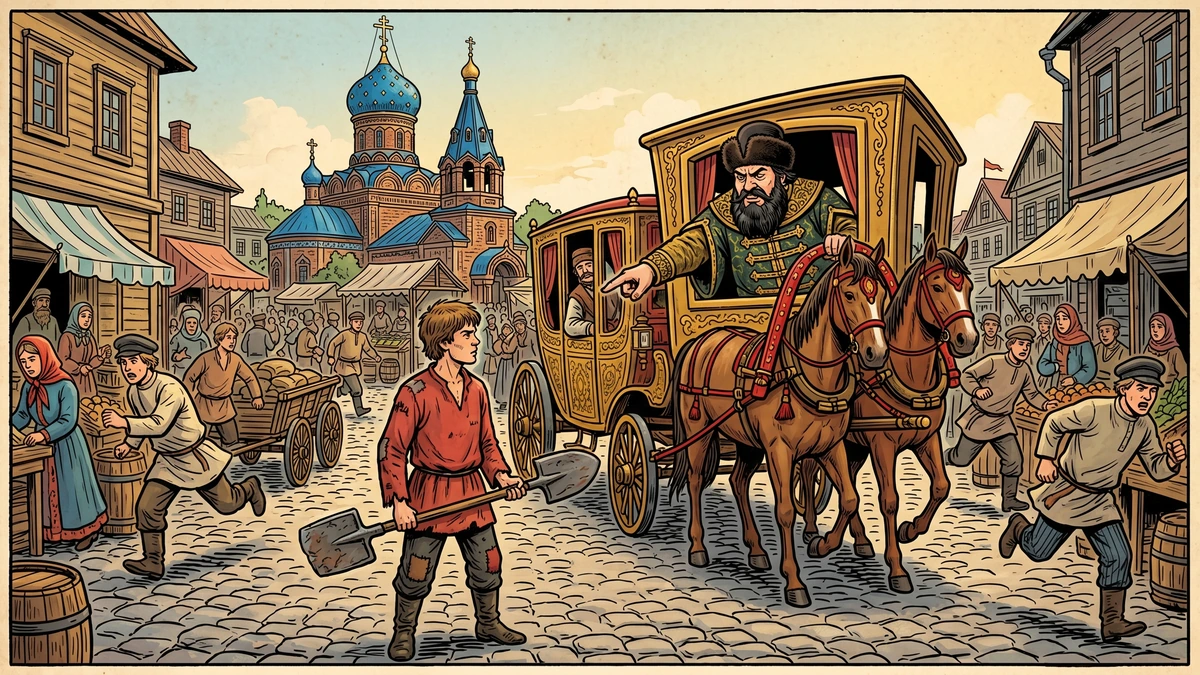
A gilded carriage rolls into the square. Inside it sits another merchant, a man “rich, proud, worth many, many thousands,” a familiar figure on every market-day in nineteenth-century Russia — the first-guild merchant, the купец первой гильдии, his gold-thread sash visible through the carriage window. Yet the moment his servants pull up to the corner where the day-labourers wait, every other able-bodied young man in the square turns on his heel and disappears between the buildings. They have heard of him before. They know what happens to the men he hires.
Only the ruined merchant’s son remains, partly out of need and partly out of pride. The proud, rich merchant calls down from his carriage in the courteous archaic Russian Blumenthal preserves: “Dost thou look for work, good fellow? Let me hire thee.” The bargain that follows is brief and pointed, and it sets the moral tone of the whole tale. The young man names a price — one hundred rubles a day — an outrageous figure by the standards of a normal Russian labourer, who in 1855 might have earned twenty kopeks for a day’s digging. The rich merchant raises his eyebrow: “Why so much?” The young man’s answer is the central proverb-line of the opening section: “If too much, go and look for someone else; plenty of people were around, and when they saw thee coming, all of them rushed away.”
It is one of the great economic moments in Russian folklore. The young man has read the marketplace correctly: a buyer whose price has driven away all the sellers is a buyer whose work cannot be safe. He has named, in a sentence, the truth of capitalism in its rawest village form — that danger commands a premium. The rich merchant pays the price without argument. “All right. To-morrow come to the landing place.” And the trap closes for the first time, in the gentlest possible way, on the merchant’s son who has just sold himself for a fortune to a man who has used the same fortune ninety-nine times before to buy ninety-nine corpses.
The Island, the Golden Palace, and the Daughter’s Gift
The next morning the ship sails. The Russian wonder-tale is very economical with geography: the storyteller does not tell us which sea, which port, which direction. He tells us only that they journey “for quite a long time” and then sight an island — the standard fairy-tale topography of unreachable plenty, the kind of island that recurs from Sindbad to Saint Brendan to the Hebrides folk-tales of Scotland. On this particular island there rise “high mountains,” and near the shore something seems to be burning. The young man, salt-spray on his face, points and says: “Yonder is something like fire.” The merchant’s reply is one of the most haunting lines in all of Afanasyev: “No, it is my golden palace.”
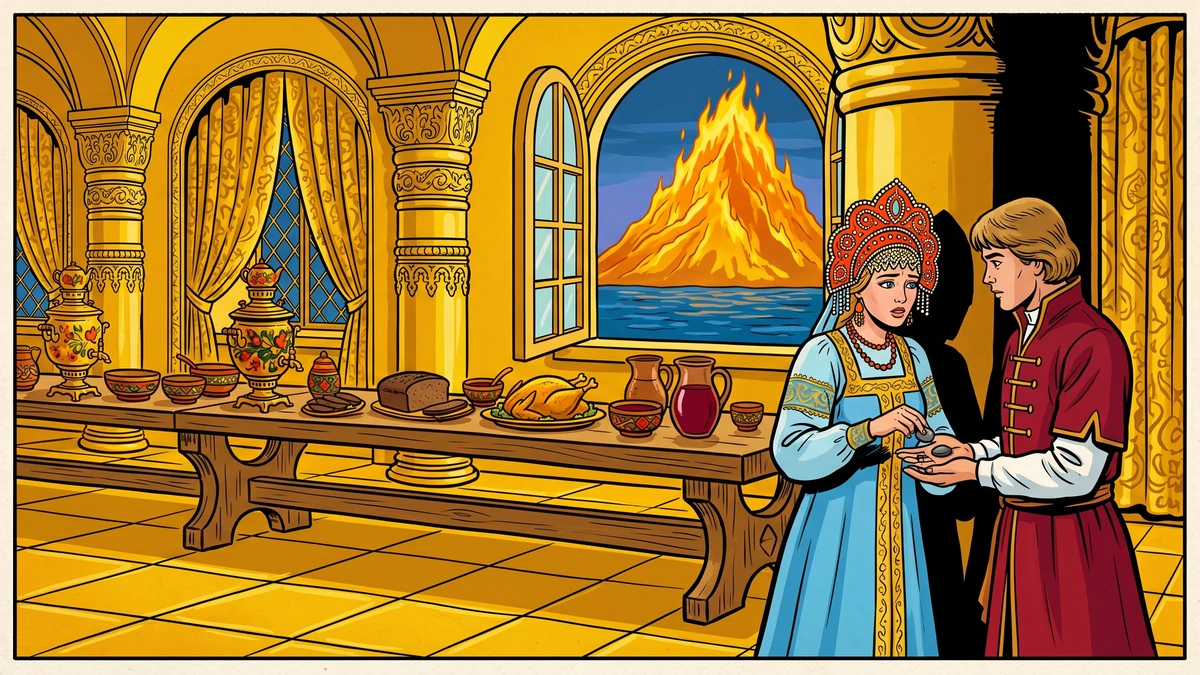
The Russian audience would have caught the resonance at once. In the East-Slavic folk imagination, gold is not coloured yellow — it burns. The Firebird’s feathers burn. The golden hut of the Tsarevna burns. The flame-rooster of Vladimirskaya legend burns on its perch. The merchant’s palace seen from the deck of the approaching ship is not gilded woodwork glinting in the sun; it is gold itself, mountain-high and incandescent, the kind of wealth that does not need the sun to shine. And the family that comes out to meet the boat — the rich merchant’s wife and the merchant’s daughter, “a lovely girl, prettier than you could think or even dream of” — are the human counterpoint to that glow. The mother smiles. The daughter, when she sees the new workman, looks at him with the quick, careful attention of a young woman who has watched ninety-nine such workmen come and not return.
The family sit at the oak table; the dishes come out; the kvass and the wine are poured; the storyteller spares us the menu but lets us feel the generosity. “One day does not count,” the rich merchant says expansively, the courteous Russian formula «один день не в счёт» — “let us have a good time and leave work for to-morrow.” But underneath the hospitality the daughter is already moving. She catches the young man’s eye, slips out of the room, and with the smallest gesture — made him a sign to follow her — she draws him into the dim outer hall. There, without explanation, she presses two small dark stones into his hand: a touchstone and a flint. “Take it,” she says. “When thou art in need, it will be useful.”
The Russian audience, again, would have understood at once what they were watching. The touchstone-and-flint motif is one of the oldest in the East-Slavic wonder-tale repertory; the magic flint that summons two helpers is catalogued in Afanasyev under D1470.1.15 of the Thompson Motif-Index, and parallel versions appear in Russian, Ukrainian, and White-Russian collections from the 1860s onward. The lovely daughter has not betrayed her father in any obvious way: she has not warned the workman, has not named the danger, has not described what is to come. She has done something more delicate. She has given him, in two cold stones, the means of his own escape, and trusted him to be clever enough to use them when the moment comes. It is the kind of help a folk-tale heroine is allowed to give — deniable, oblique, indispensable.
The Drowsy Drink, the Horse’s Carcass, and the Iron-Beaked Crows
Morning. The rich merchant and his new workman set out for the foot of the golden mountain. The mountain itself is, in the storyteller’s blunt diagnosis, impossible: “The young fellow saw at once that there was no use trying to climb or even to crawl up.” The sides are sheer; the summit, where the gold lies in heaps under the open sky, is unreachable to any man on foot. And this is where the rich merchant’s system, perfected through ninety-nine previous workmen, comes into operation.
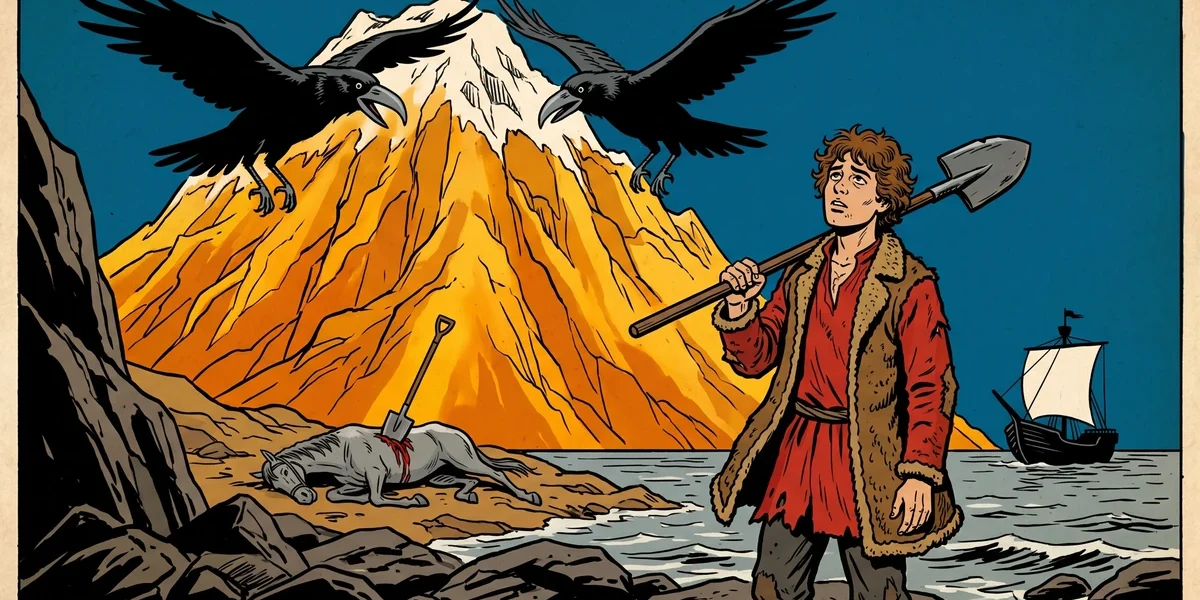
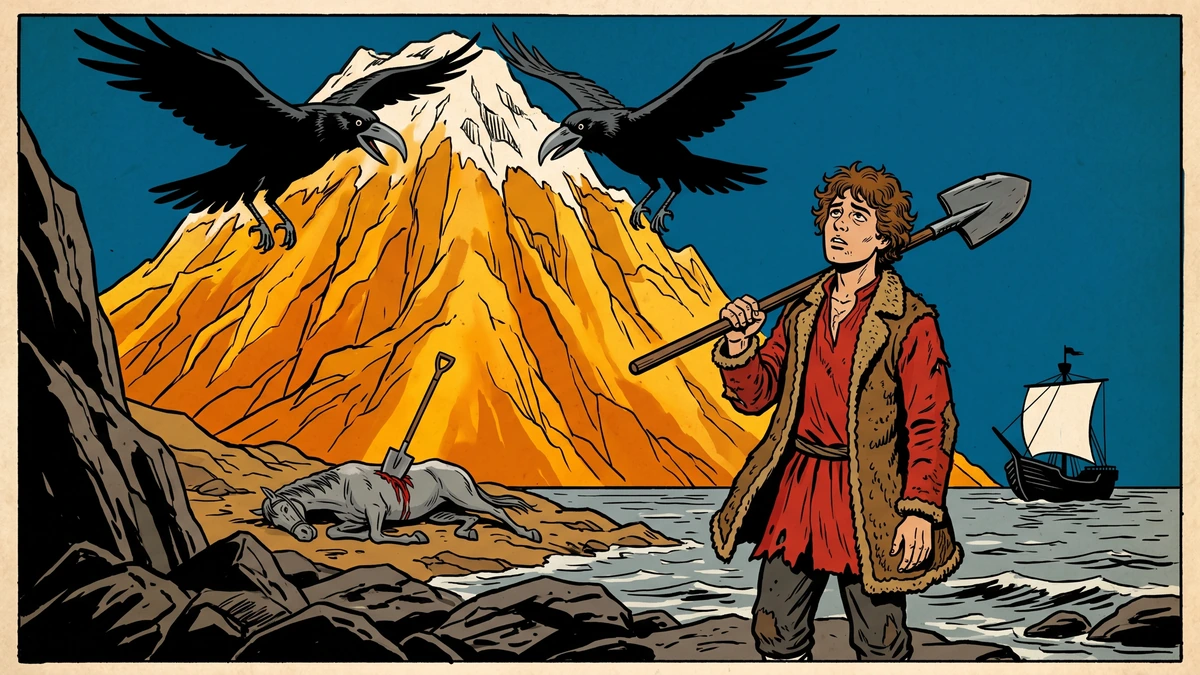
“Let us have a drink for courage,” he says, and pours out a tumbler of сонное зелье — literally “sleepy potion,” a drowsy drink, the standard treachery-tool of Russian wonder-tale villains from Koschei to the Sea-Tsar. The merchant’s son swallows it down and falls heavily asleep. The merchant works fast. He has done this before. He kills a wretched horse — the worn-out nag he has brought for exactly this purpose — slits its belly with a sharp knife, pushes the sleeping young man and the shovel into the cavity, sews up the hide with practised stitches, and withdraws into the bushes at the foot of the mountain to wait.
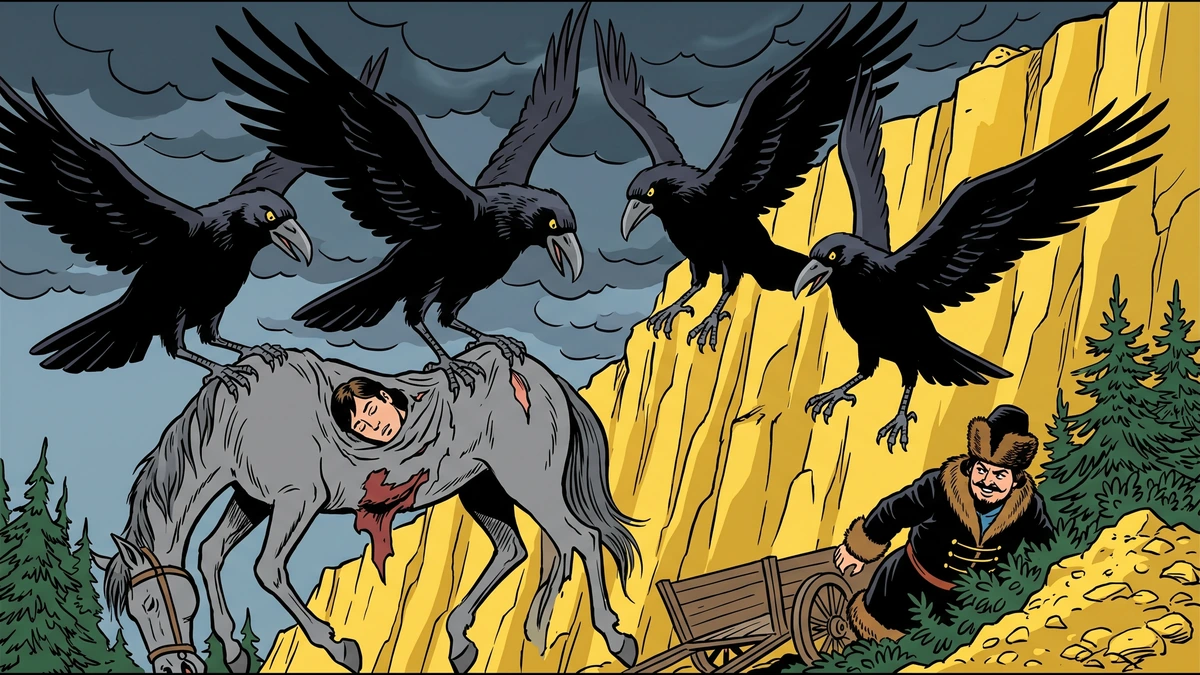
The wait is brief. The sky darkens. Down come the crows — not ordinary crows but чёрные вороны с железными клювами, “black crows with iron beaks,” a creature that lives only in Russian folklore, half raven and half hammer, the carrion-eater of the Golden Mountain. They seize the horse-carcass in their iron talons, beat their wings against the still air, and lift the entire burden — horse, hidden shovel, drugged passenger — up the impossible cliff to the gold-glittering summit. There they settle and begin, with the slow industry of carrion-birds, to pick the flesh from the bones.
The crows have already eaten through the horse-hide and are about to start on the merchant’s son when he wakes. He pushes the birds back — the storyteller gives us this gesture in a single thrilling line — sits up among the ribs of the dead nag, and looks around in the daylight at the heap of glittering metal underneath his hands. “Where am I?” he calls down. And the merchant’s voice rises faintly from the foot of the cliff: “On a golden mountain. Take the shovel and dig for gold.” The young man digs. He digs and digs. Every spadeful he throws down the mountainside, and at the bottom the merchant scoops it into the carts — load after load, cart after cart, the wealth of an island finally yielded up to the man who has paid a hundred rubles a day for it.
“Enough!” the merchant finally calls. “Thanks for thy help. Farewell!” The young man, exhausted at the top of the impossible cliff, calls down the question that every audience has been waiting to hear: “And I — how shall I get down?” The merchant’s answer is the cruellest sentence in the tale, and it is the sentence on which the whole moral economy of the story turns. “As thou pleasest. There have already perished nine and ninety of such fellows as thou. With thee the count will be rounded and thou wilt be the hundredth.” And the rich merchant, with his twelve loaded carts of golden ore, climbs into his gilded carriage and is gone.
The young man stands on the summit with the iron-beaked crows circling. He has been bought. He has been used. He has been left to die. And in this moment of utter ruin — this is the precise hinge of every Russian wonder-tale — the storyteller pauses to let the hero remember. “The fellow tried to think how it all happened, and he remembered the lovely girl and what she said to him in giving him the touchstone and the flint. He remembered how she said: Take it. When thou art in need it will prove useful.”
The Stone, the Flint, and the Revenge of the Hundredth Workman
He takes the touchstone and the flint out of his pocket. He strikes them together. And there, on the mountain-top among the bones of the horse and the wheeling crows, two brave young fellows materialise out of nowhere — the storyteller does not pause to explain them, and his audience does not need an explanation. “What is thy wish? What are thy commands?” they ask. “Take me from this mountain down to the seashore,” says the merchant’s son. And in the next sentence they are there. The two helpers vanish as quickly as they came; the daughter’s gift, used once, has done its work.
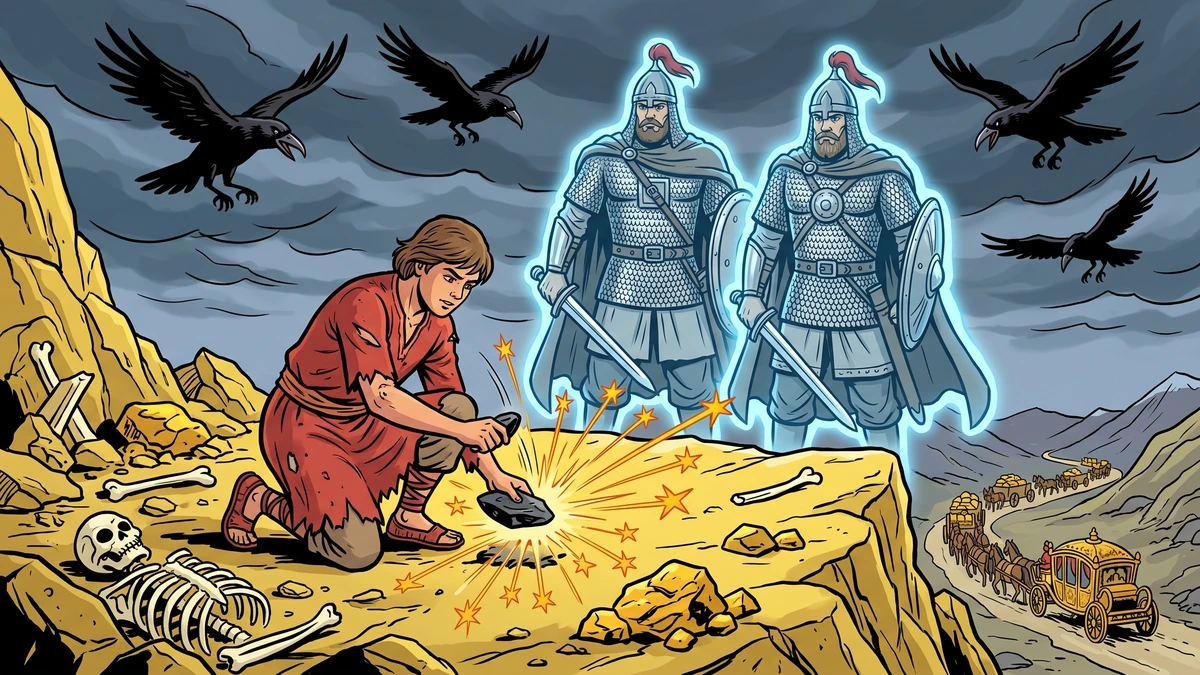
On the shore the young man hails a passing ship. The sailors first refuse him: “No time to stop!” they shout back, sailing past. But the winds rise. The storm grows heavy. The sailors, looking at the lone figure standing on the impossible beach of the golden island, suddenly suspect that “this fellow over there is not an ordinary man.” They put the helm about, land, take him aboard, and through some shift in the weather that the storyteller does not explain, bring him safely home to his native port. The Russian audience would have heard the religious undertone in that detail too: a stranger refused passage, a storm, a reversal of the sailors’ minds, a safe landfall — the Russian peasant ear, steeped in Orthodox iconography, would have caught the echo of Jonah and the merchants of Tarshish, and accepted it without comment.
Time passes. The storyteller, in the standard formula, refuses to date it: “It was a long time, or perhaps only a short time after — who could tell?” One morning the merchant’s son takes up his shovel and walks down to the market square again. The same gilded carriage rolls in. The same young men of the town scatter at the sight of it. The same proud, rich merchant calls down from the carriage window the same question: “Will you be my workman?” And the merchant’s son, who is no longer ruined and no longer young in the way he once was, answers in the precise voice of the trickster: “I will at two hundred rubles a day. If so, let us to work.” The merchant raises an eyebrow. “A rather expensive fellow.” The trap closes for the second time — on the other man.
The Bargain Reversed — A Hundredth Crow-Meal
They sail. They land. The first day passes in the same wine-soaked hospitality. On the second morning, master and workman walk to the foot of the golden mountain. The merchant, smiling, reaches for the bottle of drowsy drink. “Before all, have a drink.” And here the merchant’s son delivers the gentle reversal that turns the whole tale around. “Wait, master. Thou art the head; thou must drink the first. Let me treat thee this time.” The Russian courtesy is exact: the senior man drinks first, the host drinks first, the master drinks first. The merchant, vain as he is, cannot refuse without admitting the trap.
And so the merchant drinks. The drowsy drink — which the young man, who has spent the voyage preparing it, has substituted for the master’s own — takes effect at once. The merchant slumps and falls into the deep, heavy sleep he has so often used on others. The merchant’s son does precisely what he has watched the older man do. He slaughters a miserable old horse, slits its belly, pushes the sleeping merchant and the shovel inside, sews the hide together, and steps back into the bushes.
Down come the iron-beaked crows. Up goes the horse, up goes the merchant inside it, up the impossible cliff to the gold-blazing summit. The crows begin their patient work. The merchant wakes among the bones, looks here and there and everywhere, and shouts down the question every one of his ninety-nine victims must have shouted: “Where am I?”
And the young man’s answer comes calmly up the cliffside: “Upon the golden mountain. Now if thou art strong after thy rest, do not lose time. Take the shovel and dig.” The merchant, by his own logic, has no choice. He digs. He digs and digs. Twelve heavy carts of gold are filled at the foot of the cliff. The merchant’s son loads them onto his wagons. And then, in the only quotation of the tale that the audience has been waiting two hours to hear, he shouts the merchant’s own line back to him: “Enough! Thank thee, and farewell!”
“And I?” calls down the merchant in the rising voice of someone who suddenly understands. “And thou mayst do as thou wishest. There are already ninety and nine fellows perished before thee; with thyself there will be a hundred.” The storyteller delivers the closing sentence with the satisfaction of an executioner who has put the right man in the right place. The merchant’s son drives the twelve laden carts back to the golden palace; he marries the lovely girl who once pressed the flint into his hand; she becomes mistress of all her father’s wealth; the new couple moves to a great city to live in honour. “And the rich merchant, the proud, rich merchant? He himself, like his many victims, became the prey of the black crows, black crows with iron beaks. Well, sometimes it happens just so.”
Moral — The Pit You Dig For Another
«Не рой другому яму — сам в неё попадёшь.»
“Dig no pit for another — you will fall into it yourself.” — the classical Russian proverb that distils the moral of Zolotaya Gora; recorded in V. I. Dahl, Пословицы русского народа (Proverbs of the Russian People), Moscow 1862, under his section on «Кара — Гроза» (Punishment and Vengeance), the great peasant proverb-collection contemporary with Afanasyev’s Narodnye russkie skazki.
The moral of the Russian tale, like every truly old peasant moral, works on more than one level at once. On the simplest level it is a warning against the greed of the strong who feed on the weak. The proud merchant has not stolen his wealth from strangers in distant kingdoms; he has built it, ruble by ruble, on the bodies of ninety-nine poor Russian boys whose only fault was that they needed work. The audience understood this very clearly. In nineteenth-century Russia the line between the comfortable trader and the ruined day-labourer was thin and unforgiving, and a man could cross it in a single harvest. The tale is, in part, the labourer’s revenge fantasy: the hundredth boy who carries away the gold and marries the daughter and leaves the boss for the crows.
On a second level the tale is a precise piece of moral arithmetic. Notice how perfectly the story balances. The merchant pays one hundred rubles a day; he has killed exactly ninety-nine men. The merchant’s son names two hundred rubles a day — doubling the price exactly as he doubles the revenge. The first cart-train is loaded by the master’s system; the second cart-train, twelve carts of gold, is loaded by the same system against its inventor. Every step of the second half of the story is a mirror of the first half. This is not slapdash. It is the patient symmetry of an oral story that has been told thousands of times by Russian sailors and apprentices and clerks, and has been shaved down by repetition into a perfect geometric punishment.
On a third and deepest level the tale teaches a piece of Russian Orthodox folk-wisdom that runs through all of Afanasyev: that pride builds its own snare, and that a man who turns his fellow human beings into raw material will, sooner or later, be turned into raw material himself. The crows do not care which body they pick. The mountain does not care which workman digs. The merchant’s system — impersonal, repeatable, profitable — is the very thing that destroys him when, for the first time in a hundred bargains, a workman uses the system against the master. Pride dug the pit. Pride fell in.
Historical and Cultural Context
The Russian wonder-tale of the merchant’s son and the golden mountain belongs to a small but distinctive sub-genre of Afanasyev’s collection: the купеческие сказки, or merchant-tales, distinct from both the Tsar-and-Tsarevich tales of the high волшебные сказки and the peasant-and-Baba-Yaga tales of the village. The merchant-tales are characteristically set in port-towns and on islands, deal in gold and credit and contracts rather than in kingdoms and brides, and reflect the world-view of the Russian merchant estate that emerged after Peter the Great and flourished through the eighteenth and nineteenth centuries. Afanasyev gathered them especially from the Volga and from the northern Russian timber-trade towns of Vologda, Arkhangelsk, and Onega, where ships, sailors, and merchant clerks were a daily presence and a constant subject of village conversation.
The motif of the hero sewn into a horse-hide and carried by birds to a treasure-mountain is one of the oldest narrative units in Eurasian folklore. It appears, in slightly different costume, in the Second Voyage of Sindbad (where the giant Roc carries the merchant to the Valley of Diamonds, and the diamonds stick to the meat thrown by the watching jewellers below); it appears in the Hungarian and Romanian Iron-beaked-bird tales; it appears in Caucasian variants from Georgia and Armenia in which the carrion-eaters are eagles. The Russian variant is unusually grim. In Sindbad the merchants at the foot of the diamond-mountain are partners in a regular trade; in Zolotaya Gora they are murderers, and the mountain-top is a charnel-house littered with the bones of ninety-nine previous victims. It is one of Afanasyev’s darkest tales.
Verra Xenophontovna Kalamatiano de Blumenthal (1860–1944), whose 1903 translation we follow, was a Russian émigrée in Chicago who set herself the task of bringing the Afanasyev material to American readers in the slightly biblical, slightly antique English that English-speaking children of the period associated with fairy-tale telling: “Dost thou look for work?” — “Yonder is something like fire” — “Farewell!”. She translated nine tales, of which The Golden Mountain is the eighth and the longest. The book was illustrated by E. Boyd Smith and was reprinted three times between 1903 and 1914; it has been kept alive in the Sacred Texts Archive and the Project Gutenberg digital editions, from which the present re-telling has been re-checked against the Russian originals in Afanasyev’s third volume.
The proverb that closes our re-telling — «Не рой другому яму — сам в неё попадёшь» (“Dig no pit for another, you will fall into it yourself”) — is recorded in Vladimir Ivanovich Dahl’s vast Пословицы русского народа (Proverbs of the Russian People, Moscow 1862), assembled by Dahl from thirty thousand peasant proverbs gathered across the Russian Empire in the same years that Afanasyev was assembling the parallel collection of folk-tales. The proverb has a direct ancestor in the Old Slavonic Psalter, Psalm 7:15 (“He hath digged a pit and dug it deep, and shall fall into the hole he hath made”) and in the Book of Proverbs 26:27 — a sign of the deep absorption of Old Testament moral language into the everyday speech of Orthodox Russia. To the Russian peasant of 1860 the tale of the golden mountain was an illustration, vivid as a woodcut, of a proverb he had heard since childhood.
Parallel Russian variants exist. In a Vologda version recorded by N. E. Onchukov in 1908 the rich merchant is a Tatar khan and the mountain is silver, not gold; the iron-beaked crows are eagles. In a Don Cossack version the hero is a soldier returned from the wars rather than a ruined merchant’s son; the magical flint is replaced by a Tatar talisman the hero picked up at the siege of Azov. In a Belorussian variant the hero kills the merchant outright at the foot of the mountain rather than sewing him into a horse-hide. The Blumenthal version, which follows Afanasyev’s 1873 printing closely, is the cleanest and the cruellest of all the surviving Russian texts — one reason it is the version that has travelled best into the English-speaking world.
Why This Story Has Lasted
It has lasted, in the first place, because of the iron-beaked crows. The Russian imagination is famously rich in monstrous birds — the Firebird, the Sirin, the Alkonost, the eagle of Vladimir — but the iron-beaked crows of the Golden Mountain are something different. They are not magical. They are not symbolic. They are the practical machinery of murder. They lift the carcass. They strip the bones. They feed the merchant’s system. They are the dark counterpart of the angelic helpers who answer the flint, and they linger in the memory of the listener long after the gold-piles and the carriage and the daughter have faded from view. Generations of Russian grandmothers, telling this tale to children at bedtime, paused to make the “kraah, kraah” of the iron beak striking the horse-skin — and the children, even today in Soviet-era recordings of village storytellers, pull their blankets a little higher.
It has lasted because the geometry is so perfect. Few wonder-tales achieve the exact one-to-one mirror of Zolotaya Gora: the same shovel, the same horse, the same drowsy drink, the same gilded carriage, the same iron-beaked crows, the same ninety-nine victims, the same farewell. The hero of the second half does not invent a single new method. He simply re-uses the master’s own, and that is what gives the ending its terrible justice. Russian peasant audiences, who lived inside a deeply hierarchical society of bosses and servants, would have recognised the satisfaction of the symmetry at once. The master’s method, properly applied, ate the master.
It has lasted, finally, because of the storyteller’s last sentence. “Well, sometimes it happens just so.” In Russian, «Так-то вот, бывает и так.» It is the dry, peasant shrug of a narrator who has watched a great deal of life and is not surprised by any of it. He does not say the wicked are punished. He does not say the gods are just. He says only that sometimes, when a man has dug a pit for ninety-nine of his neighbours, the hundredth neighbour walks up the road, accepts the bargain at twice the price, and rolls the same stone over the same pit with the proud merchant inside. Sometimes it happens just so. The storyteller closes the door of the tale, and the iron-beaked crows go on with their work above the golden mountain — one carcass cleaner than another, but in the end all the same colour of bone.
You May Also Like
 Russian Folk Tales
Ages 9-12
Russian Folk Tales
Ages 9-12
The Firebird and Princess Vasilisa
The Firebird and Princess Vasilisa: In the days when the world was young and magic flowed through forests like rivers of starlight, there lived a great Tsar
 Russian Folk Tales
All Ages
Russian Folk Tales
All Ages
Father Frost
Father Frost: [Illustration] In a far-away country, somewhere in Russia, there lived a stepmother who had a stepdaughter and also a daughter of her own.
 Russian Folk Tales
Ages 9-12
Russian Folk Tales
Ages 9-12
The Three Kingdoms: Gold, Silver, and Copper
The Three Kingdoms: Gold, Silver, and Copper: Long ago, when the earth was still young and caves held wonders beyond counting, there lived a noble prince named