The Frog Princess: A Tale of Love and Redemption
The Frog Princess: A Tale of Love and Redemption: In the days when magic still dwelt in the forests of ancient Russia, there lived a noble archer named Ivan
“The Frog Princess: A Tale of Love and Redemption” — in the original Russian «Царевна-лягушка», romanized Tsarevna-lyagushka, literally «Princess-Frog» — is one of the foundational volshebnye skazki (wonder-tales) of the East Slavic tradition. The redaction printed here belongs to the continuation-variant of the type, the version in which the hero’s impatient burning of the frog-skin throws the bride into the power of Koschei the Deathless (Кощей Бессмертный) and obliges Ivan Tsarevich to journey through the three metallic kingdoms of gold, silver and copper to redeem her. The base text descends directly from Aleksandr Nikolayevich Afanasyev (1826–1871), Народные русские сказки (Narodnye russkie skazki, “Russian Folk Tales”), eight volumes, Moscow & St. Petersburg, 1855–1863, the canonical corpus that did for Russian folklore what the Brothers Grimm did for German. In the standard three-volume scholarly redaction edited by V. Ya. Propp (Moscow: Goslitizdat, 1957–1958), the three frog-bride variants are numbered 267, 268 and 269; the textual continuation into Koschei’s kingdom appears most fully in variant 269, recorded by Afanasyev from a Kursk peasant storyteller. The international classification is ATU 402 – “The Animal Bride” in the Aarne–Thompson–Uther index (Hans-Jörg Uther, The Types of International Folktales, FFC 284–286, Helsinki 2004, vol. I, pp. 235–237), here paired with ATU 400 – “The Man on a Quest for His Lost Wife” and ATU 302 – “The Ogre’s Heart in the Egg”, and is the type-tale for SUS 402 + 400 + 302 in the East Slavic Folktale Catalogue compiled by Lev Barag, Yuri Berezovsky, Konstantin Kabashnikov and Novikov (Leningrad: Nauka, 1979). Stith Thompson’s motif-index (Bloomington, 1955–1958) catalogues the chain under B604.1 (Marriage to frog), D195 (Transformation: man to frog), D721.3 (Disenchantment by destroying skin), C30 (Tabu: offending supernatural relative), E711.1 (Soul kept in egg), and E765.3.1 (Life dependent on egg in box, box in duck, duck in hare, hare in iron casket on oak). The principal English-language translations against which any modern retelling is measured are W. R. S. Ralston, Russian Folk-Tales (London: Smith, Elder & Co., 1873); Leonard A. Magnus, Russian Folk-Tales (London: Kegan Paul, 1916); Post Wheeler, Russian Wonder Tales (London & New York: A. & C. Black / Century, 1912); and above all the magisterial Russian Fairy Tales, translated by Norbert Guterman with folkloristic commentary by Roman Jakobson and illustrations by Alexander Alexeieff (New York: Pantheon Books, 1945, repr. 1973), the volume that carried Vasilisa Premudraya, Koschei Bessmertnyi and Baba Yaga into the modern English literary imagination.
I. Three Arrows in the Morning Sun
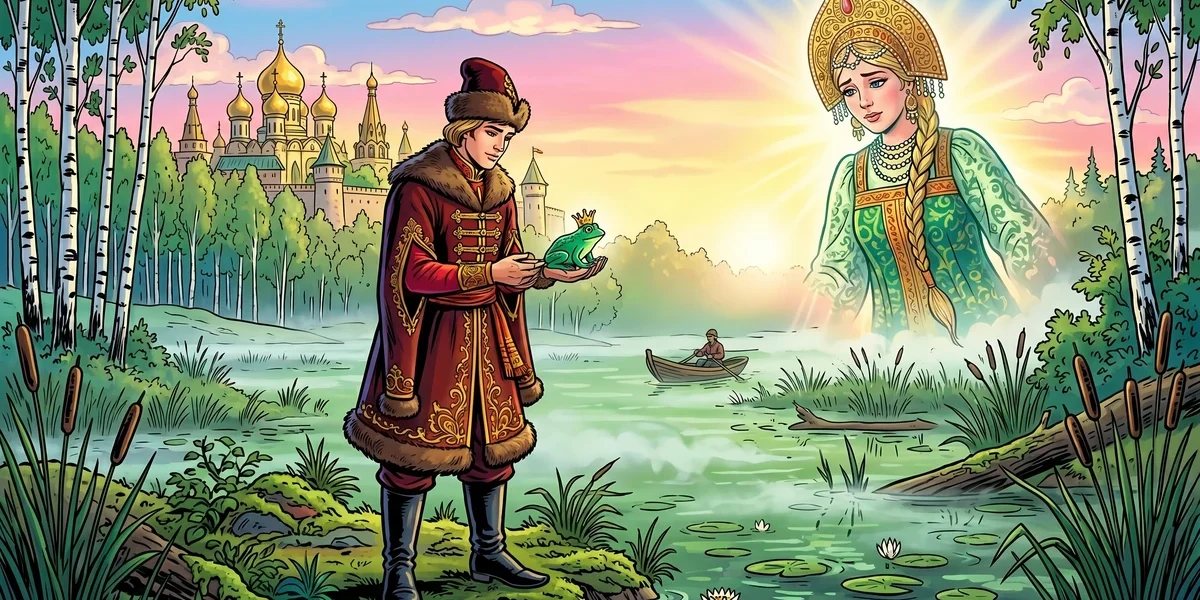
The tale opens with the oldest and most archetypal of Indo-European folktale openings: a sovereign with three sons, the youngest of whom is destined for the marvellous. The tsar of an “old, old Russian tsarstvo” — a kingdom outside historical time — commands his princes to draw their bows and let the wind decide their brides. The first arrow lands at the high tower of a boyar’s daughter; the second at the painted gallery (krasnoe kryl’tso) of a wealthy merchant; the third hisses past the cultivated lands, past the village fields and the birch-edge of the great forest, and falls into a green bog where it is caught by a frog upon a mossy stone. The arrow-shoot is no idle ritual but a survival of the very ancient Slavic ordeal of Sud’ba – Fate – the great impersonal power that, above even Perun and Mokosh, was thought in pre-Christian Slavic religion to choose the marriages no human could choose for himself. W. R. S. Ralston in 1873 (pp. 119–122) drew the cognate line from this opening through the Greek Apollodorus and the Vedic Atharva-Veda (Book III, Hymn 25), where the arrow is the marker of divine election in the betrothal rite. Vladimir Propp, in his epoch-making Морфология сказки (Morphology of the Folktale, Leningrad: Academia, 1928 – the first thirty-one-function structural analysis of narrative ever attempted, decisively translated by Laurence Scott for Indiana University in 1958), classified the arrow-shoot as a fused μ-element: simultaneously the test of the hero (function XII), the marker of magical lack (function VIIIa), and the threshold of departure (function XI). Ivan’s resistance to the croaking bride — “How can I marry the frog? Is she my equal? Certainly she is not” — is, in Propp’s later Исторические корни волшебной сказки (The Historical Roots of the Wonder Tale, Leningrad: LGU, 1946, ch. IV), the irreducible Slavic instance of ravnodushnaya gordost’, “indifferent pride,” which the marvellous bride must always break before her true form can emerge. The father’s reply, simple and absolute, anchors the whole metaphysical premise of the tale: takaya yavno tvoya sud’ba — “such is evidently your destiny.” In the Slavic world-view a sworn betrothal is a cosmic contract, not a romantic preference; the comedy of the croaking bride is, at root, the gravest of theological propositions about who chooses whom.
II. The Three Royal Tasks and the Burned Skin
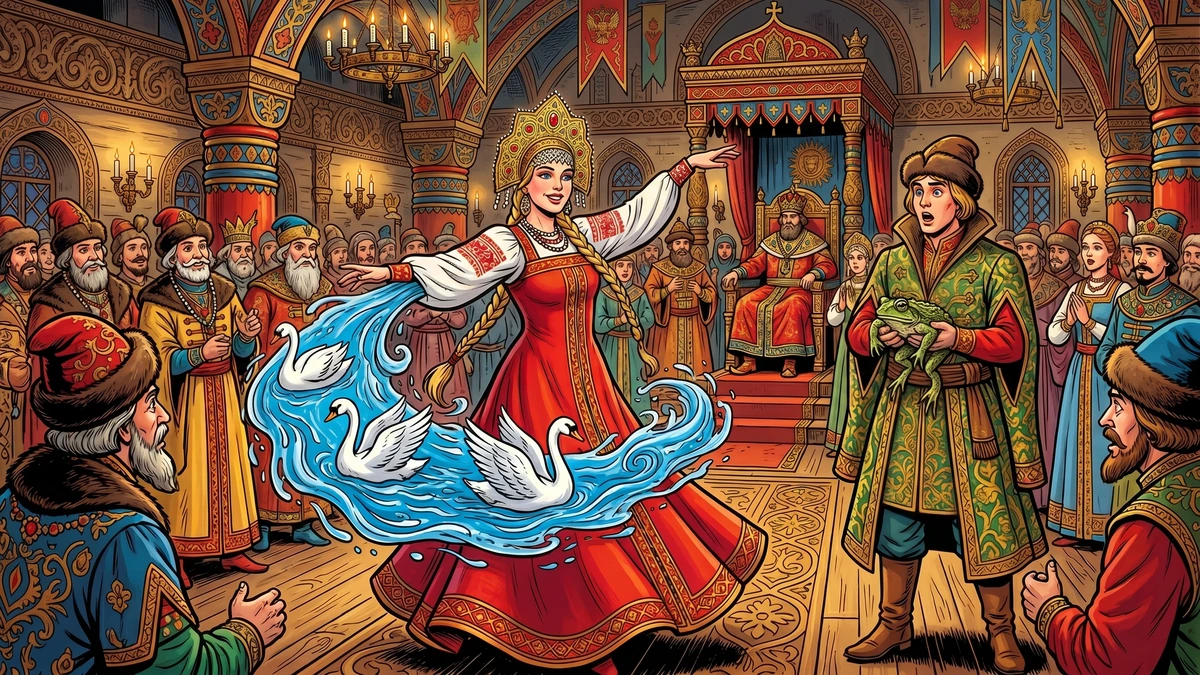
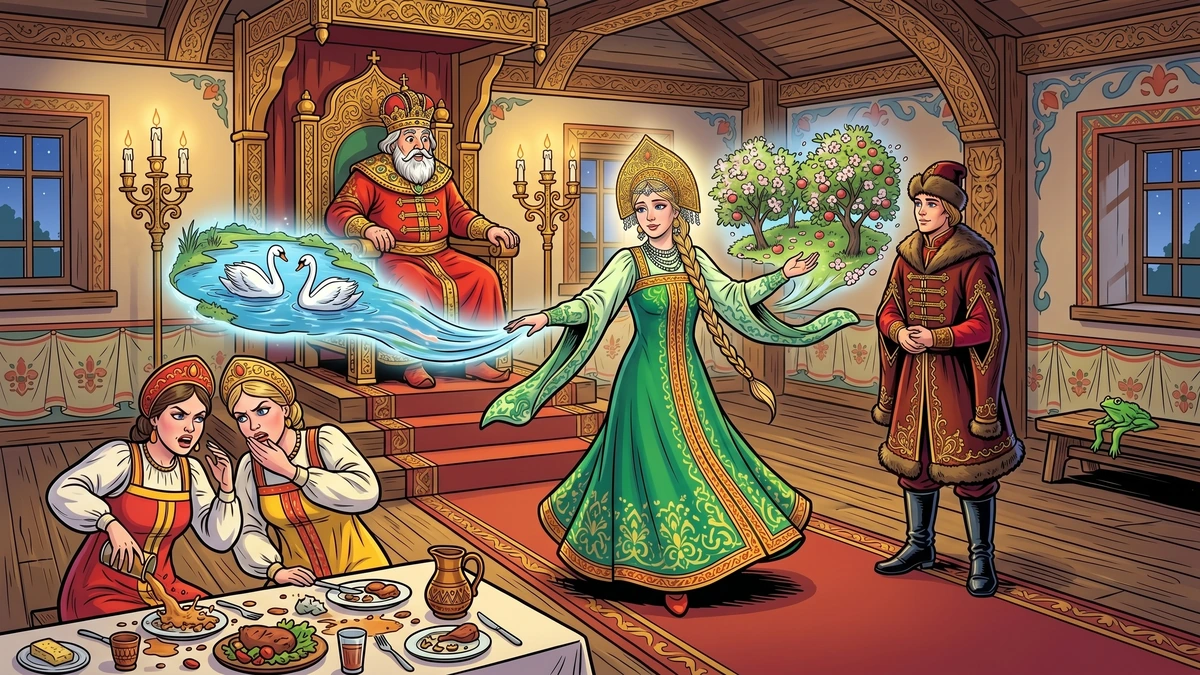
The body of the tale unfolds as a triple ordeal in which the sovereign tests his three daughters-in-law. Each night the frog sheds her warty skin in the apartments of Ivan Tsarevich and steps out as Vasilisa Premudraya (Василиса Премудрая, “Vasilisa the Wise” — not to be confused with Vasilisa Prekrasnaya, the Beautiful, the heroine of Afanasyev No. 104 in a different sub-cycle). Her recurring counsel — «Ложись, Иван-Царевич, спать; утро вечера мудренее», “Lie down to sleep, Ivan Tsarevich; the morning is wiser than the evening” — is one of the most quoted lines in the Russian language; it appears verbatim across all three Afanasyev variants and entered Russian proverbial speech long before any version was written down (see V. I. Dahl, Толковый словарь живого великорусского языка, Moscow 1863–1866, s.v. утро; and his earlier Пословицы русскаго народа, Moscow 1862, p. 24). The first ordeal is the baking of bread: while the boyar’s daughter and the merchant’s daughter struggle with flour and kneading-trough, Vasilisa whistles up her hidden helpers — «мамушки-нянюшки», “little mothers and little nurses” — and conjures a loaf “on whose sides great cities stood, and in whose centre the tsar’s own palace was raised.” The second ordeal, the weaving of a carpet, produces a textile of silk and gold thread on which “the kingdoms of the East and the West, with rivers and mountains and forests and seas, were shown as in life.” The third and final ordeal is the dancing-ball at court. The frog arrives in a coach drawn by six white horses, lays the bones of her supper in her left sleeve and pours the wine into her right sleeve, and when she dances “she shakes her left sleeve and a lake appears with swans swimming on it; she shakes her right sleeve and a garden grows with apple-trees in bloom.” The magical sleeves are older than the tale: the same cosmogonic gesture by which Mokosh, the Slavic earth-goddess later assimilated to the Bogoroditsa, creates the world in the dualist legends recorded by V. F. Miller (Взгляд на славянскую мифологию, Moscow 1882) and B. A. Rybakov (Язычество древних славян, Moscow 1981, pp. 379–392). The frog-bride is no mere enchanted maiden; she is, in the older substratum of the tale, a survival of the great female deity whom the nineteenth-century storytellers had relegated to a warty skin.
The hinge of the whole tale is then the moment of impatient love. Returning home before his wife, Ivan Tsarevich finds the small frog-skin folded on the bench and, “wishing to bind her to him forever,” casts it into the stove and watches it burn. When Vasilisa Premudraya comes back, the great sorrow falls on her at once: “Oh, Ivan Tsarevich, what have you done? Had you waited but three days more, I should have been yours forever; now I must go far, far away — beyond the thrice-ninth land, into the thrice-tenth tsardom — to Koschei the Deathless.” She turns herself into a white swan and is gone through the window. Roman Jakobson’s commentary to the Pantheon edition (1945, pp. 661–671) reads this scene as the deepest theological moment of the East Slavic wonder-tale tradition: the hero’s fault is not unbelief but the opposite — too eager belief, too possessive a love. The animal skin is the threshold between etot svet (this world) and tot svet (the other world), and to destroy it before the appointed three days is to tear the membrane of cosmos itself. The detail of “three days” is no idle frame: in Russian Orthodox folk theology — and behind it in pre-Christian Slavic eschatology — the soul leaves the body for three days, ascends through the airs for nine, and stands before judgment on the fortieth (see N. I. Tolstoy, Славянская этнолингвистика, vol. III, Moscow 1995, pp. 174–185). What Ivan burns, in Propp’s functional vocabulary (1928, function VIII “Villainy” inverted into VIIIa “Lack”), is the rite of passage itself. The motif catalogued by Thompson as C30 – Tabu: offending supernatural relative has parallels across Norse selkie tradition, Welsh Mabinogion (Rhiannon and Pwyll), Indian Apsara legends, and the Japanese Crane-Wife (Tsuru no ongaeshi); but the Russian frog-skin is the most theologically grave instance because here the impatience is born of love, not contempt.
III. The Three Kingdoms of Gold, Silver and Copper
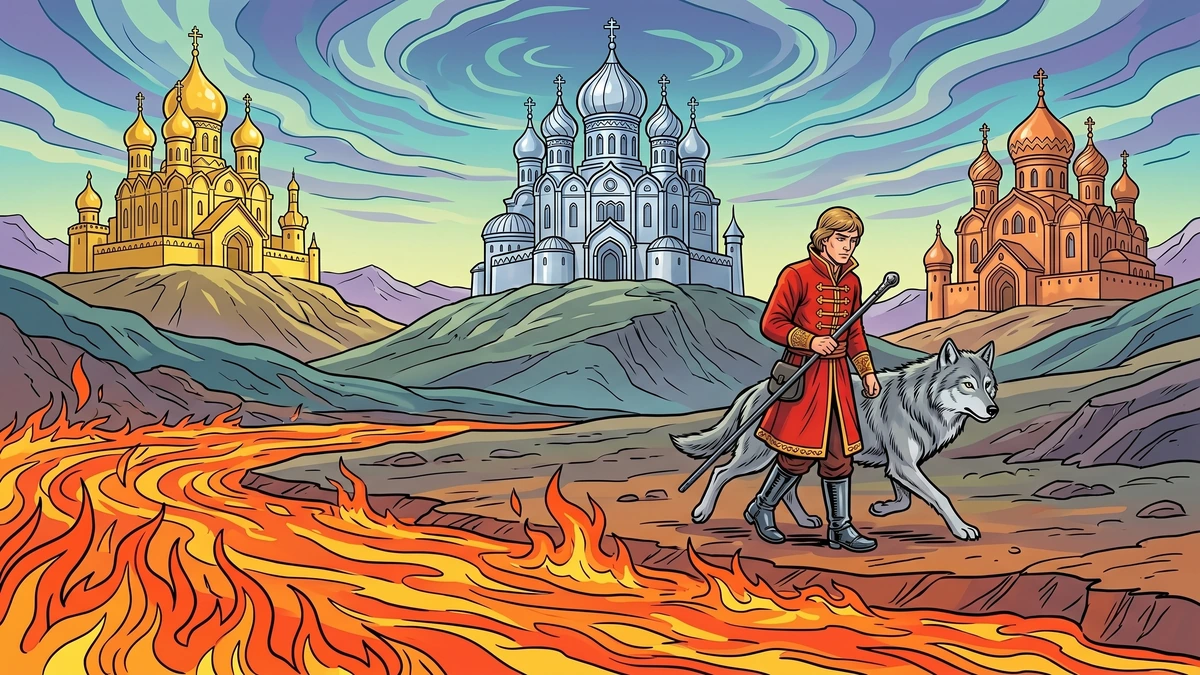
The final movement of the tale carries Ivan Tsarevich out of his father’s palace and into the geography of Russian myth itself. He pulls on iron boots, takes an iron staff and a pouch of black bread, and walks za tridevyat’ zemel’, v tridesyatoe tsarstvo — “beyond the thrice-ninth land, into the thrice-tenth kingdom” — the standard Old Russian folktale formula for the otherworld. On the road he encounters a grey wolf (seryi volk) who offers him his back: “Ride me, young prince, for I too once loved unwisely, and I know the ache of redemption.” The grey wolf is the same psychopomp who guides Ivan in Afanasyev’s parallel cycle Ivan Tsarevich, the Firebird and the Grey Wolf (variants 168–170), and his appearance here links the frog-bride tale to the wider zoological theology of the East Slavic wonder-tale. They cross in succession the Kingdom of Gold, where merchants press upon Ivan riches beyond measure — “all the gold that ever was” — and Ivan replies, “Gold cannot mend a broken promise”; the Kingdom of Silver, where maidens of silver beauty offer him the gift of forgetting and Ivan replies, “Forgetting is a betrayal”; and the Kingdom of Copper, where his own reflection appears and offers him return and peace, and Ivan still refuses. The triple metallic kingdoms are not a romantic flourish but a survival of the Hesiodic-Eurasian Ages-of-Man scheme (Works and Days, lines 109–201), passed eastward through Iranian Avestan mediation and surviving fully in the East Slavic tradition (see Vyacheslav V. Ivanov and Vladimir N. Toporov, Исследования в области славянских древностей, Moscow 1965, pp. 207–212). The triple refusal is the structural inversion of the triple acceptance of riches that destroys lesser heroes in the same corpus; the moral grammar of the tale demands that what was lost through grasping be redeemed only through ungrasping.
At the river of fire (reka ognennaya), the boundary of the dead, Ivan meets the witch of the bone-fence: Baba Yaga (Баба Яга), bone-leg crone of the chicken-legged hut. She tells him the secret known across the Russian wonder-tale corpus: “Smert’ Koshcheeva na kontse igly, igla v yaytse, yaytso v utke, utka v zaytse, zayats v sunduke, sunduk na dube, dub na ostrove Buyane v Okiyane-more” — “Koschei’s death is at the point of a needle; the needle in an egg, the egg in a duck, the duck in a hare, the hare in an iron chest, the chest on an oak, the oak on the island Buyan in the Ocean-Sea.” The nested-death motif (Thompson E711.1, E765.3.1) is one of the oldest layers in Indo-European mythology, with cognates in the Egyptian Tale of the Two Brothers (Papyrus d’Orbiney, c. 1185 BC), the Avestan myth of Yima, the Welsh Mabinogion account of Llwyd ap Cil Coed, and the Indian Brihatkatha of Gunadhya; it survives into the Russian wonder-tale as the iron chain that hides the deathless sorcerer’s mortal point. James G. Frazer treated the type as the locus classicus of the “External Soul” in The Golden Bough, Part VII, vol. II, ch. xi (London 1913). Ivan, with the help of the bear who topples the oak, the hare who catches the inner hare, the drake who seizes the duck, and the pike who finds the egg in the sea, holds at last the needle in his hand. He breaks its point; Koschei stumbles and crumbles to dust; Vasilisa Premudraya runs to her husband; and the two return at last to the tsar’s palace, where Ivan inherits the throne.
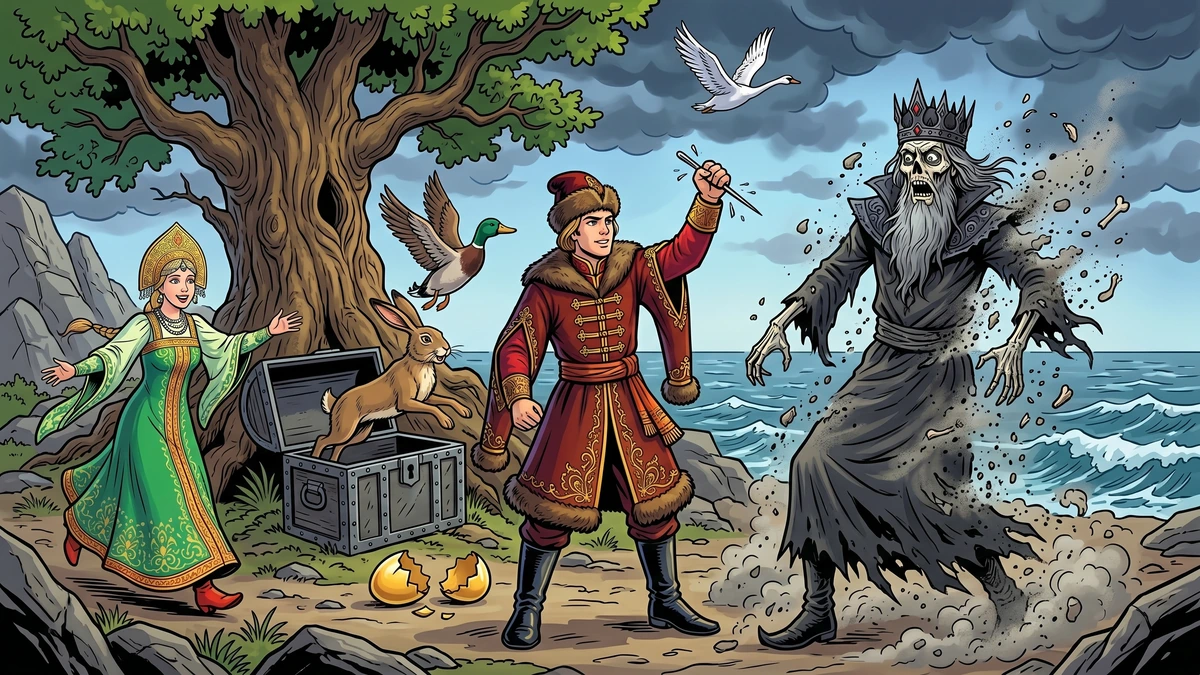
IV. The Moral — Не по хорошу мил, а по милу хорош
«Не по хорошу мил, а по милу хорош.»
“Not loved because beautiful, but beautiful because loved.”
— Russian proverb, V. I. Dahl, Пословицы русскаго народа, Moscow 1862, p. 387 (the closing gloss Russian tellers traditionally append to Tsarevna-lyagushka).
The ethical core of the redemption-variant is not the conquest of Koschei but the truth Ivan finally learns in the iron boots between the burned skin and the broken needle: that the green frog at the swamp-edge was already his beloved, and that love is the gaze that converts the warty skin into the wise sorceress, not the burning that strips it away. Ne po khoroshu mil, a po milu khorosh — “Not loved because beautiful, but beautiful because loved” — is the proverb V. I. Dahl recorded in 1862 and that Russian grandmothers have appended to the tale ever since. It is also, more severely, the lesson of trust: had Ivan waited the appointed three days, the enchantment would have completed itself in his own house, with no journey to the thrice-tenth kingdom, no iron boots worn through to the bones, no bargain with Baba Yaga in the bone-fence yard. The whole long Northern winter of his quest is the price of one impatient evening. To know which loves are still becoming, and to leave them their time to become, is the great difficult wisdom that the Russian tale-tellers stitched into the warty skin of the frog at the swamp’s edge.
Why the Frog Princess Has Lasted
The tale’s grip on Russian and world imagination is older and deeper than any printed book. It is the type-story of the East Slavic volshebnaya skazka, the wonder-tale that Propp dissected in 1928 and made the founding object of structuralist folkloristics — the analytical move that fed forward into Claude Lévi-Strauss’s “Structural Study of Myth” (1955), into Algirdas Greimas’s actantial grid (1966), into Joseph Campbell’s monomyth (1949), and into every screenwriting handbook of the late twentieth century. It is the canvas on which Ivan Bilibin painted the most influential illustrations in Russian fairy-tale history: the celebrated lithograph cycle commissioned by the Expedition of State Papers (Экспедиция заготовления государственных бумаг) in St Petersburg between 1899 and 1902, with Vasilisa Premudraya standing tall in her gold kokoshnik at the tsar’s feast and the green frog of the marsh held in Ivan’s reluctant arms (the original watercolours are now in the State Russian Museum). It is the source-tale of Igor Stravinsky’s L’Oiseau de feu (Paris, Théâtre du Châtelet, 25 June 1910, with Diaghilev’s Ballets Russes, choreography by Mikhail Fokine, sets and costumes by Léon Bakst and Alexandre Golovin), whose Koschei and immortal-egg are taken directly from this cycle. It is the canvas of Viktor Vasnetsov’s painting Tsarevna-Lyagushka (1918, oil on canvas, State Tretyakov Gallery), of Vasily Polenov’s hand-painted curtains for Savva Mamontov’s Private Opera, and of every Soviet Soyuzmultfilm cartoon — Mikhail Tsekhanovsky’s animated Царевна-лягушка (1954) in particular, whose Bilibin-style key drawings were studied frame-by-frame by Ghibli founder Hayao Miyazaki on his 1962 study visit to Mosfilm. Its ATU 402 cognates are the German The Three Feathers (KHM 63), the Italian The Snake (Calvino No. 28), the Swedish The Mouse Bride, the Burmese Princess Padmavati, the Filipino Piña — but it is the Russian frog-skin and the burned-skin tragedy that gave the type its name and its narrative gravity. Above all the tale endures because it asks a question every reader still feels: what becomes of love when we cannot bear to let it complete its own becoming? The answer the storyteller gives is severe and sweet at once: it does not die, but it must be sought to the world’s end and won back with broken iron boots and the help of every animal you remembered to be kind to. The morning, the proverb says, is wiser than the evening. The frog at the swamp-edge keeps repeating it. The tale has lasted because we still need to be told.
You May Also Like
 Russian Folk Tales
Ages 9-12
Russian Folk Tales
Ages 9-12
Koschei the Deathless
Koschei the Deathless: In the times before time itself was properly counted, when magic was as common as earth and water, there arose a sorcerer of such
 Russian Folk Tales
Ages 6-8
Russian Folk Tales
Ages 6-8
Dimian The Peasant
Dimian The Peasant: [Illustration] Not long ago, or perchance very long ago, I do not know for sure, there lived in a village, some place in Russia, a peasant
 Russian Folk Tales
Ages 9-12
Russian Folk Tales
Ages 9-12
Sadko the Rich Merchant: Echoes from the Deep
Sadko the Rich Merchant: Echoes from the Deep: In the ancient city of Novgorod, where the Volkhov River flowed like a ribbon of silver through the land, there