The Language Of The Birds
The Language Of The Birds: [Illustration] Somewhere in a town in holy Russia, there lived a rich merchant with his wife. He had an only son, a dear, bright
Russian Original: «Птичий язык» (Ptichii yazyk) — literally “Bird Tongue,” in English as The Language of the Birds.
Canonical Source: Alexander Afanasyev, Народные русские сказки (Russian Folk Tales), tale number 247 in the critical 1873 edition; recorded from peasant narrators in the great Russian rye-belt during the mid-19th century.
Tale-Type Classification: ATU 671 — “The Three Languages” (a sub-type of the Aarne–Thompson–Uther family of bird-speech and prophecy tales, related to ATU 517 “The Boy Who Learned Many Things”).
Cultural Frame: A merchant-class parable from holy Russia, where the cage-bird is a sacred messenger, the nightingale is the voice of fate, and the son who is cast out by his own father returns crowned. A favourite tale of the cathedral-bell-and-samovar repertoire that Russian grandmothers carried into the long winter nights.
In a town of holy Russia, somewhere between the slow Volga and the deeper forests where wolves still walked at twilight, there once lived a rich merchant with his wife and their only son, a bright and tender boy named Ivan. The house had carved window-frames painted blue and white, gilded ikons in the red corner, and a samovar that hissed all afternoon. Near the dining-room window, in a cage of bent willow, hung a small grey nightingale, and it was the singing of this bird — soft, sorrowful, full of trills the human ear could feel before it could hear — that set the whole tale in motion. Russian peasants who passed the story from mother to daughter understood instantly: in their tradition, a caged bird is never merely a bird. It is a fragment of unsayable knowledge waiting for the right listener.
The Merchant’s Wish and the Storm in the Forest
One evening at supper, with the candles lit and the warm wax smell of an Orthodox household, the nightingale’s song fell upon the merchant’s heart in a particular way. He laid down his spoon, looked at his wife and his small son, and said with feeling: “How I wish I could understand the meaning of the different songs of all the birds! I would give half my wealth to the man, if only there were such a man, who could make plain to me all the different songs of the different birds.” The boy Ivan, then perhaps eight or nine years old, set this wish in a corner of his mind the way Russian children set away black bread for the long journey of growing up — and forgot, for a season, that he had heard it.
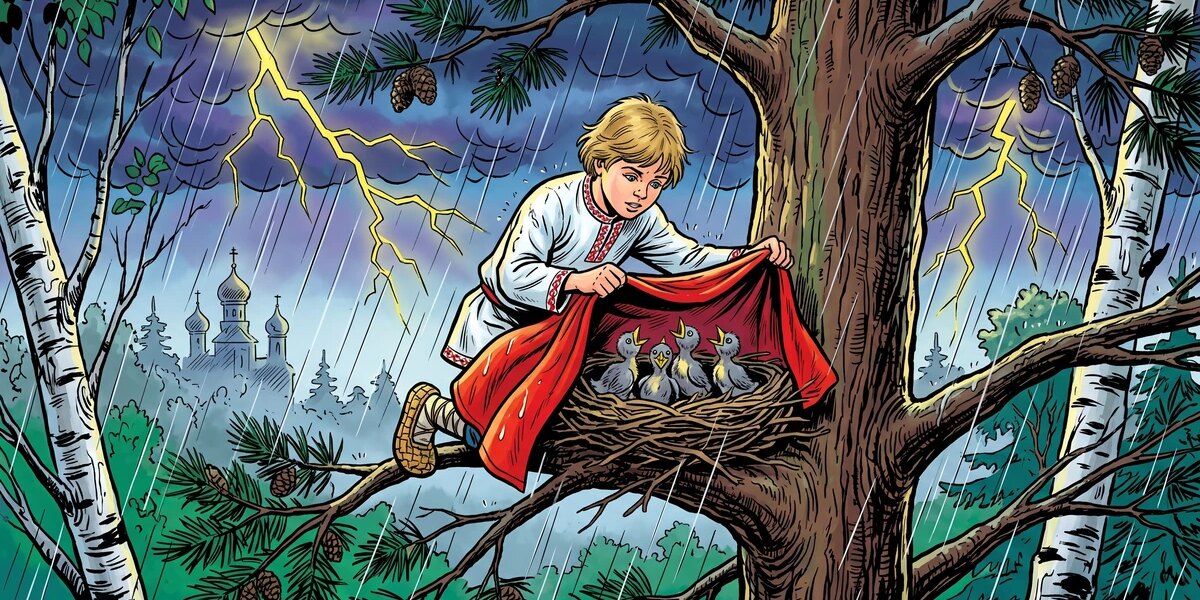
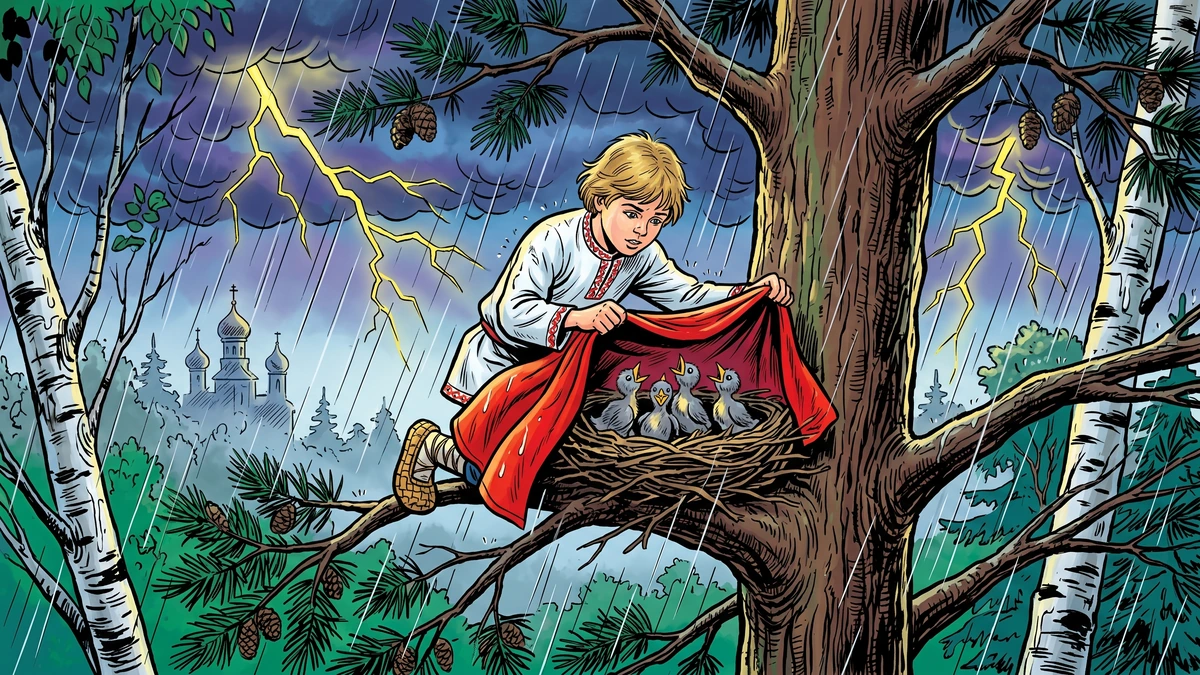
Some years later — Afanasyev’s narrator pleases himself by leaving the interval vague, as folk narrators always do — Ivan went out walking in the forest after a long summer afternoon. Storm-clouds gathered low and quick, the way they gather over the great Russian plain: a curtain of grey, a wind in the birches, a crackle of thunder that shook the kvass-bottles in the village cellars. As the first heavy drops fell, Ivan heard a thin, distressed twittering above his head. He looked up. There in a tall pine, in a nest just below a broken branch, four small chicks were beating their featherless wings against the rain. Their mother was nowhere to be seen.
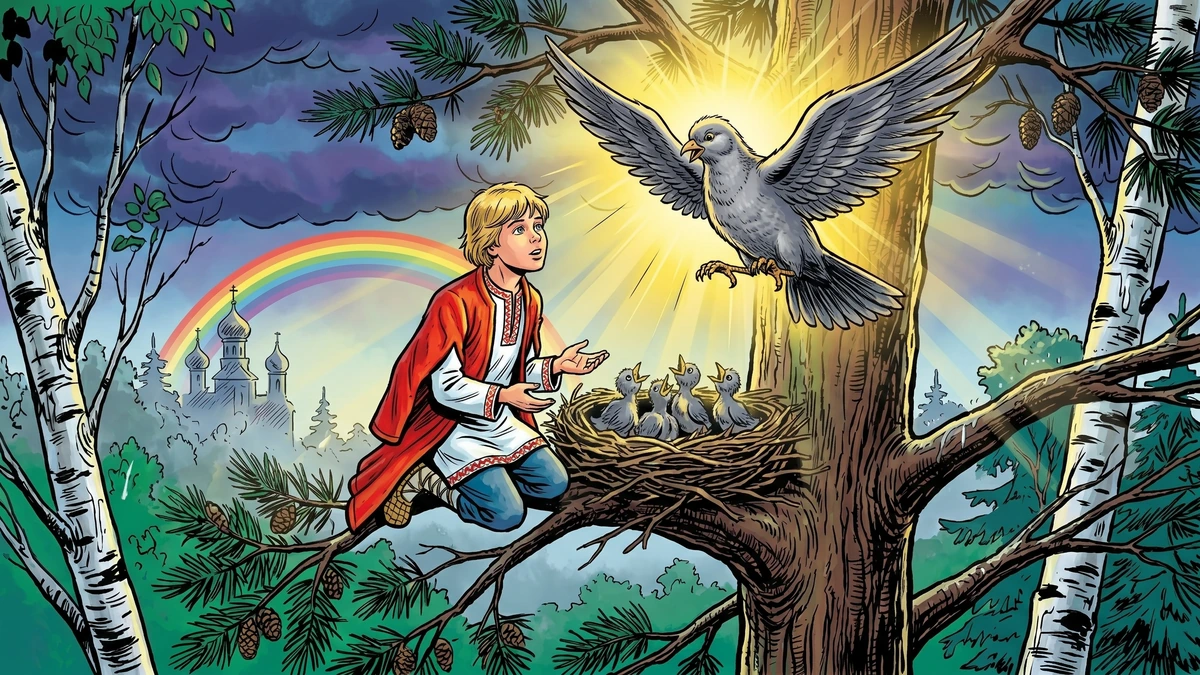
Ivan did what only a kind boy does. He climbed the pine, drew off his red kaftan — the long woollen coat of the Russian merchant-class — and spread it carefully over the nest. The chicks, sheltered, settled. Ivan stood in his shirtsleeves in the lashing rain until the storm passed. When the sky cleared and the steaming forest smelled of wet pine and birch sap, the mother bird returned — a wild grey hen-bird of unknown breed, the kind Russian narrators always leave unspecified because the mystery is part of the magic. She circled the nest, saw the kaftan, saw the boy, and spoke — not in twittering, but in plain Russian human speech: “Ivan, son of merchant, what reward do you ask for the lives of my children?” The boy, modest as Russian peasant tales required their heroes to be, asked nothing. He had only sheltered four small wings. He wanted nothing in return. The mother bird answered: “Then I shall give you what you do not ask. From this hour onward, the language of every bird that flies under heaven shall be plain to your ears.”
The Nightingale’s Prophecy and the Father’s Wrath
Ivan came home, said nothing of his strange gift, and sat down once more at the family table. The grey nightingale in the willow cage began its evening song — and this time Ivan understood every note. The bird was not singing about love or summer or the green of the birch leaves. It was singing prophecy. “There will come a day,” the small grey throat trilled, “when this boy who sits at his father’s table will be a great lord, a tsar of his own kingdom; and his father, the rich merchant, will pour water on his hands and stand barefoot at his stirrup, and his mother will hold the basin for the washing.”
Ivan grew pale. His mother saw the change in his face and asked what the bird had said. Ivan, who could not lie to a Russian mother, told them word for word. And here the tale performs the cruel and beautiful pivot that gives it its tragedy: the merchant, instead of marvelling that his son had been blessed with the gift he himself had once wished for, was overcome by pride and fear. He did not want his son to outrank him. He did not want the world to be remade with him at the bottom of the stairs. He looked at his wife — the narrator is careful to say it was a long, terrible look — and proposed, in the low voice of a man speaking against his own heart, that they kill the boy in his sleep, drop the body into the river, and tell the village he had been carried off by wolves. The mother wept, but in the way of the old Russian tales she did not refuse her husband. She wept, and she went to fetch the long-bladed knife.
This moment — the parents’ betrayal of the gifted child — is one of the most unsettling in the Russian repertoire, and Afanasyev gathered several variants of it from different provinces. The folklorist Vladimir Propp identified it in his Morphology of the Folktale as Function 8a, “the family member causes the hero harm,” and he noted that it appears with peculiar frequency in Slavic and Germanic prophecy-tales: the parent who turns on the child the moment that child threatens to surpass him. King Laius and Oedipus, King Acrisius and Perseus, the merchant of Astrakhan and Ivan — these are the same archetype in different costumes. What makes the Russian version distinctive is the mother’s role. She does not protest. She fetches the knife. Russian peasant audiences understood the bitter implication: in a patriarchal household, even a loving mother was not free to overrule the master of the table.
But Ivan, with the language of birds in his ears, heard the swallows under the eaves whispering the warning. He rose quietly in the dead of night, took only a small loaf of black bread and a cup of water for the journey, and walked out of his father’s house barefoot, leaving the door unlocked behind him.
The Three Quarrelling Crows and the Foreign King’s Riddle
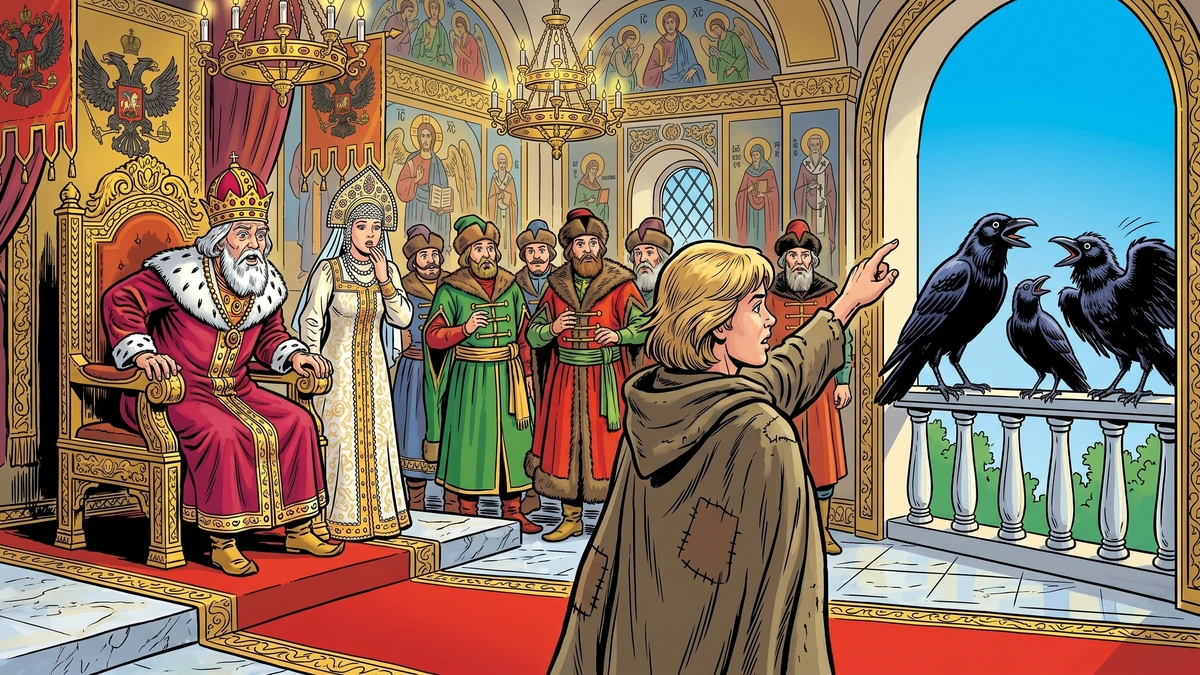
Ivan walked for many days through the open country, eating what berries the forest gave and drinking from its quiet streams. At length, footsore and threadbare, he came to the gates of a great foreign kingdom — Afanasyev does not name it, but Russian listeners always understood it to lie somewhere south of Kiev, perhaps in the lands of the Polovtsy, the Cumans, or the half-mythical empire of Pop John. The kingdom was in mourning. The bells of every monastery tolled at noon. The flags above the palace hung at half-mast. For nine long years, the narrator says, three black crows had perched in the king’s private garden, just outside the royal windows, and had quarrelled day and night without rest. No scholar, no wizard, no priest had been able to divine the cause of their dispute or persuade them to be silent. The king, an old man with a long white beard, had not slept a full night in nine years. His doctors despaired. His daughter, the Princess Yelena Premudraya — Yelena the Most Wise — had wept herself dry beside her father’s bed.
Ivan, a stranger in patched clothes, asked the gate-guards what was the king’s trouble. When he learned, he asked to be brought to the king. The court chamberlains were inclined to laugh — a boy in a torn shirt, claiming wisdom that ninety wise men had failed at — but the old king, who had heard enough laughter for nine years, signed that the boy should be admitted. Ivan came into the throne-room, bowed in the proper Russian manner with the right hand to the floor, and walked out onto the garden balcony. He listened for one quarter of an hour. The crows quarrelled. He listened for a second quarter. The crows quarrelled. He came back into the throne-room and translated, before all the assembled court, the substance of the nine-year dispute.
The three crows, he said, were a father, a mother, and a son. Many years ago, in a season of terrible famine, the mother-crow had abandoned the nest in despair of finding food, and the father-crow had raised the small son alone. Now the mother-crow had returned, fat and well, and demanded that the son acknowledge her as his rightful parent. The father-crow refused: “I fed him through the famine; she abandoned us. He is mine.” The mother answered: “I bore him in my body; my flesh is his flesh; he is mine.” The young crow himself, perched between them, did not know to whom he owed allegiance. For nine years they had been arguing this case under the king’s window, waiting for any human creature wise enough to hear and judge them — for in the old Russian tradition, only a human judgement could free a feathered soul from its long debate.
The king turned to Ivan: “And what is the judgement, boy?” Ivan answered: “The judgement is that the son belongs to the father who raised him through the famine. The mother who abandoned him has no claim, except a claim to ask his pardon.” He stepped onto the balcony again and called the judgement out in bird-speech. The three crows fell silent at once. The father and son rose and flew east; the mother bowed her wing in shame and flew west, alone. The bells of the kingdom rang out, the king slept that night for the first time in nine years, and Ivan was lifted from a beggar at the gate to a guest of honour in the palace.
The Marriage, the Return, and the Washing of the Father’s Hands
The grateful king offered Ivan whatever reward he wished. The boy, who had grown into a young man on the road, asked for the hand of the Princess Yelena and the right to one day inherit a small kingdom under the great king’s protection. The wedding was held in a cathedral painted with seven hundred saints; the feast lasted three days and three nights; the deer was roasted whole; the mead flowed; the choristers sang “Mnogaya leta” — “Many Years” — over the bride and groom. The old king made Ivan his son-in-law in law and in feeling, and within a few years, when the old man closed his eyes for the last time, Ivan inherited the throne and ruled wisely, justly, and (Russian narrators always added) with a particular kindness toward all birds.
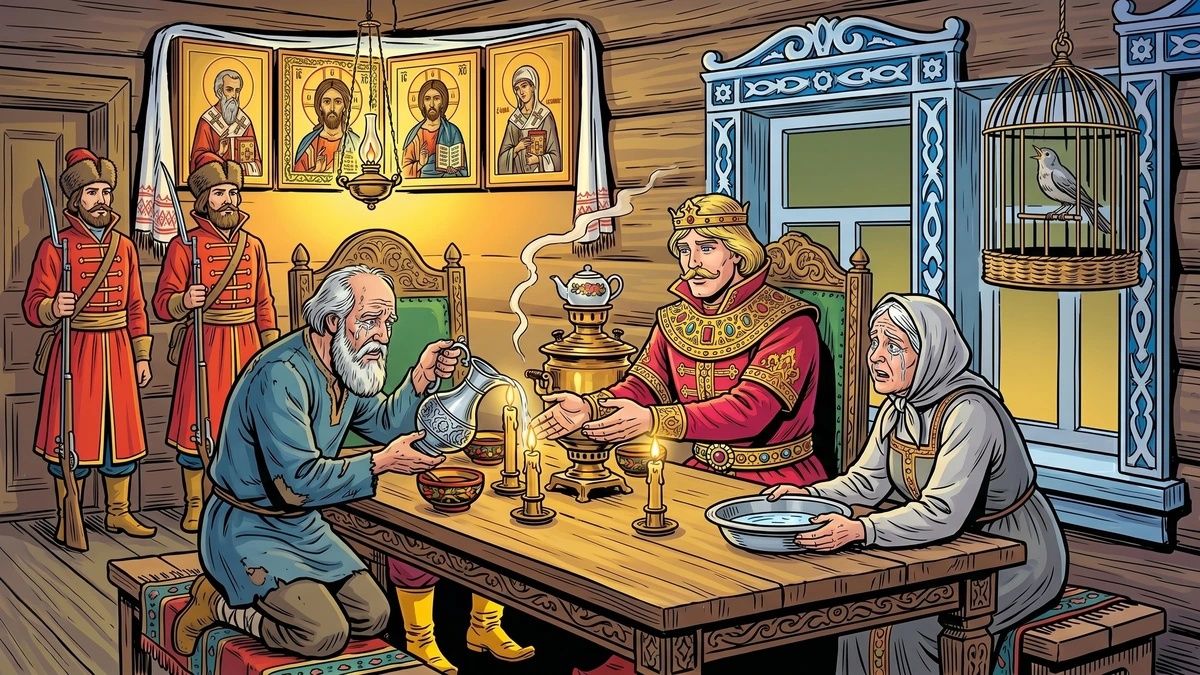
One spring some years later — the narrator never says exactly how many, but enough for Ivan to have grown into the strength of his middle years — the new Tsar Ivan dressed himself in his richest robes, mounted his finest horse, and rode out at the head of a company of soldiers on a tour of his neighbouring lands. The road brought him, by what the storyteller calls “the soft hand of God’s providence,” through the very town where the merchant his father lived. The royal party stopped for the night at the merchant’s house — for in the old custom, even a tsar travelling with his retinue would ask the hospitality of a wealthy household, and a refusal was unthinkable.
The merchant and his wife, now grey and stooped, did not recognise their son. They saw only the gilded harness, the silk caftan, the gold-embroidered sleeve. They poured water from the silver ewer for the great lord to wash his hands; they held the basin while he washed; they served at his table; they bowed when he spoke. And only at the end of the meal, when Ivan rose and looked them full in the face, did the merchant’s wife see in the young Tsar’s eyes the eyes of the small boy who had once climbed a pine tree to shelter four chicks in his red kaftan. The mother fell to her knees, weeping. The father — the man who had once gone to fetch the knife — fell forward on his hands, weeping more than his wife.
And here the Russian narrator performs the moral arithmetic that gives the tale its weight. Ivan did not punish them. He did not denounce them. He lifted his father from the floor with his own hands, embraced his mother, forgave them in plain words before all his soldiers, and took them back with him to live out their days in honour and gentleness in his palace. The nightingale’s prophecy was fulfilled exactly as the small grey throat had sung it — but the fulfilment was redeemed by the son’s mercy. “For,” said Ivan, in the line that all Russian tellers preserved, “a father is a father, even when he has done a great wrong; and a Tsar who cannot forgive his own blood will not long be a Tsar of any kingdom worth ruling.”
Moral
«Где гнев, там и милость; где милость, там и Бог.» — “Where there is wrath, there also is mercy; where there is mercy, there also is God.”
— Russian Orthodox proverb, recorded in Vladimir Dahl’s Poslovitsy Russkogo Naroda (Proverbs of the Russian People), 1862.
The moral of The Language of the Birds is not the moral that the average modern reader expects. The expected moral would be: do not betray your child, or prophecy will catch you out. But the Russian tale chooses a much harder lesson. Its moral is that the prophesied humiliation of the wrongdoer is not the end of the story; it is the beginning of forgiveness. Ivan is given the gift of bird-speech because he sheltered four small creatures who could not shelter themselves; and he keeps the gift, and rises by it to a throne, but the real proof of his fitness for the throne is that, when his unjust father stands before him with a basin of washing-water in his hands, Ivan lifts him up instead of striking him down. The Russian moral imagination is patient and slow. It demands prophecy and mercy in the same breath. It does not believe that justice and forgiveness are opposites. It believes that real justice ends in forgiveness, and that any “justice” that does not is only revenge in a clean shirt.
Why This Tale Has Lasted
The Language of the Birds has been told in Russian villages for at least three hundred and fifty years that historians can document, and probably for many centuries before that. It survived Peter the Great’s Westernising reforms, the Napoleonic invasion, the emancipation of the serfs in 1861, the October Revolution, the Stalinist purges, the Siege of Leningrad, and the collapse of the Soviet Union in 1991. Soviet folklorists, who normally distrusted any tale with a king and a cathedral in it, made an exception for this one because its hero rises from the merchant class by personal merit and ends by forgiving the wickedness of a property-owning father — themes that the Soviet pedagogy could tolerate even when it could not quite endorse the wedding-in-a-cathedral ending. As a result, every Russian schoolchild of the twentieth century read the tale in a state-approved primer, and most of them remembered it for life.
Three pillars hold the story up across so many centuries. First, the beauty of the cage-bird image — a bird in a cage, singing prophecy in a language no one can understand, is one of the most evocative pictures in any folk literature, and it is no accident that nineteenth-century Russian poets from Pushkin onward returned to it again and again. Second, the human truth of the parental betrayal — every child who has ever felt overshadowed in his own home, every child who has sensed that an adult was frightened by the child’s promise, finds in this tale a recognition that does not flinch from naming the wound. Third, the courage of the ending — the easy ending would have been Ivan punishing his father, and the Russian narrator deliberately refuses it. The forgiveness scene is the moral climax, not the wedding.
For modern Indian families discovering the tale, the parallels with home-grown Indian stories will leap to the eye. The Mahabharata’s prince Karna, born of the sun and abandoned by his mother Kunti, forgives her in the moments before the great battle. The Ramayana’s Bharata refuses the throne his mother has stolen on his behalf and goes into the forest to fetch back his exiled elder brother. The Jataka tales abound in princes who rise above the family that has cast them out, and rise specifically by not taking vengeance. The Russian forest and the Indian river-bank produce different costumes for the same wisdom: that the gift of understanding — whether bird-speech in Russia or the speech of Dharma in India — is given to those who shelter the weak, and the proof of its true ownership is the willingness to forgive the strong who tried to harm us when we were ourselves still weak. The Tsar Ivan, listening to the swallows under the eaves at midnight, would have understood Prince Bharata at Chitrakuta perfectly. They are the same young man, in the same difficult morning, with the same hard choice — and the Russian and Indian narrators agree, across all their snow and warmth, on what the right answer is.
You May Also Like
 Russian Folk Tales
Ages 9-12
Russian Folk Tales
Ages 9-12
The Snow Maiden (Snegurochka)
The Snow Maiden (Snegurochka): In a remote village at the edge of the great Russian forests, where winter lasted longer than summer and snow lay thick upon the
 Russian Folk Tales
All Ages
Russian Folk Tales
All Ages
Baba Yaga
A canonical Russian wonder-tale from Afanasyev (tales 102-103, Narodnye russkie skazki, 1855-63; English re-telling Blumenthal 1903). Two orphan twins, sent into the forest by a wicked stepmother, find Baba Yaga the witch in her hut on chicken legs. They are saved by the small kindnesses they have given to mice, a hungry cat, forest birds, a rusty gate and a wounded birch tree; the cats gift of a towel and a comb becomes a river and a dark forest behind them in the magic flight. ATU 480 fused with ATU 313H*. With scholarly attribution to Propp, Johns, Hubbs and Forrester.
 Russian Folk Tales
All Ages
Russian Folk Tales
All Ages
The Tsarevna Frog
The Tsarevna Frog: [Illustration] In an old, old Russian tsarstvo, I do not know when, there lived a sovereign prince with the princess his wife. They had