Ivanoushka The Simpleton
Ivanoushka The Simpleton: [Illustration] In a kingdom far away from our country, there was a town over which ruled the Tsar Pea with his Tsaritza Carrot.
Ivanoushka the Simpleton — known in its mother tongue as Иванушка-дурачок (Ivanushka-durachok, literally “Little Ivan the Foolish”) — is one of the great fool-as-hero tales of the East Slavic canon. The retelling that English readers know best was published by Verra Xenophontovna Kalamatiano de Blumenthal in her landmark anthology Folk Tales from the Russian (Rand McNally & Company, Chicago, 1903), the first widely-circulated English collection of Russian skazki for young readers. Behind that single book stands a much older body of oral material gathered in the mid-nineteenth century by Alexander Nikolayevich Afanasyev in his eight-volume Narodnye russkie skazki (“Russian Folk Tales,” St Petersburg, 1855–1863), the founding scholarly collection of Russian folklore. In the Aarne–Thompson–Uther international index this tale’s central jumping test belongs to type ATU 530 — “The Princess on the Glass Mountain”, and in the East Slavic Folktale Catalogue (СУС) it is registered as SUS 530 — “Сивко-Бурко” (Sivko-Burko, “The Magic Horse from the Grave”), with strong contamination from the Ivan-durak (Иван-дурак) “lucky fool” cycle. The story’s frame — the kingdom of Tsar Gorokh (“Tsar Pea”) and Tsaritza Morkovya (“Tsaritza Carrot”) — is the formulaic comic-archaic setting of Russian fairy time, the way a Russian listener says “long, long ago.”
The Father’s Will and Three Nights at the Grave
The story opens in the most ancient frame of all Russian skazka: «В некотором царстве, в некотором государстве, при царе Горохе…» — “in a certain kingdom, in a certain realm, in the days of Tsar Pea.” Over the city rule Tsar Pea and his wife Tsaritza Carrot, attended by boyars, princes, and a hundred thousand soldiers less one. On the outskirts, in a poor wooden izba, lives an old peasant with three sons: Thomas (Foma), Pakhom, and Ivan. The old man is no ordinary farmer. He has, in the gentle phrase of the storyteller, “once had a chat with the devil,” and from that conversation he learned charms that the neighbours mistook for sorcery — love-philtres made of strange roots, water-divinations that found thieves, blessings that cured cattle. He is, in folkloric terms, a znakhar (знахарь), a peasant cunning-man whose powers stand on the cusp between Orthodox piety and pre-Christian Slavic magic.
Of his sons, the two elders are clever and householders both; the youngest, Ivan, can scarcely count to three. He drinks, eats, sleeps, lies about — and yet he is so generous that if you ask him for a belt he gives you a kaftan, and if you take his mittens he presses his cap on you too. For that openness of heart, the village calls him Ivanushka-durachok, a name that in Russian carries an unexpected tenderness: durak means “fool,” but the diminutive durachok softens it into something close to “dear simpleton,” the very word a grandmother might use for a slow but kind-hearted grandchild.
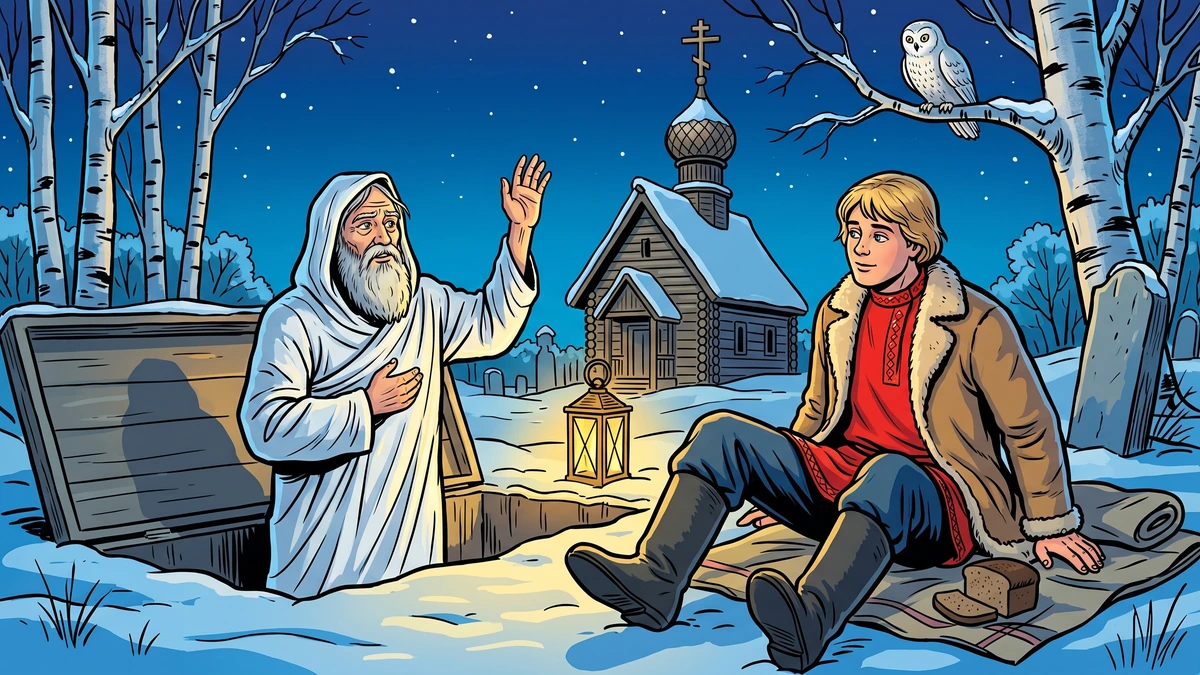
When the old man feels death approaching he calls his sons and lays a strange charge upon them: each must spend one night at his grave — Thomas the first, Pakhom the second, Ivanushka the third. The elder brothers promise; the youngest only scratches his head. The peasant dies and is buried, and after the pancakes and the toasts of the funeral feast the test begins. But Thomas, lazy or afraid, sends Ivanushka in his stead; the next night Pakhom does the same. The Simpleton goes both times without complaint, eats a slice of black rye bread, lies down on the new-turned earth, and falls into the deep sleep of those who carry no grudge. At midnight the wind roars, the church clock strikes, the owl cries from the birch wood, and the grave opens. The old man rises and asks, “Who is there?” — and twice over Ivanushka answers simply, “I.” Twice over the old man blesses him: “My obedient son, I will reward thee.”
The Bay Horse and the Princess at the High Window
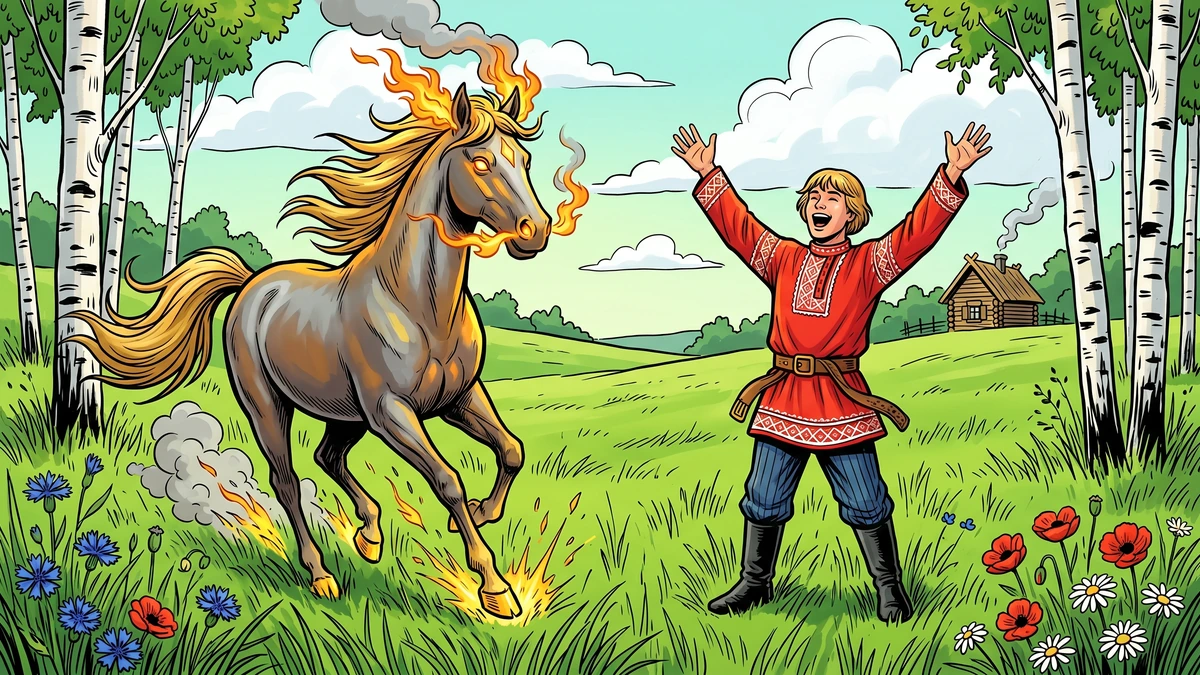
On the third night Ivanushka goes for his own turn. The grave opens, the dead father rises, and this time he speaks the great summons of Russian magical horsemanship — a charm that in Afanasyev’s Sivko-Burko variants is one of the most famous incantations in all East Slavic folklore:
«Сивка-бурка, вещая каурка, / встань передо мной, как лист перед травой!»
“Sivka the bay, bright-prophetic chestnut steed, / Stand before me as the leaf before the grass!”
The earth trembles; a horse comes flying with eyes like stars, smoke pouring from his nostrils, fire from his ears. The old man crawls into the horse’s left ear and steps out of his right ear as a young, brave dobry molodets (“a fine young fellow”) of the kind one reads of only in stories. “To thee, my son, I give this horse,” he tells Ivanushka; “and thou, my faithful horse, serve my son as thou hast served me.” At cock-crow the sorcerer drops back into his grave, and Ivanushka quietly walks home, climbs onto the warm clay stove, and snores so loudly the rafters tremble.
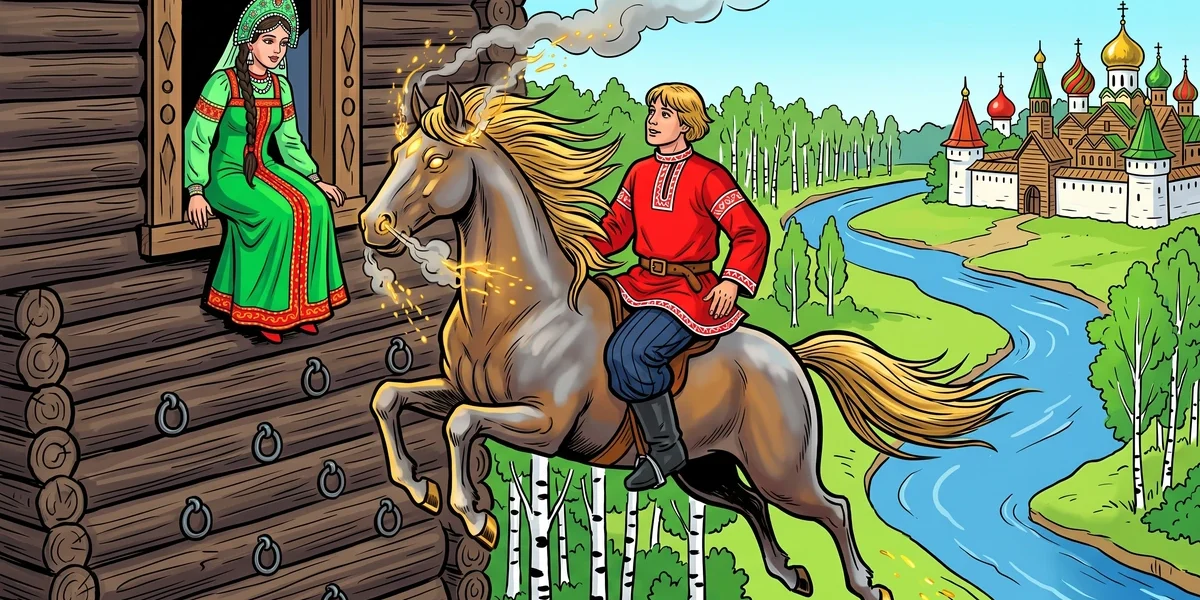
Meanwhile heralds with trumpets are riding through every village and every town. Tsar Pea and Tsaritza Carrot have an only daughter, the Tsarevna Baktriana — a princess so beautiful “the sun blushed when she looked at it, and the moon, too bashful, covered itself from her eyes.” The parents have tried every prince, korolevitch, and tsarevich in the world; Baktriana loves none of them. At last she sets her own test: a great hall is to be built with thirty-two iron rings rising in two columns to a window high above, and there she will sit. Whichever bridegroom can leap his horse up through all thirty-two rings, reach her window, and exchange a golden ring with her, that man — be he tsar or free Cossack, prince or beggar’s son — shall be her husband.
For three days the field is loud with horsemen who spring, balance, hurl themselves up, and fall back like stones to the laughter of the watching crowd. On each of the three days the elder brothers ride out, mocking Ivanushka — “Stay home, fool, watch the chickens” — “scare the sparrows from the pea field” — “give the hogs their slop.” The Simpleton agrees mildly each time, and as soon as they are gone he slips out into the open field, calls Sivka-Burka with the great charm, slips into the horse’s left ear, and steps out of the right transformed into a hero “such as is not written of in any book.” On the first day his horse clears thirty rings; on the second, thirty-one; on the third, all thirty-two. He seizes the Tsarevna in his arms, kisses her on her “sugar lips,” exchanges golden rings, and is gone like a whirlwind. Baktriana — laughing rather than offended — touches his forehead with her ring, and a diamond star blazes there to mark him forever.
Brothers, Boasts, and the Bargain in Body Parts
The Tsar orders the city sealed and every man in it brought to the palace to show his forehead. From dawn the crowds are inspected; not a star is found. Ivanushka, bandaged with rags as though he had bumped his head on a door, comes last; the guards laugh at him, but the Tsarevna calls him forward, lifts the cloths, and there the star is, burning bright. There is nothing now for the Tsar to do but call for the wedding feast. Ivanushka the Simpleton, ploughboy and stove-lounger, is wedded to Tsarevna Baktriana, and his elder brothers are made governors and given each a village.
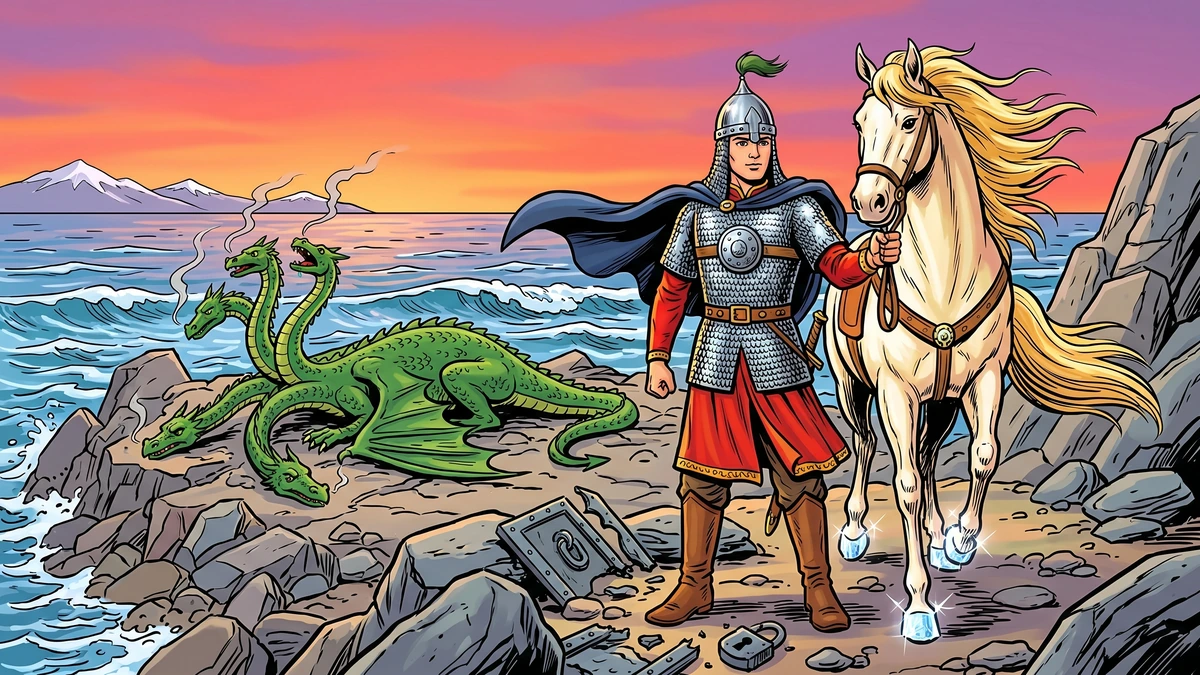
What follows is the great satirical engine of the second half of the tale — a structure folklorists call the threefold quest-bargain, and a near-perfect specimen of the Russian moral comedy of pride. Made rich, Thomas and Pakhom become unbearable: they brag in court that they alone know where the silver-leaved, golden-appled tree grows; that they will steal the Tsar a pig with golden bristles and silver tusks and her twelve piglets; that they will lead home the fiery dragon’s golden-maned mare with diamond hoofs. Each time the Tsar takes them at their word; each time they ride out in dread, having no idea where to begin. And each time it is the Simpleton — astride a borrowed lame horse, then sitting backwards on a cow, then mounted on a riding-stick — who reaches the wide field, summons Sivka-Burka with the old charm, and brings back the impossible treasure: the apple tree from the eastern country where silver waters run over golden sand; the golden pig and her piglets from a forest in the south; the dragon-guarded mare from an island where the beast keeps her behind seven locks and seven iron doors. Three days he fights the dragon; on the fourth he kills it; three days more, and the locks are torn down.
Each time the elder brothers, riding home empty-handed, stumble upon Ivanushka camped under a tent — silver-topped, then golden-topped, then diamond-topped — with the prize tethered beside him. Each time they beg to buy it. Each time the Simpleton names a price that is half-joke and half-judgement: “My tree is not for sale, brothers — but for a toe from each of your right feet, I’ll let you have it.” Then it is “a finger from each right hand” for the pig. Then it is “your right ears” for the dragon’s mare. Folly buys what cunning cannot earn, and pays for it in the flesh. Each time the maimed brothers stagger back to Tsar Pea with the treasure and a tall tale of their own bravery — they fought “beyond the blue sea, beyond the dark woods,” they shed blood and lost limbs, the dragon bit them — and each time the Tsar pours gold over them and seats them higher at his right and left hand. This is the structure of the moral joke: the more obviously they lie, the more lavishly they are rewarded, because no one in the court has the courage to ask the natural question.
The Reckoning at the Feast and the Reign of the Fool
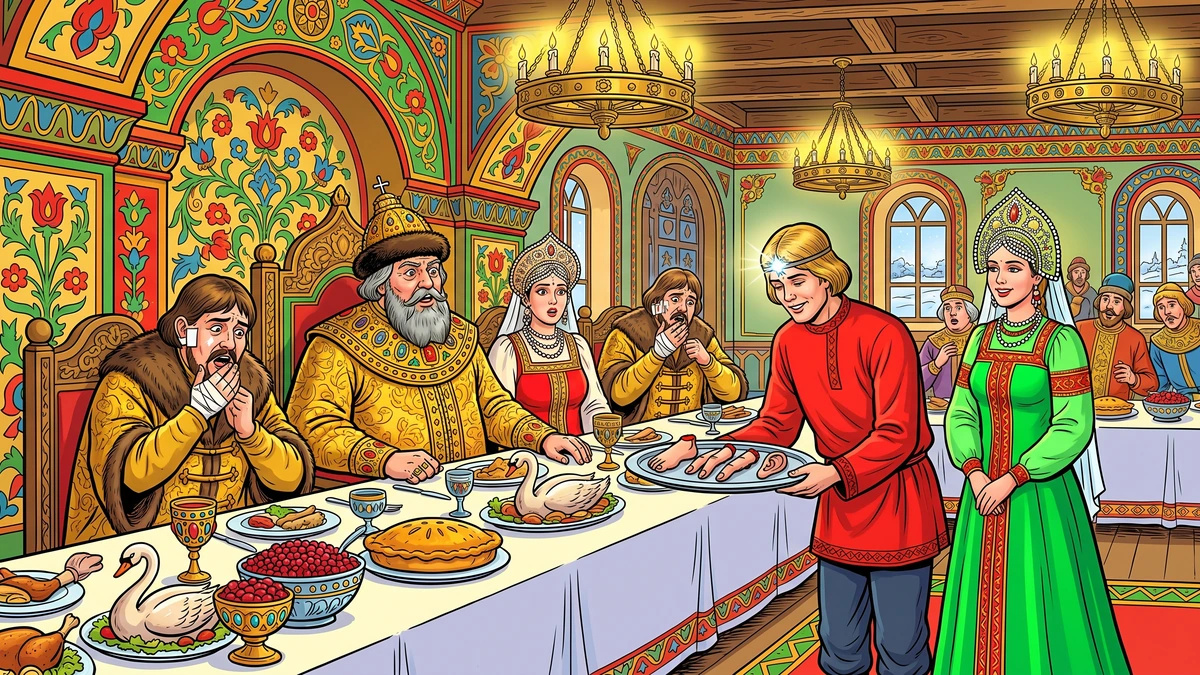
The reckoning comes at the great feast, with one brother at the Tsar’s right and the other at his left, the cellars emptied and the cooks exhausted with feeding the realm. Into the hall walks Ivanushka — quiet, plain, smiling — and bows to his father-in-law. One brother chokes on his wine; the other gags on a piece of roast swan. The Simpleton tells the story as the story was. He tells of the apple tree, the golden pig, the diamond-hoofed mare. And then, with the patience of one who has counted neither boasts nor pity, he lays out on the boards the proof: three toes, three fingers, three ears.
The Tsar rises in fury. The boasters are driven from the table with brooms — one is sent to feed the pigs, the other to herd the turkeys — and Ivanushka the Simpleton is seated at the Tsar’s own right hand and named “the highest among the very high.” When at last Tsar Pea dies, Ivanushka inherits the throne. He rules, the storyteller says, “wisely and severely”; his subjects love him; he has many children; and his beautiful Tsaritza Baktriana “remains beautiful forever.”
Moral — Holy Foolishness and the Kindness That Earns a Kingdom
The Russian Orthodox tradition has long honoured a peculiar kind of saint: the yurodivy (юродивый), the “holy fool” who casts off worldly cleverness to make a path for divine wisdom. Russian secular folklore mirrors that piety in its enormous corpus of Ivan-durak stories. The fool is the brother who keeps his promises, sleeps on graves without complaining, gives away his coat to strangers, answers “I” when his dead father asks who is there. He is not stupid; he is uncalculating. And the moral of every Ivan-durak tale, including this one, is that the world’s economy of cleverness is rigged against itself: the cunning brothers must trade their bodies for the prizes they cannot earn, while the simple brother gives away every prize at a joke price and rides home laughing on a stick.
«Простота лучше воровства, а правда святее кривды.»
“Simplicity is better than thieving, and truth is holier than crookedness.” — Russian proverb cited by V. I. Dahl, Posloviсy russkogo naroda (1862).
The deeper Russian meaning of durachok is therefore not mockery but reverence in disguise. The tale teaches what Tolstoy and Dostoevsky would later make a national theme — that the unguarded heart sees what the guarded mind cannot, that kindness done without bookkeeping is the only kindness that lasts, and that a kingdom won by mercy outlasts a kingdom won by boasting. The diamond star on Ivanushka’s forehead is the visible sign of an invisible thing: an honesty so complete that even disguise cannot hide it.
Why This Tale Has Lasted
Five reasons keep Ivanushka-durachok alive on the long benches of Russian memory. First, the structure. The triple test at the grave, the triple jump at the window, the triple quest, the triple bargain — these are the elemental architecture of oral storytelling, mnemonic for the teller and satisfying for the listener. Second, the comedy. The fool sitting backwards on a cow, throwing the lame horse into the field for the crows, scaring sparrows from the pea field — these are images peasant audiences laughed at for two centuries, because they recognised themselves in the laughter. Third, the satire. The clever brothers grow rich by lying; the cleverer they lie, the higher they sit; and only the fool’s quiet truth at the feast brings them down. In every age this is recognisably Russia. Fourth, the magic. The horse that pours fire from his ears, the dead father who rises to bless his obedient son, the diamond-hoofed mare on the dragon’s island — these are not decorative. They are the older, pre-Christian world of Slavic navi (the helpful dead) and volkhvy (the magicians) breathing through the seams of the Christian story. Fifth, the consolation. Russian winters are long, and Russian history is harder still. The peasant who told this tale beside the stove was promising his grandchildren that simple kindness, even when it looks like simple-mindedness, is a kind of bay horse waiting in a field — and that one day, when summoned, it would come at a gallop.
For nearly two centuries Ivanushka has galloped on through Russian culture. The Bilibin-illustrated chapbooks of the 1900s set him beside Baba Yaga and the Firebird in the national imagination. Soviet Soyuzmultfilm animations of the 1940s–60s carried him to millions of nursery audiences. He is the silent ancestor of Pushkin’s Balda, of Tolstoy’s Ivan the Fool (Иван-дурак, 1885), of every kind-hearted boy in twentieth-century Russian cinema who outlasts the cunning men around him. To hear his story is to step, for half an hour, into a country where the dying old father still rises from his grave at midnight to bless the son who simply came when he was asked — and where, in the end, the diamond star always shines through the bandages.
A Note on the Telling
Russian skazka opens with a ritual incantation that fixes the time of the story outside the time of the world — «В некотором царстве, в некотором государстве…» (“in a certain kingdom, in a certain realm”), or in the older, more comic register, «при царе Горохе» (“in the days of Tsar Pea”). The next phrase is often жили-были (zhili-byli, literally “there lived-and-were”), an archaic past tense that English translators usually flatten into “there once lived.” When a Russian child in 1860, or a Russian child in 2026, hears those words, the meaning is identical: we have crossed a threshold; we are no longer in the village; from here onward, horses speak with the voices of men, fathers rise from their graves to bless obedient sons, and the foolish brother is also the truest.
Source: Verra Xenophontovna Kalamatiano de Blumenthal, Folk Tales from the Russian, Rand McNally & Company, Chicago, 1903, “Ivanoushka the Simpleton.” Underlying oral material drawn from Alexander Nikolayevich Afanasyev, Narodnye russkie skazki (Russian Folk Tales), St Petersburg, 1855–1863, in the cycle of Иванушка-дурачок (Ivanushka-durachok) and Сивко-Бурко (Sivko-Burko). Tale type: ATU 530 — The Princess on the Glass Mountain (Aarne–Thompson–Uther); East Slavic SUS 530 “Сивко-Бурко.” Related motifs: H1242 (youngest brother succeeds where elders fail); E631 (helpful animal from the grave); H331.1 (suitor test, leap to princess at high window). Notable twentieth-century illustrators: Ivan Bilibin, Yelena Polenova. Cultural cognates: the yurodivy (“holy fool”) tradition of Russian Orthodox spirituality; Lev Tolstoy’s parable Ivan-durak (1885).
You May Also Like
 Russian Folk Tales
Ages 9-12
Russian Folk Tales
Ages 9-12
The Firebird and Princess Vasilisa
The Firebird and Princess Vasilisa: In the days when the world was young and magic flowed through forests like rivers of starlight, there lived a great Tsar
 Russian Folk Tales
Ages 9-12
Russian Folk Tales
Ages 9-12
The Firebird, the Horse of Power, and Princess Vasilisa
The Firebird, the Horse of Power, and Princess Vasilisa: In the days when the Russian steppes stretched endless as the sea, there lived a poor archer named
 Russian Folk Tales
Ages 6-8
Russian Folk Tales
Ages 6-8
Vasilisa the Beautiful
Vasilisa the Beautiful: There once lived a merchant of great wealth and standing who had a daughter of such exceptional beauty that men traveled from distant