The Tsarevna Frog
The Tsarevna Frog: [Illustration] In an old, old Russian tsarstvo, I do not know when, there lived a sovereign prince with the princess his wife. They had
“The Tsarevna Frog” (Russian: Царевна-лягушка, romanized Tsarevna-lyagushka, literally “Princess-Frog”) is one of the most beloved Russian wonder tales (volshebnaya skazka) — the story of Ivan Tsarevich, the croaking bride whose arrow fell into the swamp, and the long journey to the kingdom of Koschei the Deathless to win her back. The version translated by Peter Polevoi and reproduced above descends directly from the canonical Russian collection of Aleksandr Nikolayevich Afanasyev (1826–1871), Народные русские сказки (Narodnye russkie skazki, “Russian Folk Tales”), published in eight volumes between 1855 and 1863 — the foundational corpus that did for Russian folklore what the Brothers Grimm did for German. In the standard three-volume scholarly redaction edited by V. Ya. Propp (Moscow, 1957), the three frog-bride variants appear as tales 267, 268, and 269; in the original Afanasyev numbering, the cycle is filed as No. 86 a–c. The tale is classified internationally as ATU 402 — “The Animal Bride” in the Aarne–Thompson–Uther index (Uther 2004, vol. I, pp. 235–237), and is the East Slavic type-tale for SUS 402 (“Tsarevna-Lyagushka”) in the East Slavic Folktale Catalogue compiled by Lev Barag, Yuri Berezovsky, Konstantin Kabashnikov and Novikov (Leningrad, 1979). Stith Thompson’s motif-index situates it under B604.1 (Marriage to frog), D195 (Transformation: man to frog), D721.3 (Disenchantment by destroying skin), and E765.3.1 (Life dependent on egg in box, box in duck, duck in hare, hare in iron casket on oak). The most widely read English versions are W. R. S. Ralston, Russian Folk-Tales (London: Smith, Elder & Co., 1873); Leonard A. Magnus, Russian Folk-Tales (London: Kegan Paul, 1916); the Polevoi text used here (St Petersburg, 1915); and above all Russian Fairy Tales, translated by Norbert Guterman with commentary by Roman Jakobson and illustrations by Alexander Alexeieff (New York: Pantheon, 1945) — the volume that brought Vasilisa Premudraya, Koschei Bessmertnyi and Baba-Yaga into the modern English literary imagination.
I. Three Arrows in the Morning Sun
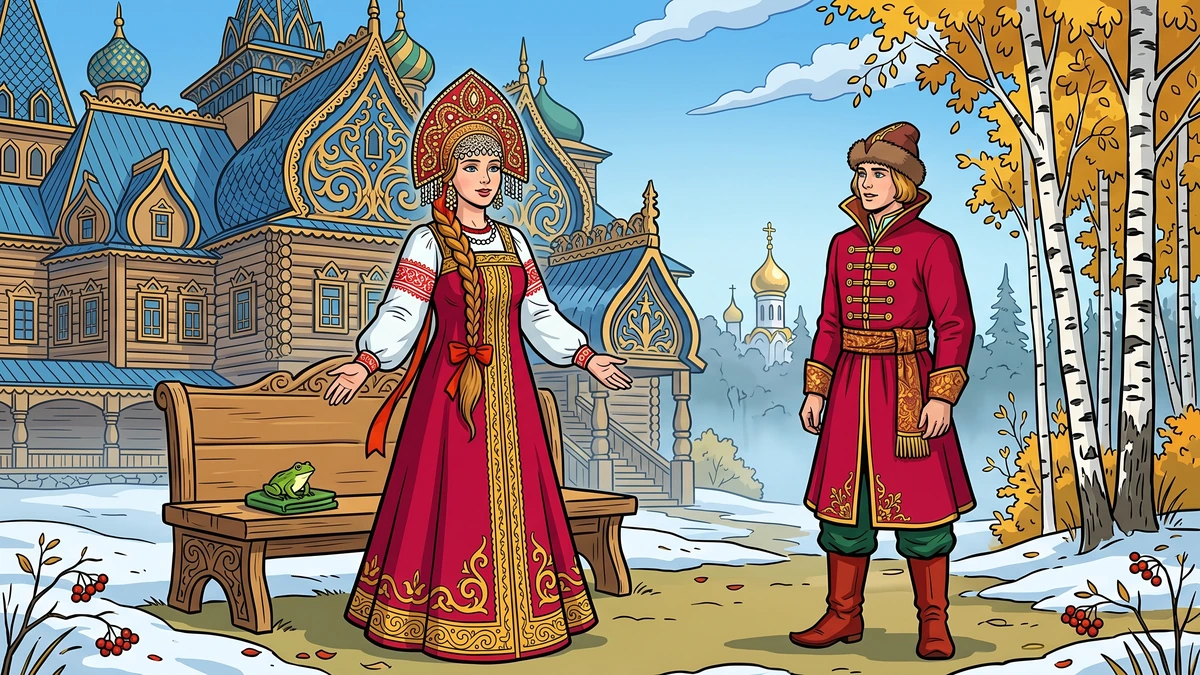
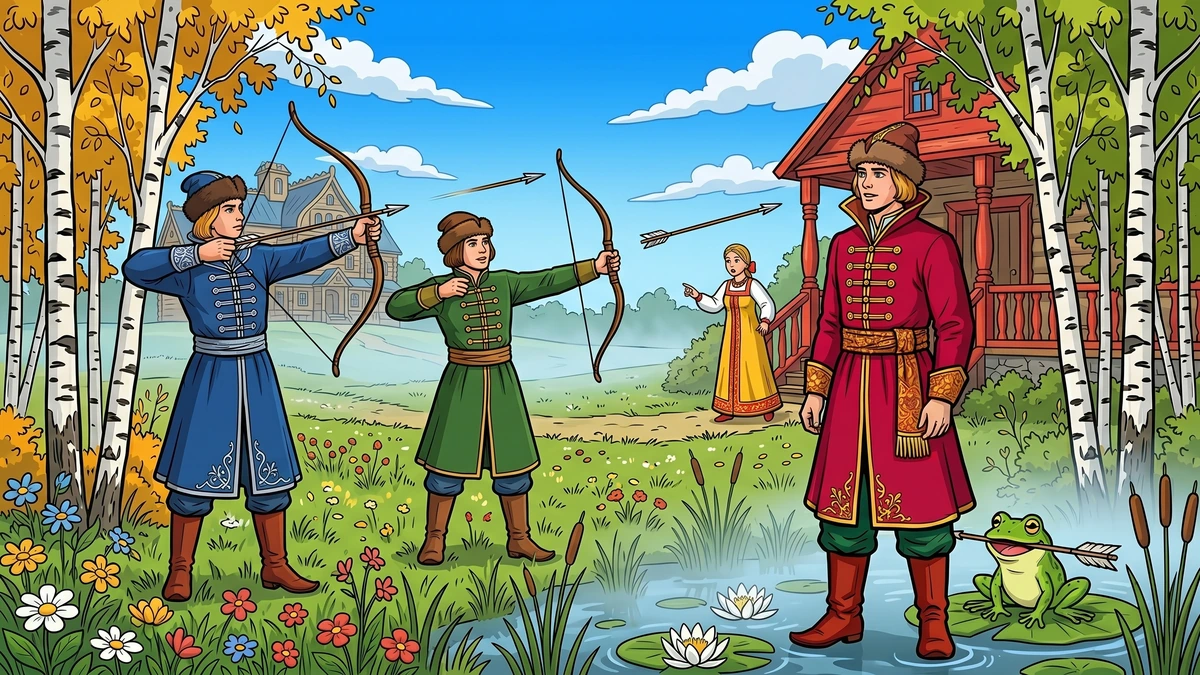
The narrative opens with the oldest and most archetypal of Indo-European folktale openings: a sovereign with three sons, the youngest of whom is destined for the marvellous. The tsar of an “old, old Russian tsarstvo” — a kingdom outside historical time — commands his princes to draw their bows and let the wind decide their brides. The first arrow lands at a boyar‘s gate; the second at a wealthy merchant’s red porch (krasnoe kryl’tso); the third disappears into a wet, reedy bog and is caught by a green frog. The arrow-shoot is no idle ritual but a survival of the very ancient Slavic oseledtsy ordeal — letting Sud’ba (“Fate”), the great impersonal force above even the gods, choose the marriage that the human cannot. Ralston (1873, pp. 119–122) noted that the Russian frog-bride sequence shares structure with Indo-European cognates from Greece (Apollodorus’s tale of Helen’s suitors), from the Scottish Highlands (the elf-bride of Glamis), and from Sanskrit Vedic ritual where the arrow as marker of divine election appears already in the Atharva-Veda (Book III, Hymn 25). Propp, applying his thirty-one narrative functions (1928, §I “Absentation” + §II “Interdiction” + §IX “Mediation” + §XI “Departure”), classified the arrow-shoot as a fused μ-element — simultaneously the test of the hero, the marker of magical lack, and the bridge into the otherworld. Ivan’s resistance — “How can I marry the frog? Is she my equal? Certainly she is not” — is the irreducible Slavic instance of the narrative function Propp called ravnodushnaya gordost’, “indifferent pride,” which in the wonder-tale schema must be broken before the marvellous bride can reveal her true form. The father’s reply, simple and absolute, anchors the tale’s whole metaphysical premise: takaya yavno tvoya sud’ba — “such is evidently your destiny.” In the Slavic world-view a sworn betrothal is a cosmic contract, not a romantic preference; the comedy of the croaking bride is, at root, the gravest of theological propositions about who chooses whom.
II. The Three Royal Tasks — Bread, Carpet, and the Dancing Ball
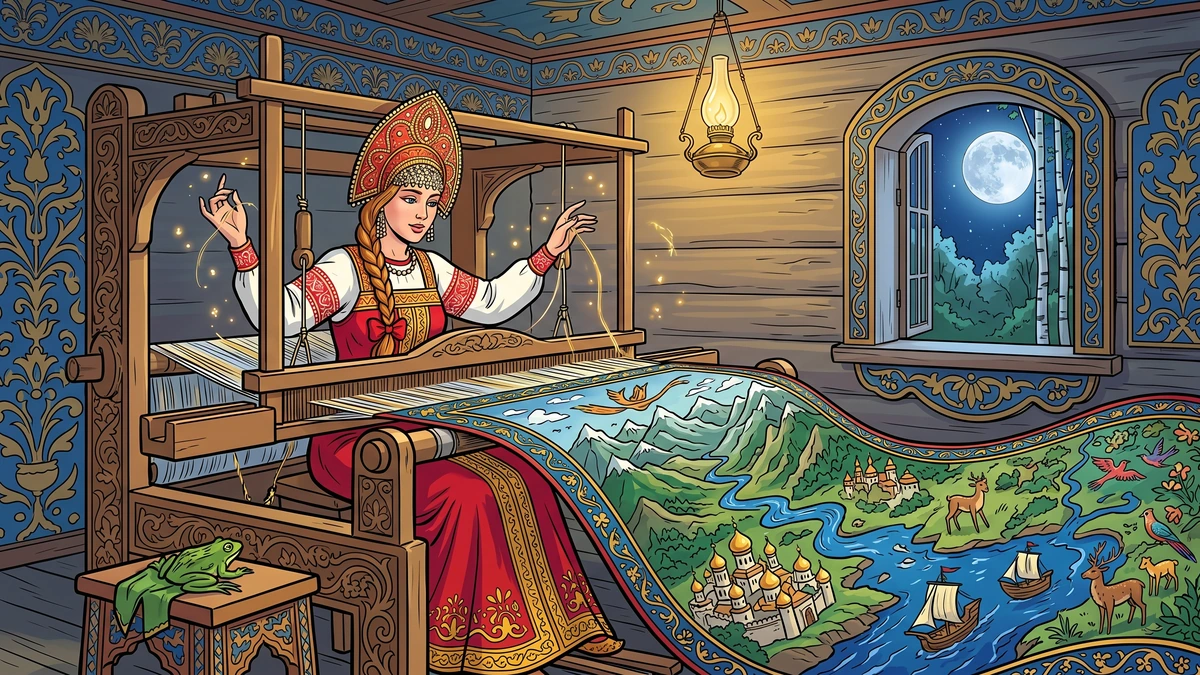
The body of the tale unfolds as a triple ordeal in which the sovereign tests his three daughters-in-law. Each night the frog sheds her warty skin in the apartments of Ivan Tsarevich and steps out as Vasilisa Premudraya (“Vasilisa the Wise”), a sorceress so radiant that “the sun in the sky was not as bright as she.” Her recurring counsel — «Ложись, Иван-Царевич, спать; утро вечера мудренее», “Lie down, Ivan Tsarevich, and sleep; the morning is wiser than the evening” — is one of the most quoted lines in the Russian language; it appears verbatim across all three Afanasyev variants and has passed into Russian proverbial speech far beyond the tale itself (see Dahl, Tolkovyi slovar’ zhivago velikorusskago yazyka, 1863–1866, s.v. утро). The first ordeal is the baking of bread: while the boyar’s daughter and the merchant’s daughter slave over flour and kneading-troughs, Vasilisa whistles up her hidden helpers — «мамушки-нянюшки», “mamushki-nyanyushki” (little mothers and little nurses) — and conjures a loaf of such artistry that “on its sides were great cities; in its centre the tsar’s own palace stood.” The second ordeal, the weaving of a carpet, produces a textile woven of silk and gold thread on which “the kingdoms of the East and the West, with rivers and mountains and forests and seas, were shown as in life.” The third and final ordeal is the dancing-ball at court. The frog arrives in a coach drawn by six white horses, lays the bones of her dinner inside her sleeve and pours the wine in her other sleeve, and when she dances “she shakes her left sleeve and a lake appears with swans swimming on it; she shakes her right sleeve and a garden grows with apple-trees in bloom.” The image of the magical sleeves is older than the tale: it is the same gesture by which Mokosh, the Slavic earth-goddess later assimilated to the Virgin (Bogoroditsa), creates the world in the cosmogonic dualist legends recorded by V. F. Miller (Russkaya mifologiya, 1899) and B. A. Rybakov (Yazychestvo drevnikh slavyan, 1981, pp. 379–392). The frog-bride is no mere enchanted maiden; she is a survival of the great female deity whom the tale-tellers, by the nineteenth century, had relegated to a frog-skin.
III. The Burning of the Frog-Skin
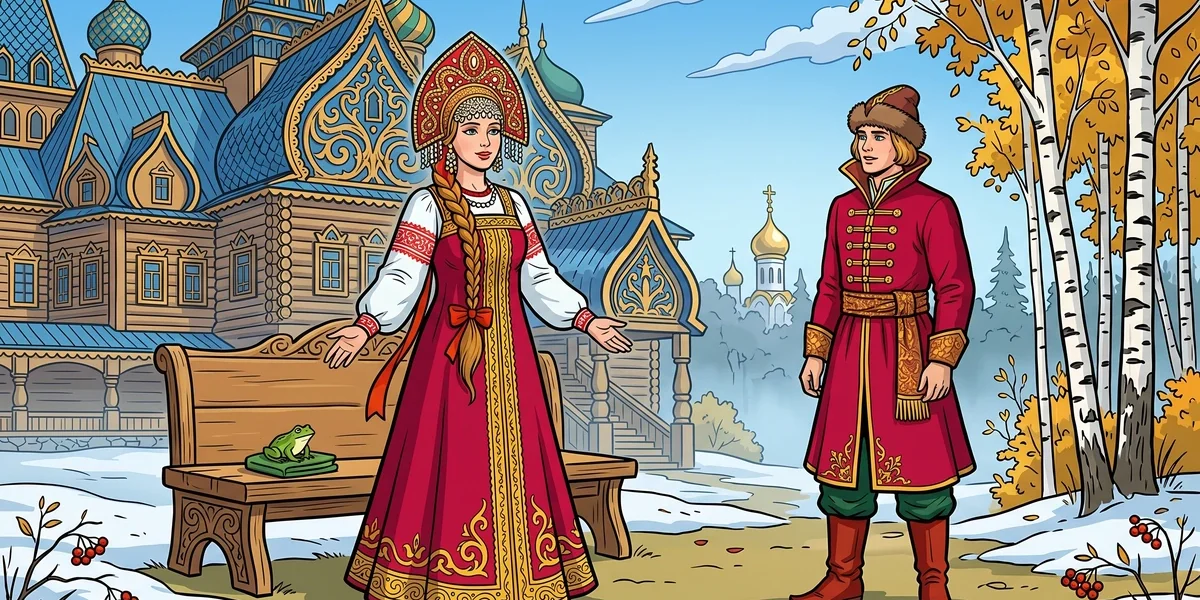
The hinge of the tale is the moment of impatient love. Returning home before his wife, Ivan Tsarevich finds the small frog-skin folded on the bench and, “wishing to bind her to him forever,” casts it into the stove and watches it burn. When Vasilisa Premudraya returns, the great sorrow comes upon her at once: “Oh, Ivan Tsarevich, what have you done? Had you waited but three days more, I should have been yours forever; now I must go far, far away — beyond the thrice-ninth land, into the thrice-tenth kingdom — to Koschei the Deathless.” She turns herself into a white swan and is gone through the window. Roman Jakobson’s commentary to the Pantheon edition (1945, pp. 661–671) reads this scene as the deepest theological moment of the East Slavic wonder-tale tradition: the hero’s fault is not unbelief but the opposite — too eager belief, too possessive a love. The animal skin is the threshold between this world (etot svet) and the other world (tot svet), and to destroy it before the appointed three days is to tear the membrane of cosmos itself. The detail of “three days” is no idle frame; in Russian Orthodox folk theology — and behind it in pre-Christian Slavic cosmology — the soul leaves the body for three days, ascends through the airs for nine, and stands before judgment on the fortieth (see N. I. Tolstoy, Slavyanskaya etnolingvistika, vol. III, 1995, pp. 174–185). What Ivan has burned, in the structural language of Propp’s functional analysis (1928, function §VIII “Villainy” inverted into §VIIIa “Lack”), is the rite of passage itself. The motif is so widespread that Stith Thompson catalogued it as C30 — Tabu: offending supernatural relative, with parallels across Norse selkie tradition, Welsh Mabinogion (Rhiannon and Pwyll), Indian Apsara legends, and the Japanese Crane-Wife (Tsuru no ongaeshi). The tale’s pedagogy is razor-sharp: the lesson is patience and the trust that love asks of time.
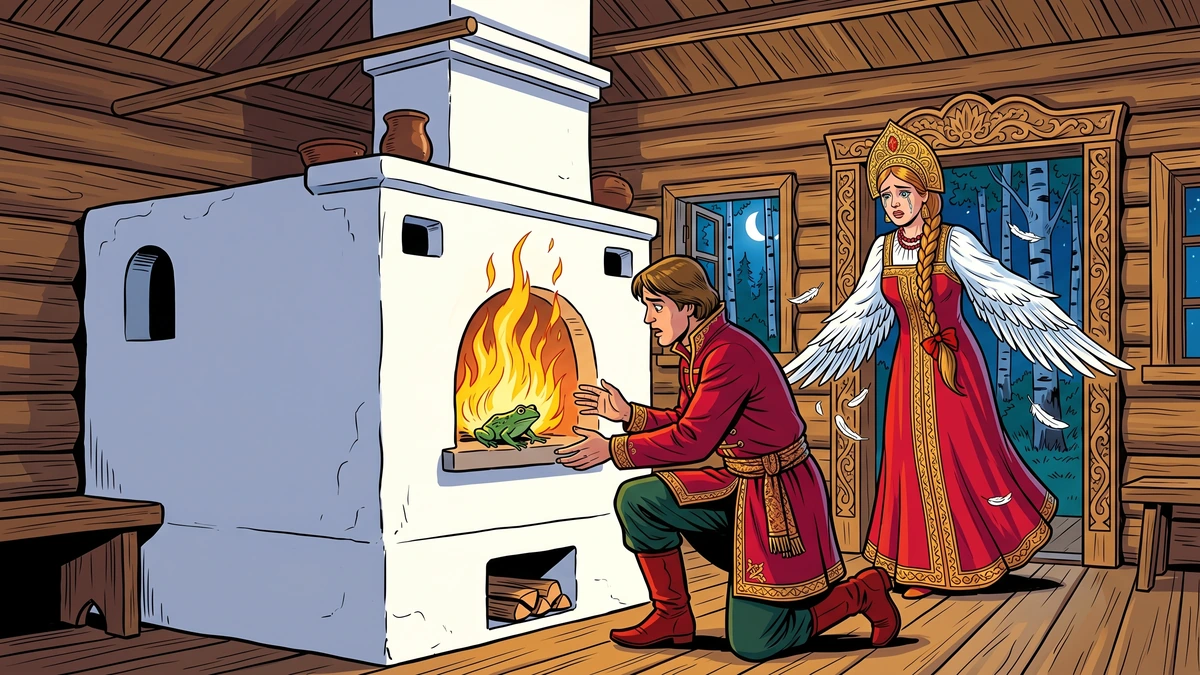
IV. The Quest for Koschei the Deathless
The final movement of the tale carries Ivan Tsarevich into the geography of Russian myth itself. He pulls on iron boots, takes an iron staff, and walks “beyond the thrice-ninth land, into the thrice-tenth tsardom” (za tridevyat’ zemel’, v tridesyatoe tsarstvo) — the standard Old Russian folktale formula for the otherworld. At the edge of the dark forest he meets an old man, white as a dove, who gives him a magic ball of yarn (klubochek) which rolls before him and shows the way. He encounters in succession a bear, a hare, a drake (or eagle in variant 268), and a great pike — each of which he spares from death or hunger, and each of which will rescue him in the hour of need. He arrives at last at the hut on chicken-legs of Baba-Yaga, the bone-leg crone who is, by turns, devourer and helper. She tells him the secret known across the Russian wonder-tale corpus: “Smert’ Koshcheeva na kontse igly, igla v yaytse, yaytso v utke, utka v zaytse, zayats v sunduke, sunduk na dube, dub na ostrove Buyane v Okiyane-more” — “Koschei’s death is at the point of a needle, the needle in an egg, the egg in a duck, the duck in a hare, the hare in an iron chest, the chest on an oak, the oak on the island Buyan in the Ocean-Sea.” The nested-death motif (Thompson E711.1, E765.3.1) is one of the oldest layers in Indo-European mythology, with cognates in the Egyptian Tale of the Two Brothers (Papyrus d’Orbiney, 13th century BC), the Avestan Yima, the Welsh story of Llwyd ap Cilcoed in the Mabinogion, and the Indian Brihatkatha; it survives into the Russian wonder-tale as Koschei’s death-in-the-egg. Ivan, with the help of the bear (who topples the oak), the hare (who catches the hare-within), the drake (who seizes the duck), and the pike (who finds the egg in the sea), holds at last the needle in his hand. He breaks its point; Koschei stumbles and dies; Vasilisa Premudraya runs to her husband, and the two return to the tsar’s palace, where Ivan inherits the throne. The closing formula in Afanasyev’s third variant (No. 269) is the standard Russian wonder-tale coda: «Я там был, мёд-пиво пил, по усам текло, а в рот не попало» — “I was there too, drank mead and beer; it flowed down my whiskers, but never a drop went into my mouth.” The teller, like the listener, stays on this side of the threshold; only Ivan and Vasilisa pass.
The Moral — Утро вечера мудренее
«Ложись, Иван-Царевич, спать; утро вечера мудренее.»
“Lie down to sleep, Ivan Tsarevich; the morning is wiser than the evening.”
— Tsarevna-Lyagushka, Afanasyev No. 267 (Polevoi translation, 1915)
The ethical core of the tale is not the conquest of Koschei but the patience that Ivan must learn between the bedchamber and the burned skin. Utro vechera mudrenee — “the morning is wiser than the evening” — is the proverb the Russian people have hung over every door of haste for at least four hundred years (cited as a saying in V. I. Dahl’s 1862 collection Poslovitsy russkago naroda, p. 24). It tells us that decisions taken in fatigue, in possessive love, in fear that the marvel will vanish, are precisely the decisions that destroy the marvel. The frog-skin was not the obstacle to Ivan’s happiness; it was its protective sheath. Had he waited three days more, the enchantment would have completed itself in his own house, with no journey to the thrice-tenth kingdom, no iron boots worn through, no bargain with Baba-Yaga in the bone-fence yard. The whole long Northern winter of his quest is the price of one impatient evening. To know which loves are still becoming, and to leave them their time to become, is the great difficult wisdom that the Russian tale-tellers stitched into the warty skin of the frog at the swamp-edge.
Why the Frog Tsarevna Has Lasted
The tale’s grip on Russian and world imagination is older and deeper than literature. It is the type-story of the East Slavic volshebnaya skazka, the wonder-tale that Propp dissected in 1928 and made into the founding object of structuralist folkloristics. It is the story behind every Russian girl’s name Vasilisa and every line of P. I. Tchaikovsky’s never-finished frog opera (sketched 1881, see Tchaikovsky-Glazunov correspondence in Russkaya muzykal’naya gazeta 1898). It is the canvas on which Ivan Bilibin painted his most famous illustrations (1899–1901, Goznak edition), with Vasilisa standing tall in her gold kokoshnik and Koschei withered black on his throne of bones. It is the source-tale of Stravinsky’s The Firebird (1910), of Vasily Polenov’s painted curtains for Mamontov’s Private Opera, and of every Soviet Soyuzmultfilm cartoon (V. Brumberg’s 1954 Tsarevna-Lyagushka animation in particular). Its ATU 402 cognates are the German Three Feathers (KHM 63), the Italian The Snake (Calvino No. 28), the Swedish The Mouse Bride, the Burmese Princess Padmavati, the Filipino Pina; but it is the Russian frog-skin and the burned-skin tragedy that gave the type its name and its narrative gravity. Above all the tale endures because it asks a question every reader still feels: what becomes of love when we cannot bear to let it complete its own becoming? The answer the storyteller gives is severe and sweet at once: it does not die, but it must be sought to the world’s end and won back with broken iron boots and the help of every animal you remembered to be kind to. The morning, the proverb says, is wiser than the evening. The frog at the swamp-edge keeps repeating it. It has lasted because we still need to be told.
Frequently Asked Questions about The Tsarevna Frog
Who originally collected and published the Russian Tsarevna Frog tale?
The tale was set down by the Russian folklorist Aleksandr Nikolayevich Afanasyev (1826–1871) in his eight-volume Narodnye russkie skazki (Russian Folk Tales), published 1855–1863 — the foundational corpus of Russian folklore that did for Russia what the Brothers Grimm did for Germany. The three frog-bride variants appear in Afanasyev’s collection as Nos. 86 a–c (tales 267–269 in the standard Propp-edited 1957 redaction). The English text widely read today is the Peter Polevoi translation (St Petersburg, 1915), reproduced and re-translated in Norbert Guterman’s 1945 Pantheon edition Russian Fairy Tales, illustrated by Alexander Alexeieff and with commentary by Roman Jakobson.
What is the international ATU classification of the Tsarevna Frog?
The tale is classified as ATU 402 — The Animal Bride in the Aarne–Thompson–Uther index (Uther 2004, vol. I, pp. 235–237), and as SUS 402 (Tsarevna-Lyagushka) in the East Slavic Folktale Catalogue compiled by Barag, Berezovsky, Kabashnikov and Novikov (Leningrad, 1979). In Stith Thompson’s motif-index it gathers under B604.1 (Marriage to frog), D195 (Transformation: man to frog), D721.3 (Disenchantment by destroying skin), and E765.3.1 (Life dependent on egg in box, box in duck, duck in hare, hare in casket on oak). Cognate type-tales include the German Three Feathers (KHM 63), the Italian The Snake (Calvino No. 28), the Swedish Mouse Bride and the Burmese Princess Padmavati.
What is the symbolic meaning of the frog-skin and why does Ivan burn it?
Roman Jakobson’s commentary (Pantheon, 1945, pp. 661–671) reads the frog-skin as the ritual membrane between this world (etot svet) and the otherworld (tot svet). Vasilisa is bound to wear it for three days more before her enchantment completes itself in Ivan’s own house. Ivan’s destruction of the skin is not unbelief but its opposite — too possessive a love, too eager to bind the marvel to himself. In Russian Orthodox folk theology (cf. N. I. Tolstoy, Slavyanskaya etnolingvistika, 1995, vol. III, pp. 174–185), the soul leaves the body for three days before judgment; the three-day interval is a cosmic threshold that cannot be hurried. The tabu of offending the supernatural relative is catalogued by Stith Thompson as C30, with cognates in the Norse selkie tradition, the Welsh Rhiannon-and-Pwyll cycle of the Mabinogion, and the Japanese Crane-Wife (Tsuru no ongaeshi).
Where exactly is Koschei the Deathless’s death hidden, and what does the formula mean?
Baba-Yaga gives Ivan the canonical Russian wonder-tale formula: Koschei’s death is at the point of a needle, the needle in an egg, the egg in a duck, the duck in a hare, the hare in an iron chest, the chest on an oak, the oak on the island Buyan in the Ocean-Sea. The nested-death motif (Thompson E711.1 and E765.3.1) is among the oldest layers of Indo-European mythology, with cognates in the Egyptian Tale of the Two Brothers (Papyrus d’Orbiney, 13th century BC), the Avestan Yima cycle, the Welsh Llwyd ap Cilcoed in the Mabinogion, and the Indian Brihatkatha. The island of Buyan in Russian folk cosmology is the great mythic island in the Ocean-Sea where the world-axis stands; on it grows the oak that is the cosmic tree, and in its heart lies the death-egg of the deathless tsar.
What is the proverb Utro vechera mudrenee, and what does it teach the listener?
Utro vechera mudrenee — literally ‘the morning is wiser than the evening’ — is Vasilisa’s recurring counsel to Ivan and one of the most quoted lines in the Russian language. It is recorded as a national proverb in V. I. Dahl’s 1862 collection Poslovitsy russkago naroda and survives unchanged through every modern edition. Its teaching in the tale is precise: decisions taken in fatigue, in fear that the marvel will vanish, in the impatient grip of possessive love, are precisely the decisions that destroy the marvel. The whole long Northern winter of Ivan’s quest across the thrice-ninth land to the thrice-tenth kingdom is the price he pays for one impatient evening. To know which loves are still becoming, and to leave them their time to become, is the difficult wisdom the Russian tale-tellers stitched into the warty skin at the swamp-edge.
You May Also Like
 Russian Folk Tales
Ages 9-12
Russian Folk Tales
Ages 9-12
The Firebird, the Horse of Power, and Princess Vasilisa
The Firebird, the Horse of Power, and Princess Vasilisa: In the days when the Russian steppes stretched endless as the sea, there lived a poor archer named
 Russian Folk Tales
All Ages
Russian Folk Tales
All Ages
Woe Bogotir
A Russian peasant folk tale of two brothers — one rich, one poor — and how the poor one outwits Woe (Gore), the gaunt grey personification of Misfortune who has come to live in his house. Translated by Verra Xenophontovna Kalamatiano de Blumenthal in Folk Tales from the Russian (1903) from Afanasyev's Narodnye russkie skazki. ATU 735A 'Bad Luck Imprisoned.'
 Russian Folk Tales
Ages 9-12
Russian Folk Tales
Ages 9-12
The Frog Princess: A Tale of Love and Redemption
The Frog Princess: A Tale of Love and Redemption: In the days when magic still dwelt in the forests of ancient Russia, there lived a noble archer named Ivan