Sadko the Rich Merchant: Echoes from the Deep
Sadko the Rich Merchant: Echoes from the Deep: In the ancient city of Novgorod, where the Volkhov River flowed like a ribbon of silver through the land, there
Sadko the Rich Merchant: Echoes from the Deep is one of the most beloved byliny (oral heroic poems) of the Novgorod cycle of medieval Russian folk literature. Catalogued as Aarne-Thompson-Uther tale type ATU 677*, “Below the Sea,” the bylina has been preserved through generations of skomorokhi (wandering minstrels) and was committed to written form in the great folk-tale compilations of Alexander Afanasyev (Narodnye russkie skazki, 1855–1864, tales 219–226) and later set as the celebrated opera-bylina “Садко” (Sadko) by Nikolai Rimsky-Korsakov in 1898, with a libretto compiled from Sadko, the Rich Trader, The Tale of the Sea King and the Wise Vasilisa, and the apocryphal Book of the Dove (Golubinaya Kniga). The titular hero may echo a historical Sotko Sytinich, recorded in the Novgorod First Chronicle as patron of the Church of Boris and Gleb in the Novgorodian Detinets, built in 1167.
The Gusli by the Volkhov
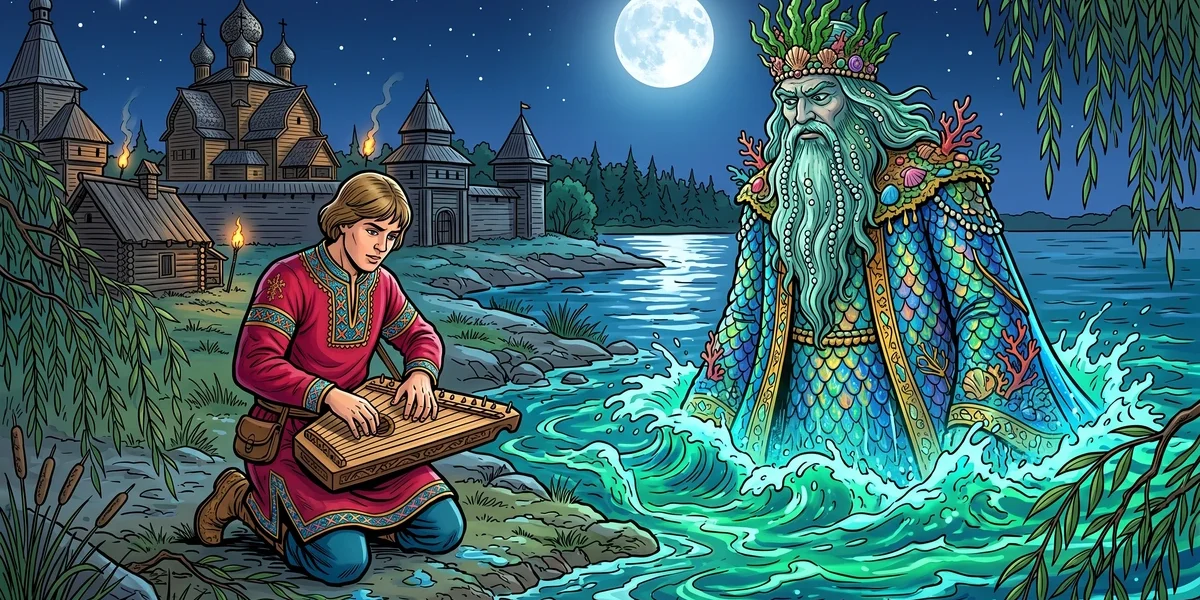
In the ancient city of Novgorod the Great, where the Volkhov River flowed like a ribbon of silver through the land, there lived a musician whose name would become legend: Sadko. He was not born to wealth, nor did he come from a family of nobility. He was born to a poor craftsman and a weaver’s daughter, and his only inheritance was a wooden gusli – a flat, harp-like stringed instrument sacred to the singers of Rus’ – that had been carved from a single piece of pine by his grandfather’s hands.
From childhood, Sadko showed gifts that money could not buy. His fingers moved across the strings of the gusli as if guided by spirits, and his melodies seemed to carry the voice of the land itself – the rustling of the birch forests, the murmur of the Ilmen Lake, the sigh of the snow upon the steppes. He played at weddings and festivals, earning mere kopecks for his performances, living hand to mouth, owning nothing but his instrument and the clothes on his back.
Yet there was magic in his music, a magic so profound that even the wealthy merchants who ruled Novgorod – the famous kuptsy of the boyar republic – would sometimes pause in their counting of gold to listen to a Sadko melody drifting through the streets. Among these merchants was one named Vasily, whose wealth was legendary, whose ships covered the Baltic and the Caspian, whose warehouses held silks from Bukhara, furs from Yugra, amber from the Varangian shore, and wine from Byzantine vineyards.
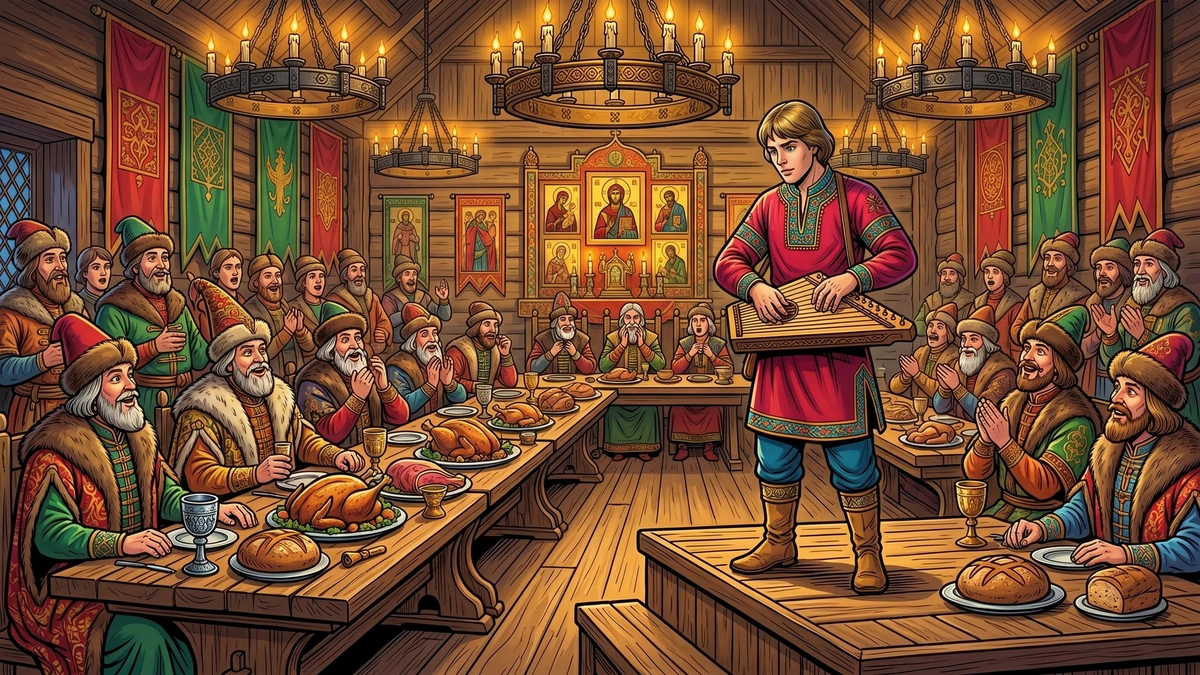
One evening, as Sadko played in the marketplace near the river, Vasily heard him and stopped in his tracks. The merchant stood listening for an hour, his face unreadable, and when Sadko had finished, Vasily approached him. “Your music is extraordinary,” said the great merchant. “I have travelled the world and heard musicians from distant lands, yet never have I heard anything to equal what you play. I will make you a wager: play for my guests at a grand feast I am hosting tomorrow. If they enjoy your music, I will give you ten gold rubli. If they do not, you forfeit your gusli to me as punishment.”
Sadko, though the stakes were terrifying – for his gusli was the one thing he loved – accepted the bargain. The next evening he played beneath the chandeliers of Vasily’s hall before merchants, princes, and visiting envoys. He played until grown men wept, until proud merchants pressed coins into his hand, until even Vasily himself sat speechless, his face transformed. The wager was won, but Sadko’s pride had been wounded by being made a spectacle of trial. He left the feast with his coins and his shame intertwined, and walked alone to the shore of Lake Ilmen.
The Bargain with the Sea King
By the dark waters of Lake Ilmen, where willows trailed in the current and the moon lay shattered on the surface, Sadko sat upon a stone and began to play. He played not for coin nor for crowd, but for his own bruised soul. The notes drifted across the water like prayers, and the night listened. He played for hours, until the surface of the lake began to tremble, until ripples spread outward as though some great body moved beneath the deep, until the water rose in a column of pale green light and the figure of an old man emerged, crowned with seaweed, robed in shimmering scales, his beard a cascade of pearls.
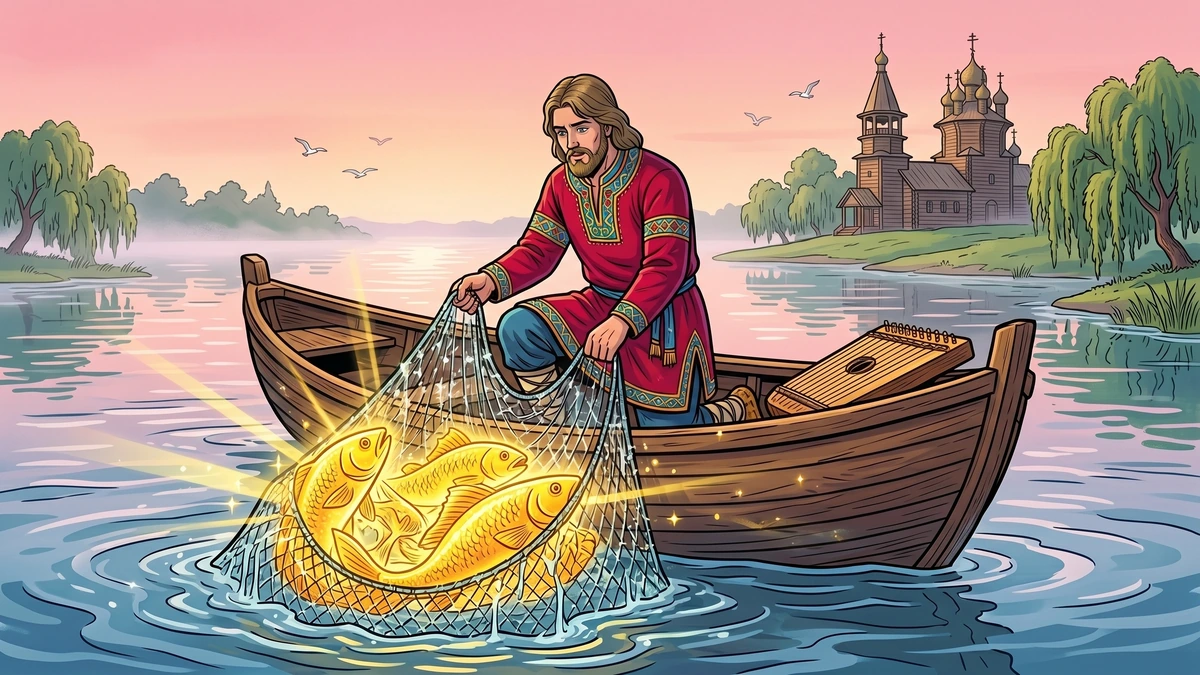
This was Morskoy Tsar, the Sea Tsar of all Russian waters – the lord of the rivers and lakes, who in older days had been worshipped by the Slavs alongside Perun the Thunderer and Volos the Cattle-Lord. “Sadko,” he said in a voice like distant thunder beneath ice, “your music has reached me even in my coral halls beneath the lake. For three nights I have listened. Tonight I have risen to thank you. Cast your net into the lake tomorrow, and you shall pull up a golden-finned fish. Sell that fish in the Novgorod market, and you shall become the richest man in all the Russian lands. Only remember: a gift demands a gift. Remember the Sea Tsar in the day of your good fortune.”
The vision sank back into the water, and Sadko, half-believing he had dreamed, returned home. But the next morning he cast a borrowed net into the lake, and on the very first throw he hauled in three fish whose fins were veined in living gold. The Novgorod merchants who saw them paid a fortune; Sadko bought ships, then more ships, then warehouses, then trading posts along the Volga and the Dnieper. Within seven years he had become Sadko Bogatyy Gost’ – Sadko the Wealthy Guest – the richest man Novgorod had ever known, with thirty white-sailed ships carrying his goods to Constantinople and Visby and the markets of the Saracens.
And yet, in the rush of fortune, Sadko forgot the Sea Tsar. He paid no offerings, sang no songs upon the shore, raised no candle to the icon of Saint Nicholas the protector of sailors. He grew proud in the boyar council; he wagered, in a moment of boast, that he could buy every commodity in all the markets of Novgorod – and when on the second day he found a market mysteriously refilled with goods from Moscow, he understood, dimly, that some patient power was watching him still.
The Storm and the Coral Court
The years passed in heedless prosperity, until at last Sadko set sail across the Caspian and the open sea with his fleet of thirty ships. The voyage prospered – chests filled with foreign gold, fine glass, silver-threaded cloth – but on the homeward journey a great storm rose without warning. The waves climbed mast-high, the wind tore the sails, and yet only Sadko’s flagship lay strangely motionless, as though held in place by an invisible hand. The sailors crossed themselves in terror. “We have angered something in the deep,” they whispered, “and it asks a tribute.”
Sadko cast gold into the waves; the ships did not stir. He cast a barrel of pearls; nothing. He cast a chest of his finest cloth; nothing. At last he ordered lots to be drawn, and three times the lot fell to him – Sadko himself. The Sea Tsar had remembered. The Sea Tsar had come to collect his gift. Sadko, with the weariness of one who has long known the debt was owing, took his gusli, stepped onto an oaken plank, and slipped over the side of his ship into the green roaring sea. The storm ceased at once. His fleet sailed safely home without him.
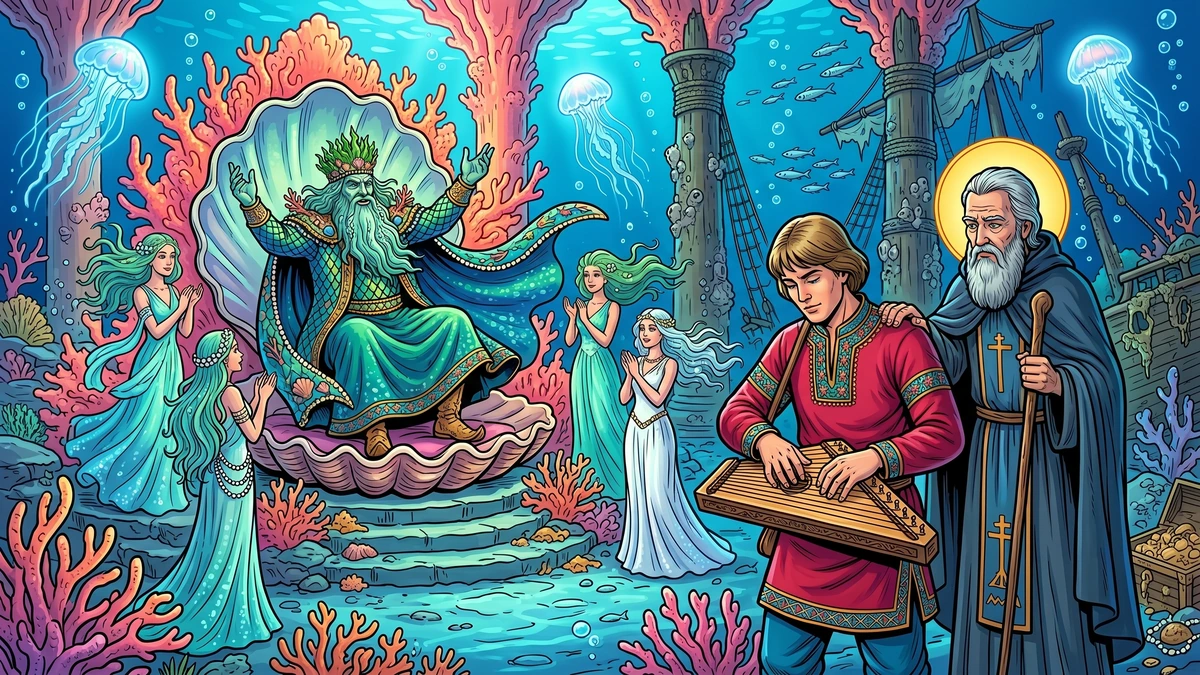
Sadko sank, not into drowning, but into a strange, slow dream. The waters parted around him; the cold deep grew warm; and at last his feet touched a floor of mother-of-pearl. He stood within the palace of the Sea Tsar himself, whose hall was lit by phosphorescent corals, whose pillars were the masts of sunken ships, whose throne was a great open shell. Around him sat the daughters of the Sea Tsar – princesses of rivers and seas, of the Volga and the Don, the Caspian and the White Sea – beautiful and strange, with hair of pale water-weed and eyes the colour of glaciers.
“Play, Sadko,” commanded the Sea Tsar, “as you have never played before.” And Sadko played. He played a dance so fierce and joyous that the Sea Tsar leapt up and danced too, his enormous bulk shaking the foundations of the deep. The waves above grew wild; ships on the surface broke apart; sailors cried out to the saints. In the upper world the storm raged so terribly that even hardened Pomor seamen prayed for deliverance, and an old monk named Mikola of Mozhaisk – Saint Nicholas himself, patron of mariners – appeared in vision among them.
The Return to Novgorod
Beneath the waves, Sadko felt a hand fall upon his shoulder. He turned and saw the same old monk standing beside him in the coral hall – grey-bearded, calm-eyed, a wooden staff in his hand. “Sadko,” said Saint Nicholas softly, so that the dancing tsar should not hear, “break the strings of your gusli. While you play, ships are dying on the surface and widows weep in every harbour. Break the strings and the dancing will end.”
With one swift movement Sadko snapped the strings of his beloved gusli. The music stopped; the Sea Tsar stumbled and fell laughing upon his throne. “You play no more, Sadko? Then you shall stay here and marry one of my daughters, and rule beside me in the deep forever.” The saint whispered again: “Choose the last and least of them, the quiet one called Chernava, named for the dark river. And when you wake in her arms tomorrow, breathe upon her once and she will become the river itself, and you shall be carried home.”
Three hundred princesses passed before Sadko – glittering, pearl-clad, jewel-eyed – and he chose, as the saint had said, the quiet Chernava who looked at him with the steady gaze of one who knows the way home. That night they lay side by side, and at dawn Sadko opened his eyes upon the green banks of the Chernava River, just outside the gates of Novgorod, while his bride flowed away beneath him as living water, returning to her father’s kingdom forever.
His wife in Novgorod, his children, his servants, his ships – all stood weeping upon the wharf, for they had given him up for drowned. He embraced them, gave thanks at the church of Saint Nicholas, broke his old gusli upon the altar as an offering, and from that day forward devoted half of his enormous wealth to the poor of the city and to the building of churches – including, the chroniclers say, the very Church of Boris and Gleb in the Novgorodian kremlin, raised by one Sotko Sytinich in the year 1167. Never again did Sadko forget the gift of the Sea King. Never again did he set sail without first kneeling on the shore.
The Moral
“Не забывай реку, что напоила тебя.”
— “Do not forget the river that gave you drink.” (Old Novgorod proverb)
The bylina of Sadko teaches that prosperity is never a private possession. Every fortune is a gift drawn from a deeper source – a teacher, a homeland, a tradition, a community, an act of grace one did nothing to deserve – and the soul that forgets the giver invites the storm. Sadko’s wealth came from the patient generosity of the Sea Tsar; his rescue came from the patient mercy of Saint Nicholas; his return was paid for by the silent sacrifice of a princess who chose to flow back into the water rather than keep him. Gratitude, in this tale, is not a sentiment but a survival skill. To remember is to live; to forget is to drown.
Historical & Cultural Context
The byliny of the Novgorod cycle are unique within Russian heroic poetry. While the Kievan cycle celebrates warrior bogatyri – Ilya Muromets, Dobrynya Nikitich, Alyosha Popovich – the Novgorod cycle reflects the mercantile, seafaring, republican character of medieval Lord Novgorod the Great (Gospodin Velikiy Novgorod), the trading city that ruled a vast northern empire from 1136 to 1478 and traded freely with the Hanseatic League. Sadko is the merchant-hero of that world, a counterpoint to the saddle-bound knight-heroes of the steppe.
The figure of the Sea Tsar (Morskoy Tsar or Vodyanoy Tsar) preserves pre-Christian Slavic water deities: the vodyanoy who claims drowned men, the rusalki who dance at midsummer, the patient bargain-keepers of every Russian lake. The intervention of Saint Nicholas of Myra – Nikola Ugodnik, the most beloved saint of the Russian Orthodox folk church and patron of sailors – grafts a Christian rescue onto an older pagan substrate, a layering visible everywhere in Slavic folklore. Maxim Gorky called the byliny “the great voice of pre-literate Russia,” and Vladimir Stasov, the critic who helped Rimsky-Korsakov shape his libretto, considered Sadko “the most operatic of all our folk poems.”
Why the Tale Has Lasted
For over eight centuries this bylina has been sung in northern Russian villages, recited by Pomor sailors before voyages, painted by Ilya Repin, set to orchestra by Rimsky-Korsakov, animated by the Soyuzmultfilm studios in 1953, and filmed by Aleksandr Ptushko in his 1952 cinema epic Sadko. It has endured because every age contains its Sadko – the gifted person whose fortune comes suddenly, who forgets the source, who must one day be reminded by storm. The image of a man playing a stringed instrument so beautifully that the lord of the deep rises to dance with him is one of the great metaphors of all folk literature: art reaching across the boundary between worlds, music as the original bargaining chip of the human soul, and gratitude as the only string strong enough to bring us home.
You May Also Like
 Russian Folk Tales
Ages 9-12
Russian Folk Tales
Ages 9-12
The Frog Princess: A Tale of Love and Redemption
The Frog Princess: A Tale of Love and Redemption: In the days when magic still dwelt in the forests of ancient Russia, there lived a noble archer named Ivan
 Russian Folk Tales
All Ages
Russian Folk Tales
All Ages
The Tsarevna Frog
The Tsarevna Frog: [Illustration] In an old, old Russian tsarstvo, I do not know when, there lived a sovereign prince with the princess his wife. They had
 Russian Folk Tales
Ages 9-12
Russian Folk Tales
Ages 9-12
Koschei the Deathless
Koschei the Deathless: In the times before time itself was properly counted, when magic was as common as earth and water, there arose a sorcerer of such