The Snow Maiden (Snegurochka)
A childless old couple build a snow girl who comes to life, but when they cheat the fox who saved her, she hears that a hen matters more and melts away.
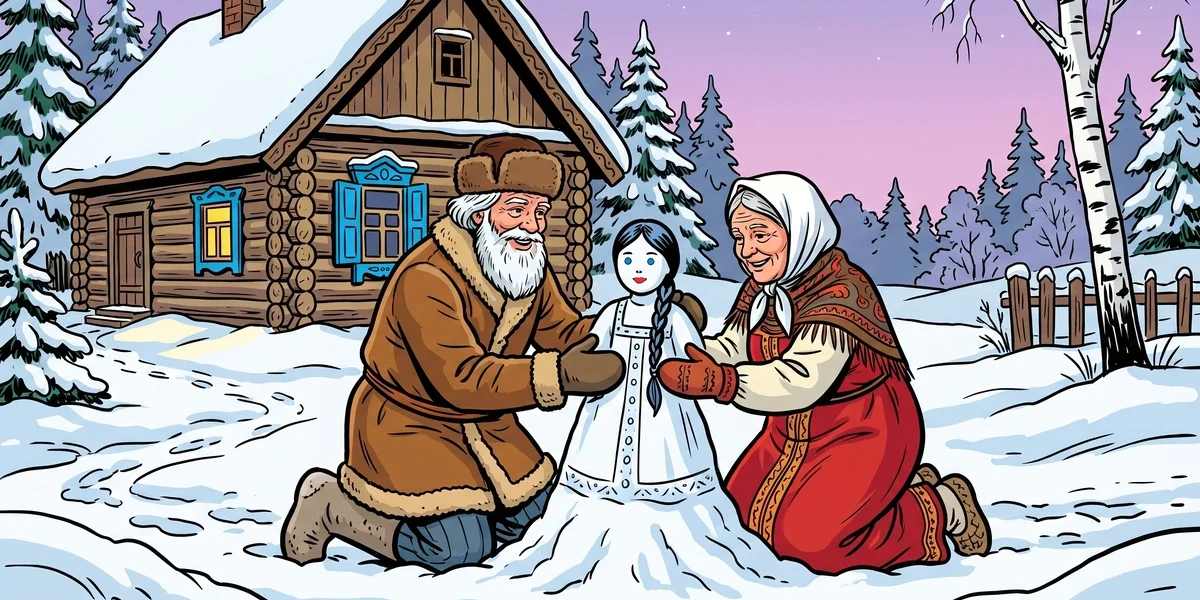
In a village at the edge of the forest lived an old man and his old wife. It was a busy little place, with eight huts and thirty or forty people, plenty of neighbours to chat with on the road. Yet the old couple were sad, because they had no children. Every other hut had babies inside and little ones tumbling about in the road who had to be shouted out of the way of passing sledges. In their hut there was nobody, and the old woman never had to run to the door to see where a child had wandered off to.
So the two of them spent hours at their window watching other people’s children play. They had dogs, a cat, a rooster and hens, but none of these made up for what was missing. When the dogs barked, the old people did not notice. When the cat curled up against them, they did not feel her. The hens were fed, and that was all. Their eyes were always on the children outside.
One winter the village children, bundled in little sheepskin coats, were playing in the crisp snow. They pelted each other with snowballs, shrieked with laughter, and rolled the snow into a snow woman, a frightful old snow witch. The old man watched from the window and said, “Wife, let’s go into the back yard and make a little snow girl. Perhaps she will come alive and be a daughter to us.” “Husband,” said the old woman, “who knows what may happen? Let’s make one.”
They put on their big coats and fur hats and went out into the yard where no one could see them. Very gently they rolled the snow and shaped her little arms and legs, and with heaven’s help their snow girl came out more beautiful than anyone could imagine, lovelier than a birch tree in spring. By evening she was finished: a little girl made all of snow, with blank white eyes and a small mouth with its snowy lips pressed shut.
“Oh, speak to us,” begged the old man. “Won’t you run about like the other children, little white dove?” asked the old woman.
And she did. In the dusk her eyes suddenly shone as blue as a clear sky. Her lips turned pink and parted in a smile that showed little white teeth, and she had black hair that stirred in the breeze. She began to dance in the snow like a small white spirit, tossing her hair and laughing softly, whirling like snowflakes in the wind, while the old people stared and gave thanks.
As she danced she sang. In her song she told them there was no warm blood in her, only water running through her veins, yet she would laugh and play through every frosty night and frosty day. But if she ever found out that they loved her only a little, she would melt and go back up into the sky, for she was the little daughter of the Snow.
“Heavens, isn’t she beautiful!” said the old man. “Run, wife, fetch a blanket to wrap her in while you sew her some clothes.” The old woman put a blanket round the snow girl’s shoulders, and the old man lifted her up. She put her cold little arms round his neck. “You mustn’t keep me too warm,” she said.
They carried her inside and laid her on the bench in the corner farthest from the stove while the old woman made her a coat. The old man went to a neighbour to buy a fur hat and boots. The neighbour laughed at him, but a rouble is a rouble anywhere, so he sold him a little fur hat and a pair of red boots trimmed with fur.
When they had dressed her, the snow girl said, “Too hot, too hot! I have to go out into the cool night.” “But it’s time for you to sleep,” said the old woman. “By frosty night and frosty day,” sang the girl. “No, I’ll play in the yard by myself all night, and in the morning I’ll play in the road with the children.” Nothing they said could change her mind. To every argument she answered, “I am the little daughter of the Snow,” and out she ran.
How she danced and raced about in the moonlight on the frozen snow! The old people watched until at last they went to bed, but the old man got up more than once to check that she was still there. Each time, there she was, chasing her shadow under the moon and throwing snowballs at the stars.
In the morning she came in laughing for breakfast and showed them how to make her porridge. It was very easy: they just crushed a lump of ice in a little wooden bowl. Then she ran out to the road to play, and the old people watched with enormous pride. They almost wished a sledge would come along so they could rush out and call to her to be careful.
She played better than anyone. She could outrun every child in the village, her red boots flashing as she went, and nobody could beat her at snowballs. When the children built a snow witch, she laughed so hard you would have thought she would burst, a laugh like little glass bells ringing, yet she helped build it, still giggling, and when it was done she threw more snowballs at it than anyone until it fell apart. “She’s all our own,” said the old woman. “Our little white dove,” said the old man.
In the evening she ate another bowl of ice porridge and ran out again. “You’ll be worn out, my dear,” said the old man. “Won’t you sleep inside tonight, love, after running about all day?” asked the old woman. But she only laughed, sang “By frosty night and frosty day,” and dashed out of the door, looking back at them with shining eyes.
So it went all winter. She sang and laughed and danced, played alone outside every night till dawn, ate her ice porridge, played with the children, ate again, and went back out into the dark. She was very good and did whatever the old woman asked, except that she would never sleep indoors. All the village children loved her and could not remember how they had ever played without her.
Things went on like this until the end of winter, when the snow was melting and the paths were clear enough to walk on. On sunny afternoons the children often wandered a little way into the forest together, and the snow girl always went too, since it was no fun without her. One day they went too far. When the others said it was time to turn back, she tossed her head under her fur hat and ran on laughing among the trees. The other children were too scared to follow. Dusk was coming. They waited as long as they dared, then ran home holding hands.
The snow girl looked round for her friends and could not see them. She climbed a tree, but the forest was so thick that she could see no farther than from the ground. “Ai, ai, little friends,” she called, “have pity on the snow girl!”
An old brown bear heard her and came lumbering up. “Why are you crying, little daughter of the Snow?” “How can I help it, big bear? I’ve lost my way, night is coming, and all my friends have gone.” “I’ll take you home,” said the bear. “I’m afraid of you, big bear. I think you would eat me. I’d rather go home with someone else.” So the bear shuffled off.
An old grey wolf came racing up and asked the same question, and she gave the same answer: she was lost, it was getting dark, her friends were gone. When he offered to take her home, she told him she was afraid he would eat her and would rather go with someone else. So the wolf loped away.
Then an old red fox came trotting up on his little paws and called out cheerfully, “Why are you crying, little daughter of the Snow?” She told him, and it was quite dark by now. “I’ll take you home,” said the fox. “I’m not afraid of you, red fox,” she said. “I don’t think you’ll eat me. I’ll go with you if you’ll take me.” She scrambled down, held on to the fur on his back, and they ran together through the black forest until they saw lights in the windows of the huts and reached the old couple’s door.
Inside, the old man and woman were weeping. “Oh, what has happened to our snow girl? Where is our little white dove?” “Here I am,” she said. “The kind red fox brought me home. You must shut up the dogs.” The old man shut them up and thanked the fox. “Do you really mean that?” said the fox. “Because I’m very hungry.” “Here’s a nice crust for you,” said the old woman. “Oh,” said the fox, “what I’d really like is a nice plump hen. Your snow girl is surely worth a plump hen.”
“Very well,” said the old woman, but she grumbled to her husband. “We’ve got our girl back.” “We have, thank heaven.” “It seems a waste to give away a good fat hen.” “It does.” “Well, I’ve been thinking,” she said, and told him her plan. He fetched two sacks. In one they put a plump hen and in the other the fiercest of their dogs. They carried the sacks outside and called the fox, who came up licking his lips. They opened the first sack and out fluttered the hen. Just as the fox was about to pounce, they opened the second, and out leapt the dog. When the fox saw its eyes blazing in the dark, he was so terrified that he fled all the way back to the deep forest without the hen.
“Well done,” said the old couple to each other. “We have our snow girl, and we kept our hen.”
Then they heard her singing inside the hut. Now her song said that she knew they loved her less than a hen, so she was going away. She bid the old ones goodbye and said she was going back across the sky to her mother, the little daughter of the Snow.
They rushed in. In front of the stove lay a little puddle of water, and in it were a fur hat, a little coat and a pair of red boots. Yet it seemed to the old people that they could still see her dancing about the room with her bright eyes and long hair. “Don’t go! Don’t go!” they pleaded, but they could hardly see her anymore. They heard her laugh and heard her sing once more that because they loved her less than a hen she would melt away and go to her mother. At that moment the door from the yard blew open, a cold wind swept through the room, and the little daughter of the Snow was gone.
Old Peter always finishes the tale this way: the snow girl jumped into the arms of her father Frost and her mother Snow, and they carried her over the stars to the far north, where she plays on the frozen seas all summer long. In winter she comes back to Russia, and one day, when you are building a snow woman, you might find the little daughter of the Snow standing there instead.
Where this tale comes from
This story appears in Arthur Ransome’s Old Peter’s Russian Tales (New York: Frederick A. Stokes) as “The Little Daughter of the Snow.” Old Peter tells it to his grandchildren Vanya and Maroosia as winter is ending. In the book the snow girl sings two short rhymed songs, one when she first wakes and one when she leaves. This telling gives their meaning in prose instead of quoting them.
Ransome’s snow girl eats porridge made of crushed ice and will not sleep indoors. It is the old couple’s trick on the fox, not the spring thaw, that makes her melt. Peter adds a closing picture of Frost and Snow as her father and mother, and that is kept here too.
Read the original: Arthur Ransome, Old Peter’s Russian Tales (Project Gutenberg #16981)
Suggested for ages 9–12 with an adult: includes a lost child, a threatened animal and the snow girl’s disappearance, leaving her carers grieving.
The rescue tests the opening song
The couple are delighted to have a child, but the fox’s request asks them to turn gratitude into action. They agree to give him a hen and then release a dog against him. The snow girl has also specifically asked them to shut up the dogs. Their trick therefore breaks both the reward agreement and the safety she requested for her helper.
Her melting makes that breach visible in the story’s magical language. It is not a rule that a child’s death or a family’s loss measures how much someone loved. Peter’s final picture gives the girl another home, even while the empty clothes leave the couple grieving.
Compare two kinds of care
Choose one scene where the couple adapt to the girl’s needs, such as the ice porridge, and one where they ignore her request. Write an alternative exchange with the fox in which they either keep their promise or honestly discuss a different reward before agreeing.
Think about it
- What does the snow girl warn the old couple about in her first song?
- Why does the snow girl trust the fox when she refuses the bear and the wolf?
- Was the old couple’s trick on the fox clever or a mistake? Use the ending to explain your answer.
Related stories
- Father Frost — another Russian winter tale where Frost rewards kindness
- Morozko — Frost tests two very different girls in the snowy forest
- Sadko — another Ransome tale with a bittersweet, magical ending
Also known as: Snegurochka
Frequently Asked Questions
Who is the Snow Maiden?
Does she melt because of spring?
Who are her father and mother?
You May Also Like
 Russian Folk Tales
Ages 9-12
Russian Folk Tales
Ages 9-12
Morozko
Abandoned in the freezing fields, a stepdaughter receives gifts from Morozko; her stepmother sends her own daughter after riches, with a fatal result.
 Russian Folk Tales
Sadko
A poor Novgorod dulcimer player is paid in jewels by the Tzar of the Sea, grows rich, and twelve years later must leap overboard to keep his promise.
 Russian Folk Tales
The Golden Mountain
Tricked into digging gold on a mountaintop and left there to die, a ruined merchant's son escapes with a girl's gift and turns the trick on his master.