The Firebird and Princess Vasilisa
The Firebird and Princess Vasilisa: In the days when the world was young and magic flowed through forests like rivers of starlight, there lived a great Tsar

Russian Original: «Сказка об Иване-царевиче, жар-птице и о сером волке» (Skazka ob Ivane-tsareviche, zhar-ptitse i o serom volke, “The Tale of Ivan-Tsarevich, the Firebird and the Gray Wolf”), with its companion variant «Жар-птица и Василиса-царевна» (Zhar-ptitsa i Vasilisa-tsarevna, “The Firebird and Vasilisa-Tsarevna”). These twin Russian wonder-tales were among the most beloved fairy-tales in the Tsarist Empire, retold in pre-revolutionary picture-books, painted by Ivan Bilibin in his celebrated 1899–1902 series, and set to music by Igor Stravinsky in his 1910 ballet L’Oiseau de feu for Diaghilev’s Ballets Russes.
Canonical Source: Alexander Nikolayevich Afanasyev, Народные русские сказки (Narodnye russkie skazki / Russian Folk Tales), 8 vols., St Petersburg, 1855–1863 — tale no. 168 (“Ivan-Tsarevich, the Firebird and the Gray Wolf”), with the Vasilisa-Tsarevna sequence as a closely related variant. Afanasyev recorded the tale from a peasant teller in Kursk province; companion variants were gathered in Voronezh and Tambov. The story circulated in twentieth-century English in Post Wheeler’s Russian Wonder Tales (London 1912) and Arthur Ransome’s Old Peter’s Russian Tales (London 1916).
Tale-Type Classification: The story is catalogued in the Aarne-Thompson-Uther index as ATU 550 “Bird, Horse and Princess” (Search for the Golden Bird), the type whose German cousin is the Grimm Brothers’ KHM 57 Der goldene Vogel and whose Italian relative is the Pentamerone’s L’Acqua del bel parlare. In the East-Slavic SUS catalogue (Сравнительный указатель сюжетов восточнославянской сказки, Leningrad 1979) it appears as SUS 550 («Иван-царевич, Жар-птица и Серый Волк»). The motifs are catalogued in Stith Thompson’s Motif-Index as B435.1 (“Helpful wolf”), H1331.1.3 (“Quest for the Firebird”), and L161 (“Lowly hero marries princess”).
Cultural Frame: The Firebird (Жар-птица, Zhar-ptitsa — literally “Heat-bird” or “Glow-bird”) is one of the great supernatural figures of the Russian fairy-tale imagination: a creature of brilliant red, orange and gold plumage whose feathers shine in the dark like burning coals and whose appearance always inaugurates a heroic quest. The bird is descended from the older Slavic Rarog, a fiery falcon-spirit attested in pre-Christian East Slavic religion, and is the Russian counterpart to the Persian Simurgh and the medieval European phoenix. The Gray Wolf is one of the most loyal of all Russian fairy-tale helpers, the magical companion who carries Ivan-Tsarevich across thousand-verst distances on his back at supernatural speed.
The tale opens in the Russian fairy-tale grammar of “В некотором царстве, в некотором государстве” — “In a certain Tsardom, in a certain country” — that opening phrase by which every Russian listener of the 1850s would have known the storyteller was about to suspend ordinary geography and step into the world of the wonder-tale. A great Tsar named Vyslav Andronovich had three sons — Dmitri-Tsarevich, Vasili-Tsarevich and the youngest, Ivan-Tsarevich — and a magnificent walled garden in the centre of his palace grounds. In the middle of this garden grew a single apple-tree that bore apples of pure gold: яблоки золотые. The Russian peasant listener already recognised the apple-tree as a fragment of the Slavic tree of the world, the cosmic axis at the centre of every wonder-tale garden, and the golden apples as the fruit of paradise that an unauthorised intruder would shortly come to steal.
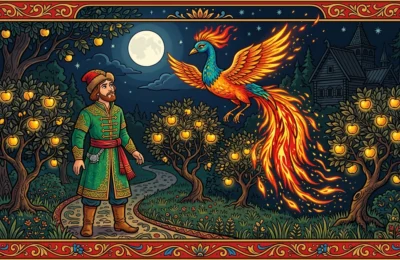
One autumn morning the Tsar’s gardener brought him bad news. A bird was visiting the golden apple-tree by night, and every dawn one more apple was missing. The Tsar set his sons to keep watch in turn. Dmitri-Tsarevich and Vasili-Tsarevich both fell asleep at their posts. But Ivan-Tsarevich, the youngest — the figure the storyteller calls Иванушка-дурачок, “little Ivan the simpleton,” with the deep Russian peasant irony that the youngest, the foolish and the lowly are always the ones to whom the supernatural reveals itself — kept his eyes open through the cold autumn night. And just before dawn the bird came.

The Firebird in the Apple-Tree
The narrator describes the arrival of the bird with the kind of breathless precision Russian wonder-tales reserve for the supernatural: “and the whole garden was suddenly so bright as if it had been lit by a great many lights and fires.” The Firebird’s feathers were the colour of red-hot iron and burning gold, her eyes the colour of oriental crystal, and the light from her body filled the garden as bright as noon. She came down through the branches of the golden apple-tree, plucked one of the apples in her beak — and Ivan-Tsarevich, hidden behind a bush with his hand stretched up, just caught hold of her tail. The Firebird flew up with a great cry, leaving a single feather in Ivan-Tsarevich’s hand.
The feather, the narrator says, was so bright that it lit the chamber of Ivan-Tsarevich’s bedroom all night without a candle. The Tsar examined it in the morning and pronounced his judgement: whichever of his three sons brought him the Firebird alive should inherit his throne. The three princes saddled their horses and rode out from the palace gates together — but as in every Russian wonder-tale, the older brothers turned off the road early into idleness and merrymaking, while Ivan-Tsarevich rode on alone toward the white pillar at the crossroads of the world.
The White Pillar and the Gray Wolf
The white pillar (столб) at the three-way crossroads is one of the most ancient Russian wonder-tale motifs. On it are carved three inscriptions: “Who goes straight ahead shall be cold and hungry“; “Who turns to the right shall live, but his horse shall die“; “Who turns to the left shall die, but his horse shall live.” Vladimir Propp identified this triple inscription as a fossilised remnant of the Slavic shamanic initiation, the threshold-test that separates the hero from the ordinary man. Ivan-Tsarevich, after long deliberation, turned to the right.
He rode for three days through dense pine forest until at the edge of a clearing a great Gray Wolf burst from the trees, sprang upon his horse and devoured it. Ivan-Tsarevich sat down on a fallen log and wept. But the Wolf, having eaten the horse, came back and spoke to him in a voice of perfect courtesy — for the Russian wonder-tale Wolf, unlike the Russian wonder-tale stepmother, is one of the most reliable of all supernatural patrons. “Why dost thou weep, Ivan-Tsarevich? I have done what the pillar foretold, and now I am thy debtor. Climb upon my back, and I shall serve thee until thy quest is done.“

The motif of the helpful wolf — Stith Thompson B435.1 — is one of the oldest in Indo-European folklore. The Wolf carries Ivan-Tsarevich at supernatural speed, “past the standing forests and below the running clouds,” выше лесу стоячего, ниже облака ходячего — a formula the listener of 1855 knew by heart from a dozen other Afanasyev tales. At each stage of the quest the Wolf gives Ivan-Tsarevich a single precise instruction. “Climb the wall of the king’s garden, take the Firebird out of her golden cage, but on thy life do not touch the cage itself.” Ivan-Tsarevich, who is good but not clever — the storyteller insists on this — disobeys, touches the golden cage, sets off twelve hidden alarms, and is seized by the king’s guards and brought before the king of that country.
The Three Quests and the Gathering of Wonders
The king is a man of bargains. He offers Ivan-Tsarevich his life and the Firebird in exchange for the Horse with the Golden Mane, who lives in the stables of another king two kingdoms to the south. The Wolf carries Ivan-Tsarevich there; the same instruction is given (“take the horse, but not the golden bridle“); the same disobedience repeats itself; the second king demands in exchange the Princess Yelena the Beautiful, who lives three kingdoms further on, in a walled palace by a river of fire. The threefold escalation is the textbook Proppian structure of the magical quest: each task is harder than the last, each disobedience deeper, each helper more indispensable.
At the palace of the Princess Yelena — whom several Afanasyev variants name Vasilisa-tsarevna, “Vasilisa the Wise” — the Wolf himself takes a hand. He waits in the garden at twilight; when the Princess walks out among the rose-trees with her women, the Wolf springs from the bushes, throws her on his back and carries her to Ivan-Tsarevich. The Russian wonder-tale here makes a strikingly modern point: Ivan-Tsarevich, who has shown himself a bumbler at the first two tasks, falls deeply and helplessly in love with the Princess on the road back. The Wolf, watching this, devises one of the cleverest stratagems in the whole Afanasyev collection.
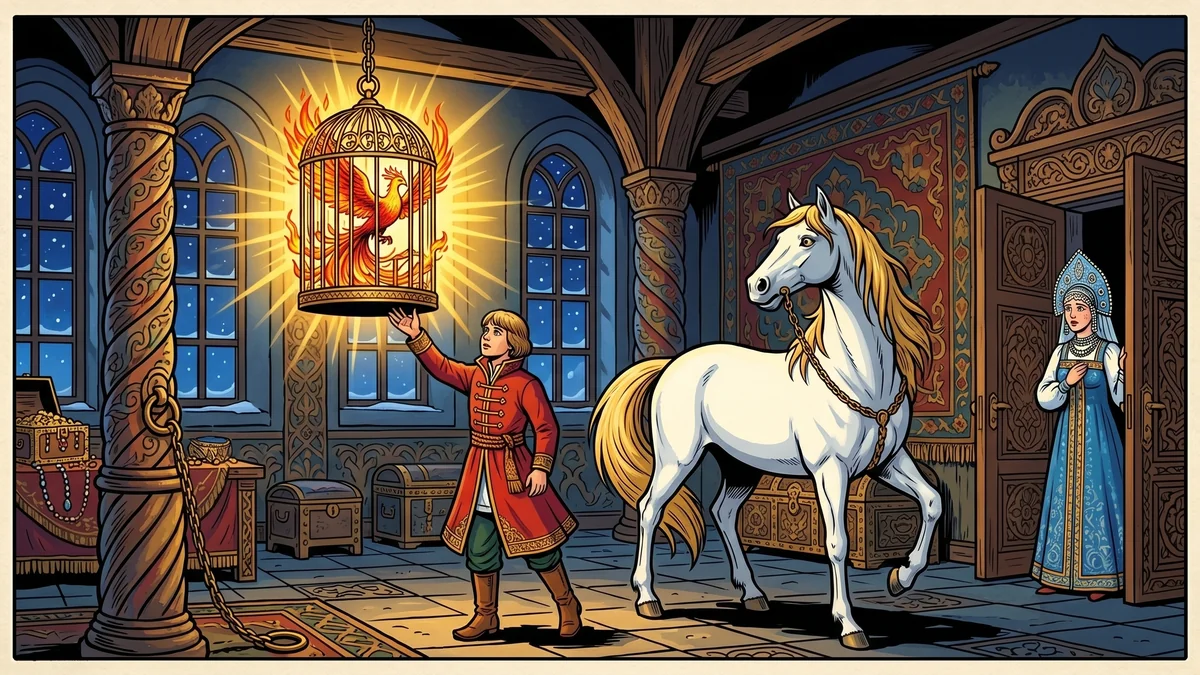
The Wolf assumes the shape of the Princess and presents himself to the second king, in exchange for the Horse with the Golden Mane. The king receives the false princess into his chambers — and as soon as Ivan-Tsarevich and the real Princess are safely down the road, the Wolf shakes himself, resumes his own grey shape, and races out of the palace by an upper window. The same trick is played at the first king’s palace: the Wolf becomes the Horse with the Golden Mane, is exchanged for the Firebird, and escapes from the stables before the king discovers the substitution. Ivan-Tsarevich now possesses all three wonders — the Princess, the Horse and the Firebird — and the Wolf has acquired none of them, having served only out of debt and friendship. The Russian wonder-tale presents this without comment; the listener was expected to recognise the moral on his own.
The Treachery of the Brothers
The Wolf carries Ivan-Tsarevich, the Princess, the Horse and the Firebird to within a day’s journey of his father’s Tsardom. There they part, the Wolf bowing low and promising to return if ever Ivan-Tsarevich needs him a fourth time. Ivan-Tsarevich, exhausted, lies down in a meadow to rest. The Princess sits at his head. The Firebird burns quietly in her golden cage; the Horse with the Golden Mane stands close by.
It is at this moment of greatest triumph that the Russian wonder-tale strikes its hardest blow. The two elder brothers, Dmitri-Tsarevich and Vasili-Tsarevich, who had turned off the road into idleness months before, are riding home with empty hands when they come upon the sleeping Ivan-Tsarevich and his magnificent prizes. They consult; they decide; they draw their swords; they kill Ivan-Tsarevich where he sleeps and cut him into small pieces. They threaten the Princess with the same fate if she does not swear silence, and carry the Firebird, the Horse and the weeping Princess home to their father as their own prizes. The Tsar, in joy, prepares to wed the Princess to Dmitri-Tsarevich, the eldest.
The Wolf and the Water of Life
The Russian wonder-tale does not end here, and the Russian listener of 1855 knew it would not. The Wolf, who had bowed and promised to return if ever needed a fourth time, found Ivan-Tsarevich’s body in the meadow on the third day. He gathered the pieces, fitted them together, and then sent the Raven King’s son (whom he had threatened to eat) on the great Slavic errand of all wonder-tales: to fly to the ends of the earth for the живая and мёртвая waters, the Living Water and the Dead Water. The Russian wonder-tale distinguishes these two with precise care: the Dead Water heals wounds and re-knits torn flesh, the Living Water restores the soul. The Wolf sprinkled Ivan-Tsarevich first with the Dead Water — his cuts closed, his bones knit — and then with the Living Water, and Ivan-Tsarevich opened his eyes and sat up in the meadow as if from a long sleep.
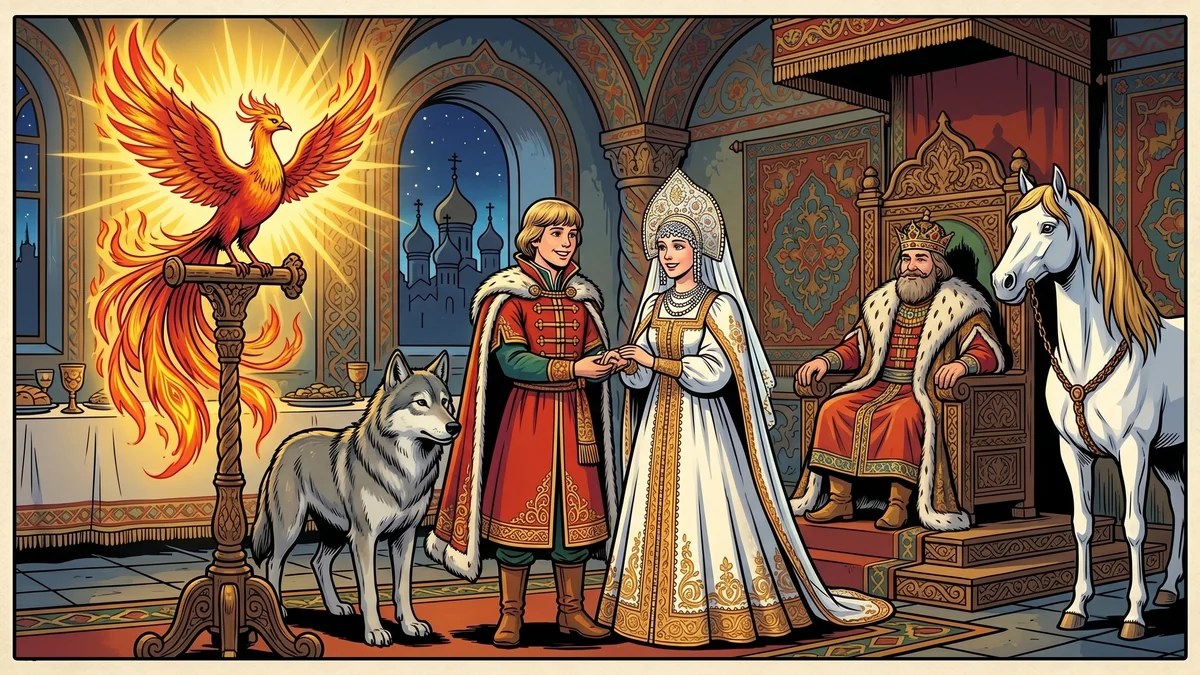
The Wolf carried Ivan-Tsarevich home to the palace gates on his own grey back. Ivan-Tsarevich walked into the great hall on the very day of the wedding feast, the Princess saw him, and fell at his feet weeping with relief; the Firebird in her cage burned bright; the Horse with the Golden Mane neighed in the courtyard; and the Tsar, understanding everything in a single glance, banished his two elder sons to the wilderness and gave the throne, the Princess and all the wonders to Ivan-Tsarevich. The two elder brothers were never heard of again.
Moral — The Loyalty of the Wolf and the Triumph of the Simpleton
«Не в силе Бог, а в правде.»
“God is not in might, but in righteousness.” — the saying attributed to Alexander Nevsky and recorded in the thirteenth-century Житие Александра Невского (Life of Alexander Nevsky); cited by V. I. Dahl, Пословицы русского народа (Proverbs of the Russian People, Moscow 1862), in the chapter on «Правда — Кривда» (Truth and Falsehood). The proverb encapsulates the moral of The Firebird: the simpleton-hero Ivan triumphs because his cause is right, while his stronger but wickeder brothers, who relied on cunning and the sword, are destroyed by the very treachery they thought to use.
The moral of The Firebird and Princess Vasilisa works on three levels. On the surface it is the familiar Russian wonder-tale arithmetic of three brothers: the two older brothers, who are clever and physically strong and start with every advantage, end with nothing; the youngest brother, who is foolish and weak and starts with nothing, ends with the throne and the Princess and the Firebird. The moral here is the deep peasant moral of the Russian wonder-tale: cleverness is not the same as goodness, and the world ultimately rewards the second.
On a second level the tale is a piece of Russian peasant theology about loyalty. The Gray Wolf, who has every reason to abandon Ivan-Tsarevich at three separate junctures of the quest — who is, after all, only paying back the debt of a single eaten horse — chooses instead to serve faithfully to the end, to assume his own destruction in shape-shifted form at two royal palaces, and finally to return a fourth time to resurrect his master from a meadow of cut pieces. The Russian wonder-tale ranks the loyalty of a wolf above the loyalty of two brothers of royal blood — and the listener of 1855, who lived in a village where treachery within the family was common and loyalty to a stranger was rare, took the moral as one of the most piercing in the Afanasyev collection.
On a third level the tale is a meditation on the difference between possession and worthiness. The two elder brothers possess the Firebird, the Horse and the Princess for a single evening, by murder; they cannot keep them. Ivan-Tsarevich, who has been beaten unconscious and cut to pieces, is given back the same three wonders in the same hour because he, alone of the three brothers, has earned them. The Russian wonder-tale closes with the quiet assertion that the supernatural prizes of the world belong to whoever has paid the supernatural cost — and that the cost the Firebird requires is not cleverness or strength but the patient, blundering goodness of a simpleton who would never have thought to kill his own brother in his sleep.
Historical and Cultural Context
The Firebird (Жар-птица) is one of the great supernatural creatures of the East Slavic imagination. Descended from the pre-Christian Slavic Rarog, a fiery falcon-spirit attested in eleventh-century chronicles, the Firebird survived the Christianisation of Rus in 988 by becoming a creature of pure folklore rather than a deity, appearing in Russian fairy-tales as the inaugurating wonder that summons heroes onto their quests. Her plumage of red, orange and gold became one of the most beloved subjects of Russian decorative art — painted on lacquered Palekh and Fedoskin boxes, woven into Pavlovsky shawls, embroidered onto peasant women’s wedding sarafans across the Volga and Don provinces.
The tale entered international culture through Igor Stravinsky’s 1910 ballet L’Oiseau de feu (The Firebird), composed for Sergei Diaghilev’s Ballets Russes in Paris, with choreography by Michel Fokine and stage designs by the Russian painter Alexander Golovin. Stravinsky drew on Afanasyev’s text and on the parallel variant collected by Stasov, and the ballet became one of the foundation works of twentieth-century modernist music; its 1919 orchestral suite is now one of the most-performed orchestral works in the world. The Bilibin illustrations of 1899–1902 — Ivan Bilibin’s stylised Russian Art-Nouveau paintings of Ivan-Tsarevich, the Gray Wolf and the Firebird — remain the canonical visual representation of the tale in Russian school-books to the present day.
Alexander Nikolayevich Afanasyev (1826–1871) recorded the tale and its closest variants in volume 5 of his Народные русские сказки, published in St Petersburg between 1855 and 1863, gathered from peasant correspondents in Kursk, Voronezh and Tambov provinces through the network of the Russian Geographical Society. Afanasyev placed the tale in the section «Волшебные сказки», the wonder-tales proper, distinguishing it from the shorter household tales of Morozko and the trickster anekdoty of Dimian-the-Peasant. It is the largest, brightest and most cinematic of Afanasyev’s wonder-tales, and the one that has travelled furthest from Russian peasant memory into the wider world of music, painting and the international fairy-tale tradition.
Why It Lasted
The Firebird tale has outlasted the Russian empire that produced it, the peasant villages that first told it, the Bilibin school of illustration that painted it, the Ballets Russes that danced it, and the Cold War that for a time silenced it. It survives because it carries, in fifteen minutes of telling, three of the most enduring questions a wonder-tale can ask: can a simpleton be a hero; can an animal be more loyal than a brother; can goodness without cleverness still win in the end. The Russian peasant of 1855 answered all three questions yes. So did the Stravinsky audience of 1910. So, in our own time, do the millions of Russian schoolchildren who continue to read the tale in Afanasyev and the millions more around the world who first meet the Firebird in the orchestra hall, the picture-book or the animated film. The Firebird’s plumage still burns. The Gray Wolf still keeps his promises. Ivan-Tsarevich still wakes from the meadow. And the throne still goes to the youngest, the foolish, and the kind.
Frequently Asked Questions
What is the original Russian title of The Firebird and Princess Vasilisa, and where does it appear in Afanasyev’s collection?
How is the tale classified in the Aarne-Thompson-Uther index, and what are its European cousins?
Who is the Firebird (Жар-птица) and what are her cultural roots?
How did Stravinsky’s 1910 ballet bring the tale to international audiences?
What proverb closes the moral, and what is its source?
You May Also Like
 Russian Folk Tales
Ages 6-8
Russian Folk Tales
Ages 6-8
Vasilisa the Beautiful
Vasilisa the Beautiful: There once lived a merchant of great wealth and standing who had a daughter of such exceptional beauty that men traveled from distant
 Russian Folk Tales
All Ages
Russian Folk Tales
All Ages
Ivanoushka The Simpleton
Ivanoushka The Simpleton: [Illustration] In a kingdom far away from our country, there was a town over which ruled the Tsar Pea with his Tsaritza Carrot.
 Russian Folk Tales
Ages 9-12
Russian Folk Tales
Ages 9-12
The Firebird, the Horse of Power, and Princess Vasilisa
The Firebird, the Horse of Power, and Princess Vasilisa: In the days when the Russian steppes stretched endless as the sea, there lived a poor archer named