Vasilisa the Beautiful
Vasilisa the Beautiful: There once lived a merchant of great wealth and standing who had a daughter of such exceptional beauty that men traveled from distant
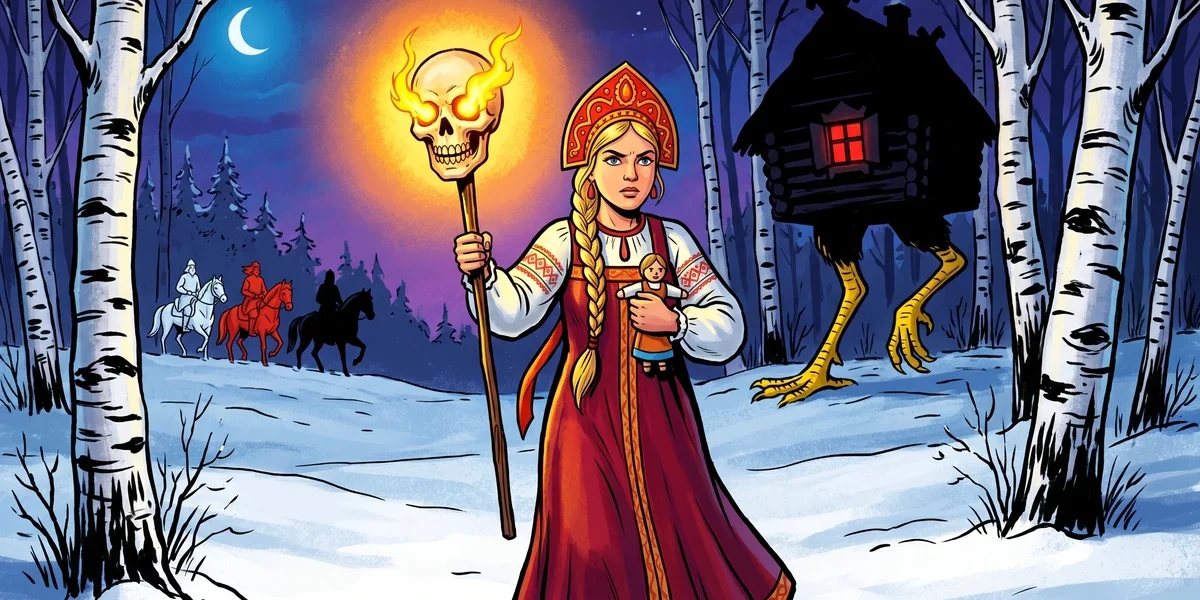
Origin & Canonical Sources. Russian wonder-tale, Василиса Прекрасная (Vasilísa Prekrásnaya, “Vasilisa the Beautiful”). Alexander Afanasyev printed it as no. 104 in the first edition of Народные русские сказки (St Petersburg 1855–1863); it became no. 59 in the 1873 second critical edition (Moscow), and is no. 104 again in the L. G. Barag and N. V. Novikov Nauka reprint of 1984–1985. The source informant was a peasant woman of Kursk Province; Afanasyev cites no further provenance.
Tale type. ATU 480 “The Kind and the Unkind Girls” (Hans-Jörg Uther, FFC 284, 2004), with elements of ATU 510A (Cinderella). East-Slavic catalogue numbers: SUS 480, SUS 480* C in Barag-Berezovsky-Kabashnikov-Novikov, Сравнительный указатель сюжетов: восточнославянская сказка (Leningrad, 1979). Stith Thompson motifs: D1601.31 “Self-returning magic object” (the doll), D1389.8 “Magic skull furnishes light”, G201 “Three witch sisters”, G241.1.1.1 “Witch’s house on chicken legs”, H1212 “Quest assigned because of stepmother’s enmity”, S31 “Cruel stepmother”, N825.3 “Old woman helper”, E323.2 “Dead mother returns to aid persecuted child”.
First Western printings & translators. Edith Hodgetts, Tales and Legends from the Land of the Tzar (Griffith Farran, London 1891) pp. 1–26. William Ralston Shedden-Ralston, Russian Folk-Tales (Smith, Elder & Co., London 1873), pp. 150–163 (summary). Andrew Lang, “Vasilissa the Beautiful” in The Red Fairy Book (Longmans, London 1890), via Ralston. Post Wheeler, Russian Wonder Tales (Century, New York 1912). Norbert Guterman / Roman Jakobson, Russian Fairy Tales (Pantheon, New York 1945, Bollingen XLI), pp. 439–447 — the canonical American school-library text. Leonard Magnus, Russian Folk-Tales (E. P. Dutton, New York 1916). Most recent: Jack Zipes, The Russian Folk Tale by Vladimir Propp (Wayne State U.P., Detroit 2012), appendix.
Etymology. Васили´са from Greek βασίλισσα “queen” (the feminine of βασιλεύς), Christianised through Saint Basilissa of Antioch (martyred c. 309 AD); the Russian name was attested in the chronicles by the 11th c. Прекра´сная from прекрасный “most beautiful”, a Church Slavonic superlative. Max Vasmer, Russisches etymologisches Wörterbuch (Heidelberg 1953–1958), notes the name’s wide currency among 19th-century peasants.
Scholarship. Vladimir Propp, Морфология сказки (Leningrad 1928) tabulates the tale as functions β (initial misfortune), A¹ (villainy), B (dispatch), G (guidance), M (assigning the difficult task), N (solution), F (receipt of magical agent), K (liquidation). His Исторические корни волшебной сказки (Leningrad 1946) reads Baba Yaga as a guardian-of-the-threshold from the matriarchal initiation cult, and the chicken-legged hut as a survival of the Finno-Ugric burial cabin set on stilts. Maria Tatar, The Classic Fairy Tales (Norton, New York 1999), pp. 173–177, compares Vasilisa’s doll to the active agency Cinderella lacks. Marina Warner, From the Beast to the Blonde (Chatto, London 1994), reads the skull-lantern as a transmuted matrilineal blessing. Linda J. Ivanits, Russian Folk Belief (Sharpe, Armonk 1989), pp. 81–83, places Baba Yaga in the chthonic pantheon as khozáika tsa´rstva mertvykh, “mistress of the kingdom of the dead”. Joanna Hubbs, Mother Russia: The Feminine Myth in Russian Culture (Indiana U.P., Bloomington 1988), pp. 36–52, reads Vasilisa as a pre-Christian agrarian goddess re-clothed as a Christian heroine.
Visual & musical afterlife. Ivan Yakovlevich Bilibin’s six-plate Vasilisa Prekrasnaya (Ekspeditsiya Zagotovleniya Gosudarstvennykh Bumag, St Petersburg, 1899–1900) — the rider-on-the-white-horse and Baba Yaga’s hut became the global visual brand. Viktor Vasnetsov 1899 oil sketch (Tretyakov). Aleksandr Rou, Vasilisa Prekrasnaya, Soyuzdetfilm, 1939 — the first Soviet folk-tale fantasy film, with Sergei Stolyarov as Ivan and Lyubov Myasnikova as Vasilisa. Igor Stravinsky, The Firebird (Ballets Russes, Paris, 1910), incorporates Baba Yaga and the doll into the choreography. Míla Mellanová’s 1971 Czech adaptation; Yuri Vasnetsov’s 1973 children’s-book lithographs; Madonna Coffman’s pop-up book (Putnam, NYC 1996); Vasilisa Coelho’s “Vasilisa” graphic novel (Boom! Studios, 2020). Used as a base text for Hayao Miyazaki’s Howl’s Moving Castle hut by his own admission in Starting Point 1979–1996 (Viz, San Francisco 2009).
Of all the tales Alexander Afanasyev collected from the Russian peasantry between 1855 and 1863, “Vasilisa the Beautiful” is the one that became the wonder-tale’s most concentrated study of female resilience. The opening sentence in Afanasyev’s first edition is plain: “В некотором царстве жил-был купец. Двенадцать лет жил он в супружестве и прижил только одну дочь Василису Прекрасную” — “In a certain tsardom there lived a merchant. For twelve years he lived in wedlock and got but one daughter, Vasilisa the Beautiful.” The mother dies when Vasilisa is eight. On her deathbed she gives her daughter a tiny wooden doll, instructs her to keep it always in her pocket, to feed it a little when she is in trouble, and to ask it for help. The doll is the tale’s hinge. It is, as Maria Tatar puts it, “the only secret weapon in fairy-tale literature that arrives at the beginning of the story instead of in the middle”.
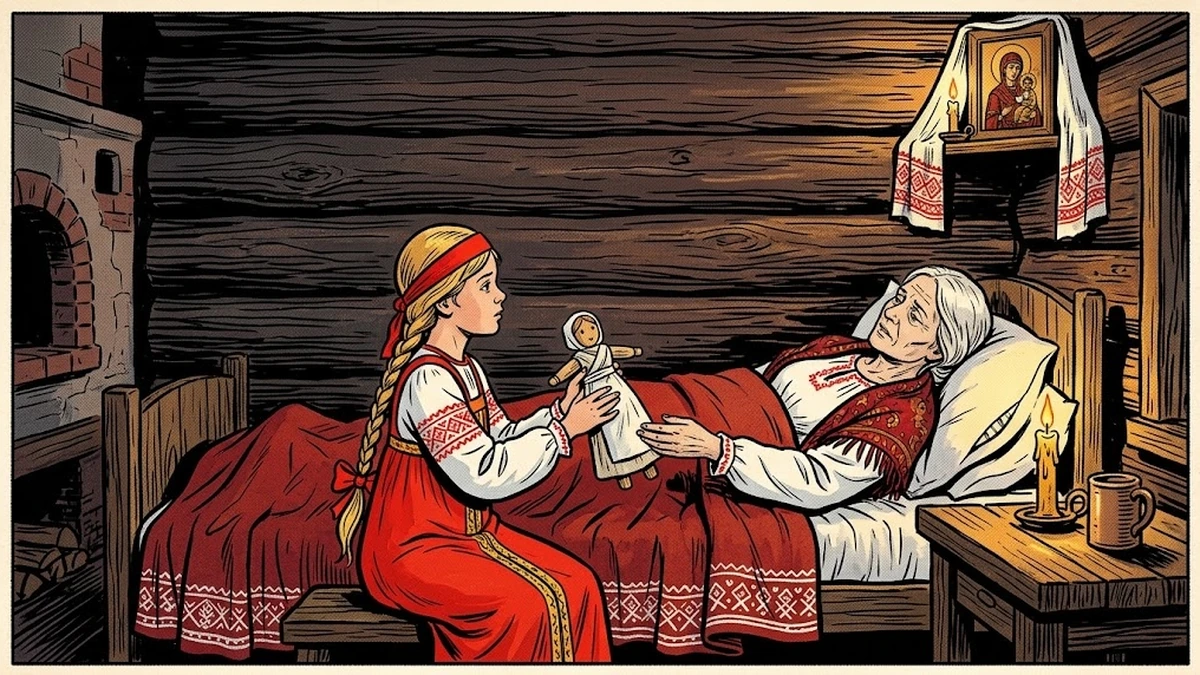
I. The Doll and the Stepmother — how a mother’s last gift becomes a girl’s first ally
The merchant remarries. The stepmother brings two daughters of her own. The familiar cruelty begins: Vasilisa is given every drudgery from before dawn, while the two stepdaughters spend their days idle. But the doll, fed each evening with bread and milk, works through the night so that Vasilisa’s tasks are always done by morning. Vladimir Propp’s Historical Roots of the Wonder Tale (1946, ch. iv) reads the doll as a survival of the nárta, the wooden ancestor-figurine kept in the icon corner of pre-Christian Russian peasant houses, fed with crumbs at meals as a household-spirit; the doll, then, is the dead mother continuing to mother the living child. Joanna Hubbs in Mother Russia (1988) called this “the wonder-tale’s most explicit defence of the matrilineal current that Christianity tried to overwrite”. The two stepdaughters cannot see the doll — it is invisible to anyone whose mother has not given it — and so they live their idle lives without ever wondering how Vasilisa keeps up.
The merchant goes away on business. The stepmother sells the comfortable house and moves the four women to a small dark hut at the edge of the forest, “where the wolves howl and the bears snore”. One evening she gives each girl a task by the light of a single candle: the eldest is to make lace, the middle one to knit a stocking, Vasilisa to spin. As Vasilisa works, the candle is deliberately snuffed out by the eldest stepsister. “Now,” says the stepmother in mock dismay, “someone must go for fire. None of us can manage without it. You, Vasilisa, are the youngest. Go to Baba Yaga in the wood — she will give you fire.” This is the dispatch: Stith Thompson H1212 “Quest assigned because of stepmother’s enmity”; Propp’s function B “a misfortune or shortage is made known”. The candle has not gone out by accident.
II. Baba Yaga’s Hut — three riders and three tasks
Vasilisa walks into the forest. The doll, fed from her last crust, sits in her pocket, weeping silent advice. Three riders pass her on the road. The first, all in white on a white horse, gallops past at dawn; the second, all in red on a red horse, at noon; the third, all in black on a black horse, at dusk. These are Baba Yaga’s day, sun and night, the only servants she keeps. Vladimir Propp catalogued the triad as motif D1719.3 “Personified day, sun, night”; Linda Ivanits (1989) connected them to the Trizna ancestor-rite preserved in the Primary Chronicle for 945 AD. Vasilisa comes to a clearing fenced with human bones, every bone with a skull on top, every skull with a candle-light inside. In the centre of the clearing stands the hut: it spins on two enormous yellow chicken’s legs, and stops only when Vasilisa says the formula recorded in every variant: “Избушка, избушка, повернись к лесу задом, ко мне передом”, “Little hut, little hut, turn your back to the forest and your face to me.” The hut obeys.
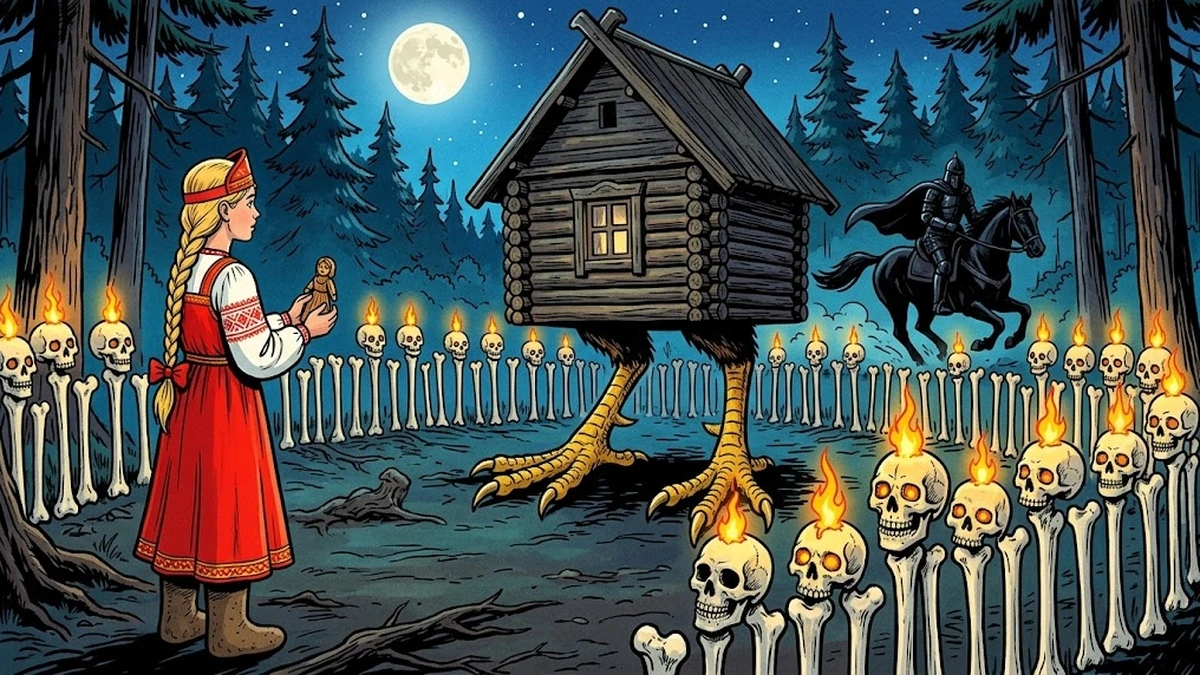
Out comes Baba Yaga, riding in a stone mortar that she drives with a stone pestle and sweeps her tracks behind her with a broom of birch. Marina Warner (From the Beast to the Blonde, 1994) connects this iconography to the medieval Hexenflug of central-European witch trial confessions, but Afanasyev had it from a Kursk peasant a century earlier. Baba Yaga sniffs the air: “Фу, фу, фу! Русским духом пахнет!”, “Fee, fie, foe, foo — I smell the Russian spirit!” (the closest documented Russian analogue to the English Jack-the-giant-killer formula; Stith Thompson G84 “Fee-fi-fo-fum”). She agrees to give Vasilisa fire, but only if Vasilisa first works for her: separate poppy seed from soot in one heap; sort good grain from blighted in another. Both heaps are mountainous. Vasilisa cannot possibly finish before evening. The doll, fed once more, works through the night while Vasilisa sleeps. By morning both heaps are sorted. Baba Yaga, returning, says nothing. She sets another impossible task. The doll completes that too. The tale is now firmly in ATU 480’s territory: the Kind Girl’s pious obedience and the magical helper’s invisible labour combine to satisfy the impossible quota of an ogress whose surface generosity hides a death-trap.
III. The Skull-Lantern — the gift that judges
On the third day Baba Yaga, suspicious, asks Vasilisa how she has done it. Vasilisa answers, exactly as her dying mother instructed: “By my mother’s blessing.” Baba Yaga snorts — she cannot abide blessings — and throws Vasilisa out, but not before granting the fire. She takes one of the skull-lanterns from the fence, hands it to the girl on a stick, and says, “Take it to your stepmother. She has been wanting fire from me a long time.” This is the central irony. The stepmother, who has sent Vasilisa to her death, has unwittingly summoned a death-gift that she herself, not Vasilisa, will receive. Stith Thompson catalogues this as Q411.9 “Punishment: burning to death by sorcery”, a motif more often associated with the Brothers Grimm Frau Trude (KHM 43, 1812). Walter Anderson, “Das Maerchen vom Frau Trude” (Folklore Fellows Communications 121, 1937), tabulates fifty European variants and singles out Afanasyev’s Vasilisa as the most narratively integrated.
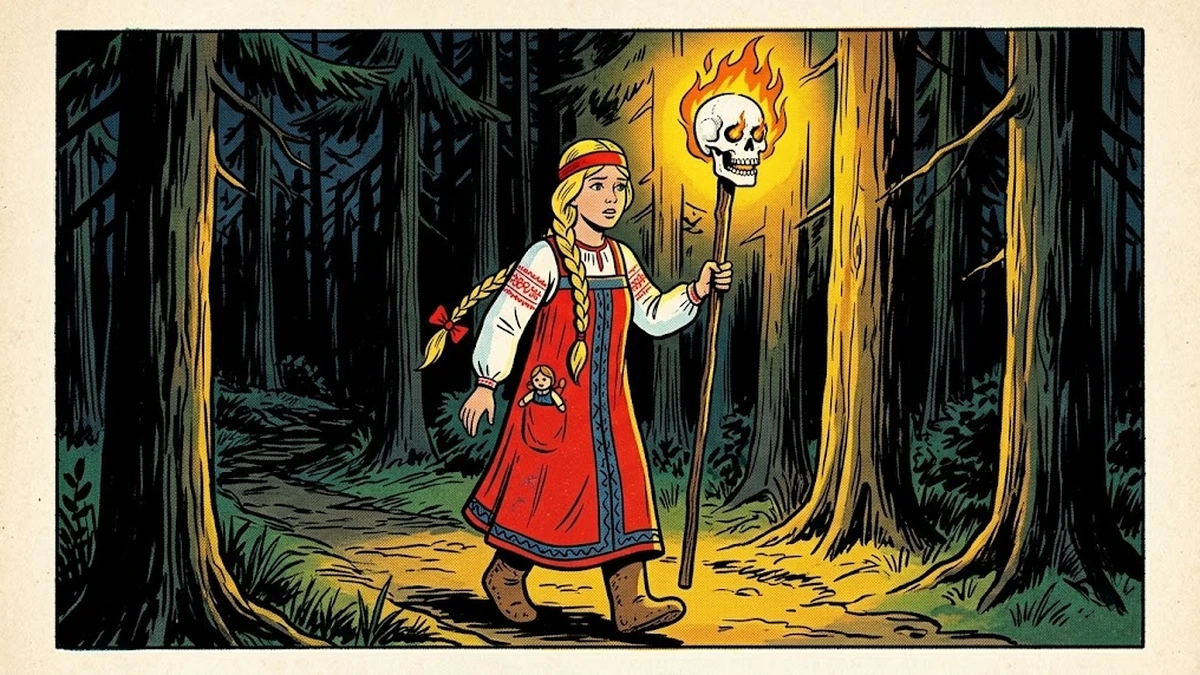
Vasilisa walks home through the dark forest carrying the skull on its stick. The eyes of the skull burn through her like X-rays; whenever she stops to rest, the doll urges her on. At the cottage door she would have thrown the skull away if the doll had not spoken: “Не бросай: внеси к мачехе в горницу”, “Don’t throw it away. Take it into your stepmother’s parlour.” The skull’s eyes follow the stepmother and her two daughters wherever they move; they cannot turn their faces from it. By morning the three are burned to a fine grey ash. Vasilisa buries the skull in the ground (the doll specifies a depth of three feet, an inversion of the funeral-customary three sazhens), shuts up the hut, and walks to the city.
IV. The Magic Linen — how a girl’s work meets a tsar’s gaze
In the city Vasilisa lodges with a childless old woman who lets her sit at the window and spin. With the doll’s help she spins flax so fine that it is “as gossamer through the eye of a needle and as broad as a river when woven”. The old woman takes the cloth to the Tsar’s palace as a present. The Tsar handles the cloth, marvels, and asks who made it. The old woman, primed by the doll, replies “the orphan Vasilisa”. The Tsar sends for her, sees her, and proposes marriage on the spot — a Propp function W (wedding) achieved without a single armed combat or quest. Andrew Lang in The Red Fairy Book (1890) found this so anticlimactic by Victorian standards that he added a paragraph about Vasilisa being formally educated at the palace before the wedding; no Russian variant preserves this addition.
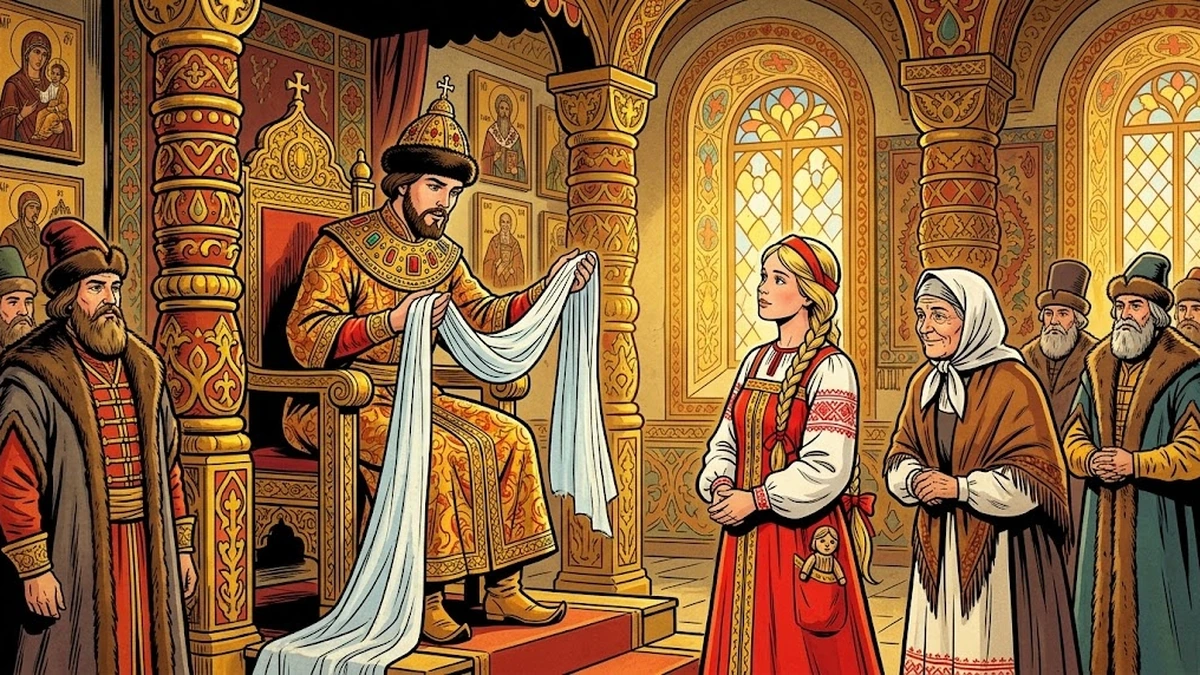
Vasilisa marries the Tsar. Her father returns from his long journey, hears the news, and weeps with joy. The doll, the dying mother’s last gift, is kept in Vasilisa’s pocket for the rest of her life, fed each evening with bread and milk, as her own mother once instructed. The closing formula, recorded by Afanasyev, is unusual in that it does not exclude the narrator from the wedding feast: “Они стали жить-поживать и добра наживать. А Василиса до самой смерти всегда носила куклу в кармане”, “They lived on and prospered. And Vasilisa, until her dying day, always carried the doll in her pocket.” Tatar (1999) calls this “the wonder-tale’s tenderest closing line”.
Moral — “A mother’s blessing draws no man down”
«Материнское благословение в воде не тонет, в огне не горит.»
“A mother’s blessing does not drown in water and does not burn in fire.” — Vladimir Dahl, Пословицы русского народа (Moscow 1862), in the section “Дети — Родители” (“Children — Parents”).
The proverb is one of the most quoted in 19th-century Russian peasant homilies; Sergei Aksakov used it in Years of Childhood (1856), and Tolstoy quoted it in Anna Karenina (1875–77, II.ii). The Vasilisa tale is its narrative gloss. Vasilisa survives stepmother, forest, witch and skull because she carries her mother in her pocket — not as memory but as actual continuing agency. To the Russian peasant girl listening to the tale by candlelight, the moral was practical: your dead mother is not gone; she is in the embroidery of your dress, in the prayers you remember, in the small wooden object that you feed at night. The story is, in Joanna Hubbs’s reading, the agrarian goddess transmuted into the form a Christian peasant girl could safely keep. Maria Tatar adds a second moral: kindness is not weakness. Vasilisa never refuses Baba Yaga, never lies, never tries to escape. She works, she answers, she carries the skull. The kindness wins because it is steady and because it does not know it is being tested.
Why the tale has lasted
It has lasted because every component is portable. Bilibin’s six 1899–1900 plates — the white rider, the bone-fence, the hut on chicken’s legs, the spinning Vasilisa — became the visual template not only of Russian children’s books but of the Russian Pavilion at the 1900 Paris Exposition where they were exhibited beside the Mariinsky Theatre miniatures. Aleksandr Rou’s 1939 Soyuzdetfilm Vasilisa Prekrasnaya made the tale the first ideological export of Soviet children’s cinema, screened across the Eastern Bloc as the model of female perseverance. The hut on chicken’s legs reappears in Hayao Miyazaki’s Howl’s Moving Castle (Studio Ghibli, 2004), in Naomi Novik’s Uprooted (2015), in Catherynne M. Valente’s Deathless (2011), in Holly Black’s The Spiderwick Chronicles (2003), and in the recurring “spirit house” of Neil Gaiman’s American Gods (2001). The doll motif — the mother’s gift that whispers advice — appears in Studio Ghibli’s Spirited Away (2001), in Philip Pullman’s daemon system in His Dark Materials (1995–2000), in Cinderella’s mouse-helpers from Disney 1950, and ultimately back to the agency-of-a-pocket of the original Afanasyev text.
The deepest reason is the one Propp identified in 1946 and Joanna Hubbs restated in 1988: the tale gives narrative shape to a daughter’s discovery that her mother’s love is not exhausted by her mother’s death, that the love continues to work in the world in tangible forms — a remembered prayer, an embroidery, a doll — and that those forms, fed and listened to, are stronger than any cruelty the world will set against her. A thousand years of Russian peasant girls have learned, in the firelight, that this is the only inheritance that counts. The tale outlasts empires precisely because every generation keeps confirming it.
You May Also Like
 Russian Folk Tales
All Ages
Russian Folk Tales
All Ages
Woe Bogotir
A Russian peasant folk tale of two brothers — one rich, one poor — and how the poor one outwits Woe (Gore), the gaunt grey personification of Misfortune who has come to live in his house. Translated by Verra Xenophontovna Kalamatiano de Blumenthal in Folk Tales from the Russian (1903) from Afanasyev's Narodnye russkie skazki. ATU 735A 'Bad Luck Imprisoned.'
 Russian Folk Tales
Ages 9-12
Russian Folk Tales
Ages 9-12
Koschei the Deathless
Koschei the Deathless: In the times before time itself was properly counted, when magic was as common as earth and water, there arose a sorcerer of such
 Russian Folk Tales
Ages 9-12
Russian Folk Tales
Ages 9-12
The Frog Princess: A Tale of Love and Redemption
The Frog Princess: A Tale of Love and Redemption: In the days when magic still dwelt in the forests of ancient Russia, there lived a noble archer named Ivan