Father Frost
Father Frost: [Illustration] In a far-away country, somewhere in Russia, there lived a stepmother who had a stepdaughter and also a daughter of her own.
Russian Original: «Морозко» (Morozko) — literally “Little Frost” — also widely known in nineteenth-century printings as «Дед Мороз» (Ded Moroz, “Grandfather Frost”) and translated by Blumenthal as Father Frost. One of the most famous of all Russian wonder-tales, beloved across the Slavic world and still recited every December by Russian schoolchildren.
Canonical Source: Verra Xenophontovna Kalamatiano de Blumenthal, Folk Tales from the Russian (A. C. McClurg & Co., Chicago, 1903), tale IV of the nine-tale collection — the same volume that supplied the Baba-Yaga, Dimian-the-Peasant, Woe-Bogotyr and Golden Mountain re-tellings already published on this site. The Russian original appears as no. 95 in Alexander Afanasyev’s Народные русские сказки (Narodnye russkie skazki / Russian Folk Tales), 8 vols., St Petersburg, 1855–1863, where Afanasyev recorded three separate variants of the tale gathered from Voronezh, Kursk and Tambov provinces.
Tale-Type Classification: The story is catalogued in the Aarne-Thompson-Uther index as ATU 480 “The Kind and the Unkind Girls” — one of the most widely distributed tale-types in world folklore, with hundreds of recorded variants across Europe, Asia and North Africa. In the East-Slavic SUS catalogue (Сравнительный указатель сюжетов восточнославянской сказки, Leningrad 1979) it appears as SUS 480 («Морозко»), the canonical Russian representative of the type. The central motifs are catalogued in Stith Thompson’s Motif-Index of Folk-Literature as Q2 (“Kind and unkind”) and S322.4.2 (“Stepmother orders stepchild taken into the woods to die”).
Cultural Frame: Father Frost (Морозко, Дед Мороз) is one of the great supernatural figures of the Russian winter — a pre-Christian Slavic spirit of the killing cold who survived the conversion of Russia to Orthodox Christianity in 988 by becoming, in folk-memory, a stern but fair old man who tests the souls of those who meet him in the snow. The tale is read across Russia as a piece of moral and meteorological theology at once: the frost itself, in Russian peasant theology, judges the human heart.
In a far-away country, the storyteller begins — for Russian wonder-tales like to keep their geography pleasantly vague — somewhere in the boundless Russian countryside, there lived a husband and a wife and two girls. One of the girls was the wife’s own daughter; the other was the husband’s daughter from a former marriage. The two girls were of nearly the same age, and they grew up together in the same wooden hut by the same wooden stove, but the household into which they had been born was not a kind one. Russian peasant tales have a particular fondness for this kind of opening — the second wife, the stepdaughter, the warm corner of the hut and the cold corner of the hut — and the listener of 1855, sitting in his own warm corner with the storyteller, would recognise the arrangement at once.
The wife adored her own daughter. Whatever the girl did, however lazy, however rude, the mother praised her and stroked her hair and saved the best slice of bread for her. The stepdaughter, on the other hand, was good and quiet and quick about her work — and was scolded for everything she did. The storyteller phrases the moral set-up with the dry brevity of the Russian peasant proverb: “The wind blows, but stops blowing at times; the wicked woman never knows how to stop her wickedness.” In Russian: «Ветер дунет — и затихнет; злая баба никогда не уймётся.» Every Russian listener already knew where the story was going. The question was not what the stepmother would do, but how cold the night would be when she did it.
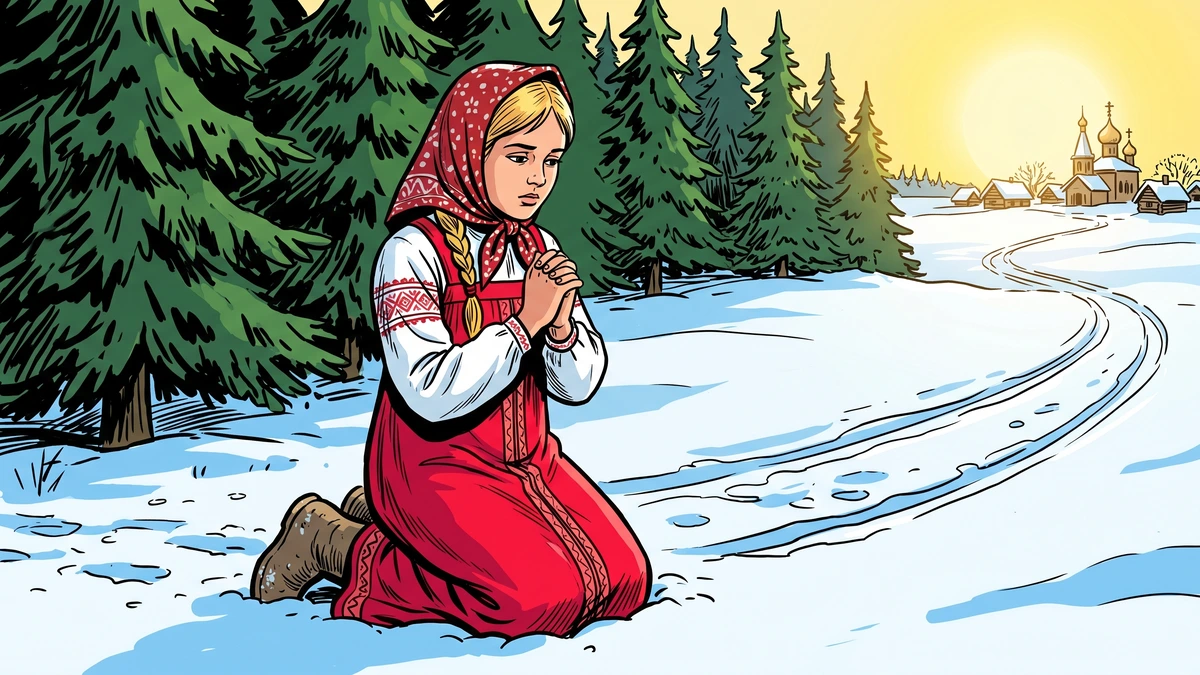
The Old Man Drives His Daughter Into the Frost
One bright cold morning — and Russian wonder-tales love this collocation, яркий морозный день, a bright frosty day, because the very brightness of the sun on the snow is what makes the killing temperature possible — the stepmother turned to her husband at the breakfast table and gave him an order. “Now, old man,” she said, “I want thee to take thy daughter away from my eyes, away from my ears. Thou shalt not take her to thy people into a warm izba.” The Russian изба (izba) is the peasant log-hut, with its great clay stove and its prized warm corner; to forbid the warm izba is to specify the exact instrument of murder. “Thou shalt take her into the wide, wide fields to the crackling frost.“
The old father wept. The Russian narrator gives him no speech of refusal — only the tears, and the small physical detail that he wanted to cover the girl with a sheepskin and did not dare. His wife was watching from the window of the hut. The storyteller’s economy here is brutal: in a single sentence Russian peasant patriarchy is condemned. The father is a good man and a coward, and the difference between the two has, on this particular morning, the value of his daughter’s life.
He drove her in the sleigh out into the wide white fields, nearly as far as the edge of the dark forest, and left her sitting in the snow. Then, as the storyteller says with a knife’s-edge of irony — “he was a good man and did not care to see his daughter’s death” — he turned the sleigh around and drove home as fast as the horse could carry him. The girl sat alone in the snow. She did not scream, and she did not run. Russian wonder-tales place this kind of patient, prayerful courage at the centre of female sanctity: the stepdaughter sat quite still and said over to herself, in a low voice, all the prayers she knew.
Father Frost Comes Cracking Through the Pine-Trees
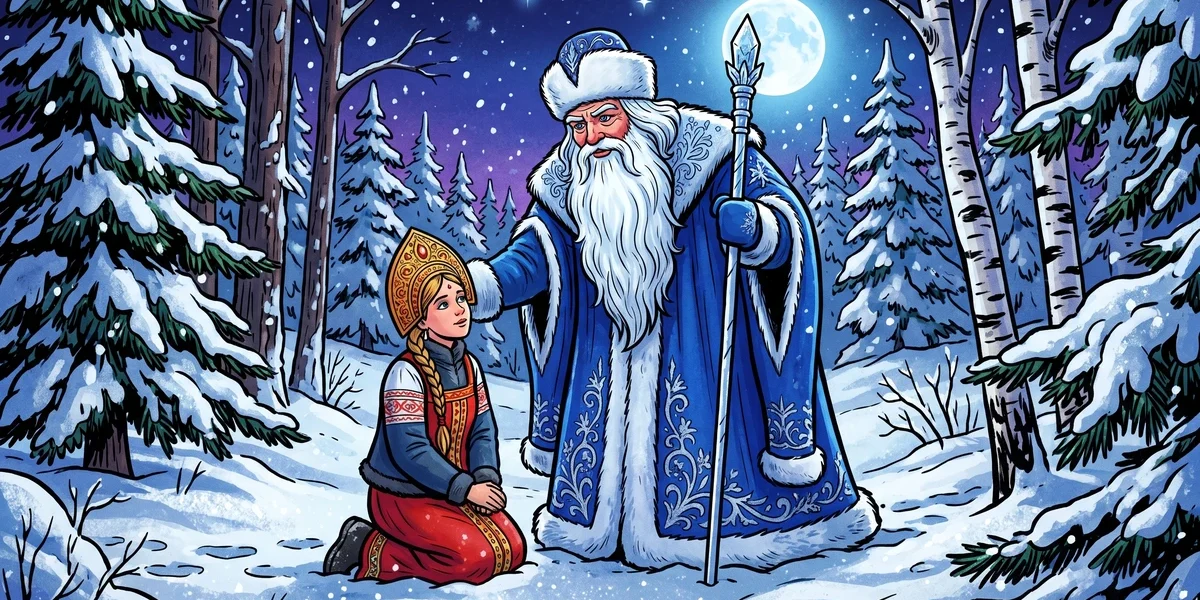
And then the storyteller, who has been quiet about the supernatural until now, opens the second movement of the tale with the entrance of the god. He does not call him a god — Russian peasant tales after 988 are too careful with their language for that — but the figure who appears between the pines is unmistakably the old pre-Christian Slavic master of the winter, the spirit of the killing frost, in his guise as a stern, white-bearded old man clad in furs of the most expensive kind. “Father Frost,” says the narrator, “the almighty sovereign at that place, clad in furs.” The Russian phrase is striking: «всесильный властелин тех мест», the all-powerful ruler of those places. The forest in the bitter cold belongs to him, and the rules of his court are not the rules of the warm izba.
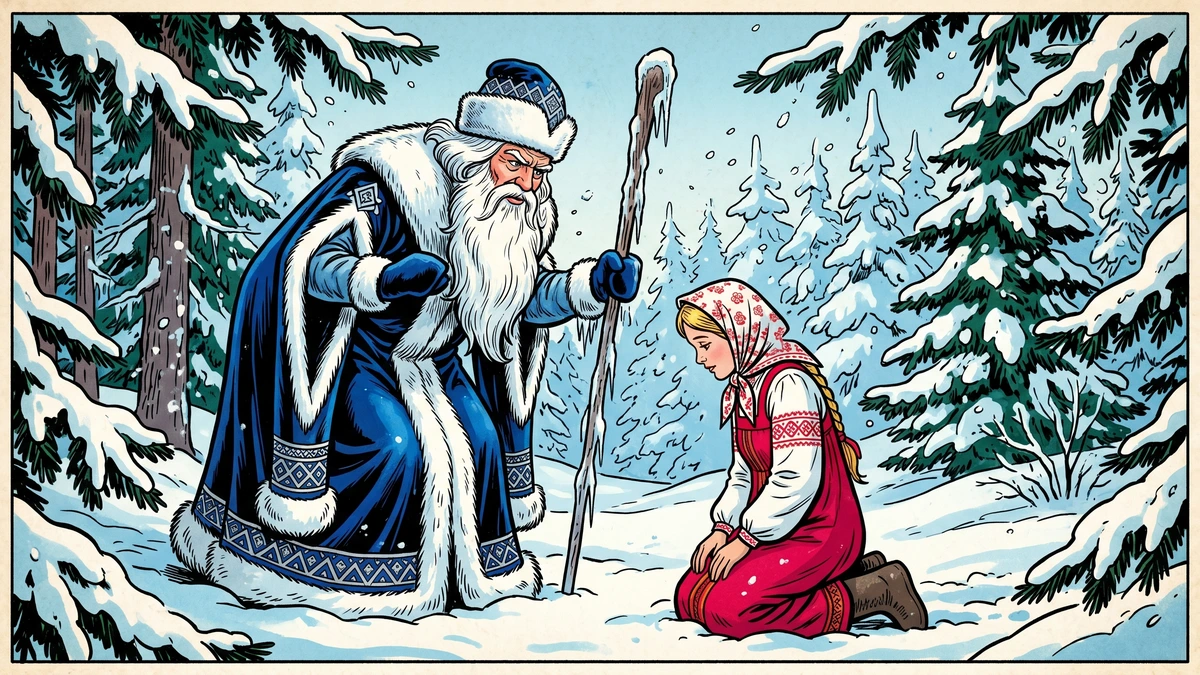
Father Frost came cracking through the pine-trees. The Russian verb is трещать, the same sharp dry sound the trees themselves make when their sap freezes and splits the wood in the deep cold — a sound every Russian child of 1855 had heard on the winter nights when the temperature dropped below minus forty. The narrator does not tell us what the old man looks like in detail; he simply tells us that he came, and that he leaned down close to the seated girl, and that he asked her a question. “Art thou warm, sweet girl?” In Russian: «Тепло ли тебе, девица?» It is, the listener recognises, a trick question. The honest answer is no, and the honest answer will kill her.
The stepdaughter knew the rules of polite Russian peasant speech. To complain to a guest, even an uninvited one, was to admit defeat; to complain to an old man clad in furs in the middle of his own forest was unthinkable. She bowed her head — Russian peasant girls bowed for everything — and answered in the gentlest of voices: “Quite warm, dear Father Frost. Quite warm.” «Тепло, батюшка-Морозушко, тепло.» The diminutive Морозушко is a tiny stroke of affectionate respect — calling the deadly Frost “little Frost”, the way a Russian peasant child might call her own grandfather “dear little granddad”. The narrator notes the form. We are listening to the test of courtesy, and the test of courage at the same time.
Father Frost stepped closer and crackled the cold a degree harder around her. The girl repeated her answer. He stepped closer again, and harder still, until the trees themselves were splitting along their length and the snow was hissing on the pine-needles — and still the girl, half-frozen, blue-lipped, with her hair already silvered by the rime that had settled on her shawl, answered as politely as before. The Russian narrator preserves the threefold structure of all wonder-tales: three questions, three answers, the third answer the most dangerous, the third answer the one that opens the gate to the reward.
The Treasure of the Stepdaughter
Father Frost laid aside his test. He had found, in the wide white field outside her father’s village, the rarest creature on the Russian winter — a soul that would not break its courtesy under the cracking ice. He lifted the girl up and, the narrator tells us, “wrapped her in his own great fur cloak, and gave her a chest filled with the most beautiful gifts, and a silver-and-gold troika to carry her home.” The Russian тройка is the three-horse sleigh of Russian fairy-tale and Russian opera — Tchaikovsky’s snowy troika, Pushkin’s snowy troika, every Russian schoolchild’s mental image of winter itself. The stepdaughter was now riding home in the most beautiful conveyance her village had ever seen, wrapped in furs that the richest merchant in the province could not have afforded.
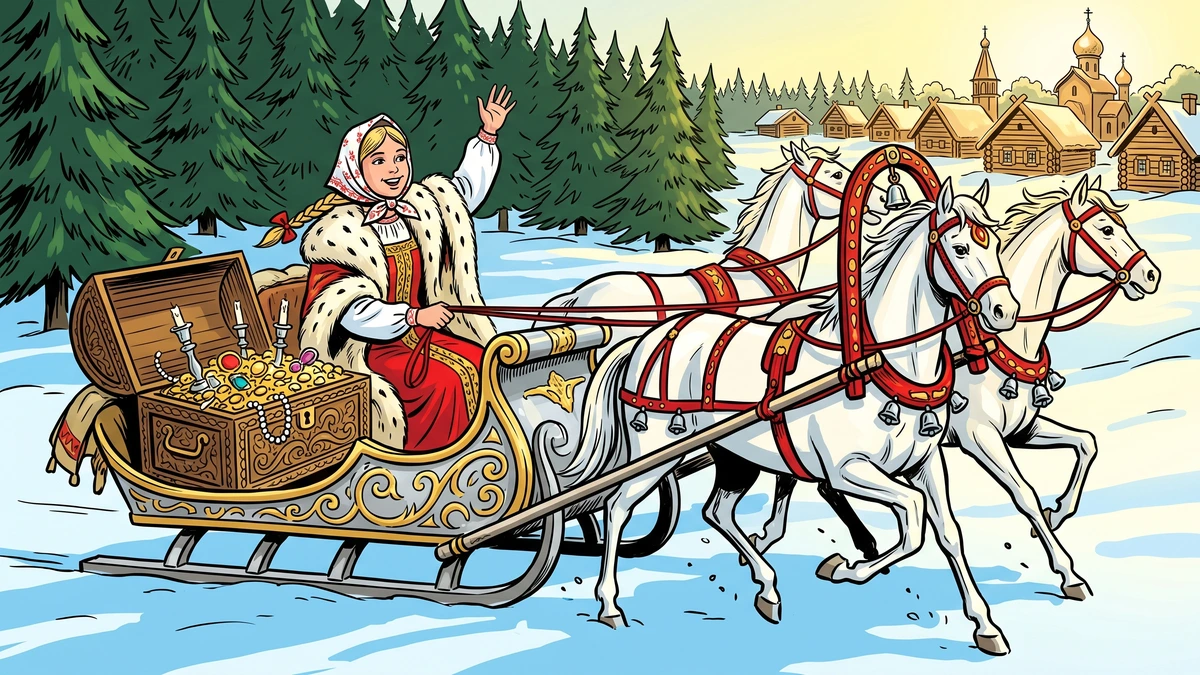
Meanwhile, back in the warm izba, the stepmother was sitting at the table baking blini, the small flat Russian pancakes traditionally cooked on the day of a funeral, and grumbling to her husband that he should go fetch his daughter’s frozen body home for the burial service. The old dog under the table, which the narrator has not mentioned until now but which is a stock figure of every Russian wonder-tale household, suddenly cried out from beneath the stove: “Tiav, tiav! The old man’s daughter is coming home in gold and silver, and the old woman’s daughter, the suitors will refuse!” In Russian: «Тяв-тяв! Старикову дочь в злате-серебре везут, а старухину дочь женихи замуж не возьмут!» The dog’s couplet is one of the most famous lines in the whole Afanasyev collection; Russian children today still recite it from memory.
The stepmother threw a piece of bread at the dog and shouted at it to say what she wanted said — that the stepdaughter’s bones were being brought home in a sack. But the dog repeated its couplet a second time, and a third, and then through the door came the troika and out of the troika stepped the stepdaughter, alive, glowing, wrapped in white fur, carrying a heavy chest of treasure. The narrator dwells on the silence that fell in the izba. The stepmother’s face went the colour of cold lard. The old father wept again, this time for joy. And the stepmother, calculating with the immediate, fearful arithmetic of the wicked, decided that if the forest could pay so much for one girl it would surely pay twice as much for her own.
The Cruel Daughter and the Cracking Cold
“Now, old man,” she said, with the same flat, commanding voice she had used at breakfast on the morning of the first murder, “take my daughter into the same field, in the same place. Father Frost will give her even greater gifts.” The old man, the narrator tells us, was now so afraid of his wife that he obeyed without weeping. He drove the second girl out into the wide white snow, set her down in the same spot as before, and turned the sleigh home.
The second girl was warmly dressed — her mother had wrapped her in three sheepskins and a fur-trimmed kerchief and a pair of high felt boots, and had placed in her lap a covered basket of blini and salt pork to keep her strength up while she waited for the rich old gentleman of the forest to arrive. She sat in the snow grumbling that the wind was cold, that the basket was heavy, that her mother had not packed enough vodka, and that the stepsister’s good fortune was a personal insult that the entire family was now expected to repair. The narrator does not say anywhere that she was a bad girl. He simply lets her speak. Russian wonder-tales know that the surest condemnation of a character is to give her her own dialogue and step back.
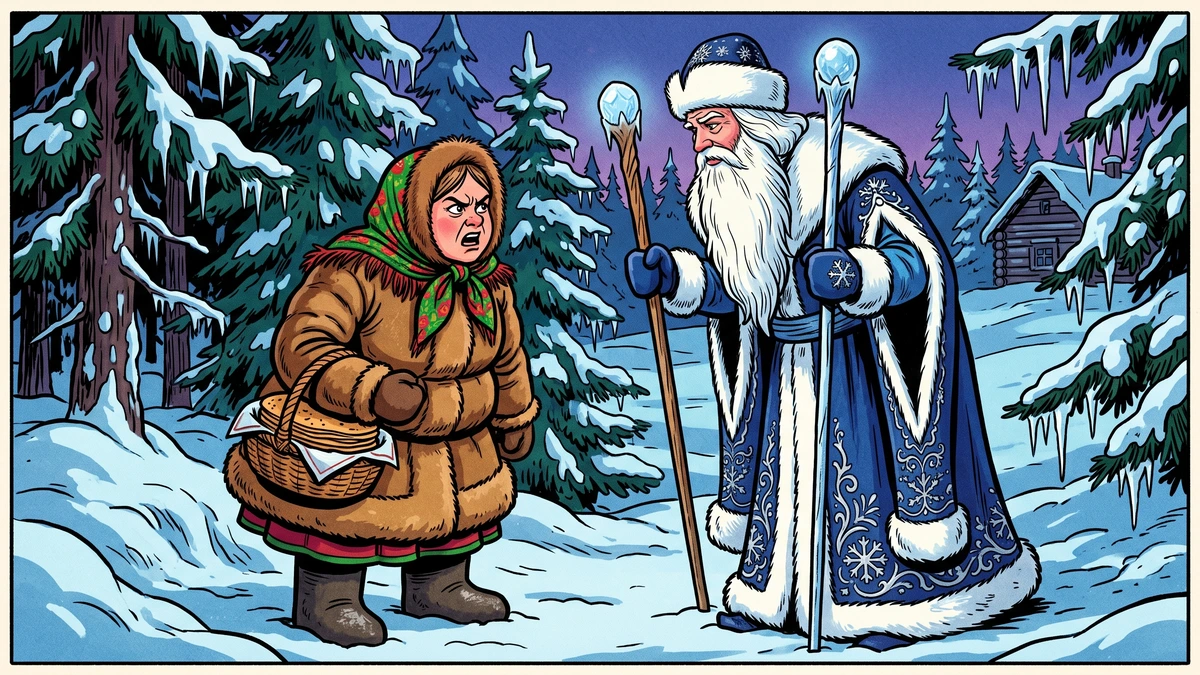
Father Frost came cracking through the pine-trees a second time. He leaned down to the second girl exactly as he had leaned down to the first. He asked her exactly the same question. “Art thou warm, sweet girl?” The second girl did not bow her head. She did not call him dear little Father Frost. She glared up at him out of her fur-trimmed kerchief and shouted, in the broad indignant peasant voice every Russian listener knew: “Art thou blind, old man? Canst thou not see that my hands and feet are nearly frozen?” In Russian: «Ослеп, что ли, старый? Не видишь, что у меня руки-ноги отморожены?»
Father Frost stepped closer and crackled the cold a degree harder. The second girl swore at him. He stepped closer again, and harder still. She cursed him by every saint of the Orthodox calendar and by every name her mother had ever called the old husband. He stepped closer the third time — and the storyteller, who had been so patient with the first girl’s three answers, is now ruthless with the second. The third question receives no answer at all. Father Frost wrapped his cloak around the girl as he had wrapped it around her stepsister, but this time the cloak did its true work, and the killing cold went into her bones, and the second girl froze stiff in the snow with her basket of blini still cooling beside her.
“Tiav, tiav!” — The Mother Goes Out to Meet the Sleigh
Back in the warm izba the stepmother sat at the same table baking the same blini, this time in cheerful expectation. The old dog under the stove cried out a second time: “Tiav, tiav! The old man’s daughter is being courted by suitors, and the old woman’s daughter — they are bringing her bones home!” In Russian: «Тяв-тяв! Старикову дочь сватают, а старухиной дочери костей не везут!» The stepmother flew at the dog with the rolling-pin and tried to teach it the right words. The dog repeated its couplet a second time, and a third, and then through the door came the sleigh — and there was no second troika, and there was no chest of treasure, and there was no daughter alive. Only a sack of frozen bones, brought home by the old father with a face the colour of the snow he had driven through.
The stepmother fell down beside the sack and wailed. The narrator gives her no second chance and no comforting epilogue. He merely closes the tale with the single Russian sentence that has become almost proverbial: «Так и пропала старухина дочь, и старуха с горя слегла» — “So perished the old woman’s daughter, and the old woman herself took to her bed with sorrow.” Father Frost is not mentioned again. He has gone back into the forest. The tale ends in the warm corner of the izba, with the kind stepdaughter married to a rich young man from a neighbouring village and the wicked stepmother lying in a corner of the same hut, broken at last by the cold she had tried to use as a weapon.
Moral — The Frost Knows the Heart
«Что посеешь, то и пожнёшь.»
“What thou sowest, that shalt thou reap.” — the classical Russian proverb that distils the moral of Morozko; cited in V. I. Dahl, Пословицы русского народа (Proverbs of the Russian People), Moscow 1862, in the chapter on «Добро и зло» (Good and Evil). The proverb is also a direct citation of Galatians 6:7 from the Old Slavonic Bible, woven into Russian peasant speech a thousand years deep.
The moral of Morozko works on three levels at once. On the surface it is the simplest of children’s lessons — the kind girl is rewarded, the cruel girl is punished, kindness pays better than greed. Every Russian schoolchild from the 1860s to the present has been told the tale in exactly this register, with the closing image of the troika full of treasure as the visible proof that virtue is profitable.
On a second level the moral is a sterner piece of peasant theology. Russian Orthodox Christianity, layered over the older Slavic veneration of the forest spirits, did not pretend that virtue was always rewarded in the visible world. The stepdaughter’s reward is exceptional, even miraculous — and the storyteller knows it. What he is asserting is rather that cruelty always meets cruelty in the end: the stepmother used the killing cold to murder a girl and the killing cold returned the cruelty exactly, neither more nor less, to her own door. The frost knows the heart. The proverb «Что посеешь, то и пожнёшь» is recited not as a promise of reward but as a warning about consequence.
On a third and quieter level the tale teaches a piece of Russian feminine wisdom that is older than Afanasyev and older even than the Christianisation of Rus. The stepdaughter survives the cold not because she is strong but because she is courteous in the face of the worst the world can do to her. She bows. She uses the diminutive. She replies “warm, dear little Father Frost” with her lips already blue. In the moral universe of the Russian peasant wonder-tale, this courtesy is the highest available form of courage — and the supernatural patrons of the forest, listening for it, will defend a soul that holds to it against any cold a stepmother can think to use.
Historical and Cultural Context
Father Frost — Morozko, Дед Мороз — is one of the most ancient figures of the Slavic supernatural. Long before the Christianisation of Rus in 988 he was the personification of the killing winter cold of the East European Plain, a god of the deep January frost honoured with offerings of kissel and porridge left on the doorstep on the longest nights of the year. The Orthodox Church, which suppressed many older Slavic deities, treated Morozko with a careful permissiveness: he became, in folk-Christian memory, not a demon but a kind of weather-elder, a moral force of the snow, sometimes identified in peasant homilies with the Old Testament patriarchs who lived through extraordinary natural ordeals. In the twentieth century, after the Bolshevik Revolution, the Soviet state attempted to re-purpose him as the friendly secular Russian counterpart of Santa Claus — and to a degree succeeded; the modern Дед Мороз who delivers presents to Russian children on New Year’s Eve is descended directly from the Morozko of this tale, with his white beard and his fur cloak and his snow-troika carefully softened from menacing to grandfatherly.
Alexander Nikolayevich Afanasyev (1826–1871) recorded three separate variants of the tale in his Народные русские сказки (Narodnye russkie skazki, Russian Folk Tales, St Petersburg 1855–1863), gathered from Voronezh, Kursk and Tambov provinces by his network of correspondents drawn from the Russian Geographical Society. The variant on which Blumenthal’s English re-telling is closest is Afanasyev no. 95, which carries the trade-mark dog’s couplet that has made the tale recognisable from one end of Russia to the other. Afanasyev placed the tale in the section «Сказки бытовые с волшебным элементом», domestic tales with a magical element, distinguishing it from the longer wonder-tales of Tsareviches and Firebirds; it is the most domestic of Russia’s supernatural stories, played out almost entirely between the door of the warm izba and the edge of the dark forest.
Verra Xenophontovna Kalamatiano de Blumenthal (1860–1944), the Russian-American editor of the 1903 Folk Tales from the Russian, drew her English text from Afanasyev’s no. 95 with characteristic light touches of nineteenth-century English diction — “thou shalt”, “thy daughter”, the antique politeness of “art thou warm, sweet girl?” Her stiff biblical English preserves something of the original Russian’s solemnity and is the version that has carried the tale across the English-speaking children’s-book tradition into the twentieth century. The 1903 Blumenthal volume is preserved today at the Sacred Texts Archive and in the Project Gutenberg digital edition, where the version we follow is freely available.
Parallel “Kind and Unkind Girls” tales (ATU 480) appear in almost every European folk-literature: as the Grimm Brothers’ Frau Holle (KHM 24), where the stepdaughter falls down a well and is rewarded by the snow-shaking goddess Holle; in Charles Perrault’s Les Fées (1697), where the kind girl is rewarded with pearls and the cruel girl with toads from her lips; in the Italian I doni di Befana, in the Norwegian Goldenhair, in the Romanian Soacra cu trei nurori. The Russian variant is distinguished from its European cousins by three features: the supernatural patron is not a goddess of the well or the rose-garden but the killing cold itself; the test is not a single task but a threefold ritual of courtesy under increasing pain; and the moral is sharper and colder than its German or French equivalents. The Russian winter, the storyteller seems to say, makes a sterner judge than the German rose-garden.
The dog’s couplet “Tiav, tiav!” — «Тяв-тяв!», the standard Russian onomatopoeia for a small dog’s bark — is the most beloved single line in the Russian folk-tale corpus, and Afanasyev’s record of it has been compared by Russian folklorists to the line “Mirror, mirror on the wall” in the Grimm tradition. Russian schoolchildren memorise it in the same way British schoolchildren memorise “Fee fie fo fum”. The image of the small dog under the stove, the only honest member of the household, is itself a piece of Russian peasant folk-theology: even the dog knows the truth that the stepmother will not face.
Why This Story Has Lasted
It has lasted because every culture has a stepmother story, but the Russian one is the coldest. The German Frau Holle is brusque but maternal; the French fairies are stern but courteous. Russian peasant winter, by contrast, kills. The storyteller of Morozko does not pretend that the wide white field outside the village is anything other than a place where a child sent out at dawn will be dead by sundown. The reader feels the genuine danger of the test, and feels in the same measure the genuine virtue of the girl who holds her courtesy through it. The treasure at the end is not a fairy-tale flourish but a reward exactly matched to the price of the ordeal.
It has lasted, too, because of its mathematical structure. Three questions, three answers, two girls, two outcomes, one dog under the stove who speaks the truth twice. The Russian wonder-tale, perfected by centuries of oral retelling, builds its moral architecture with the precision of an icon-painter. Every detail mirrors something else: the warm izba mirrors the cold field, the kind sister mirrors the cruel sister, the diminutive Морозушко mirrors the imperative “Art thou blind, old man?”, the treasure-chest mirrors the sack of frozen bones. There is not a wasted word.
And finally it has lasted because of Father Frost himself. Of all the supernatural figures in Russian folklore — Baba-Yaga, Koschei the Deathless, the Firebird, the Snow Maiden, the Sea-Tsar — he is the one who most closely mirrors the actual lived experience of the Russian winter. Every Russian who has walked home through a January night below minus thirty knows the sound of the trees cracking. Every Russian who has watched the breath freeze on their own scarf knows the question Father Frost asks. The tale is, at its deepest level, a piece of theology written by the climate. To listen to Morozko is to be reminded that the Russian winter has been judging Russian souls for a thousand years, and that the test it asks is, and always has been, the same: Art thou warm, sweet girl?
You May Also Like
 Russian Folk Tales
Ages 9-12
Russian Folk Tales
Ages 9-12
The Snow Maiden (Snegurochka)
The Snow Maiden (Snegurochka): In a remote village at the edge of the great Russian forests, where winter lasted longer than summer and snow lay thick upon the
 Russian Folk Tales
All Ages
Russian Folk Tales
All Ages
The Language Of The Birds
The Language Of The Birds: [Illustration] Somewhere in a town in holy Russia, there lived a rich merchant with his wife. He had an only son, a dear, bright
 Russian Folk Tales
Ages 6-8
Russian Folk Tales
Ages 6-8
Vasilisa the Beautiful
Vasilisa the Beautiful: There once lived a merchant of great wealth and standing who had a daughter of such exceptional beauty that men traveled from distant