Woe Bogotir
A poor man picks up a ragged spirit called Bitter Woe who rides on his shoulders and drinks away his goods, until he tricks Woe into a pit full of gold.
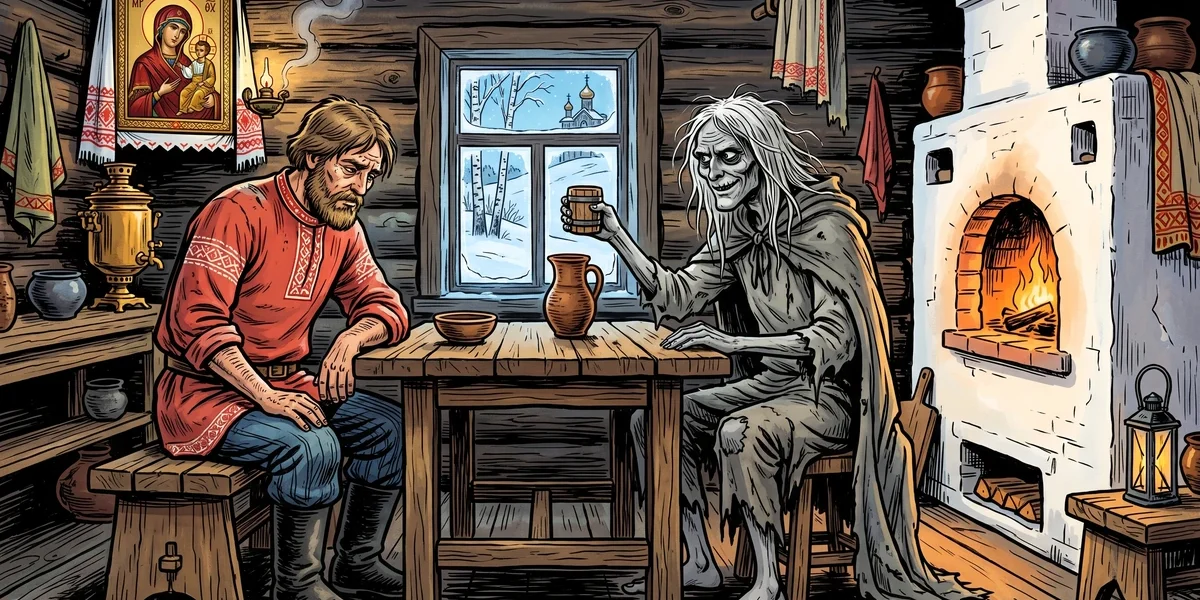
In a small village (don’t ask me which one; somewhere in Russia, anyway) there lived two brothers, one rich and one poor. Everything the rich brother touched went well and brought him a profit. However hard the poor brother worked, nothing went right for him at all.
The rich brother grew richer still. He moved to a big town, bought a large house and became a merchant among merchants. The poor brother grew so poor that often there was not even a crust in his izba, his log cabin, and his ragged little children cried with hunger. At last he lost heart. His head hung low on his chest, and one day he went to his rich brother to ask for help.
“Please be kind and help me,” he said. “I’m almost at the end of my strength.”
“Why not?” said the rich man. “We have plenty of money, but we also have plenty of work. Stay here a while and work for me.”
So the poor brother swept the big yard, groomed the horses, carried water from the well and chopped wood. After two weeks of this, his brother paid him twenty-five copecks and gave him a loaf of black rye bread. “Thank you kindly,” said the poor man humbly, and he turned to go home. Perhaps the rich man felt a twinge of conscience, because he called him back. “Why rush off? Tomorrow is my birthday. Stay for the feast.”
But even at a feast the unlucky man had no luck. His brother was so busy with his many friends, who all came to tell him what a fine fellow he was, that he forgot the poor brother completely. The poor man sat shyly in a corner with nothing to eat or drink. When the guests left, they bowed and paid the host compliments, and the poor brother did the same, only he bowed lower and thanked him harder than anyone. The guests rode home singing in their carts. The poor brother walked home hungry and miserable, and he thought, “What if I sing a cheerful song too? Then people will think I had a fine time at my brother’s.”
He began to sing, and nearly fainted with fright, because a thin, shrill voice behind him was singing along. When he stopped, the voice stopped. When he started again, so did the voice. “Who’s there? Show yourself!” he shouted. Out came a creature, tall, yellow and as thin as a skeleton, dressed in rags. Trembling, the man crossed himself and asked who it was.
“Me? I’m Bitter Woe, one of the Russian heroes, Woe Bogotir. I feel sorry for weak people. I feel sorry for you, and I want to help you along.”
“All right, Bitter Woe,” sighed the man. “Let’s walk together. I don’t suppose I have any other friends in the world.”
“Let’s ride instead,” laughed the creature. “I’ll be your faithful companion.”
“Thank you, but what shall we ride on?”
“I don’t know what you’ll ride on, but I’m riding on you!” And Woe leapt onto the poor man’s shoulders. The man had no strength to throw him off. He staggered along the long, hard road with Woe on his back, singing, whistling and flicking him with a switch the whole way. Whenever the man sighed, Woe asked, “Why so gloomy, master? Let me teach you my favourite song.” It went something like this: “I’m Woe the brave and Woe the bold; whoever keeps me keeps his sorrows in hand, and when he runs short of money, I’ll find him gold.” “Now then, master,” Woe added, “you have twenty-five copecks. Let’s go and buy some wine and have a jolly time.”
The poor man did as he was told, and they drank away every copeck. Then he came home with Woe still on his shoulders. His wife was sad and his children were hungry and crying, but he, under the spell of Woe and the wine, danced and sang.
The next day Woe groaned, “My head aches from all that drink. Let’s drink some more.” “I’ve no money,” said the man. “Have you forgotten my song? Let’s trade the harrow, the plough, the sledge and the cart for money and enjoy ourselves.” The man was too weak to refuse. Woe Bogotir had become his master. Off they went to the tavern and spent everything. The day after, Woe sighed again. “Let’s drink and be merry. Let’s sell whatever is left, even ourselves.”
That was when the man understood that he was close to ruin, and he made up his mind to trick his sorrowful companion. “I once heard the old folk say that behind the village, near the dark forest, a great treasure lies buried under a huge stone. It’s too heavy for one man to move. But if you and I could shift it, Woe Bogotir, we’d have all the drink we wanted.”
“Quick, let’s go!” shrieked Woe. “Bitter Woe can do much harder things than move a stone!”
They went the long way round behind the village and found the stone, so big that five or six strong peasants couldn’t have budged it. But the poor man and Woe rolled it aside at once. Beneath it was a deep, dark pit, and far down at the bottom something glittered. “Brave Woe,” said the man, “jump down and throw the gold up to me. I’ll hold the stone.”
Woe jumped in and laughed aloud. “Master, there’s no end of gold down here! Twenty pots of it and more!” He passed one pot up. The man tucked it under his shirt and quickly slid the heavy stone back into place. So Bitter Woe was left down in the pit. “That’s the right place for my comrade,” the man thought. “With a friend like that, even gold would taste bitter.”
He crossed himself and hurried home, and, free of Woe’s demands and with money to begin again, he resumed his work. He bought a grove of trees and some cattle, repaired his cabin and started trading, and he did very well. Within a year he had made a good deal of money and built a fine new log house in place of the old hut.
One bright day he went to town to invite his rich brother and family to a feast in his new home. “What a joke!” scoffed the rich brother. “You haven’t a rouble in your pocket, you fool. I suppose you want to play at being rich.” He laughed and laughed, but he was curious too, so he went at once to have a look. When he arrived, he could hardly believe his eyes. His poor brother now looked as rich as he was, maybe richer, and everything was well kept. The host treated his guests kindly. They ate well and drank plenty of honey drink, and everyone grew chatty. The younger brother told the whole story of Woe, how he had tricked him, and how happy he had become since he got rid of that burden.
The rich man listened greedily and thought, “What a fool! All those pots and he took only one. When you have money, even Bitter Woe isn’t so bad.” He decided at once to find the stone, take the whole treasure and send Woe back to his brother.
No sooner thought than done. He said goodbye, but instead of going home he hurried to the stone. He heaved and strained until he moved it just a little. He had no time even to look inside: Woe sprang out of the pit and onto his shoulders. The rich man felt a terrible weight, turned his head and saw the hideous creature. “Clever, aren’t you?” Woe whispered in his ear. “You wanted to leave me to rot down there? Well, my dear, you won’t get rid of me now. We’ll be together always.”
“Stupid Woe,” said the rich man, “it wasn’t me who shut you under the stone, it was my brother. Go to him!” But Woe only laughed and laughed. “It makes no difference to me. Let’s be dear companions, you and I.”
So the rich man went home bent under the heavy weight of Woe, and soon all his wealth was gone. His brother, who had learned how to get rid of Woe, did well and is doing well to this day.
About this telling
“Woe Bogotir” is the fifth tale in Verra Xenophontovna Kalamatiano de Blumenthal’s Folk Tales from the Russian (Project Gutenberg #12851). Bogotir (more often spelled bogatyr) is the word for the heroes of Russian legend. Here a ragged spirit of misery borrows the title for himself as a bitter joke. Blumenthal turns the twenty-five copecks the poor brother earns into “only thirteen cents” for her American readers. Her notes explain words such as izba, a peasant’s log cabin, and kabak, a village tavern.
This telling keeps Blumenthal’s bargain, the trick at the stone and the turnaround at the end. Woe’s little song is paraphrased rather than quoted.
Read the original: Verra Xenophontovna Kalamatiano de Blumenthal, Folk Tales from the Russian (Project Gutenberg #12851)
Best for ages 9–12 with adult discussion: hunger, an exploitative employer, drinking that consumes a family’s livelihood and a frightening spirit. Woe personifies distress; the tale does not explain real poverty or mental illness.
Reading the story closely
The poor brother is already hardworking before Woe appears. His brother’s inadequate payment and failure to feed him precede the drinking, so misery cannot fairly be blamed on laziness or simply ‘giving up.’ The gold matters too: escape provides resources as well as a change of behavior. Woe’s offer of help becomes literal weight, and the promise to ride together means only Woe gets a ride.
Compare the two visits to the stone. Mark each brother’s aim, what he knows about Woe and what he is willing to risk. The second brother wants not just more gold but to send suffering back to his sibling. Finally compare the two feasts: who is fed, noticed and welcomed? The contrast gives the ending more substance than a simple rich-versus-poor reversal.
Think about it
- How does Woe persuade the poor brother to spend all his money and sell his tools?
- Why does the poor brother take only one pot of gold? Was that wise?
- What do you think the storyteller wants us to learn from what happens to the rich brother?
Related stories
- Dimian The Peasant — a short Blumenthal tale about a host who is outsmarted
- The Golden Mountain — another Blumenthal tale with a dangerous reversal between two men
- Ivanoushka The Simpleton — a poor younger brother’s luck turns in another tale from the book
Frequently Asked Questions
Who is Woe Bogotir?
How did the poor brother get rid of Woe?
What happened to the rich brother?
What does Bogotir mean?
You May Also Like
 Russian Folk Tales
Seven Simeons
A lonely tsar recruits seven peasant brothers with odd talents, from building a sky-high pillar to stealing, to carry off a proud island king's daughter.
 Russian Folk Tales
Ages 6-8
Russian Folk Tales
Ages 6-8
Dimian the Peasant
Bossy Dimian forces gifts on his guests to make them refuse, until a sly visitor accepts his supper, his best coat and finally his finest horse.
 Russian Folk Tales
Ages 9-12
Russian Folk Tales
Ages 9-12
The Tsarevna Frog
Forced to marry the frog who caught his arrow, Ivan finds she is the wise Vassilissa, but burning her skin too soon sends him on a quest against Kostshei.