3. How Partlet Died And Was Buried, And How Chanticleer Died Of Grief
From that day Chanticleer would eat and drink no more, and pined away until he died of grief.
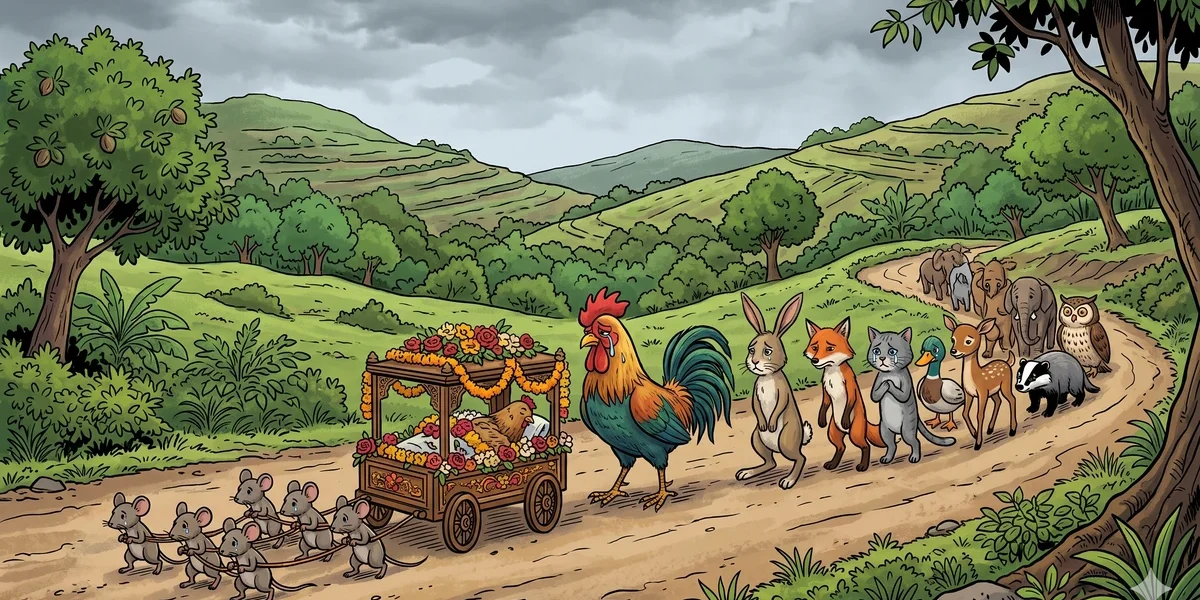
Partlet’s Death and Chanticleer’s Grief: The Tale of Inseparable Love
The third and final story in the Brothers Grimm’s Chanticleer and Partlet cycle closes the saga of the rooster-and-hen pair with a tale of conjugal love pushed to its tragic extreme: Partlet the hen dies, and Chanticleer the rooster’s grief is so profound that it proves contagious — spreading first to the animals who attend her funeral procession, then to the stream that bears them, and finally consuming Chanticleer himself. This tale belongs to a distinctive genre of the “contagious grief” or “chain-reaction lament” narrative, in which mourning spreads through an entire ecosystem, demonstrating that one being’s death touches all connected beings in ways that exceed rational accounting.
The tale’s emotional logic resonates with the Indian concept of shoka — the grief that Valmiki experienced when he witnessed the hunter kill the male krauncha bird and saw its mate’s lament, a grief so overwhelming that it produced the first Sanskrit shloka (verse). Shoka that transforms into poetry, into community mourning, into cosmic acknowledgment of loss — this is the Indian understanding of how grief functions as a relational force that exceeds individual experience. Chanticleer’s grief at Partlet’s death is shoka at its most acute: the loss of the complementary half that gave existence its meaning.
The Processional Grief: Community Drawn Into Mourning
The tale’s structure — a funeral procession that accumulates mourners as it moves, each new participant drawn into grief by contagion — is a precise narrative enactment of how mourning actually functions in community contexts. The ducks join the procession, then are joined by others, until the entire community (and, in the tale’s escalating absurdity, the stream itself, trees, the environment) participates in the collective acknowledgment of loss. This communal mourning structure mirrors the Indian funeral procession (yatra) in which the dead is accompanied by an expanding community whose presence converts private loss into publicly acknowledged fact.
The Sanskrit concept of antyesti (funeral rites) emphasizes the community’s role in acknowledging and processing the loss of one of its members. The funeral procession is not merely a practical matter of transporting the body but a communal act of recognition: this person existed, this person mattered, this community is diminished by this loss. When Chanticleer’s procession grows to include creatures who barely knew Partlet, the tale is enacting this communal antyesti principle: grief is not private property but a communal claim that mobilizes collective response.
Contagious Grief and the Ecology of Loss
The tale’s most striking feature — that Chanticleer’s grief eventually proves fatal, and that the grief has spread through an entire ecosystem before claiming him — reflects a folk narrative understanding of what modern ecologists call “trophic cascades”: the ripple effects of a single event through an entire interconnected system. The pond that absorbs the grieving procession and drowns them, the stream that floods, the trees that mourn — these are not merely poetic exaggerations but accurate accounts of how loss propagates through systems of connection.
In Indian ecological thinking, the concept of pratityasamutpada (dependent origination) holds that all phenomena arise in dependence on other phenomena, which means that the destruction of one element propagates disturbance through the entire web. A forest without its keystone species declines; a family without its central relationship loses coherence; a rooster without his Partlet cannot perform the function (announcing the dawn) that gives his life its meaning. Chanticleer’s death is not mere melodrama but the natural consequence of the removal of the relationship that constituted his identity.
Conjugal Love and Its Absolute Character
The tale’s theological depth lies in what it implies about conjugal love: that it is constitutive rather than additive. Partlet is not a part of Chanticleer’s life that can be removed while leaving the rest intact; she is the context within which Chanticleer’s identity as Chanticleer has meaning. His dawn-crow was always crow-for-Partlet; his strutting and preening always in relation to her presence; his adventures always with her as partner and witness. When she is removed, not just comfort but the very structure of his meaningful activity collapses.
This understanding of conjugal love as constitutive — rather than merely important or pleasurable — resonates with the Indian tradition’s treatment of the ardhanari (half-male-half-female) principle: the cosmic unity of Shiva and Shakti suggests that the most complete form of existence is the inseparable pair, each of whom is incomplete without the other. Chanticleer is not a whole rooster who has lost something valuable; he is half of a pair who has lost his constitutive other half. The grief that kills him is therefore not excessive but proportionate to an actual loss of being.
“He crowed every morning because she was there to hear it. When she was no longer there, the crowing had no reason — and without reason, not long after, neither did he.”
Why This Story Lasted
How Partlet Died and Chanticleer Died of Grief has lasted because it takes conjugal love seriously — seriously enough to argue that its loss is genuinely fatal, not through sentiment but through logic. The rooster and hen who have built their entire life’s meaning in relation to each other have made themselves vulnerable to exactly this: the loss of meaning when the constitutive relationship is severed. The tale does not mourn this vulnerability; it honors it. A love so thorough that its loss is unbearable is not weakness — it is the deepest form of devotion available to creatures who can love at all. Every generation that has loved deeply enough to understand this has found their experience honored in Chanticleer’s grief.
Frequently Asked Questions
What is the “contagious grief” genre and where else does it appear?
Contagious grief narratives — in which mourning spreads through an entire ecosystem — appear across world folk traditions. In Indian literature, Valmiki’s shoka at the krauncha bird’s death produced the first Sanskrit shloka (verse), demonstrating grief transforming into communal artistic expression. Chanticleer’s grief follows this pattern: personal mourning spreads through the entire ecosystem, each new mourner acknowledging the loss’s cosmic scale.
What is antyesti and how does the funeral procession enact it?
Antyesti (funeral rites) in Indian tradition emphasizes the community’s role in converting private loss into publicly acknowledged fact — the procession declares “this person existed, this person mattered, this community is diminished.” When Chanticleer’s procession expands to include creatures who barely knew Partlet, the tale enacts this principle: grief is not private property but a communal claim that mobilizes collective recognition and response.
Why does Chanticleer die of grief — is this biologically plausible?
The tale is using “death of grief” metaphorically but accurately: when a relationship is constitutive (not merely valuable) to a being’s identity and meaningful activity, its removal does not leave the being intact minus one relationship — it collapses the entire structure of meaning. Chanticleer’s dawn-crow was always crow-for-Partlet; without her presence, the activity loses its context and eventually its performer. This is the pratityasamutpada (dependent origination) of personal identity.
How does the ardhanari principle illuminate this tale?
The ardhanari (half-male-half-female) cosmic principle — embodied in the Shiva-Shakti unity — suggests that the most complete form of existence is the inseparable pair, each incomplete without the other. Chanticleer is not a whole rooster who has lost something; he is half of a pair who has lost his constitutive other half. His grief is proportionate to this loss of being, not excessive sentiment about the loss of a companion.
Does the stream/environment mourning reflect an animist worldview?
Yes — the tale reflects the animist folk understanding that the natural world is fully responsive to human (and animal) grief: the stream mourns, the trees respond, the environment itself participates in the community’s loss. This resonates with Indian ecological philosophy’s pratityasamutpada (dependent origination): all phenomena arise in mutual dependence, so the death of one significant being genuinely disturbs the entire interconnected system — not merely as metaphor but as ecological fact.
You May Also Like
 Grimm's Fairy Tales
Ages 9-12
Grimm's Fairy Tales
Ages 9-12
Hans In Luck
Hans In Luck: Some men are born to good luck: all they do or try to do comes right all that falls to them is so much gain all their geese are swans all their
 Grimm's Fairy Tales
Ages 9-12
Grimm's Fairy Tales
Ages 9-12
Iron Hans
Iron Hans: There was once upon a time a king who had a great forest near his palace, full of all kinds of wild animals. One day he sent out a huntsman to shoot
 Grimm's Fairy Tales
Ages 6-8
Grimm's Fairy Tales
Ages 6-8
The Golden Goose: Kindness Rewarded, Greed Punished
The Golden Goose: Kindness Rewarded, Greed Punished: The Foolish Youngest Son In a time when the world still held magic in its forests and mountains, there