The Death of Baldur
The Death of Baldur: In the golden halls of Asgard, there lived a god so beautiful, so pure, so beloved by all beings in the Nine Worlds that his very presence

Of all the deaths in Norse myth, only one makes the gods themselves weep. Warriors fall in their thousands, giants are slain, even Odin is fated to die in the jaws of the wolf — and the cosmos receives all of it without a tear. But when Baldur the bright dies, the weeping spreads outward until it reaches the stones and the metals and the dew on the morning grass. This is the story of how the most beloved being in the Nine Worlds was killed by the one thing his mother forgot to ask, and of how a single sprig of mistletoe set the long countdown to Ragnarök running.
A Death Recorded Across the Eddas
The death of Baldur is the best-attested single episode in all of Norse mythology, and it survives because four separate medieval traditions each thought it too important to lose. The fullest and most familiar account appears in the Prose Edda of the Icelandic scholar and chieftain Snorri Sturluson, composed around 1220. Snorri tells the tale in the section called Gylfaginning — “The Beguiling of Gylfi” — where it occupies chapters 49 and 50, the emotional climax of his whole survey of the old gods.
Snorri did not invent the story; he was preserving poems already centuries old. In the Poetic Edda, the prophetic poem Völuspá (“The Seeress’s Prophecy”) devotes stanzas 31 to 34 to Baldur’s death and its immediate aftermath, and returns in stanza 60 to his shining rebirth in the world after Ragnarök. The short, eerie poem Baldrs draumar (“Baldur’s Dreams”) opens with the very nightmares that begin our tale, as Odin rides down to the underworld to wake a dead seeress and demand their meaning. The poem Lokasenna (“Loki’s Quarrel”) has Loki boast openly, to the assembled gods, that it was he who arranged the killing. Earlier still, around 985 CE, the skald Úlfr Uggason described Baldur’s funeral in his Húsdrápa, a poem composed to celebrate the carved wooden panels of a great Icelandic hall — proof that the scene was being illustrated in art a thousand years ago. A very different, euhemerised version, in which Balderus and Høtherus are rival human princes, was set down by the Danish historian Saxo Grammaticus in his Gesta Danorum around 1200.
There is no single international folktale number for a myth of this kind, but its engine is one of the most widespread story-motifs ever catalogued: invulnerability that fails at a single overlooked point. Folklorists file it under motif Z311 in the Stith Thompson Motif-Index of Folk-Literature — the same deep pattern that gives the Greek world the heel of Achilles and gives countless tales their one forbidden door, one unasked question, one thing left out.
The Brightest of the Aesir
To feel the weight of this myth, you must first understand what Baldur was. He was the son of Odin, the All-Father, and of Frigg, the All-Mother and queen of the Aesir. Snorri describes him in superlatives that he grants to no other god: the fairest of all, so bright that light shone from him, the wisest and most eloquent and most merciful of the gods, though — Snorri adds with a strange, sad precision — it was a quality of his that none of his judgements could stand. Baldur dwelt in a hall called Breidablik, “broad-gleaming,” into which nothing unclean could come.
He was, in other words, the one being in the Norse cosmos with no enemies. The giants, the dwarves, the beasts, the gods — all of them loved him without reservation. And it is exactly that universal love which the myth is about to weaponise. A world that adores Baldur completely is a world that has staked its happiness on a single life, and the story of his death is the story of that wager being called in.
Beat One: The Dreams and the Mother’s Oath
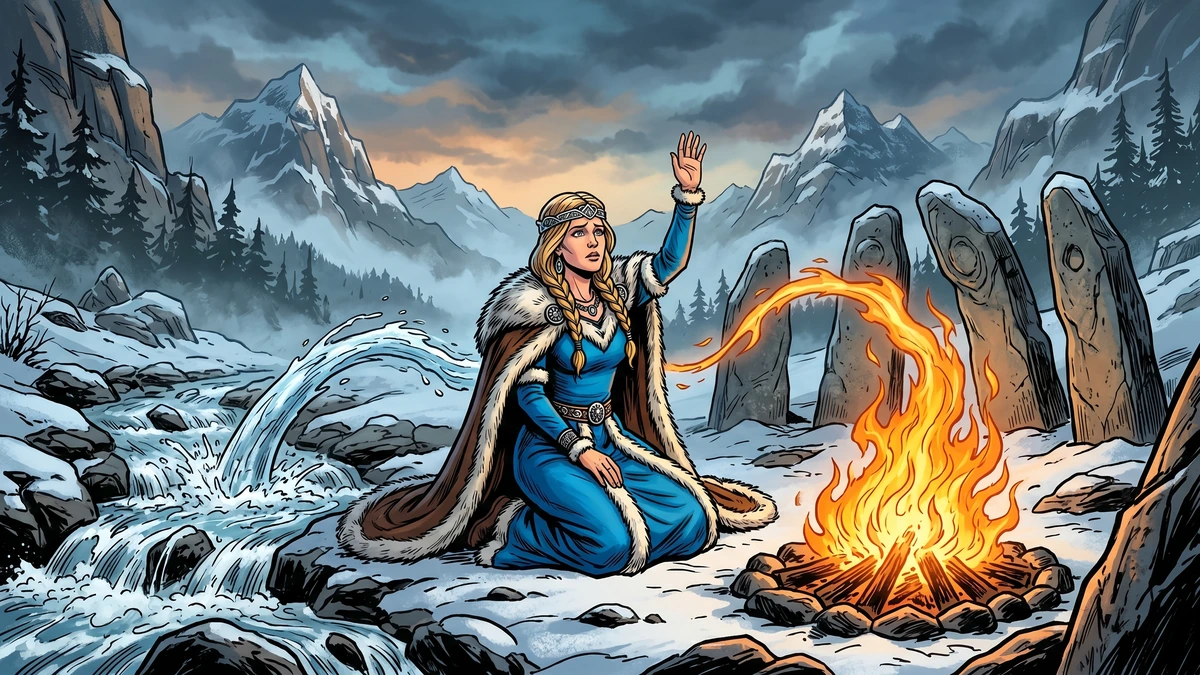
It begins, as so many doom-tales begin, with sleep. Baldur woke night after night from dreams he could not shake — dreams heavy and dark, in which he saw his own death approaching like weather across a plain. He told the gods, and the gods were afraid, because Baldur did not frighten easily and because dreams, in the Norse mind, were not idle things but leaks of the future into the present. Odin himself saddled his eight-legged horse Sleipnir and rode the long road down to Hel’s cold country, where he raised a dead prophetess from her grave and forced her to speak. Her answer was the worst possible one: the benches of Hel stood decked with gold, she said, in readiness, and they were waiting for Baldur.
Frigg refused to accept it. If a mother’s will could outrun fate, hers would. She set out across the whole of creation and went from thing to thing, asking each in turn to swear a binding oath never to harm her son. Fire swore it. Water swore it. Iron and every metal swore it; stones, the earth itself, the trees, the sicknesses, the beasts, the birds, the creeping things, the very poisons — each gave Frigg its solemn promise. She came home certain that she had unwritten the prophecy. Everything that existed had bound itself to keep Baldur alive.
Beat Two: The Game of Spears
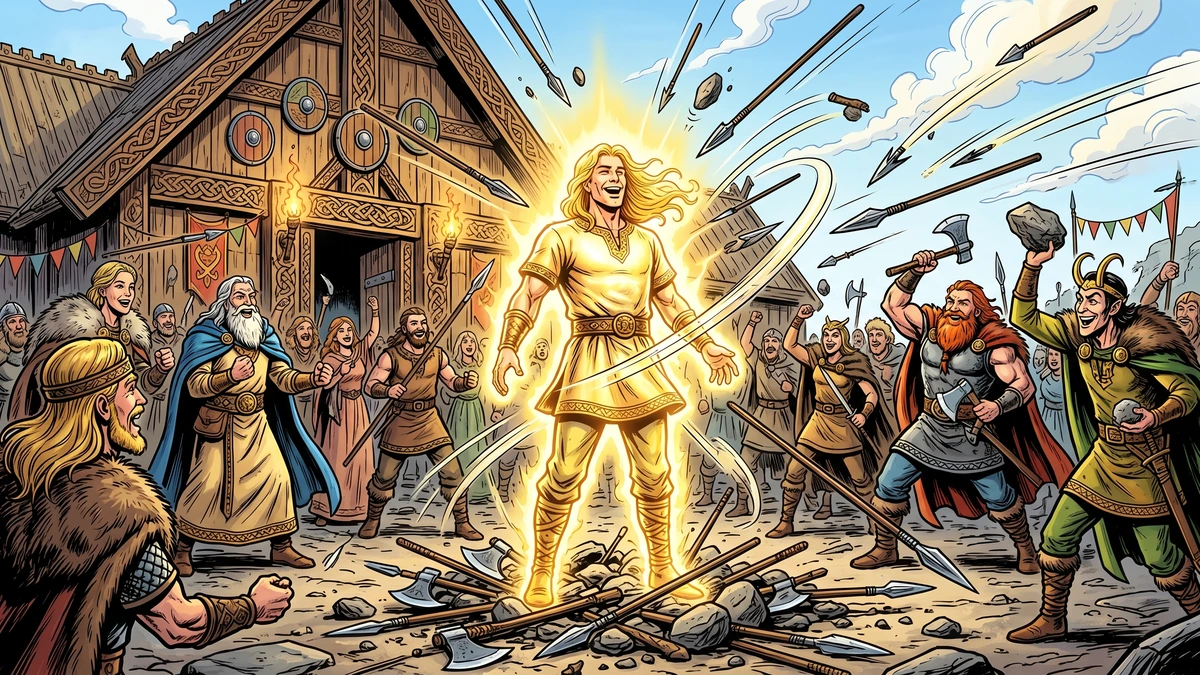
What followed became the strangest entertainment in Asgard. Since nothing could wound Baldur, the gods made a game of the fact. They would stand him in the centre of the assembly-place, the Thing, and then take turns hurling at him whatever came to hand — stones, darts, axes, blades, spears thrown with full force. And nothing touched him. Weapons swerved, blades turned, edges refused to bite; the missiles fell harmless at his feet while Baldur stood unharmed and laughing in the middle of it. The gods roared their delight. To them this was proof made visible, a daily ritual of reassurance: look, the world keeps its word, our bright one cannot die.
It is one of the eeriest images in Norse myth — an entire pantheon throwing spears at the thing it loves most, and calling it joy. The game was a celebration of safety, but it was also, though none of them saw it, a rehearsal. They were teaching themselves the gesture that would kill him. They were only waiting, without knowing it, for one weapon that had never been asked to swear.
Beat Three: The Mistletoe and the Blind Brother
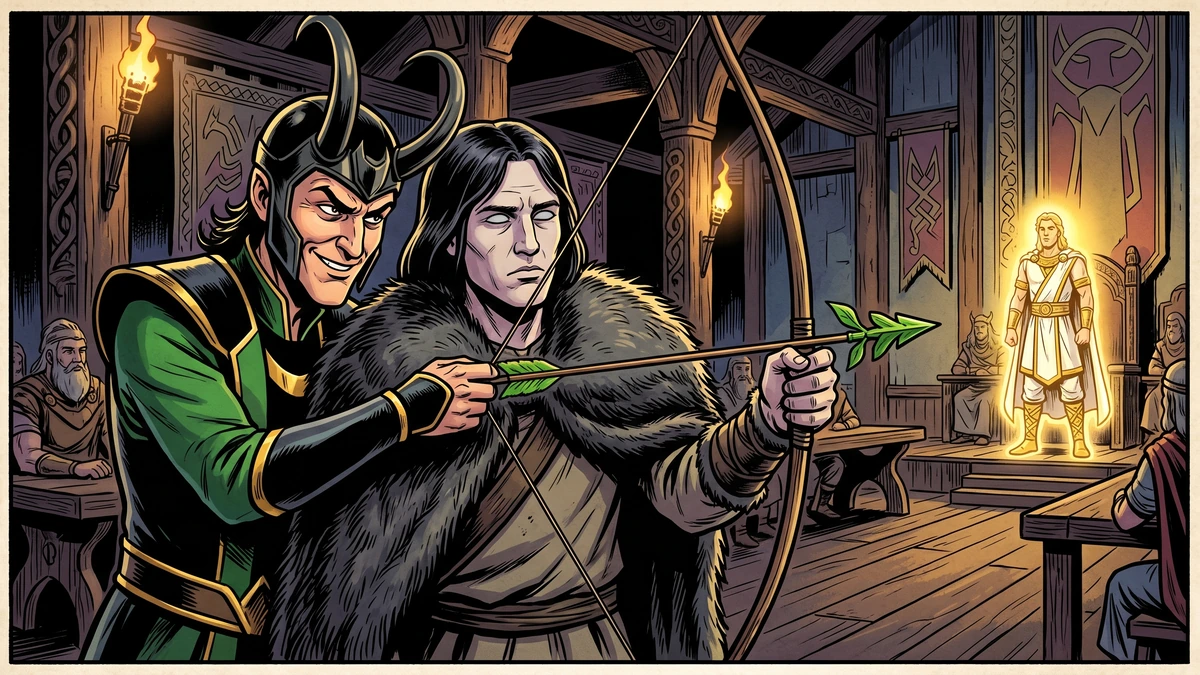
Loki could not bear it. Whether from envy, from spite, or from the simple inability to leave a perfect thing alone, the trickster set out to find the flaw. He changed his shape into that of an old woman and went to Frigg, and there, in conversation, he drew the secret out of her with a single careless-seeming question. Had truly everything sworn the oath? Frigg, suspecting nothing, admitted there had been one exception. West of Valhalla grew a slender plant called mistletoe, and it had seemed to her so young, so soft, so harmless that she had passed it by and asked nothing of it.
That was all Loki needed. He went west, cut the mistletoe, and shaped it into a dart or a slender shaft. Then he returned to the game, where the gods were still happily flinging their weapons, and he found Hödur — Baldur’s own brother, who was blind, and who stood at the edge of the crowd taking no part because he could not see to aim and had nothing to throw. Loki offered to help. He put the mistletoe into the blind god’s hand, pointed him toward his brother, and guided the throw. Hödur, glad to honour Baldur like everyone else, let the dart fly. The mistletoe, which had sworn nothing, passed through Baldur as though he were unarmoured, and the bright god fell dead in the middle of the cheering. It was, Snorri says, the greatest misfortune ever worked among gods and men.
Beat Four: The Pyre and the Ride to Hel
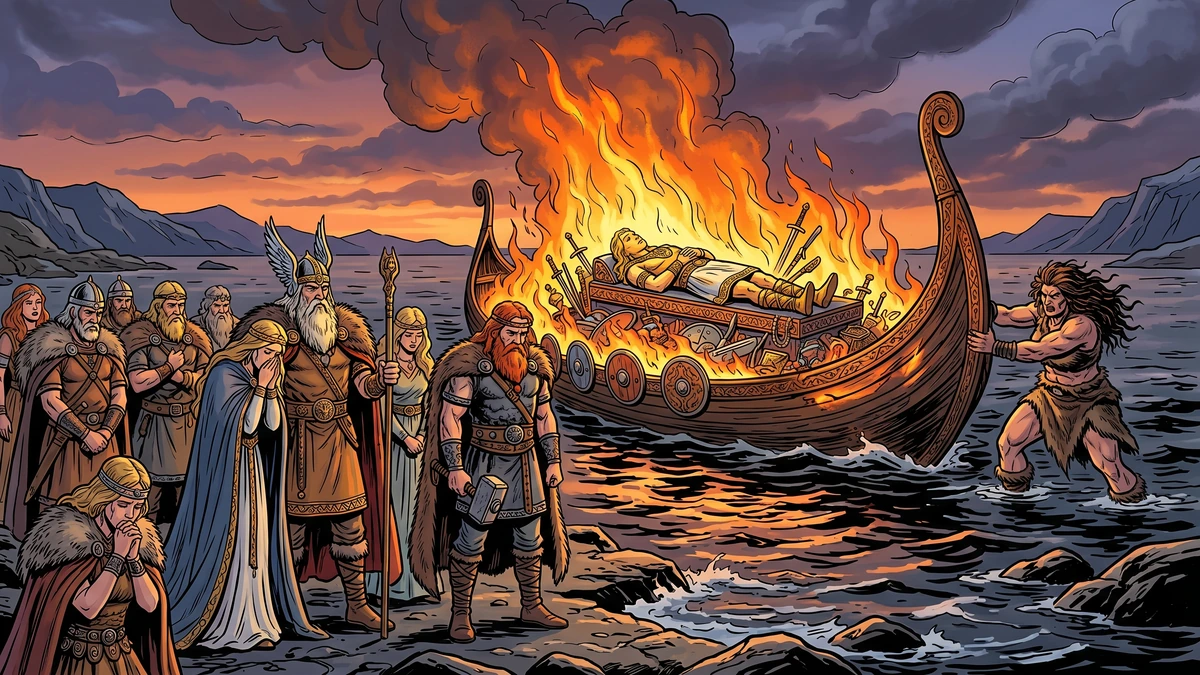
The silence that fell on Asgard was unlike anything the gods had known. They could not even speak; they could not lift him; grief held them where they stood. Baldur’s body was carried to the shore and laid aboard his great ship, Hringhorni, for a funeral by fire. The ship was so heavy with the dead god and his grave-goods that the gods could not launch it, and they had to send for a giantess, Hyrrokkin, who came riding a wolf and shoved the vessel into the sea with a single push. Odin laid upon the pyre his own ring, Draupnir. Baldur’s wife Nanna’s heart broke at the sight, and she died of grief and was laid on the pyre beside him. The mourners came from every world — gods, frost-giants, mountain-giants — to watch the brightest thing in creation burn.
But Frigg would not stop fighting even now. She asked who among the gods would ride to Hel and offer a ransom for Baldur’s release. Baldur’s brother Hermod took up the task, rode Sleipnir nine nights down through dark valleys, and came at last before Hel, the pale queen of the dead. Hel made a bargain: if it were truly so, if Baldur were as universally loved as everyone claimed, then let it be tested — if every thing in the world, living and dead, would weep for him, she would let him go. The gods sent messengers to the ends of creation, and the whole world wept; people, animals, earth, stones, trees, and metals all shed tears, as wet stones still do, they say, when they come out of frost into warmth. Only one creature refused. In a cave sat a giantess who called herself Þökk — “Thanks” — and she would not weep. It was Loki in disguise, and his refusal sealed the door. Baldur would stay in Hel.
The Moral: The Thing Left Unasked
The death of Baldur is, on its surface, a tragedy of carelessness — but the myth is far too precise to be read as mere bad luck. Frigg’s great labour was almost perfect, and “almost perfect” is the most dangerous condition the story knows. She asked fire and iron and stone, the obvious threats, and skipped only the one plant too small and too gentle to seem worth the trouble. The myth’s hard lesson is that danger does not announce itself by looking dangerous. The overlooked thing — the soft sprig, the unasked question, the exception made out of kindness — is precisely the gap through which doom walks in.
And the cruelty is doubled by who delivers the blow. It is not an enemy who kills Baldur but Hödur, his own loving brother, blind and entirely innocent, guided by another’s hand. The myth refuses to let the gods comfort themselves with a clean villain. Loki supplies the malice, but the act passes through love and blindness to reach its mark, which is why no one can quite be punished and no one can quite be forgiven. The Eddic wisdom-poetry of the same tradition keeps returning to this knowledge that the worst losses are irreversible and that grief cannot be bargained away. When Þökk gives her dry-eyed answer in Gylfaginning, she speaks it, chillingly, as a verse:
Þökk mun gráta
þurrum tárum
Baldrs bálfarar;
kyks né dauðs
nautk-a ek karls sonar:
haldi Hel því er hefir.“Þökk will weep dry tears at Baldur’s funeral fire; living or dead, the old man’s son gave me no joy — let Hel keep what she holds.” — Gylfaginning, chapter 49
One creature in all the worlds withholds one tear, and that is enough. The myth measures love by its completeness and shows that completeness is almost impossible to reach. The same lesson that doomed Baldur in Beat One — one exception undoes the whole — returns to doom him a second time at the gate of Hel. Frigg forgot one plant; the world, in the end, contained one unwilling heart. Goodness, the tale says, is not safe simply by being good; it must be guarded everywhere at once, and no guard is ever quite that wide.
Baldur After Ragnarök
Yet the Norse imagination did not leave the story in pure darkness, and this is what lifts it above ordinary tragedy. Baldur’s death is not only a grief; it is the first domino of Ragnarök itself. With the bright god gone and Loki’s guilt exposed, the gods bind Loki beneath the earth, and the slow machinery of the world’s ending begins to turn. Baldur in Hel becomes a hostage of fate, the proof that even the gods cannot keep what they love.
But Völuspá, in its sixtieth stanza, looks past the fire. After Ragnarök has burned the old world away, a new and green earth rises from the sea — and Baldur comes back. He returns from Hel to live in the halls of the renewed world, reconciled with Hödur, the brother who killed him, the two of them dwelling together in peace. The death that began the end also seeds the world that follows it. In the Norse scheme, Baldur is light withdrawn from a doomed age and held in safekeeping until a worthier one can receive it. His death is a loss the cosmos cannot survive — and his return is the promise that something, on the far side of every ending, survives anyway.
Why the Tale Has Lasted
The death of Baldur has outlived its religion by a thousand years, and it is not hard to see why. It is the rare myth that is honest about grief. It does not pretend that love is a shield, that goodness is armour, or that a sufficiently devoted mother can out-argue mortality. Frigg does everything right and her son dies anyway, and the gods, for all their power, can only weep — and even their weeping is not quite enough. Few stories from any culture look that squarely at the limits of what love can do.
And yet it is not a hopeless story, which is the second secret of its endurance. It holds loss and renewal in the same hand: the worst thing that can happen does happen, and still a green world rises afterward with the bright god walking in it. That double vision — clear-eyed about the pyre, unembarrassed about the dawn — is why audiences from medieval Iceland to the modern world keep returning to Baldur. He is the myth’s way of saying that what we cherish is genuinely fragile, that one overlooked sprig can take it from us, and that we are right to grieve when it goes — and also that grief is not the last word the world gets to speak.
You May Also Like
 Norse Folk Tales
Ages 9-12
Norse Folk Tales
Ages 9-12
East Of The Sun And West Of The Moon
East Of The Sun And West Of The Moon: Once on a time there was a poor husbandman who had so many children that he hadn’t much of either food or clothing to
 Norse Folk Tales
Ages 9-12
Norse Folk Tales
Ages 9-12
The Cat On The Dovrefell
A traveller's 'white cat' is really a great white bear — and on Christmas Eve he teaches a band of trolls a lesson they never forget.
 Norse Folk Tales
Ages 9-12
Norse Folk Tales
Ages 9-12
The Lad Who Went To The North Wind
The Lad Who Went To The North Wind: Once on a time there was an old widow who had one son; and as she was poorly and weak, her son had to go up into the safe