Thor and the Giant’s Kettle
Thor and the Giant's Kettle: In the golden halls of Asgard, where the gods feasted and plotted, the need for a new cauldron had become undeniable. The old
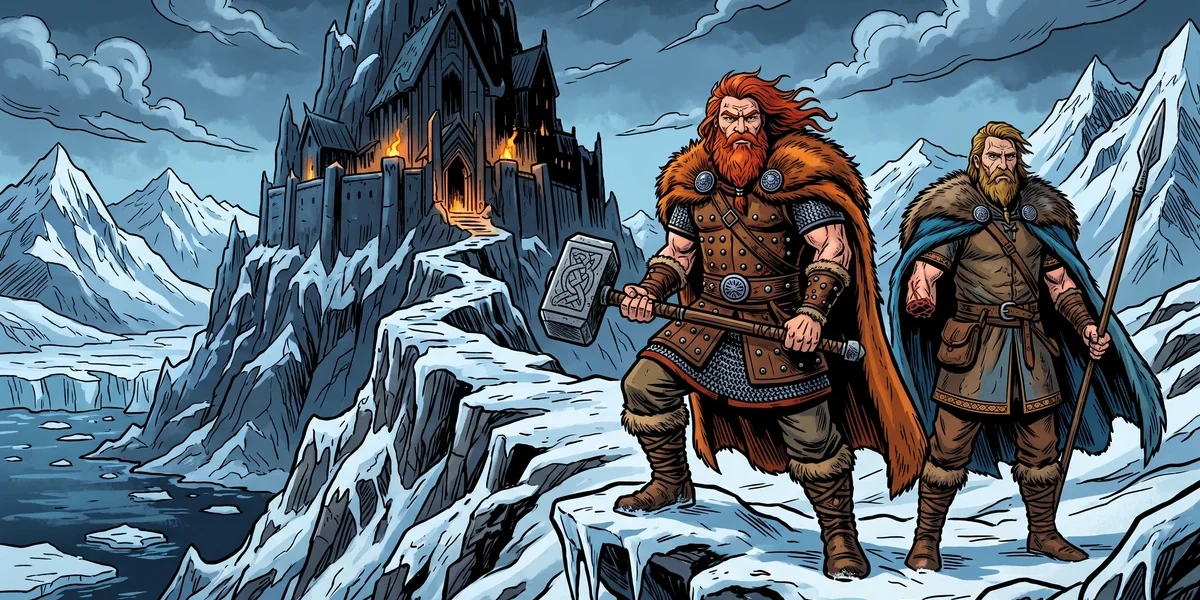
Among the loud, vivid, and faintly comic adventures of the thunder god, few are as beloved as the tale of how Thor went into the land of the giants to fetch a cauldron large enough to brew ale for all the gods at once. It is a story of enormous appetite and enormous strength, of a one-handed companion who keeps his courage when the thunder god loses his temper, and of a fishing trip that very nearly hooked the monster destined to end the world. Beneath its broad humour lies one of the oldest themes in Norse storytelling: that a guest carries obligations into a hall, and that strength, freely tested, can win what no bargain could.
The gods of Asgard loved their feasts, and a feast in the old North meant ale brewed in quantity. When the sea-giant Aegir was pressed to host the Aesir, he set one stubborn condition: he would brew for them only if someone brought him a kettle vast enough to hold the drink for the whole company. No such vessel stood in Asgard. The search for it sends Thor and his quiet, watchful companion Tyr out across the worlds, and the journey they take is the heart of this tale.
The Origin of the Tale and How It Reaches Us
This story is not a loose folk legend but a poem with a name and a manuscript. It survives as the Hymiskvida, “The Lay of Hymir,” one of the mythological poems gathered in the Poetic Edda — also called the Elder Edda — the great collection of Old Norse verse on gods and heroes. The single medieval book that preserves nearly all of these poems is the Codex Regius (catalogued today as GKS 2365 4to), an Icelandic manuscript written down in the later thirteenth century. The poem itself is older than the book that carries it; scholars generally place its composition somewhere in the twelfth or early thirteenth century, noting that its style leans more heavily on ornate poetic circumlocution than most of its neighbours in the collection.
The same myth was known to Snorri Sturluson, the Icelandic chieftain and scholar who, around 1220, compiled the Prose Edda as a handbook for poets. In the section called Gylfaginning, Snorri retells the most dramatic moment of the tale — Thor’s fishing for the World Serpent — in vigorous prose, which means the two halves of the story circulated both as a single poem and as separate, well-loved episodes. English readers have met the Hymiskvida through a long line of translators, among them Benjamin Thorpe in 1866, Henry Adams Bellows in his influential 1923 rendering, and more recently Carolyne Larrington, whose modern translation has introduced the poem to a wide readership. Because the verse is terse and allusive, retellings such as this one expand its bare scenes into a fuller narrative while keeping faith with its sequence of events.
The Broken Cauldron and Aegir’s Stubborn Condition
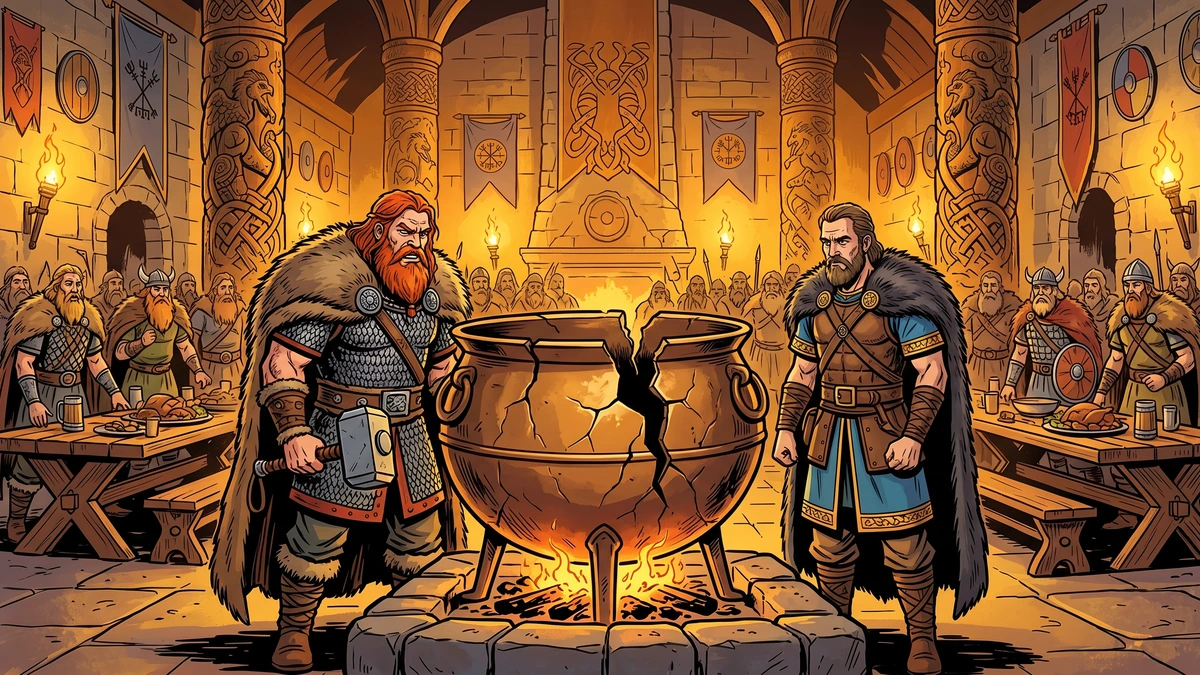
The trouble began, as troubles in Asgard often did, around a feast. The old brewing vessel of the gods had cracked past mending, and the mead and ale that fuelled the endless festivities of the divine realm could no longer be made in the quantities the Aesir expected. When the gods cast their lots and decided that Aegir, lord of the sea, should host them, Aegir agreed only grudgingly, and then with a catch. He would brew for the whole company, he said, but only if the gods first delivered to him a kettle deep and broad enough to hold ale for them all in a single brewing. It was a fair demand and an impossible one, for no such cauldron existed in Asgard.
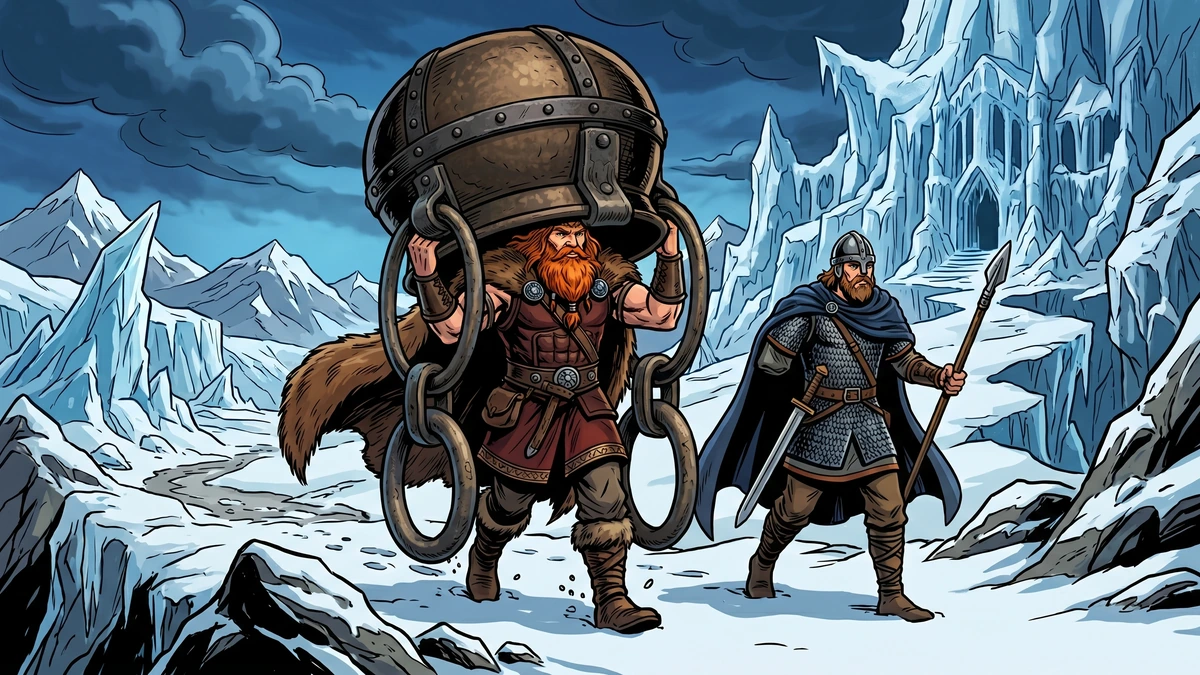
It was Tyr — the god of war and of sworn law, who had given his right hand into the jaws of the wolf Fenrir so that the gods could bind the beast — who remembered where such a vessel might be found. His own father was the giant Hymir, who dwelt at the edge of the world beyond the cold rivers, and in Hymir’s hall stood a kettle a full league deep. Thor, never a god to refuse a journey that promised a fight, agreed at once. The two set out together: the thunder god with his hammer Mjolnir, and the one-handed god of law whose presence would matter more than Thor expected, for the giant they sought was Tyr’s own kin.
The Journey to Hymir’s Hall and the Emptied Larder
Thor and Tyr crossed out of the ordered worlds into Jotunheim, the country of the giants, where the land itself seemed to resent them: mountains that scraped the clouds, valleys so deep the light died in them, and rivers running with water cold enough to still the blood. At last they came to the hall of Hymir. Tyr’s grandmother, a fearsome figure with nine hundred heads in the old verse, was there, and so was Tyr’s mother, gentler and gold-browed, who welcomed them and warned them: Hymir was often harsh with guests, and they would do well to hide beneath the kettles until his mood could be judged.
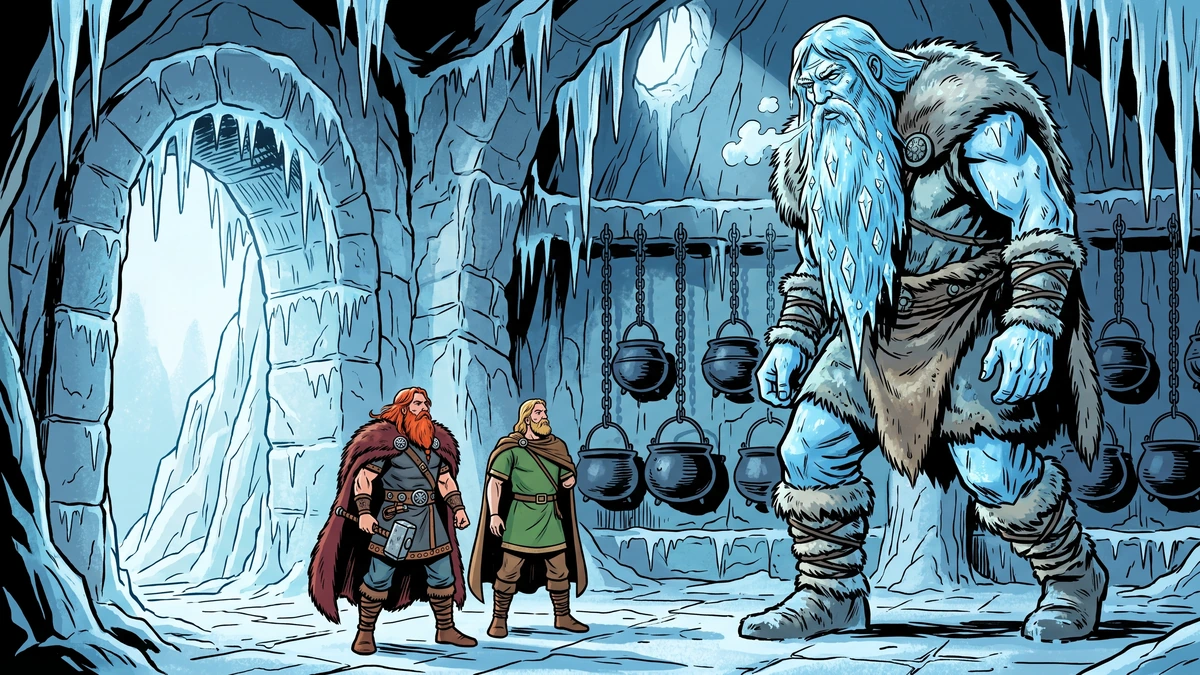
When Hymir came home from the hunt, the cold of the frost glittered in his beard, and his glare at the sight of visitors shattered a roof-beam and sent eight kettles crashing from their shelf — only one, hard-forged, survived the fall. Still, custom held even giants, and Hymir set a meal before them: three whole oxen, roasted. Thor, whose appetite was as legendary as his strength, ate two of the three himself. Hymir watched his stores vanish and said, plainly, that the next night the three of them would have to live on what they could catch from the sea, for his herds would not survive another such supper. The thunder god had eaten his way into exactly the test the giant wanted to set him.
The Fishing Trip and the Serpent at the Bottom of the World
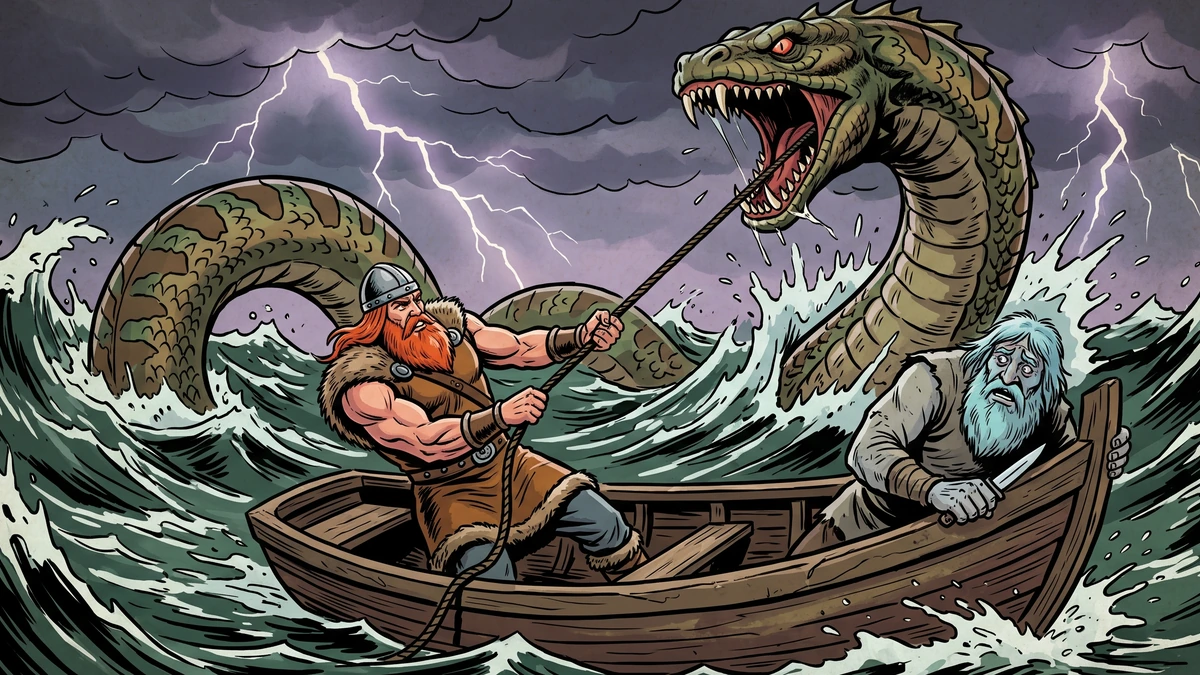
At dawn they rowed out. Thor asked for bait, and Hymir told him carelessly to find his own; so Thor strode to the giant’s herd, took the largest ox, and tore off its head to hang upon his hook. They rowed far past the grounds where Hymir liked to fish, the giant uneasy, until Thor would row no further. He baited the great hook with the ox-head and cast it down, and the line ran out into the dark water — and what took the bait was Jormungand, the Midgard Serpent, the monster that circles the whole of the world with its tail in its mouth, the beast prophesied one day to kill Thor and be killed by him at the world’s ending.
Thor hauled. The serpent fought, and the thunder god braced himself with such force that his feet drove straight through the planks of the boat and struck the sea-bed. He drew the monster’s venom-dripping head up over the gunwale, and his eyes blazed; the serpent glared back. It was, in the old poem, the nearest the world ever came to seeing that final battle fought early. But Hymir, white with terror at the sight, snatched up his knife and cut Thor’s line. The serpent sank back into the depths. Thor, in fury, struck the giant a blow — and the catch was lost, though the world, perhaps, was the safer for it.
The Breaking of the Cup and the Winning of the Kettle
Back in the hall, Hymir was still not ready to surrender his treasure. He set Thor a final test: if the thunder god could shatter a certain goblet, the kettle would be his. Thor hurled the cup against a stone pillar — and the pillar broke, but the cup rolled back whole. Then Tyr’s mother, who wished her son and his companion well, whispered the secret: the cup could be broken on nothing in the hall except the giant’s own skull, which was the hardest thing under that roof. Thor took the cup, threw it against Hymir’s forehead, and the goblet at last fell to pieces while the giant’s head stood unharmed. The bargain was won.
Now the kettle had to be carried out. Tyr tried twice to lift it and could not stir it at all. Thor gripped the rim, set it over his head like a vast hood with the rings clashing about his heels, and bore it from the hall. But Hymir’s pride could not let the gods go free. He gathered a host of many-headed giants and came after them. Thor set the kettle down, swung Mjolnir, and the lay says he slew them all. Then he carried the cauldron home to the gods, and Aegir, his condition met at last, brewed ale for the whole company of the Aesir — and, the poem promises, would host them so each winter thereafter.
The Meaning Beneath the Laughter
It is easy to read the Hymiskvida only for its comedy — the bottomless appetite, the kettle worn as a hat, the giant’s roof-beam shattered by a single sour look. But the old audiences heard something firmer underneath. This is a story about obligation. Aegir’s condition is binding because a feast freely promised must be honoured; Hymir, however grudging, cannot simply refuse guests who have eaten at his table, and so he sets tests instead of turning them away. Thor wins the kettle not by trickery and not by theft, but by meeting every test the giant devises — out-eating his larder, out-fishing his boat, breaking the unbreakable cup. Strength here is not mere violence; it is the willingness to be measured, openly, against an impossible standard and to hold.
The Norse mind prized that kind of proven worth above almost everything, because it believed that a life ends but a reputation does not. The most quoted lines of all Old Norse poetry, from the wisdom-poem Havamal, say exactly this:
Deyr fe, deyja fraendr, deyr sjalfr it sama; ek veit einn at aldri deyr: domr um dauthan hvern.
“Cattle die, kinsmen die, the self must likewise die; but one thing I know that never dies — the renown of each one dead.”
Thor’s reward in this tale is the cauldron, but his lasting gain is the story itself — the proof, told and retold, that the thunder god could be set the hardest tasks in the giant-world and finish every one. That is the quiet argument the poem makes through all its noise: deeds done in the open become a name, and a name outlasts the doer.
The Cast of the Tale and Why Their Pairing Matters
Part of the poem’s craft lies in who it sends on the errand. Thor is the obvious choice — the strongest of the Aesir, the defender of gods and humankind against the giants, the god whose hammer Mjolnir was the single most important weapon in the Norse imagination. His appetite, his temper, and his readiness to swing first and reason later are not weaknesses the poem apologises for; they are the very qualities that the giant’s tests are designed to measure, and they carry him through. In the older religion Thor was among the most widely worshipped of the gods, the friend of farmers and seafarers, and a tale that shows him out-eating, out-fishing, and out-fighting a giant is a tale that flatters the people who honoured him.
But the poem does not send Thor alone, and the choice of Tyr as his companion is deliberate. Tyr is the god of sworn oaths and lawful order, remembered above all for laying his right hand in the jaws of the wolf Fenrir as a pledge of good faith so that the gods could bind the beast — and losing the hand when the pledge proved false. He is, in other w
You May Also Like
 Norse Folk Tales
Ages 9-12
Norse Folk Tales
Ages 9-12
Tyr and the Binding of Fenrir
Tyr and the Binding of Fenrir: In the time before Ragnarok, when the gods still believed they could prevent the end times through cunning and sacrifice, there
 Norse Folk Tales
Ages 9-12
Norse Folk Tales
Ages 9-12
The Widow’s Son
The Widow's Son: Once on a time there was a poor, poor _Widow_, who had an only _Son_. She dragged on with the boy till he had been confirmed, and then she
 Norse Folk Tales
Ages 9-12
Norse Folk Tales
Ages 9-12
The Princess On The Glass Hill
The Princess On The Glass Hill: Once on a time there was a man who had a meadow, which lay high upon the hill-side, and in the meadow was a barn, which he had