The Giant Who Had No Heart In His Body
The Giant Who Had No Heart In His Body: Once on a time there was a _King_ who had _seven sons_, and he loved them so much that he could never bear to be
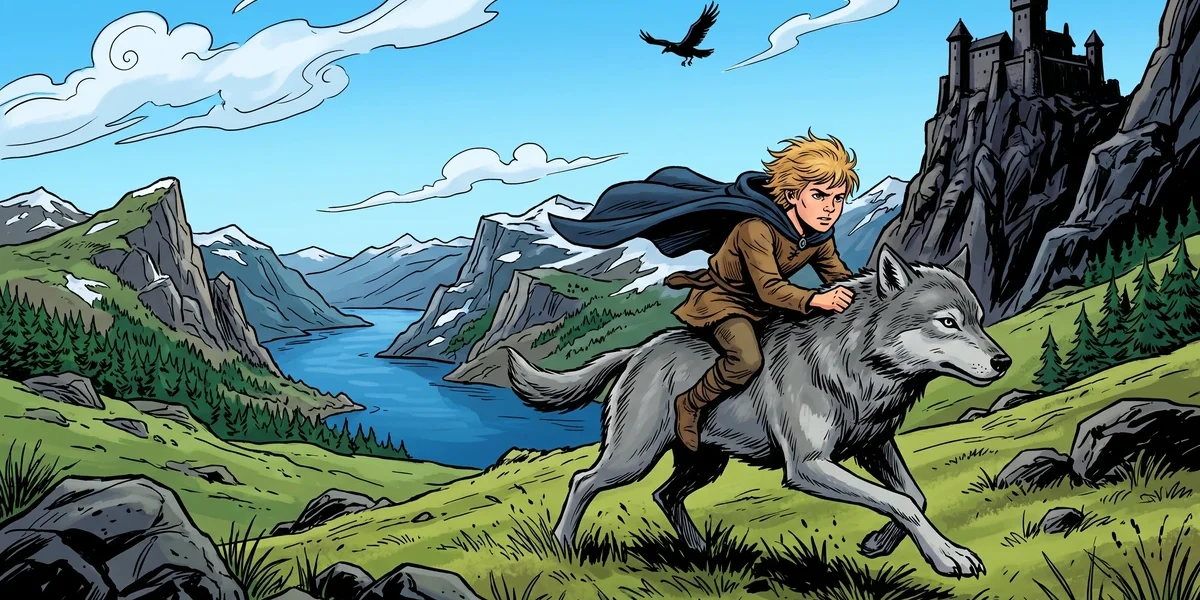
Among the wonder-tales that Norway gave the world, few have travelled as far or sunk as deep as The Giant Who Had No Heart in His Body. In its original tongue it is Risen som ikke hadde noget hjerte paa sig, and it was gathered from oral tradition by Peter Christen Asbjørnsen and Jørgen Engebretsen Moe for their landmark collection Norske Folkeeventyr (Norwegian Folktales), issued in instalments between 1841 and 1844. The tale belongs to one of the most ancient and most widespread of all storytelling patterns — the villain who keeps his life hidden somewhere outside his own breast — and folklorists classify it as Aarne–Thompson–Uther type 302, The Ogre’s Heart in the Egg. What the Norwegian telling adds to that old skeleton is a particular warmth: a youngest son who wins not by force but by small kindnesses, and three grateful animals who carry the whole quest on their backs, wings and fins.
A Tale Gathered from the Valleys
When Asbjørnsen and Moe began their collecting in the 1830s, Norway had only lately emerged from four centuries of Danish rule and was hungry for a literature that sounded like itself. The two friends made an ideal pair: Asbjørnsen was a zoologist with a folklorist’s patient ear, while Moe was a poet who would later become a bishop. Together they walked the valleys and fjordsides, writing down what farmers, herders and grandmothers told them by the hearth. Their real achievement was not merely gathering the tales but finding a prose for them — a plain, voice-driven Norwegian that kept the rhythm of the spoken story rather than smoothing it into bookish Danish. Risen som ikke hadde noget hjerte paa sig is a perfect specimen of that style: brisk, wry, fond of repetition, and unembarrassed by a hero everyone underrates.
Norske Folkeeventyr did not appear all at once. The collectors released it in slim booklets — a first part in 1841, further instalments through 1843 and 1844, and an enlarged edition in 1852 — revising as they re-listened. The collection later acquired its enduring visual identity from the illustrators Erik Werenskiold and Theodor Kittelsen, whose drawings of trolls and giants taught generations of Norwegians what the creatures of their folklore looked like. The tale reached English readers through George Webbe Dasent, whose Popular Tales from the Norse (1859) translated Asbjørnsen and Moe with such vigour that it shaped how the Victorian world imagined Scandinavia. It is Dasent who gave the youngest prince the cheerful English name “Boots” — his rendering of Askeladden, the Ash-Lad, the cinder-boy who sits by the fire while his betters ride out, and who turns out, every time, to be the one who matters.
The Ash-Lad: Norway’s Unlikely Hero
To understand why this tale moved Norwegian listeners so deeply, it helps to know the figure at its centre. The youngest prince here is a version of Askeladden, the Ash-Lad, the single most beloved hero of the Norwegian folk tradition. His name comes from the ashes of the hearth, the place he is said to sit and rake while his elder brothers do the work the world admires. He is the child everyone overlooks — too young, too idle, too unremarkable to be sent on any errand that matters. And in tale after tale, it is precisely he who comes home with the princess, the kingdom and the giant’s gold.
Folklorists have long read the Ash-Lad as a deeply democratic hero, the expression of a rural, egalitarian culture that wanted to believe worth could lie unnoticed in the humblest seat by the fire. He rarely wins by brute strength or noble birth; he wins by curiosity, courtesy, attentiveness, and a willingness to stop for the small and the starving when his brothers ride briskly past. In The Giant Who Had No Heart in His Body this is the whole engine of the plot. The six elder princes are handsome, richly dressed and superbly mounted — and they fail, forgetting their errand and riding straight into the giant’s spell. The boy left behind, given the one broken-down horse no one else would touch, is the one who frees them all. The storytellers are making a quiet, pointed argument about where real capability is found.
That argument was also a literary one. Asbjørnsen and Moe were writing for a young nation trying to hear its own voice, and the Ash-Lad — plain, kind, sharp-witted, unimpressed by rank — became something close to a national self-portrait. The illustrators Theodor Kittelsen and Erik Werenskiold gave him a face: a barefoot boy in homespun, dwarfed by the brooding shapes of trolls and giants, yet utterly unafraid. It is this figure, not a knight in armour, whom Norwegian children have followed into the giant’s castle for nearly two centuries.
The Six Brothers Turned to Stone
The story opens in a king’s hall with seven sons. The king loves his children so dearly that he cannot bear to have them all away at once, so when six of the princes ride off to find brides, the youngest is kept at home. The six are sent in the finest clothes imaginable, mounted on costly horses, and charged to bring back a seventh princess for the brother left behind. They find a king with six daughters and, delighted, take all six as brides — and in the joy of the moment forget entirely the errand for the seventh.
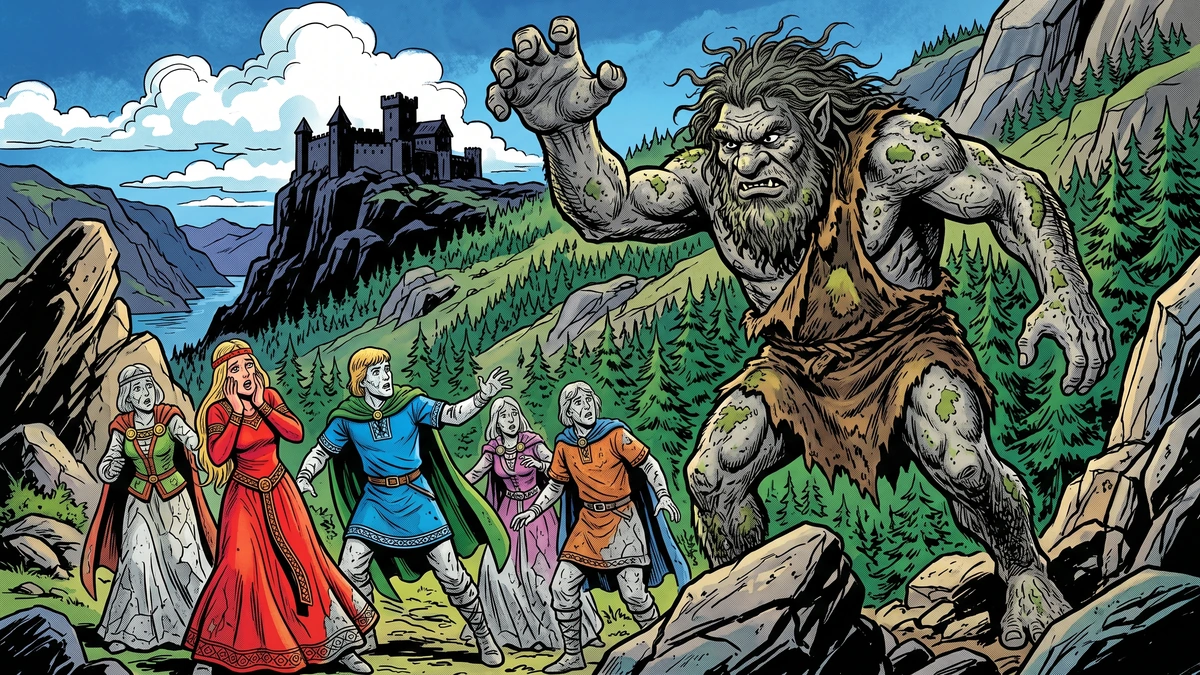
Riding home with their new wives, the brothers pass a mountain where a giant has his castle. The giant comes out, and with a word turns all twelve — the six princes and their six brides — into cold stone. When no riders return, grief settles over the old king’s hall. At last the youngest son asks leave to go and search. His father refuses again and again, certain he will lose his last child too, but the boy will not be quieted, and in the end he is allowed to set off — on the only mount left in the stables, a broken-down nag that no one else would ride. It is the classic opening of the Ash-Lad tale: the despised youngest, the worthless horse, the long odds. Everything that follows depends on what kind of traveller this unpromising boy turns out to be.
Three Kindnesses on the Road
The heart of the Norwegian version — and the part that lifts it above a simple monster-slaying — lies in what Boots does on the road. He comes first upon a raven lying in the path, so faint with hunger it can barely move. His own provisions are slender and the way is long, yet he stops, and feeds it, and the raven recovers and promises to help him in his hour of need. Further on he finds a great salmon stranded on dry rock, gasping its life away; Boots lifts it and slips it back into the water, and the salmon too promises aid. At last he meets a grey wolf, starving and gaunt, who begs for something to eat. The boy has nothing left but his horse — his only means of travel — and the wolf asks for it plainly. Boots gives it up.
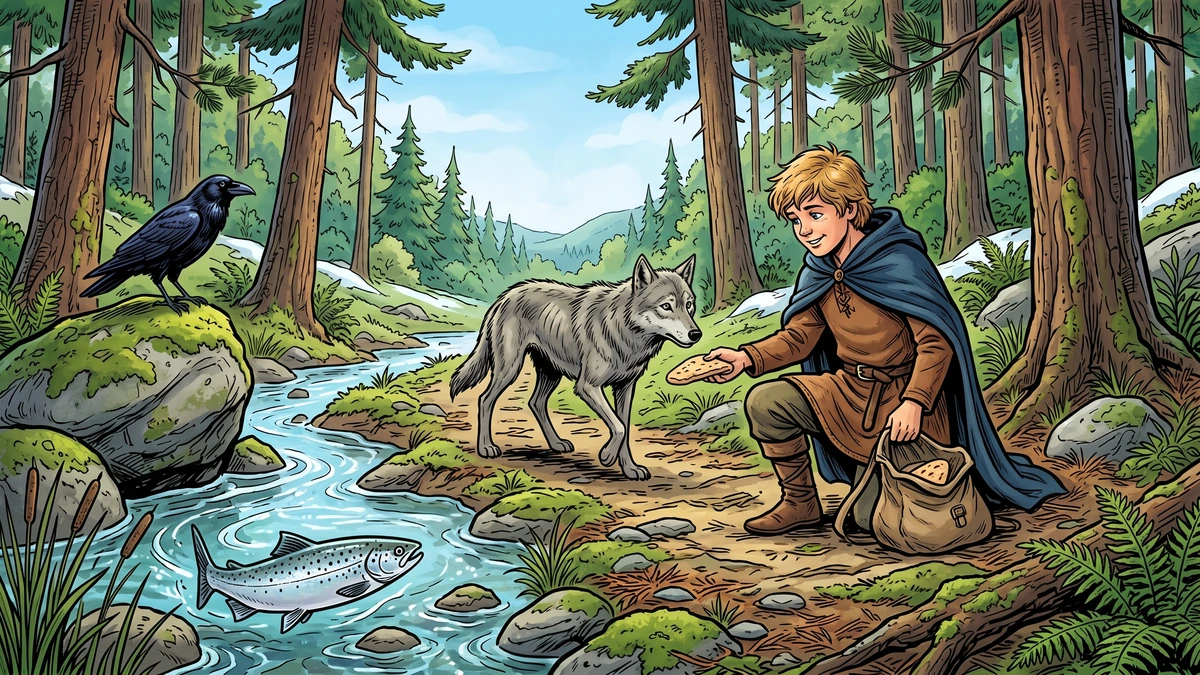
It is a small, strange, generous moment, and the tale knows its worth: the hero surrenders the very thing a hero is supposed to need. But the wolf, once fed, is strong enough to carry the boy himself, and far faster than any horse. With Boots on its back the wolf runs to the giant’s castle, and there a pattern quietly completes itself. Three creatures of air, water and land — raven, salmon, wolf — have each been shown a kindness, and each will be needed before the end, in exactly the element it rules. The folktale is teaching, without once pausing to preach, that courtesy spent on the weak is never wasted, and that the traveller who shares his last crust is buying help he cannot yet imagine.
The Captive Princess and the Hidden Heart
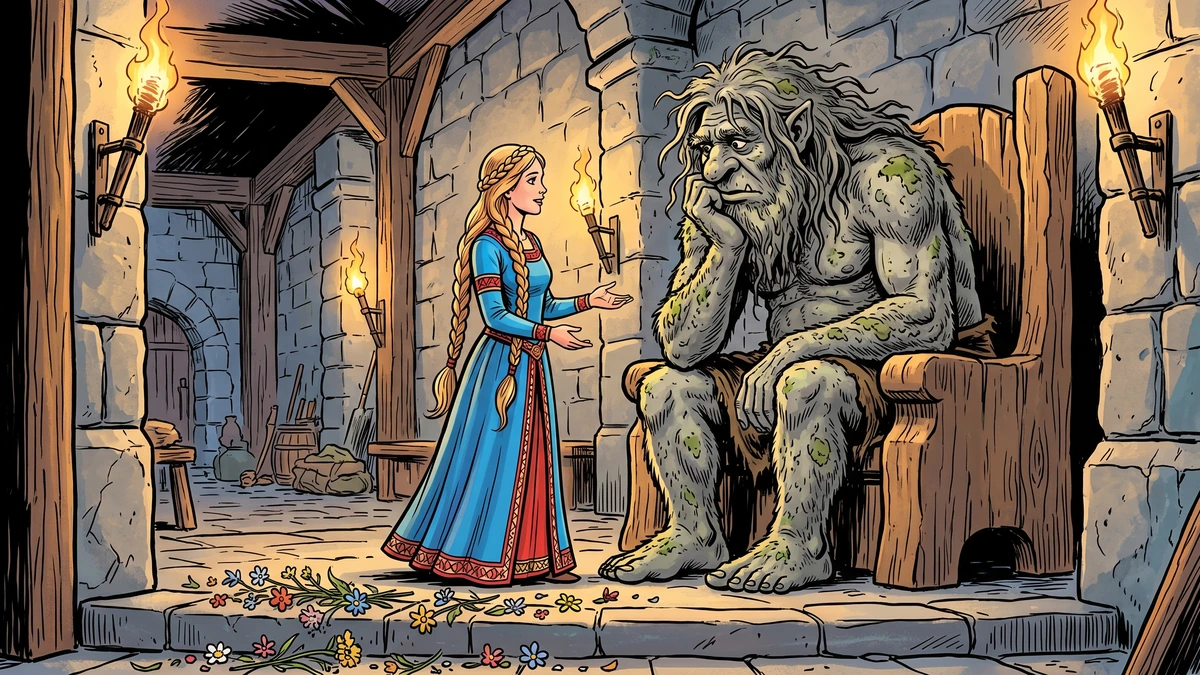
At the giant’s castle the wolf sets Boots down and tells him to go inside, where he will find a princess the giant has carried off. She is astonished to see a living visitor and frightened for him, for the giant, she says, cannot be killed: he keeps no heart in his body, and so no blow can ever reach his life. But the wolf has already given the boy his counsel — let the princess coax the secret out of the monster. So Boots hides, and the princess, sweet and patient, asks the giant where he keeps his heart, “for surely,” she says, “a body must have a heart somewhere.”
The giant, flattered by her care, answers carelessly at first — under the door-sill, he says. Next morning the princess has strewn the sill with flowers, and when the giant asks why, she tells him she wished to honour the place where his heart lay. Pleased and disarmed, he laughs and confesses the truth. His heart is very far away, on an island in a lake; on that island stands a church; in the church is a well; in the well swims a duck; inside the duck lies an egg; and in that egg — only there — is his heart. The nesting is the signature of the whole tale-type: the life of the monster shut box within box within box, hidden behind water and stone and feather, set as far from any sword as the storyteller’s imagination can reach.
The Egg, and the End of the Giant
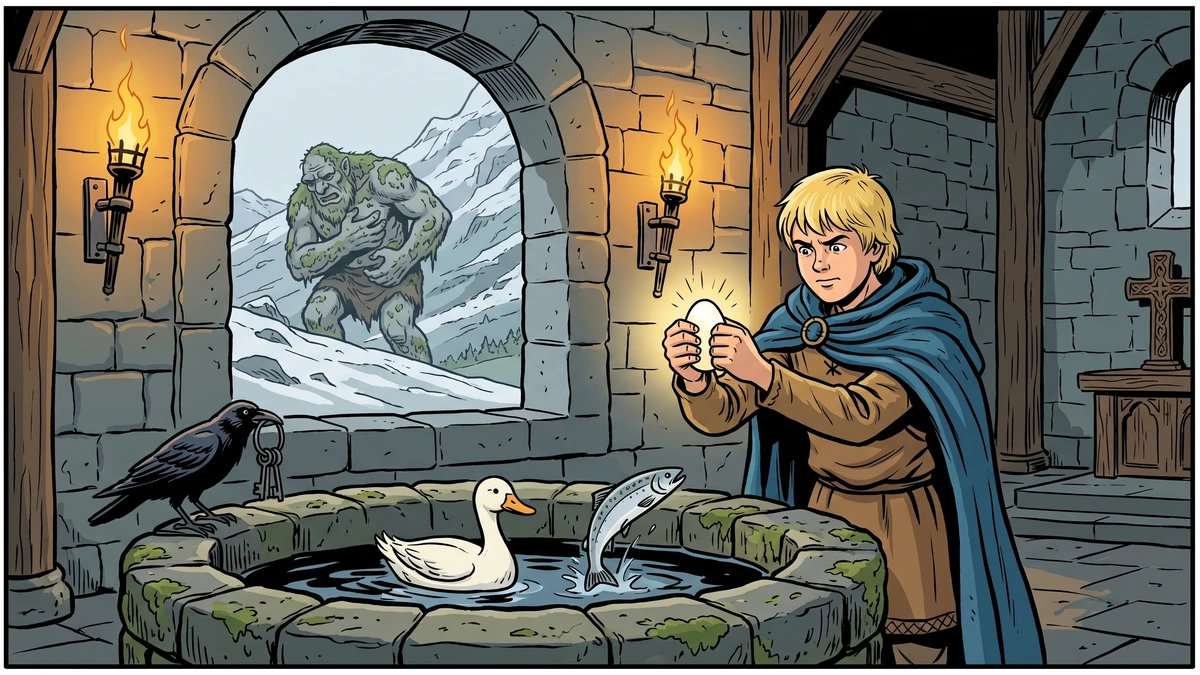
Now the three kindnesses are repaid in turn, each in its own element. The wolf carries Boots over hill and valley and at last across the water to the island. The church door is locked and the keys hang high out of reach — so the boy calls the raven, who flies up and brings the keys down in its beak. Inside, Boots finds the well and the duck swimming on it; he coaxes the duck to him, but as he lifts it from the water the bird lets the egg fall, and it sinks straight to the bottom of the well. It would be lost forever — except that the salmon is there, and dives, and fetches the egg up from the dark water into the boy’s hands.
The wolf has told him what to do. Boots squeezes the egg, and far away in his castle the giant screams in pain and begs for mercy. The boy tells him he will be spared only if he restores to life everyone he has ever turned to stone. The giant agrees at once, and the moment the twelve — the six princes and their six brides — stand breathing again, Boots squeezes the egg in two. With it the giant bursts and is gone. The seven brothers ride home together with seven brides, for the rescued princess becomes the wife of the youngest, and the old king’s hall, so long shadowed by grief, is filled with the noise of a wedding feast.
The Giant in the Norwegian Imagination
The villain of this tale is, in the Norwegian, a rise — a giant — and he belongs to a whole population of mountain-dwelling monsters that crowd the country’s folklore. Giants and trolls are perhaps the most distinctive creatures Norway gave to the world’s storytelling, and they are inseparable from the land itself. In a country of sheer cliffs, deep forests, and winters of long darkness, the folk imagination peopled the wild places with beings vast, slow, old and dangerous — embodiments of the landscape’s own indifference to human life. Theodor Kittelsen’s illustrations made these creatures unforgettable: his trolls are practically hills that have stood up, mossy and lichened, their bulk almost geological.
The heartless giant of this tale draws on that tradition but sharpens it into something stranger and more pointed. An ordinary troll can be outwitted or caught by sunrise; this giant has done something deliberate and unnatural. He has taken his heart out of his body and hidden it, and in doing so has made himself not merely strong but, he believes, beyond death altogether. The detail gives the monster a chilling logic. His invulnerability is bought at the price of his feeling: a creature with no heart in his body can neither be killed nor be moved to mercy. He is the folk imagination’s portrait of power that has cut itself off from everything power exists to serve.
It is worth noticing, too, how the hiding place is described. The heart is not in some hellish vault but on an island, in a church, in a well — ordinary, even holy, places. The storyteller is playing on the unease of the familiar made secret: the safest-seeming spot in the world, a church on a quiet island, is exactly where the worst thing is concealed. That instinct — that great evil keeps itself hidden behind the appearance of calm and order — is part of why the image has never lost its grip.
The Moral: Kindness Is a Quest’s Best Provision
It would be easy to read this as a tale about cleverness — the trick of the flowers, the secret teased loose — but its older and deeper lesson is about generosity. Boots succeeds because, long before he knows he will need them, he treats a starving raven, a stranded salmon and a gaunt wolf as creatures worth his trouble. He gives away his food and even his horse, the things a lone traveller can least spare, and every gift comes back transformed into exactly the help the moment requires. The Norwegian storytellers had a proverb that fits the boy’s road precisely:
“Som man roper i skogen, får man svar.”
— “As you call out in the forest, so the answer comes back to you.”
The whole quest is the echo of that calling. Kindness sent out into the world returns as kindness; the wolf the boy fed becomes the road he travels, the raven becomes his key, the salmon becomes his hand in deep water. The tale also quietly honours patience and humility — the princess wins the secret not by force but by gentle, steady attention — and it reserves its triumph for the child everyone wrote off. The Ash-Lad is, in this sense, a democratic hero: the worth of a person, the folktale insists, may sit unnoticed by the cinders while the clever and the costly ride past.
Why the Tale Has Lasted
The motif at the centre of this story is one of the oldest that folklorists have traced. They call it the “external soul” or “life-index”: the idea that a being’s life can be kept apart from its body, hidden in an object or an animal, so that the creature cannot die until that hidden thing is found and destroyed. Sir James Frazer devoted a long, famous section of The Golden Bough to gathering versions of it from across the world. The pattern runs from the ancient Egyptian Tale of Two Brothers, where Bata hides his heart in a cedar tree, to the Russian tales of Koshchei the Deathless, whose death waits in a needle, in an egg, in a duck, in a hare, in a chest, in an oak on a far island — almost the same nesting the Norwegian giant describes. Indian tradition knows it too, in tales such as the Bengali Life’s Secret, where a demon’s life is bound up in a necklace and a string of beads. ATU 302 is, in short, a genuinely global story, and the Norwegian version is one of its clearest and most humane tellings.
Yet the tale endures not because it is old but because it still says something true. The image of the heartless giant — vast, cruel, and unkillable precisely because he has put his heart somewhere safe — reads almost as a parable. To be invulnerable, the giant has had to remove the very organ that would let him feel; his power and his lovelessness are the same act. The hero who undoes him is his exact opposite: a boy whose strength is his open-heartedness, who carries his heart visibly in every kindness he does. Children meet the story as a thrilling adventure of nested hiding places and a race against a monster. Older readers come to see what the storytellers of the Norwegian valleys were saying all along — that a life walled off from feeling is no life worth keeping, and that the smallest mercy shown along the road may turn out to be the thing that carries you home.
You May Also Like
 Norse Folk Tales
Ages 9-12
Norse Folk Tales
Ages 9-12
The Three Princesses In The Blue Mountain
The Three Princesses In The Blue Mountain: There were once upon a time a _King_ and _Queen_ who had no children, and they took it so much to heart that they
 Norse Folk Tales
Ages 9-12
Norse Folk Tales
Ages 9-12
The Theft of Thor’s Hammer (Thrymskvida)
The Theft of Thor's Hammer (Thrymskvida): Thor, the mighty god of thunder, woke one morning in his hall Bilskirnir with a start of alarm that was rare for one
 Norse Folk Tales
Ages 9-12
Norse Folk Tales
Ages 9-12
The Death of Baldur
The Death of Baldur: In the golden halls of Asgard, there lived a god so beautiful, so pure, so beloved by all beings in the Nine Worlds that his very presence