The Theft of Thor’s Hammer (Thrymskvida)
The Theft of Thor's Hammer (Thrymskvida): Thor, the mighty god of thunder, woke one morning in his hall Bilskirnir with a start of alarm that was rare for one

Of all the poems gathered in the Poetic Edda, none has delighted readers quite like Þrymskviða, the “Lay of Þrymr.” It is a comedy — broad, fast-moving, and gleefully absurd — built around a single outrageous image: Thor, the thunder-god, the terror of every giant in the Nine Worlds, obliged to put on a bridal gown and a veil and travel into the land of his enemies to play the blushing bride. The story survives because it is funny, but it endures because beneath the laughter it asks a serious question. When brute force has been stripped away, what is a hero made of?
This retelling follows the old poem closely while opening out its scenes for a modern reader. Thor wakes one morning in his hall and finds that Mjölnir, the hammer that holds the whole cosmos in balance, has vanished in the night. What follows is a rescue mission that no amount of strength can solve — only wit, nerve, and a willingness to look ridiculous.
Origins and Attribution
Þrymskviða is preserved in a single medieval manuscript: the Codex Regius of the Poetic Edda, catalogued as GKS 2365 4to and now held in Reykjavík. The Codex Regius was written in Iceland during the 1270s, a vellum book of forty-five leaves that is the chief source for almost everything we know of Eddic poetry. The poem stands among the mythological lays of the collection, near the other tales of Thor and the giants. There is no second copy; if that one book had been lost, the Lay of Thrym would be lost with it.
The poem runs to thirty-two stanzas in fornyðislag (“old story metre”), the most common Eddic verse form, an alliterative measure built of short, hammering half-lines. Scholars generally place its composition in the broad window of 1150–1300, making it one of the later poems of the Edda — written, that is, in a Christian Iceland where the old gods had become an antiquarian and literary interest rather than objects of worship. That distance is part of why the poem can be so playful: a poet who no longer fears Thor can afford to laugh with him. Some earlier critics, including the influential nineteenth-century scholar Sophus Bugge, even suspected the poem might be the work of the thirteenth-century historian Snorri Sturluson himself, though that attribution is not now accepted. What is agreed is that Þrymskviða draws on a far older oral tradition: the motif of the thunder-weapon stolen and recovered echoes across Indo-European myth, and the tale survived for centuries after the manuscript was closed, resurfacing in the medieval Scandinavian ballads — the Faroese Tórsvísa and the Danish and Swedish songs of Tord af Havsgård — sung long after anyone remembered why.
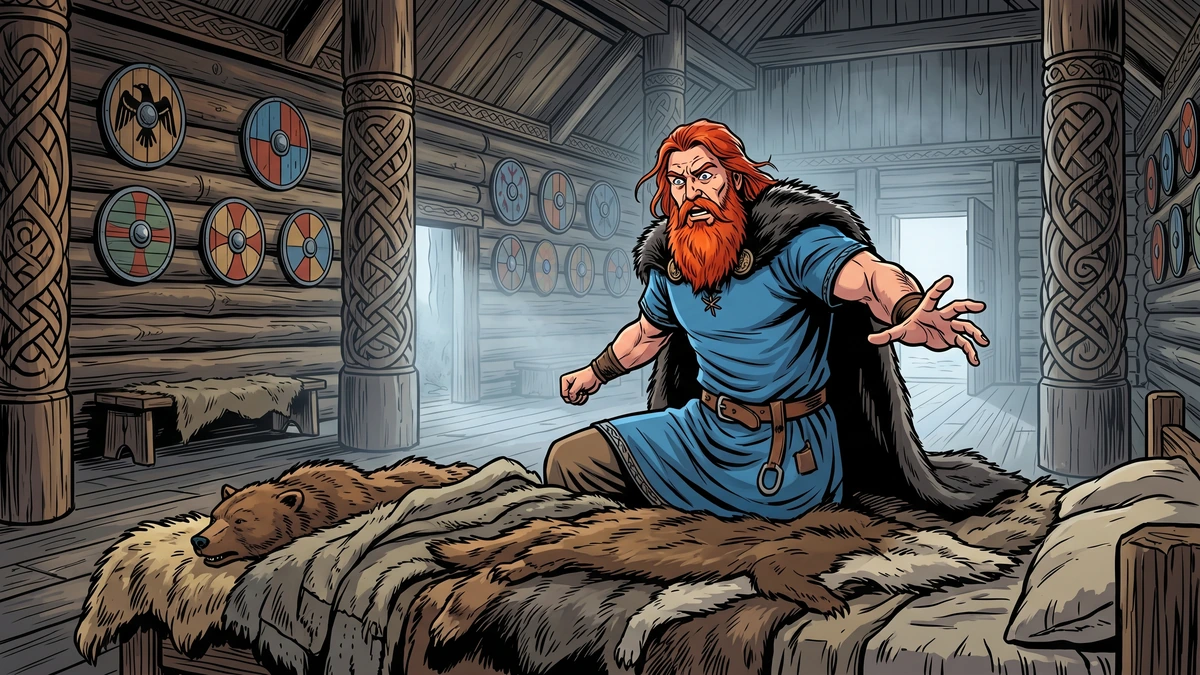
The poem opens with one of the most quoted lines in all of Norse verse, the picture of a furious god groping in the dark for a weapon that is no longer there:
Vreiðr var þá Vingþórr,
er hann vaknaði
ok síns hamars
of saknaði;
skegg nam at hrista,
skor nam at dýja,
réð Jarðar burr
um at þreifask.“Wrathful was Ving-Thor when he awoke and missed his hammer; his beard began to shake, his hair to bristle, as the son of Jörð groped about him.” — Þrymskviða, stanza 1
The Hammer in the Dark
Thor woke in his hall with a start of alarm rare for one of his power. His hand flew to his side, where Mjölnir should have hung — and closed on empty air. The hammer forged by the dwarf-smiths Sindri and Brokkr, the weapon that had never once failed him, was gone. His roar shook the rafters and rolled out across the worlds like thunder that builds and builds but never breaks.
His first thought was for Loki, the trickster who lived in the gods’ hall and was the natural suspect for any disappearance. But this theft was beyond even Loki’s mischief. The two went together to Freyja, loveliest of the goddesses, and Loki asked to borrow her feather-cloak, the falcon-skin garment that let its wearer fly. Freyja gave it gladly — she would have lent it, she said, if it were made of silver, and given it if it were gold. The smallness of the favour, set against the size of the disaster, is the poem’s first quiet joke.
Loki rose into the air with the feathers whirring and flew out of Ásgarð, the realm of the gods, and on into Jötunheimr, the country of the giants. There, on a green mound at the edge of his lands, he found exactly the figure he was looking for.
Thrym’s Price
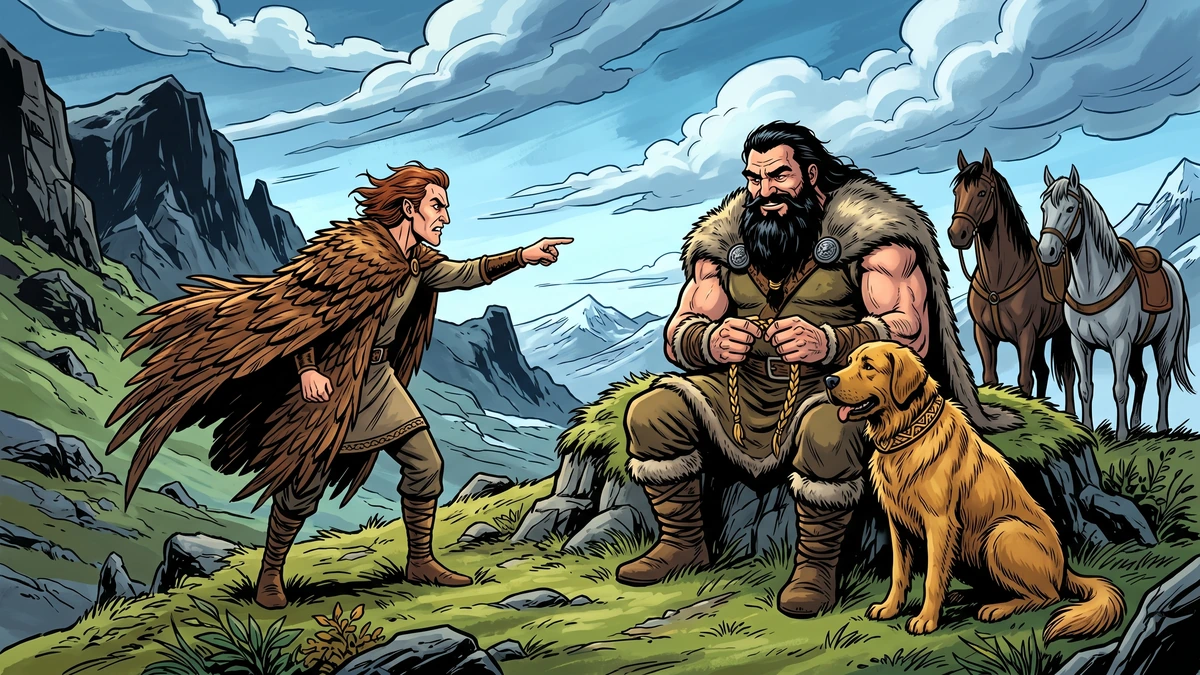
The giant Þrymr — whose name means something close to “Uproar” or “the Crashing One” — sat on his howe like a lord surveying his estate. He was plaiting golden collars for his hounds and trimming the manes of his horses, perfectly at ease, a thief so confident he did not trouble to hide. When Loki demanded to know whether the giant had stolen the hammer, Þrymr did not deny it. He had taken Mjölnir, he said, and buried it eight leagues deep beneath the earth, and no one would ever lift it out again —
— unless the gods brought him Freyja as his wife.
Here is the engine of the whole comedy. Þrymr does not want gold, or land, or the death of his enemies. He wants to marry up. He wants the most beautiful goddess in the Nine Worlds to be seen on his arm, and he is sure that holding the hammer hostage will buy her. It is the demand of a giant who imagines that the order of the cosmos can be haggled over like a horse.
Loki flew home, the feather-cloak whirring once more, and the worlds passing dark and small beneath him. He landed in the courtyard of Ásgarð where Thor was already waiting, and before his feet had fairly touched the ground Thor was demanding the news — for a messenger, the poem observes drily, often forgets his report the moment he sits down, and lies are easier told sitting than standing.
The Bride Who Would Not Go
The two gods went straight to Freyja with the giant’s terms, and told her, with the breeziness of men delivering bad news that will not fall on them, to put on a bridal veil: she was to be driven to Jötunheimr and married to Þrymr.
Freyja’s answer is the most famous explosion in the poem. She was so angry that the hall shook and the great necklace of the Brisings, Brísingamen, burst from her throat and fell. She would be thought, she said, the most man-mad woman in all the worlds if she rode at Loki’s side to the land of the giants. The refusal is total, and it is correct. Freyja is a goddess, not a coin; she will not be spent.
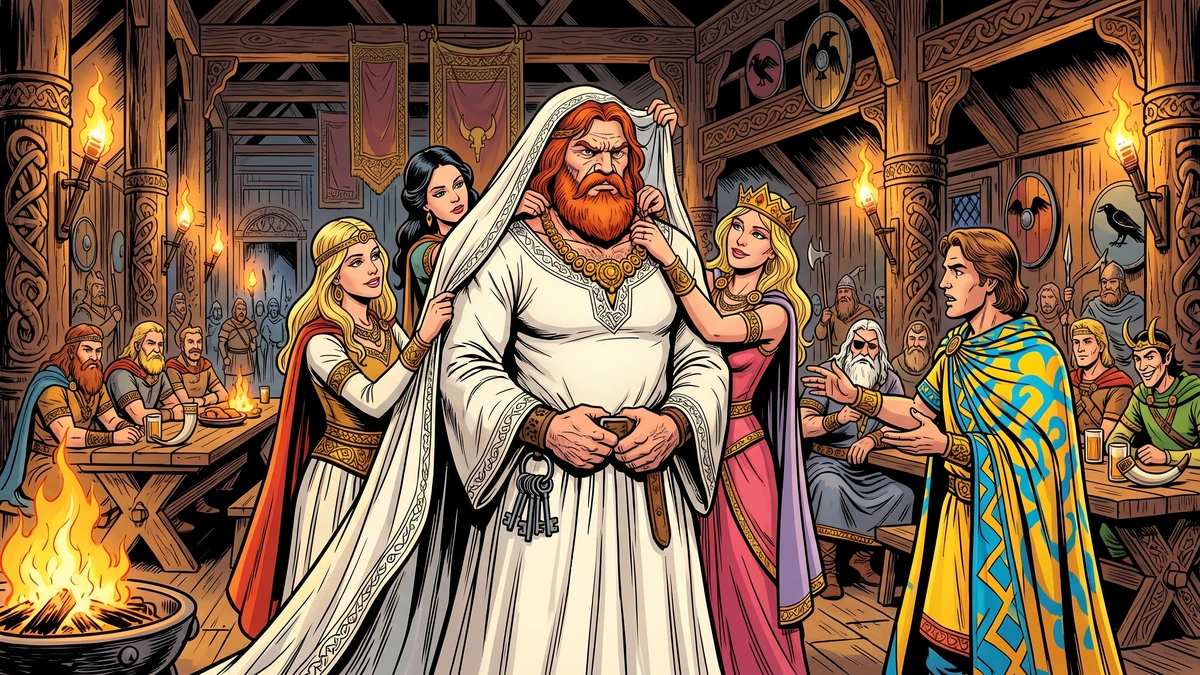
So the gods gathered in council, and every one of the Æsir and the Ásynjur came to debate how Mjölnir might be won back. It was Heimdallr — the watchman of the gods, the whitest of the Æsir, who could see far into the future — who proposed the plan that no one else dared to say aloud. Let them dress Thor as the bride. Let them tie the bridal linen on the thunder-god, hang the broad Brisings’ necklace at his throat, set the household keys jangling at his waist and a woman’s gown about his knees, pin brooches on his breast and a neat cap upon his head.
Thor’s objection was immediate and predictable. The Æsir would call him argr — unmanly, shameful — if he let himself be dressed in a bride’s clothing. And it was Loki, the shape-changer who had himself worn other forms and other sexes, who answered him with the plain arithmetic of the situation: be silent with that talk; the giants will live in Ásgarð itself if you do not fetch your hammer home. The cosmos was the stake. Against that, a god’s dignity weighed very little. Thor put on the gown. Loki, ever practical, volunteered to dress as the bridesmaid and ride at his side.
The Wedding at Jötunheimr
The goats were harnessed, the chariot ran, and the mountains split and the earth burned with fire as the son of Odin drove to Jötunheimr. Þrymr, seeing the wedding-party approach, called his giants to strew the benches and bustle about: his bride was coming at last. He boasted of his wealth — gold-horned cattle, jet-black oxen, heaps of treasure, heaps of jewels — and declared that Freyja was the one thing his hall had lacked.
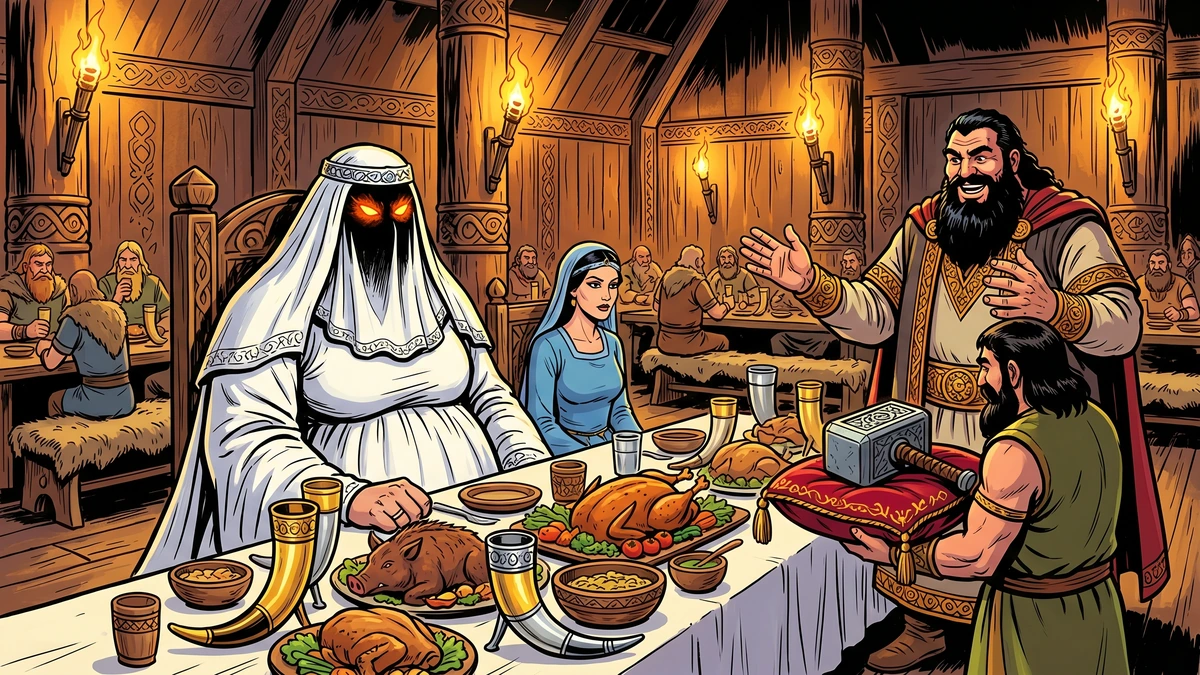
Then the feast began, and the disguise nearly came apart at once. The veiled “bride” ate an entire ox. She ate eight whole salmon. She ate all the dainties set aside for the women, and washed it down with three full casks of mead. Þrymr stared and said that never had he seen a bride bite so broadly, nor any maiden drink so deep.
It was Loki, seated as the “bridesmaid,” who saved the moment with the quickest lie in Norse literature. Freyja, he explained smoothly, had been so wild with longing for Jötunheimr that she had eaten nothing at all for eight days and nights. Hunger, not greed. The giant was charmed.
So Þrymr stooped beneath the veil to steal a kiss — and leapt the whole length of the hall, for the bride’s eyes were burning at him like live coals. Why are Freyja’s eyes so terrible? he cried. And again Loki was ready: she had not slept for eight nights, so fierce was her desire to be his. Every flaw in the disguise, the bridesmaid turned into proof of the bride’s devotion.
Then Þrymr, in the joy of his triumph, gave the order that undid him. Bring in the hammer, he commanded, to hallow the bride — lay Mjölnir in the maiden’s lap, and let the goddess Vár bless the wedding-oath. It was a real custom dressed as a fatal mistake: the holy hammer was used to sanctify a marriage. Þrymr meant to consecrate his wedding. He was handing his executioner the axe.
Laughter in the Heart of Thor
When Mjölnir was laid across the bride’s knees, the poem says that the heart of Hlórriði — Thor — laughed within him. He closed his fist around the haft of his hammer for the first time in days, and the disguise was finished with.
He killed Þrymr first, the lord of the giants, and beat the whole giant-kin to ruin. He killed the giant’s aged sister — the one who, a moment before, had been begging the “bride” for a wedding-gift of rings — and she got the back of the hammer for her dowry, a blow instead of a coin. So Odin’s son won back his hammer, and the poem ends as abruptly as a door slammed shut. The order of the worlds was restored. The thief and his hall were rubble. Mjölnir was home.
The Moral of the Tale
On its surface Þrymskviða is pure farce. But Eddic comedy is rarely only comedy, and this poem carries a real argument inside its laughter.
The first lesson belongs to Þrymr. The giant’s ruin is not bad luck; it is the direct result of his own vanity. He could have hidden the hammer and kept it. Instead he wanted to be seen winning — to display Freyja, to boast of his herds, to celebrate himself in a great public wedding. His need for an audience is exactly what brings his enemy into his hall and his death into his lap. Pride does not merely precede the fall here; pride builds the stage for it.
The deeper lesson belongs to Thor. The thunder-god’s strength, in this one story, is useless. He cannot punch a buried hammer out of the earth; he cannot intimidate a problem that depends on disguise. To win, he must do the thing he most dreads — surrender his dignity, accept a humiliating role, and let himself be laughed at. And he does it, because Loki’s arithmetic is sound: the safety of the Nine Worlds outweighs one god’s pride. The hero of this poem is defined not by the blows he can strike but by the embarrassment he is willing to endure for something larger than himself.
And the third lesson belongs to Loki, who is for once entirely on the side of the gods. It is wit — the borrowed cloak, the wedding plan, the lightning-fast lies about hunger and sleepless longing — that carries the mission from start to finish. Strength recovers the hammer in the last stanza, but cleverness gets strength into the room. The poem quietly insists that the two need each other: muscle without cunning would still be sitting in Ásgarð with an empty hand.
Why This Story Has Lasted
For eight centuries, since a scribe set it down in the Codex Regius, Þrymskviða has been one of the best-loved poems of the North — and it has lasted because it does something difficult and rare. It takes the most powerful figure in its mythology and makes him absurd, without ever making him contemptible. We laugh at Thor in his veil, but we never stop rooting for him; the comedy is affectionate, not cruel.
It has lasted, too, because it is genuinely funny in a way that survives translation and the passage of a thousand years. The image of the giant leaping back from his bride’s burning eyes, the bridesmaid’s instant inspired lies, the aged giantess who asks for a ring and gets a hammer-blow — these are jokes built so well that they still land. The medieval Scandinavians thought so too, which is why the tale outlived its own manuscript and went on being sung as a ballad in the Faroes and Denmark for centuries.
Most of all it has lasted because of its central, durable idea: that there are problems no amount of force can solve, and that real courage sometimes means accepting ridicule rather than risking disaster. A god who can shatter mountains learns, for one morning, that the harder thing is to put on a dress and walk into the enemy’s house with his head held high. That is a lesson with no expiry date — and it is delivered, in the old Norse way, with a straight face and a roar of laughter at the same time.
Frequently Asked Questions
Where does the story of Thrymskvida come from?
Þrymskviða, the “Lay of Thrym,” survives in a single medieval manuscript — the Codex Regius of the Poetic Edda (GKS 2365 4to), written in Iceland in the 1270s. The poem itself is usually dated to the period 1150–1300 and is composed in thirty-two stanzas of the alliterative metre fornyðislag. It is one of the most popular of all the Eddic poems and the tale also survived in later Scandinavian ballads such as the Faroese Tórsvísa.
Why did the giant Thrym steal Thor’s hammer?
Þrymr did not steal Mjölnir for its power but as ransom. He buried the hammer eight leagues deep in the earth and demanded the goddess Freyja as his bride in exchange for its return. His motive is social ambition — he wants to marry the loveliest goddess of Ásgarð and be seen doing it — and that craving for display is ultimately what destroys him.
Why did Thor have to dress as a bride?
When Freyja flatly refused to be handed over to a giant, the gods held a council. Heimdallr proposed that Thor himself be disguised as the bride — veil, gown, the Brisings’ necklace and household keys — and delivered to Jötunheimr in Freyja’s place. Thor objected that it was shameful, but Loki pointed out that the giants would occupy Ásgarð itself if the hammer were not recovered. The disguise was the only way to get close enough to seize Mjölnir.
How did Loki keep the disguise from being discovered?
Loki travelled as the “bridesmaid” and twice rescued the deception with quick lies. When the “bride” devoured an ox, eight salmon and three casks of mead, Loki explained that Freyja had fasted for eight days out of longing for Jötunheimr. When Þrymr saw the bride’s terrifying burning eyes, Loki said she had not slept for eight nights, so eager was she for the marriage. Each flaw was turned into proof of devotion.
What is the moral of Thrymskvida?
The poem teaches several lessons at once. Þrymr is ruined by vanity — his need to display his prize brings his enemy into his hall. Thor learns that some problems cannot be solved by strength, and that true courage can mean enduring humiliation for a greater good. And Loki’s role shows that wit and cleverness are as vital as raw power: cunning gets the heroes into the room, and only then can strength finish the task.
You May Also Like
 Norse Folk Tales
Ages 9-12
Norse Folk Tales
Ages 9-12
Soria Moria Castle
Soria Moria Castle: Once on a time there was a poor couple who had a son whose name was _Halvor_. Ever since he was a little boy he would turn his hand to
 Norse Folk Tales
Ages 9-12
Norse Folk Tales
Ages 9-12
Tyr and the Binding of Fenrir
Tyr and the Binding of Fenrir: In the time before Ragnarok, when the gods still believed they could prevent the end times through cunning and sacrifice, there
 Norse Folk Tales
Ages 9-12
Norse Folk Tales
Ages 9-12
The Husband Who Was To Mind The House
The Husband Who Was To Mind The House: Once on a time there was a man, so surly and cross, he never thought his _Wife_ did anything right in the house. Empathy