Prince Lindworm
A childless queen is told to eat only one of two magic roses, but she eats both, and years later a great serpent blocks her son’s road demanding a bride.
Once upon a time, there lived a fine young king whose queen was the loveliest in all the world. The two of them were very happy except for one thing: they had no children. This often made them sad, for the queen yearned for a little one of her own, and the king needed someone to rule after him.
One day the queen went out walking alone, and she met an old woman who spoke with the confidence of someone used to magic. “Why do you look so gloomy, pretty lady?” she asked.
“It’s pointless to tell you,” the queen replied. “No one on earth can help me.”
“Ah, but who can say?” the old woman answered. “Tell me what the trouble is, and perhaps I can put it right.”
“My dear woman, how could you?” said the queen, but she told her anyway. “The king and I have no children. That is why I am so unhappy.”
“Well, you needn’t be,” said the old witch. “I can fix that in a twinkling, if you do exactly as I say. When the sun goes down tonight, take a small two-handled cup and set it upside down on the ground in the northwest corner of your garden. Lift it up tomorrow morning at sunrise, and underneath you will find two roses, a red one and a white one. Eat the red, and a son will be born to you. Eat the white, and you will have a daughter. But whatever you do, you must not eat both roses, or you will be sorry. I warn you! Only one, mind!”
The queen thanked her over and over, delighted, and offered her gold ring as a reward, but the old woman refused it.
Back home, the queen followed the instructions, and at sunrise the next morning she slipped out into the garden and lifted the little cup. She was amazed, for she had hardly expected to find anything, but there lay the two roses, one red and one white. Now she was terribly puzzled about which to choose. “Suppose I pick the red one and have a son,” she thought, “he may grow up, go to war and be killed. But suppose I pick the white one and have a daughter; she will stay with us for a while, but one day she will marry and go away. Either way, we may end up with no child after all.”
At last she chose the white rose and ate it. But it tasted so sweet that she ate the red one too, without a thought for the old woman’s solemn warning.
Some time later, the king went off to war, and while he was away, the queen gave birth to twins. One was a beautiful little boy. The other was a lindworm, a kind of great serpent. The sight of it terrified her, but the creature wriggled out of the room, and no one else seemed to have seen it, so she told herself she had dreamed it. Her little prince was so lovely and strong that the queen was full of joy, and the king was just as overjoyed when he got back and met his son. No one ever said a word about the lindworm, though now and again it crossed the queen’s mind.
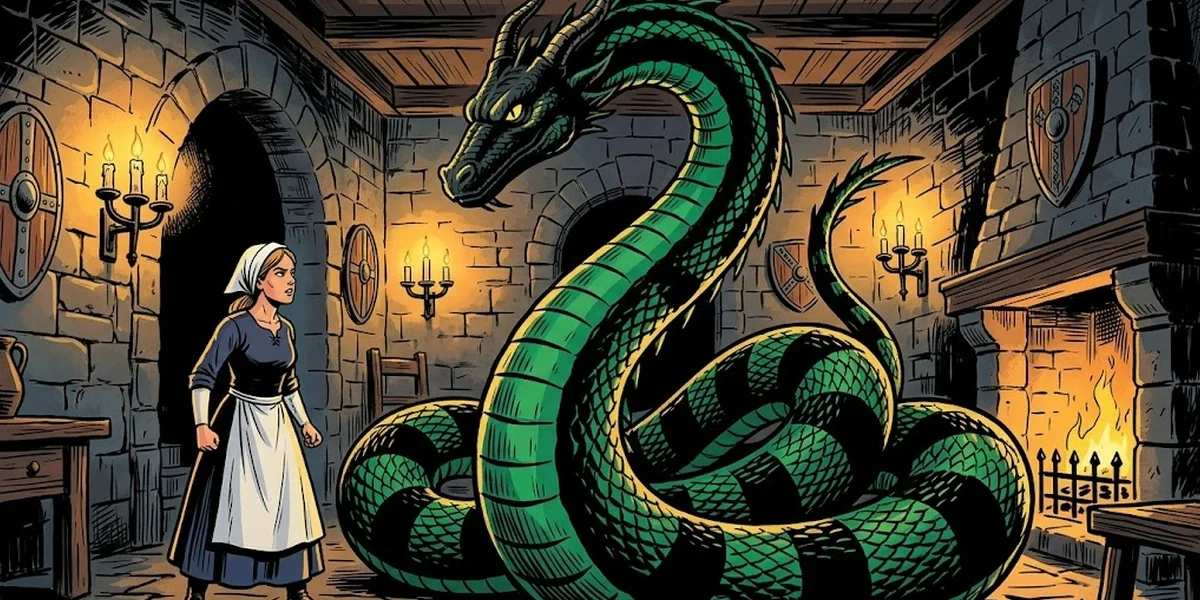
Many years went by, and the little boy grew into a handsome prince, old enough to marry. The king sent him off in the royal coach, drawn by six white horses, to tour foreign lands in search of a princess fit to be his bride. But at the first crossroads they came to, a gigantic lindworm barred the way, a sight to scare the boldest. It sprawled across the road with its great mouth wide open and cried, “A bride for me before a bride for you!”
The prince turned the coach around and tried another road, but it was no use. At the first crossroads lay the lindworm, crying, “A bride for me before a bride for you!” So the prince had no choice but to drive home and abandon his travels. And the queen was forced to confess that what the lindworm said was true. He was really the elder of her twins, so he ought to be married first.
If the younger twin was ever to wed, the lindworm would need a wife first. So the king sent a letter to a distant land, asking for a princess as a bride for his son, though of course he did not say which son, and soon a princess arrived. No one let her set eyes on the groom until he was standing next to her in the great hall and they were married, and by then it was too late for her to refuse him. But the next morning, the princess had vanished. The lindworm lay sleeping all alone, and everyone feared the worst: that he had swallowed her.
A little while later, the prince decided he might go off once more in search of a princess, and he drove away in the royal coach with the six white horses. But at the first crossroads, there lay the lindworm with its great mouth open, crying, “A bride for me before a bride for you!” The coach tried another road, the same thing happened, and once more they had to turn back.
So the king wrote to several foreign countries, asking whether anyone would marry his son. At last a second princess came, from a land very far away. Like the first, she saw her husband only at the wedding itself, and there, beside her, was the lindworm. The next morning she too had vanished, and the lindworm lay sleeping alone, and it was all too clear what had become of her.
By and by, the prince set out on his quest a third time, and at the first crossroads lay the lindworm with its mouth gaping, demanding a bride as before. Back to the castle went the prince. “My elder brother needs yet another bride,” he told the king.
“I don’t know where to find one,” said the king. “Two mighty kings sent me their daughters, and now both are my enemies. How could I ever get a third? People are starting to say strange things, and no princess will be brave enough to come.”
Now, in a little cottage near a wood lived the royal shepherd, an old man, with his one daughter. One day the king came to him and said, “Let your daughter marry my son the lindworm, and you will be a rich man all your days.”
“Forgive me, Your Majesty, but I can’t,” the shepherd answered. “She’s all I have, and I’ll need her care in my old age. Besides, if the lindworm didn’t spare two beautiful princesses, he won’t spare her either. She deserves far better than that.” But the king kept insisting until the old man gave way.
When the old shepherd told his daughter she was to be Prince Lindworm’s bride, she was in utter despair. Out into the forest she ran, weeping, twisting her hands together and mourning her bad luck. As she roamed about, an old witch suddenly stepped out of a big hollow oak tree. “Why do you look so gloomy, pretty lass?” she asked.
“It’s no good telling you,” said the shepherd girl. “No one alive can help me.”
“Who knows?” said the old woman. “Tell me what the trouble is, and perhaps I can put it right.”
“Ah, how could you?” said the girl. “I am to marry the king’s eldest son, who is a lindworm. Two lovely princesses have married him already, and both disappeared, and the same will happen to me! No wonder I’m upset.”
“Well, you needn’t be,” said the old woman. “All that can be put right in a twinkling, if you do exactly as I tell you.” The girl promised she would.
“Listen, then,” said the old woman. “When the wedding is over and it is time for bed, ask them to put ten pure white nightgowns on you. Then ask for a tub of lye, which is strong washing water made from wood ash, a tub of fresh milk, and an armful of whips, as many as a boy can hold, all brought to your room. When the lindworm tells you to take off a gown, tell him to shed a skin. When all his skins are off, soak the whips in the lye and beat him with them. After that, bathe him in the milk. Finally, hug him close, even if it’s just for a moment.”
“That last part is the worst of all. Ugh!” said the shepherd’s daughter, shivering to imagine hugging that cold, scaly, slimy creature.
“Follow my advice and everything will turn out well,” the old woman said, and she vanished into the oak tree.
When the wedding day came, the girl rode in the royal coach behind the six white horses to the castle, where she would be made ready. She asked for ten snow-white nightgowns, the tub of lye, the milk and the armful of whips. The ladies and gentlemen of the court thought it must be some silly country superstition, but the king ordered, “Give her anything she wants.”
Dressed in marvelous robes, she made the most beautiful bride. In the wedding hall she set eyes on the lindworm for the first time, as he slid in to take his place beside her. So they were married, and a great feast was held, worthy of a prince.
When the feast was over, the bride and bridegroom were led to their room with music and torches and a grand procession. The moment the door closed, the lindworm faced her and said, “Fair maiden, shed a gown!”
The shepherd’s daughter answered, “Prince Lindworm, shed a skin!”
“No one has ever dared to tell me to do that!” he said.
“Well, I am telling you now!” she replied.
He started to groan and squirm, and soon a long snakeskin lay on the floor beside him. The girl took off her first nightgown and spread it over the skin.
“Fair maiden, shed a gown,” said the lindworm a second time.
“Prince Lindworm, shed a skin,” said the shepherd’s daughter.
“No one has ever dared to tell me to do that,” he said, but she commanded him, and groaning, he shed a second skin, which she covered with her second gown. A third time he told her to shed a gown, and a third time she told him to shed a skin. “No one has ever dared to tell me to do that,” he said, his small eyes rolling with rage. Yet the girl stayed unafraid and she commanded him to do as she said.
And so it went on until nine lindworm skins lay on the floor, each covered with a snow-white nightgown. All that remained of the lindworm was a great thick lump, horrible to look at. Then she grabbed the whips, soaked them in the lye and beat him with all her might. After that she washed him from head to tail in the milk. Last of all, she pulled him onto the bed and put her arms around him, and at that very moment she fell fast asleep.
Very early the next morning, the king and his court crept up to peek through the keyhole, eager to learn the girl’s fate, though no one had the courage to enter. Finally they grew brave enough to push the door open just a little. And there they saw the girl, fresh and rosy, and beside her lay not a lindworm but the handsomest prince anyone could wish to see.
The king ran to fetch the queen, and there was such rejoicing in the castle as no one had ever known. A second wedding was held, far finer than the first, with feasting and dancing and celebration that lasted for weeks.
Never did a king and queen love a daughter-in-law more than this country girl from the shepherd’s cottage. Their kindness to her knew no limits, for her wisdom, her steady nerves and her bravery had rescued their son, Prince Lindworm.
About this story
“Prince Lindworm” is a Danish fairy tale included in the 1914 edition of East of the Sun and West of the Moon: Old Tales from the North, famous for Kay Nielsen’s illustrations, where it appears in a fresh English translation alongside the Norwegian tales of Asbjørnsen and Moe. A lindworm is a wingless dragon or giant serpent from Scandinavian and German folklore.
The story is a cousin of “Beauty and the Beast.” A frightening bridegroom becomes a prince through a violent magical ordeal. The girl acts resourcefully under coercion; the comparison does not make the marriage or the king’s conduct a model to follow.
Read the original: East of the Sun and West of the Moon: Old Tales from the North (Project Gutenberg)
For older readers: includes forced marriages, brides apparently eaten, repeated undressing, corrosive washing liquid and whipping during a supernatural transformation.
Who has a choice?
The king conceals the groom’s identity from two princesses, then pressures the shepherd after he refuses. The third bride is not simply volunteering for an adventure. The old woman gives her a way to answer each demand with a demand of her own, reversing the obedience expected of her.
The final celebration recognises her achievement but does not restore the earlier brides or address the king’s deception. Nor does the magical transformation mean a person should endure a dangerous relationship in the hope of changing someone. The lye and whipping are violent fantasy, not a healing practice.
Read the repeated commands
Compare the king’s demand to the shepherd with the bride’s replies in the chamber. Who can refuse, and who cannot? Identify what the ending resolves for the prince and what it leaves unresolved for the two princesses.
Questions to ask
- What warning did the queen forget, and what happened because of it?
- How did the shepherd girl prepare for her wedding night?
- What qualities helped her save Prince Lindworm?
You may also like
- East of the Sun and West of the Moon — another enchanted bridegroom from the same book
- The Lassie and Her Godmother — another tale of an endangered young woman and a supernatural authority
- The Blue Belt — another tale from the Kay Nielsen collection
Frequently Asked Questions
Why was Prince Lindworm born a serpent?
What does the lindworm demand?
Who breaks the spell?
How does the story end?
You May Also Like
 Norse Folk Tales
Ages 9-12
Norse Folk Tales
Ages 9-12
Freya’s Necklace: The Brisingamen
Freyja longs for a jewel to wear to the great feast, but the shining necklace she wins from four laughing dwarfs costs her far more than she expects.
 Norse Folk Tales
Ages 6-8
Norse Folk Tales
Ages 6-8
The Cat on the Dovrefell
A traveler leading a great white bear to the King of Denmark asks for shelter on Christmas Eve, the one night a whole pack of trolls always comes to feast.
 Norse Folk Tales
The Mead of Poetry
Two jealous dwarfs brew a magic mead that turns anyone who drinks it into a poet, and Father Odin sets out in disguise to win it from the giants.