Thakurmar Jhuli: The Prince of the Golden Palace
Thakurmar Jhuli: The Prince of the Golden Palace: In a realm where palaces shimmered like jewels and kingdoms prospered along great rivers, there existed a
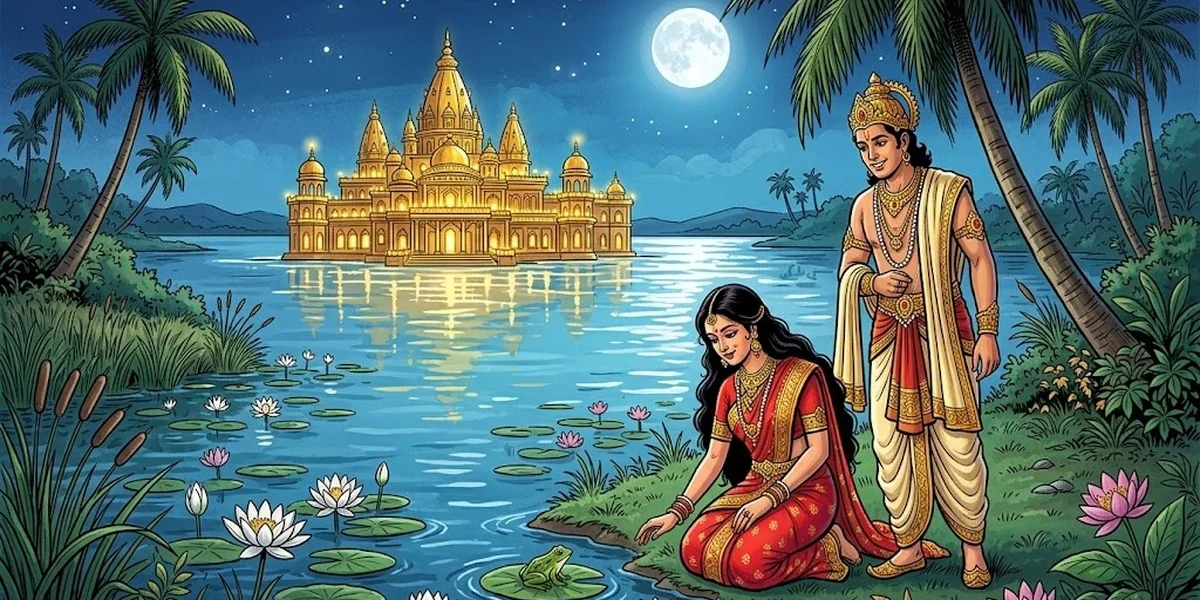
Origin and Narrative Tradition
“Thakurmar Jhuli: The Prince of the Golden Palace” comes from the most celebrated anthology of Bengali fairy tales ever assembled: Thakurmar Jhuli—literally “Grandmother’s Bag of Tales”—compiled by Dakshinaranjan Mitra Majumdar and first published in Calcutta in 1907. If Lal Behari Day’s Folk-Tales of Bengal (1883) was the first systematic English-language collection of Bengali oral narrative, Thakurmar Jhuli was the first major Bengali-language collection: a conscious act of cultural preservation addressed to Bengali readers and Bengali children at a moment of national awakening, when the Bengali literary renaissance (nababanga sahitya) was reasserting the value of vernacular tradition against the cultural prestige of English letters. Rabindranath Tagore wrote the preface to the collection and praised it in terms that echoed his own deepest convictions about folk narrative: that the stories the grandmother tells by firelight are not primitive precursors to proper literature but the living root from which all literature grows. The “jhuli”—the bag, the inexhaustible sack of stories—is the book’s central image: the grandmother’s bag of tales never empties, because the oral tradition from which it draws is itself inexhaustible.
Beat I — The Grandmother’s World
The thakurma (paternal grandmother) who is the collection’s presiding figure is not merely a narrator but a character: an old woman who has heard everything and forgotten nothing, who keeps her stories in an invisible bag that gets lighter as she tells them and heavier as she remembers more. She tells her stories to grandchildren in the evening, using the distinctive Bengali storytelling register that Mitra Majumdar’s collection preserves—a register characterised by vivid sensory detail, formulaic opening and closing phrases (ek deshe chhilo ek raja—“in a certain country there was a king”), and the performer’s direct address to her audience (shuno shuno”—“listen, listen”). “The Prince of the Golden Palace” is, within this frame, one of the grandmother’s most elaborate gifts: a long, detailed, richly imagined tale of a prince whose destiny leads him to a palace that no ordinary traveller can reach, through trials that test every quality he possesses.
Beat II — The Sonar Mahal and Its Meaning
The golden palace (sonar mahal) is Bengali folk narrative’s most durable architectural image—a building that exists at the intersection of the material and the divine, too beautiful for ordinary reality and too real to be purely metaphorical. Its gold is not the gold of wealth; it is the gold of purity and permanence, the gold of the sun’s light crystallised into a dwelling. In Thakurmar Jhuli’s tale, the golden palace is typically located in a realm adjacent to but separate from the ordinary human world: accessible only by crossing impossible water, climbing impossible mountains, or passing through some threshold that ordinary persons cannot perceive. The palace may be inhabited by a princess of equally extraordinary nature—a rajkanya (king’s daughter) whose beauty matches the palace’s brilliance—or it may be empty, waiting for the prince whose completion is measured by his ability to reach and occupy it. In either case, it represents the destination that justifies the journey—not as a reward for virtue already possessed but as the revelation of virtue proven through the process of the quest.
Beat III — The Bengali Prince-Quest and Its Moral Architecture
The prince who sets out for the golden palace in Thakurmar Jhuli’s telling is the archetypal Bengali rajkumar: young, brave, possessed of a restlessness that his comfortable palace cannot contain. The trials he faces on the journey are organised according to the tale’s particular moral logic—each trial tests a quality that the golden palace specifically requires, so that by the time he arrives, the hero has demonstrated precisely the character that the palace’s gold signifies. He shows courage at the moment of greatest fear, generosity when he has least to give, truthfulness when lying would save him considerable trouble, and patience at the moment when impatience would feel most justified. The Bengali fairy-tale tradition, unlike the European fairy-tale tradition’s occasional reliance on luck or magical assistance as the decisive factor, consistently requires the hero to earn his destination through character rather than fortune. The magical helpers who assist him (birds, old women, grateful animals) do so in response to his demonstrated virtue, not in spite of its absence.
Beat IV — Tagore’s Preface and the Cultural Moment of 1907
Rabindranath Tagore’s preface to Thakurmar Jhuli situates the collection within the Bengali cultural renaissance’s project of recovering and dignifying vernacular tradition. The year 1907 was a charged moment in Bengal’s history: the partition of Bengal (1905) had galvanised Bengali nationalist feeling, and the Swadeshi movement’s emphasis on indigenous culture as a resource for resistance gave folk collections like Thakurmar Jhuli a political valence they would not have had in a quieter time. Tagore’s endorsement signalled that the grandmother’s stories were not merely children’s entertainment but the cultural heritage of a people asserting its identity—that the thakurma’s bag was as full of national wealth as any European fairy-tale anthology, and that Bengali children deserved to know these stories in their own language as the foundation of their imagination. The prince of the golden palace, in this reading, is not merely a fictional hero; he is Bengali literary culture itself, finding its way to a destination whose value had been obscured by two centuries of colonial cultural pressure.
Ek deshe chhilo ek raja, taar chhilo ek chele—In a certain country there lived a king; he had one son. (Traditional Bengali fairy-tale opening formula from Thakurmar Jhuli, the formula that signals the beginning of a world where everything is possible)
Why This Story Has Lasted
Thakurmar Jhuli has been in continuous print since 1907 and has been adapted into films, television series, comics, and children’s books throughout the Bengali world. “The Prince of the Golden Palace” endures within that collection because it gives the Bengali child’s imagination the most complete possible image of heroic aspiration: a prince who leaves everything known to find something unprecedented, who earns his destination through the full exercise of his character, and who arrives at a golden palace that no map contains but that the story makes immediately and unforgettably real. The grandmother’s bag of tales never empties because the human need for this kind of story—the story of the worthy hero who reaches the impossible destination—never diminishes.
Tradition & Collection Notes
Collection: Thakurmar Jhuli (Grandmother’s Bag of Tales) compiled by Dakshinaranjan Mitra Majumdar, first published Calcutta, 1907; preface by Rabindranath Tagore. Cultural context: Bengali literary renaissance (nababanga sahitya); Swadeshi movement (1905–1911); partition of Bengal (1905). Tale-type: ATU 400 (Man on Quest for His Lost Wife) / Bengali rajkumar sonar mahal (prince-golden palace) subtype. Motif index: F771 (Extraordinary castle or palace), H1220 (Quest voluntarily undertaken), L100 (Unpromising hero). Parallel collections: Lal Behari Day, Folk-Tales of Bengal (1883); Upendrakishore Ray Chowdhury, Goopy Gyne Bagha Byne (1915). Adaptations: Satyajit Ray’s Goopy Gyne Bagha Byne (1969) draws from this tradition; multiple Bengali television adaptations of Thakurmar Jhuli tales (2000s–present). Scholarly reference: Sukumar Sen, History of Bengali Literature (1960); Nihar Ranjan Ray, Bangalir Itihas (1949).
You May Also Like
 Bengal Folk Tales
Ages 6-8
Bengal Folk Tales
Ages 6-8
The Story of a Hiraman
The Story of a Hiraman: Source: Folk Tales of Bengal | Type: Folktale | Country: India | Language: English In a certain village there lived a poor man named
 Bengal Folk Tales
Ages 3-5
Bengal Folk Tales
Ages 3-5
The Boy With the Moon on His Forehead
The Boy With the Moon on His Forehead: Source: Folk Tales of Bengal | Type: Folktale | Country: India | Language: English Once upon a time there was a king who
 Bengal Folk Tales
Ages 9-12
Bengal Folk Tales
Ages 9-12
The Story of Prince Dodul and the Ruby Queen
The Story of Prince Dodul and the Ruby Queen: In the ancient kingdom of Gaur, nestled between the Ganges and the Brahmaputra rivers, there lived a prince named