The Story of a Hiraman
A talking parrot helps a king abduct a distant woman, then joins her in planning an escape after a second king takes her captive.
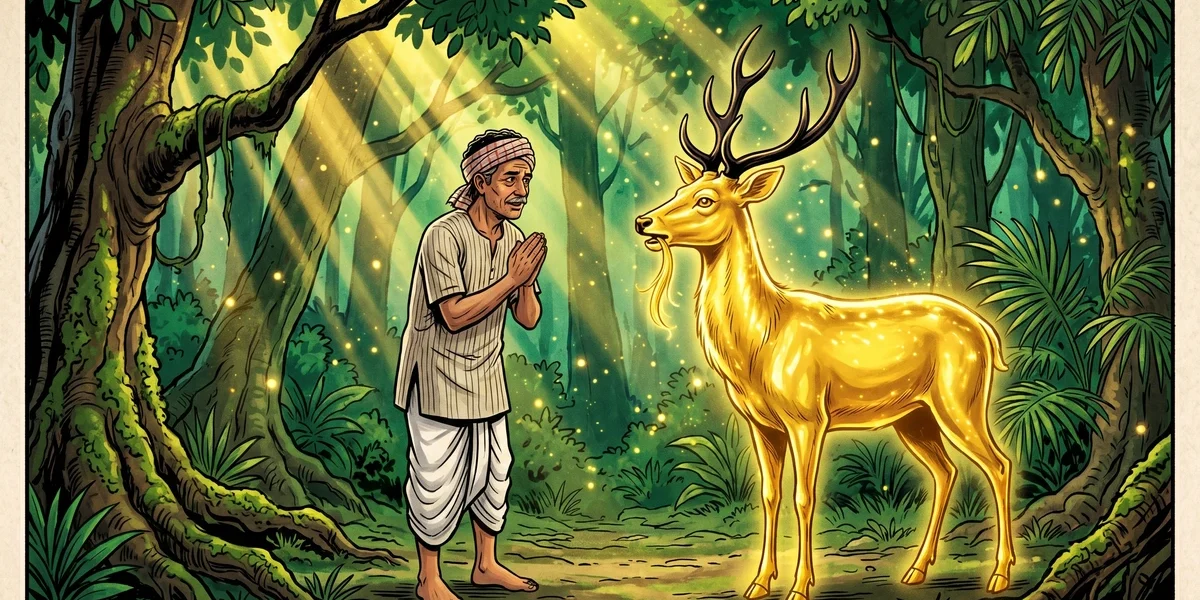
A bird-catcher’s wife said to her husband one day, “I know why we are always poor. You sell every bird you catch. If we ate some of them now and then, I am sure our luck would change. So whatever you catch today, let’s not sell it. Let’s cook it and eat it.”
The bird-catcher agreed, and he went out with his sticky limed rods, his wife beside him. They wandered from one wood to the next without catching a thing until nearly sunset. Then, just as they were heading home, they caught a lovely hiraman, a kind of green parrot.
The wife held it and felt it all over. “What a tiny bird,” she said. “There is hardly any meat on it. It isn’t worth killing.”
“Mother, please don’t kill me,” said the hiraman. “Take me to the king instead. If you sell me to him, you will get a great deal of money.”
The couple were amazed to hear the bird talk, and they asked it how much they should ask for it. “Leave that to me,” said the hiraman. “Take me to the king and offer me for sale. When he asks the price, say, ‘The bird will name its own price,’ and I will name a large sum.”
The next day the bird-catcher took the hiraman to the palace. The king was charmed by its beauty and asked what he wanted for it. “Great king, the bird will name its own price,” said the bird-catcher.
“What! Can it talk?” asked the king.
“Yes, my lord. Please ask it yourself.”
Half joking, the king said, “Well, hiraman, what is your price?”
“If it please your majesty, my price is ten thousand rupees,” said the hiraman. “Don’t think that too much. Pay the man, for I will be of the greatest use to you.”
“What use could you be to me?”
“Your majesty will find out in good time.”
The king was astonished that the bird could speak, and speak so sensibly. He took it and told his treasurer to pay the bird-catcher ten thousand rupees.
The king had six queens, but he grew so fond of the bird that he almost forgot they existed. He spent his days and nights with the hiraman instead of with them. The bird gave a wise answer to every question, and it also recited names of deities, using the tale’s traditional figure of three hundred and thirty million, which the king heard with devotion. The queens felt neglected, grew jealous of the parrot and decided to kill it.
For a long time they had no chance, because the bird never left the king’s side. Then one day the king went hunting and was to be away for two days. The six queens saw their opportunity. “Let’s ask the bird which of us it thinks is the ugliest,” they said, “and whoever it names will strangle it.” They went to its room, but before they could ask anything, the hiraman began reciting the names of the gods and goddesses so sweetly and devoutly that their hearts softened, and they left without doing it.
By the next day, though, their wicked mood had come back, and they called themselves a thousand times foolish for being put off. They hardened their hearts and went back to the room. “O hiraman,” they said, “we hear you are very wise and always judge rightly. Tell us, which of us is the most beautiful, and which is the ugliest?”
The bird knew exactly what they were planning. “How can I answer from inside this cage?” it said. “To judge properly I must look closely at every one of you, front and back. Set me free if you want my opinion.”
At first the queens were afraid it would fly away, but then they shut all the doors and windows and let it out. The hiraman looked round the room and spotted a drain for water that it could slip through. The queens asked their question several times, and at last the bird replied, “Not one of you is as beautiful as the little toe of the lady who lives beyond the seven oceans and the thirteen rivers.”
The queens were furious at being insulted like this and rushed at the bird to tear it apart, but it darted out through the drain and hid in a woodcutter’s hut close by.
When the king came home and found the perch empty, he went wild with grief. The queens told him they knew nothing about it. He wept day and night, crying, “O my hiraman! Where have you gone?” His ministers began to fear he would lose his mind. So drummers went through the kingdom announcing that whoever brought back the king’s parrot would receive ten thousand rupees. The woodcutter, overjoyed at the thought of never having to work again, brought the bird and collected the reward.
The hiraman told the king that the queens had tried to kill it, and the king flew into a rage. He had them driven out of the palace into a wild, empty place with no food, and a few days later people said that wild animals had killed them.
Some time afterwards the king said, “Hiraman, you told the queens that none of them was as lovely as the little toe of the lady beyond the seven oceans and thirteen rivers. Do you know any way for me to reach her?”
“Of course,” said the hiraman. “I can take you to the very door of her palace, and if you follow my advice, I will place her in your arms.”
“I will do whatever you say. What must I do?”
“We need a pakshiraj, a winged horse. On a horse like that we can cross the seven oceans and the thirteen rivers in no time.”
“I have a great many horses. Let us go and see if any of them is a pakshiraj.”
They went to the royal stables together. The hiraman flew past all the handsome, spirited horses and landed on a miserable, skinny pony. “This is the one,” it said. “It is a true pakshiraj, but it must be fed on the finest grain for six whole months before it is ready.” The king gave the pony a stable of its own and made sure every day that it ate the best grain in the kingdom. It grew sleek and strong, and after six months the hiraman said it was ready.
Then the parrot asked the king to have the royal silversmith make a great many khais, little silver grains shaped like puffed rice. When they were ready to set off, the hiraman said, “I have one request. Whip the horse only once when we start. If you whip it twice, we will not get to the palace but will come down halfway. And on the way home with the lady, you must again whip it only once, or we will only get halfway home.”
The king mounted the pakshiraj with the hiraman and the silver khais and gave it a single light flick of the whip. The horse shot through the sky like lightning, over countries, kingdoms and empires, across the oceans and the thirteen rivers, and that evening it landed at the gate of a beautiful palace.
A tall tree stood near the gate. The hiraman told the king to put the horse in the stable nearby and then hide up in the tree. Then the parrot took the silver khais in its beak and dropped them one after another, starting at the foot of the tree and going all along the corridors and passages right up to the door of the lovely lady’s bedroom. After that it flew back to the tree where the king was hiding.
Some hours after midnight, the lady’s maid, who slept in the same room, opened the door to step out and saw the silver grains on the floor. She picked up a few and, not knowing what they were, showed them to her mistress. The lady thought the little silver pieces were charming and wondered how they had got there. She came out and began to pick them up. They seemed to lead away from her door in a long trail, she could not tell how far. With a basket in her hand she followed it, gathering up the shining khais through every corridor and passage, until she reached the foot of the tree.
The moment she arrived, the king climbed down as the hiraman had told him, took hold of her and lifted her onto the horse beside him. The parrot settled on the king’s shoulder, the king gave the horse one light flick, and off they flew as fast as lightning. But the king was so eager to get home with the woman he had taken that he forgot the hiraman’s warning and whipped the horse a second time. At once it came down at the edge of what looked like a thick forest.
“What have you done, O king?” cried the hiraman. “Didn’t I tell you to whip it only once? You have whipped it twice, and now we are lost. We may die here.” But what was done could not be undone. The pakshiraj had lost its power, and they could go no farther. They got down, but there was no sign of a human home anywhere. They ate some fruit and roots and slept on the ground that night.
The next morning the king of that land happened to be hunting in the forest. Chasing a stag he had wounded with an arrow, he came upon the king and the lovely lady. He was so struck by her beauty that he wanted her for himself. He whistled, and his men came running. They took the lady prisoner. The first king was not killed, but they blinded him and left him alone in the forest, though not quite alone, because the faithful hiraman stayed with him.
The lady was taken to the palace of the king of that land, and the pony went with her. She told this king that he must not come near her for six months, because she had made a vow that would take that long to fulfil. She chose six months because that was how long the pakshiraj would need to get its strength back. Since she said she had to spend every day at her prayers because of the vow, she was given a house of her own. She took the pony there and fed it on the very best grain.
But all this would be useless unless she could find the hiraman. How could she get word to it? She thought of a plan. She told her servants to scatter heaps of rice, grain and all sorts of beans on the roof of her house for the birds to eat. Soon thousands of birds were flocking to the roof for the feast, and every day the lady watched for her hiraman.
Meanwhile the hiraman was having a hard time in the forest. It had to look after the blind king as well as itself. It picked ripe fruit for him and ate some itself, and that was how it lived. The other forest birds said to it, “O hiraman, what a miserable life you lead here! Why not come with us? A good, kind lady scatters huge piles of beans on her roof for birds. We fly there early every morning and come back in the evening, after eating as much as we like with thousands of other birds.”
The hiraman decided to go with them the next morning. It had a shrewd idea that there was more to this lady’s kindness than the other birds guessed. It found the lady, and they had a long talk about the blind king, about how his sight might be cured, and about her escape.
This was their plan. The pony would soon be ready to fly, for most of the six months had gone. And the king’s eyes could be healed if the hiraman could fetch some droppings, fresh and warm, from the chicks of the bihangama and bihangami birds, whose nest was in the tree at the gate of the lady’s palace beyond the seven oceans and thirteen rivers, and put them on the king’s eyes.
The next morning the hiraman set out on its mission of mercy. It spent the night in the tree at the palace gate, and early the following morning it waited under the birds’ nest holding a leaf in its beak, and the chicks’ droppings fell onto it. At once the parrot flew back across the oceans and rivers to the forest and spread the precious medicine on the king’s blind eyes. The king opened them and could see.
A few days later the pakshiraj was fit to fly. The lady escaped on it to the forest and picked up the king, and the lady, the king and the hiraman all reached the king’s capital safe and sound. There the king and the lady were married. They lived together happily for many years and had sons and daughters, and the beautiful hiraman always stayed with them, reciting the names of the three hundred and thirty million gods.
About this telling
“The Story of a Hiraman” is from Lal Behari Day’s Folk-Tales of Bengal. Day’s notes quote Carey’s Bengali dictionary for the bird’s name: hiraman comes from words meaning “green” and “gem” and names a beautiful species of parrot. He explains a pakshiraj as a winged horse, literally “the king of birds,” and khai as fried paddy, which is why the silver pieces here are described as little grains.
Day’s text says the jealous queens were turned out with no food and that wild beasts were rumoured to have eaten them; this page keeps that detail brief. The king’s blinding in the forest is part of the tale, and it is healed before the end.
Read the original: Lal Behari Day, Folk-Tales of Bengal (Project Gutenberg ebook #38488)
Reading guidance: Ages 9–12 with adult preview; includes abduction, intentional blinding, attempted killing and the reported deaths of six abandoned queens. The eye cure is fictional magic, not something to try.
A closer reading
The hiraman first speaks to save its own life, negotiates its price, then finds a physical exit when the queens try to trap it in a beauty contest. Its intelligence is practical and adaptable. Yet being a skilled helper does not make every plan it proposes just: the silver trail lures a woman into an abduction, not a courtship in which she chooses to leave.
The second king repeats that act of taking her, exposing an uncomfortable similarity between the apparent hero and his opponent. Her six-month vow gives her time to restore the horse, and the grain on the roof creates a message network through visiting birds. These plans make her an active rescuer after two kings have treated her as something to possess.
The first king’s treatment of his six queens also exceeds a simple happy-ending account: they are abandoned without food and reportedly killed. The bird-dropping eye cure belongs to the tale’s magic and must not be imitated. Neither the eventual marriage nor the restored sight makes the earlier violence harmless.
Try this with the story
Compare the silver trail with the grain scattered on the roof. Both attract someone by offering food-like objects, but one takes away choice and the other makes contact for escape. Identify the planner, intended visitor and result of each.
Questions to ask
- How does the hiraman change tactics when its first attempt to soften the queens fails?
- What is similar about the two kings’ treatment of the woman?
- How do the six-month delay and rooftop food help her escape?
- Which characters do the rescuing at different stages?
You may also like
- Life’s Secret — pigeons and a jealous queen in another Day tale
- The Ghost-Brahman — another quick thinker who saves the day in Day’s book
- The Boy Whom Seven Mothers Suckled — a hero who crosses the ocean using a magic secret
Frequently Asked Questions
What is a hiraman here?
How does the king reach the distant lady?
How does the lady help arrange the escape?
You May Also Like
 Bengal Folk Tales
The Bald Wife
A cruelly treated wife is kind to a cotton plant, a plantain tree, a bull and a basil plant, and a forest sage rewards her with beauty and riches.
 Bengal Folk Tales
Ages 9-12
Bengal Folk Tales
Ages 9-12
The Indigent Brahman
The goddess Durga gives a poor Brahman a pot that pours out endless sweets; when a cheat steals it, her second gift is a pot full of demons.
 Bengal Folk Tales
Ages 9-12
Bengal Folk Tales
Ages 9-12
The Match-Making Jackal
A jackal invents a rich kingdom to arrange a weaver’s marriage. The deceived princess later builds the wealth for which the jackal claims credit.