Gopal the Jester and the King’s Dream
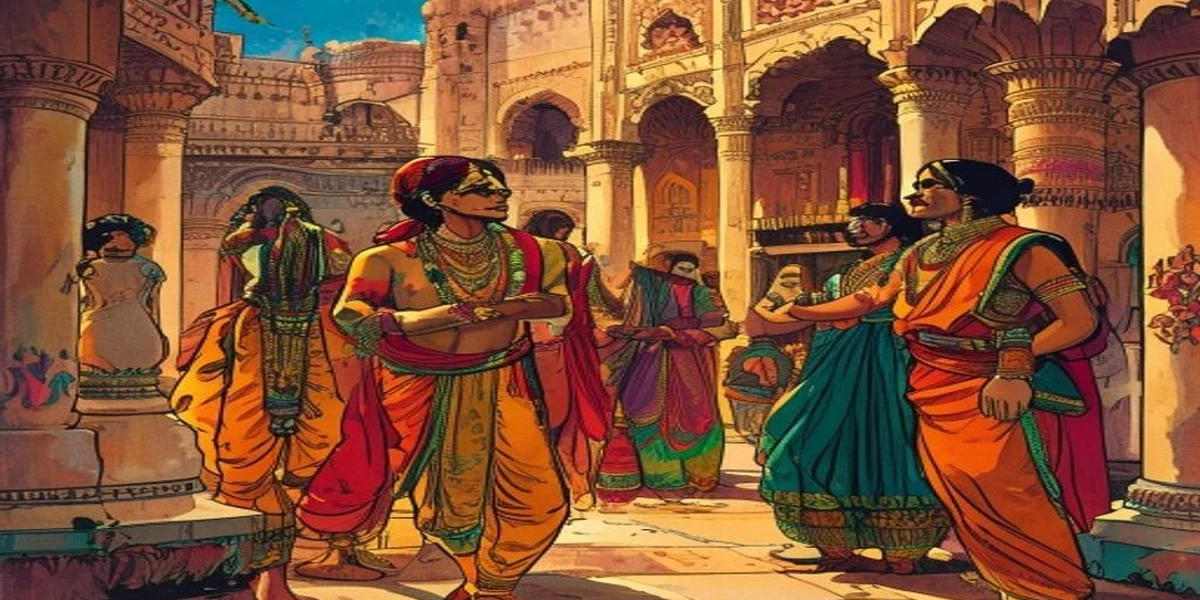
Gopal the Jester and the King's Dream: In the prosperous kingdom of Dhaka, there ruled a king named Vikram who was respected for his strength and feared for
Origin and Narrative Tradition
Gopal Bhar is Bengali folk literature’s greatest wit—a historical figure who served as the court jester of Maharaja Krishnachandra Ray of Nadia (c. 1710–1782), and who has since become the protagonist of an ever-expanding cycle of comic folk tales that continue to be told, performed, and published in Bengal today. His position in Bengali folk culture is precisely analogous to that of Tenali Rama in Telugu tradition, Birbal in the Mughal-court cycle, and Nasreddin Hodja in the Sufi-Turkish tradition: the wise fool whose apparent absurdity contains the most penetrating social intelligence, and whose laughter—at the king, at the court, at pomposity, at hypocrisy, and occasionally at himself—is the most efficient vehicle available for truths that direct speech cannot safely deliver. “Gopal the Jester and the King’s Dream” belongs to the sub-genre of Gopal Bhar tales in which the dream serves as the occasion for political commentary: the king reports a dream that he takes as significant, the courtiers offer flattering interpretations, and Gopal alone delivers the reading that is true rather than comfortable—typically by approaching the dream’s imagery from a completely unexpected angle that transforms flattery into gentle but irresistible satire.
Beat I — King Krishnachandra’s Court and Its Dynamics
King Krishnachandra Ray of Nadia was, by all historical accounts, a genuine patron of literature and the arts, a man of considerable intellectual curiosity, and a ruler whose relationship with Gopal Bhar was one of genuine mutual regard as well as ceremonial master-servant hierarchy. The Gopal Bhar tales consistently present this complexity: the king is not a fool to be outwitted but an intelligent man who understands that Gopal’s wit serves a function that conventional courtiers cannot. The courtiers—ministers, pandits, astrologers—are constrained by self-interest to tell the king what flatters him; Gopal is licensed by his role as fool to tell the king what is actually true. In the dream-tale specifically, the courtiers compete to interpret the king’s dream in whatever way most glorifies the dreamer: they find in it auguries of conquest, divine blessing, and cosmic favour. Gopal’s interpretation punctures this competitive sycophancy with a reading that is simultaneously absurd on its surface and devastating in its accuracy—the signature move of the Bengali comic wit tradition.
Beat II — The Dream and Its Several Readings
The king’s dream is typically the kind of royal dream that invites grandiose interpretation: he has seen himself at the centre of some cosmic event—ruling the stars, conversing with gods, or receiving homage from all directions. Each courtier, reading the same imagery, finds in it confirmation of whatever aspect of the king’s greatness would most please him to hear about. The pandit finds a scriptural precedent; the astrologer locates an auspicious planetary conjunction; the military commander sees a portent of victory. The competitive quality of the interpretations reveals their uselessness: the courtiers are not reading the dream but reading the room, not interpreting the imagery but gauging the king’s desire. Gopal’s reading is different not because he is smarter than the courtiers—some of them are formidably learned—but because he is the only one in the room whose livelihood does not depend on the king’s pleasure. His licence to be ridiculous is, paradoxically, what makes his reading reliable.
Beat III — The Jester’s Art and the Bengali Comic Tradition
The Bengali comic folk tradition represented by the Gopal Bhar cycle is among the most sophisticated and socially aware in Indian literature. Unlike the pure slapstick of some folk comedy traditions, Bengali wit is characteristically vyangatmak—oblique, ironic, relying on the gap between the literal meaning of a statement and its actual import. Gopal’s interpretations typically work by taking the dream’s imagery with absolute literalness while the courtiers have been interpreting it metaphorically, or by interpreting metaphorically an image the courtiers have taken literally. This inversion—reading at the level the audience least expects—is the structural foundation of Bengali wit, and it carries a philosophical implication: the world and its events can always be read at more than one level, and the level that produces the most comfortable interpretation is rarely the most accurate. The jester’s comedy is thus a permanent corrective to the human tendency to read reality at the level most flattering to one’s existing beliefs.
Beat IV — What the Dream Cannot Hide
Gopal’s reading of the king’s dream typically reveals something the king already knows but has arranged not to know officially: that his kingdom has a problem he has been deferring, that a courtier is corrupt, that the king’s own recent behaviour has been less than admirable. The dream is the occasion, not the subject; the jester uses its imagery as a hook on which to hang the observation that the court’s social protocols would otherwise make unsayable. The king laughs—because Gopal’s delivery is irresistible, and because the king is intelligent enough to recognise the truth when it is made funny enough to be tolerable. This is the jester’s ultimate social function: not to entertain the court (though he does) but to maintain the court’s connection to reality in an environment where every institutional force pushes toward flattery and illusion. The fool who makes the king laugh is the court’s immune system.
Hasya rasa pradhano hi, satya-katha hasye vadata—Humour is the supreme flavour; let truth be spoken in laughter. Where direct speech would wound, comedy heals; where the courtier flatters, the fool instructs. (Bengali literary maxim on the role of hasya rasa in court poetry and folk performance)
Why This Story Has Lasted
The Gopal Bhar cycle endures because the social situation it dramatises—the intelligent person surrounded by sycophants, trying to maintain contact with reality through the one licensed truth-teller in the room—is perennial. Every organisation, every court, every institution develops the same structural pressure toward comfortable illusion, and the question the Gopal Bhar tales always ask is: who is the Gopal in this court? Who is the person whose livelihood does not depend on the powerful person’s pleasure, and who is therefore free to say the true thing? The Bengali folk tradition’s answer—the court fool, the comic, the oblique speaker whose absurdity is the price of his license—is not the only possible answer, but it is a memorable one, and the stories that embody it are among Bengali folk literature’s most enduring gifts to world comic narrative.
Tradition & Collection Notes
Historical figure: Gopal Bhar (Gopal the Jester), court jester of Maharaja Krishnachandra Ray of Nadia (c. 1710–1782); active approximately 1740–1780. Tale-type: ATU 1920 (Contest of Lying); ATU 1737 (The Parson in the Sack); Bengali vyangatmak-katha (wit-tale) subtype. Comparative tradition: Tenali Rama cycle (Telugu); Birbal cycle (Mughal-Hindi); Nasreddin Hodja cycle (Turkish-Sufi); Eulenspiegel cycle (German). Bengali literary context: Hasya rasa (comic aesthetic) in Sanskrit poetics; Bharata’s Natyashastra on the vita (court wit); Bengali kobiyal comic performance tradition. Motif index: J1700 (Clever persons and their doings), K1800 (Deception through disguise), J1250 (Clever verbal retort). Scholarly reference: Sunitikumar Chattopadhyaya, Bengali Folk Literature (1955); Narayana Rao et al., Symbols of Substance (1992).
You May Also Like
 Bengal Folk Tales
Ages 3-5
Bengal Folk Tales
Ages 3-5
The Origin of Opium
The Origin of Opium: Source: Folk Tales of Bengal | Type: Folktale | Country: India | Language: English Long ago, there was a terrible demon who lived in the
 Bengal Folk Tales
Ages 6-8
Bengal Folk Tales
Ages 6-8
The Field of Bones
The Field of Bones: Source: Folk Tales of Bengal | Type: Folktale | Country: India | Language: English In a certain village there was a haunted field where no
 Bengal Folk Tales
Ages 3-5
Bengal Folk Tales
Ages 3-5
The Boy With the Moon on His Forehead
The Boy With the Moon on His Forehead: Source: Folk Tales of Bengal | Type: Folktale | Country: India | Language: English Once upon a time there was a king who